6.3 The Development of Understanding of Genetics & Evolution
 Call Kai
 Learn
Learn Practice Test
 Spaced Repetition
 Match
Match Flashcards
 Knowt Play
1/22

Earn XP
Description and Tags
6.3.2 Speciation – 6.2.2 Evolution | 6.3.3 The Understanding of Genetics – 6.1.6 Genetic inheritance | 6.3.7 Resistant Bacteria – 3.1.8 Antibiotics & Painkillers
Name | Mastery | Learn | Test | Matching | Spaced | Call with Kai | Chat |
|---|
No analytics yet
Send a link to your students to track their progress
23 Terms
Who proposed the theory of evolution by natural selection?
Charles Darwin
What is the theory of evolution by natural selection? (4)
Mutations occur — provides variation between organisms
If a mutation provides a survival advantage — organism is more likely to survive
Survivors pass advantageous mutations onto offspring through genes
Over many generations, mutation becomes more common within the population
Why was the theory of evolution by natural selection only gradually accepted? (3)
It challenged the idea that God made all the animals and plants on Earth
Insufficient evidence at the time to convince many scientists
Mechanism of inheritance and variation was not known at the time
Other theories, including that of Jean-Baptiste Lamarck, are based mainly on the idea that changes that occur in an organism during its lifetime can be inherited.
What is this called?
The inheritance of acquired characteristics
What is the definition of speciation?
The formation of new species in the course of evolution — often due to the evolution of two isolated populations.
Alfred Russel Wallace independently proposed the theory of ___________ by __________ _________.
He published joint writings with __________ in 1858 which prompted __________ to publish On the Origin of Species (1859) the following year.
Wallace worked worldwide gathering ____________ for evolutionary theory. He is best known for his work on warning colouration in animals and his theory of ___________.
Alfred Wallace did much pioneering work on ___________ but more evidence over time has led to our current understanding of the theory of ___________.
evolution
natural selection
Darwin
Darwin
evidence
speciation
speciation
speciation
What is a species?
A group of similar organisms able to interbreed and produce fertile offspring.
What is the process of speciation? (6)
Genetic mutations result in variation within a population
Alleles which provide a survival advantage are selected through natural selection
Populations of a species can become isolated — e.g. through physical barriers
Different alleles may be beneficial in their new environment → they are selected and passed on
Selection of different alleles increases the genetic variation between the two groups
When they are unable to breed together and produce fertile offspring — a new species is formed
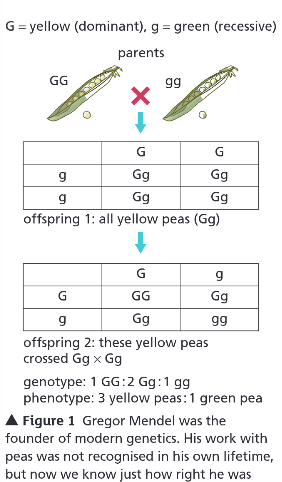
In the mid-19th century Gregor Mendel carried out breeding experiments on plants.
What were his main observations? (3)
Inheritance of each characteristic → determined by ‘units’ → passed on unchanged
One unit from each parent
Units can be dominant or recessive — cannot be mixed together
Why was Mendel’s work not recognised until after his death?
Genes and chromosomes were not discovered yet — people couldn’t understand.
The Understanding of Genetics:
In the late 19th century behaviour of _______________ during cell division was observed.
In the early 20th century it was observed that _________________ and Mendel’s ‘units’ behaved in similar ways.
This led to the idea that the ‘units’, now called ________, were located on _______________.
In the mid-20th century the structure of _________ was determined and the mechanism of ______ function worked out.
This scientific work by many scientists led to the _______ _________ being developed.
chromosomes
chromosomes
genes
chromosomes
DNA
gene
gene theory
What are two pieces of evidence that support evolution?
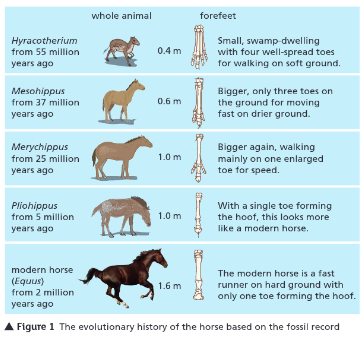
Fossils
Antibiotic resistance in bacteria
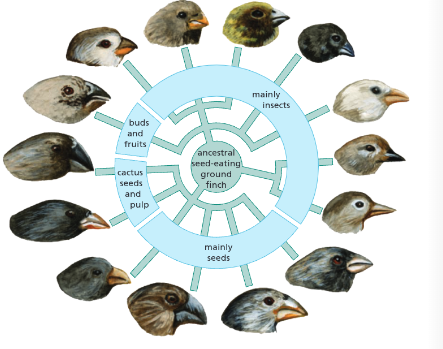
Evidence for Evolution:
Evidence for Darwin’s theory is now available as it has been shown that _________________ are passed on to offspring in ________.
There is further evidence in the _________ record and the knowledge of how resistance to __________ evolves in bacteria.
characteristics
genes
fossil
antibiotics
What are fossils?
The remains of organisms from millions of years ago — found in rocks.
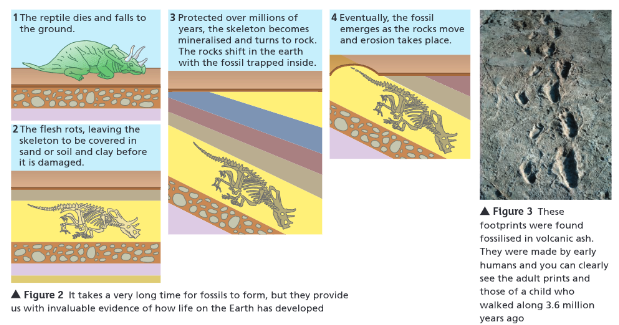
What are the three ways fossils may be formed?
From parts of organisms that have not decayed — one or more of the conditions needed for decay are absent
When parts of the organism are replaced by minerals as they decay
As preserved traces of organisms — e.g. footprints, burrows, and rootlet traces
Why can’t scientists be certain about how life began on Earth?
Many early life forms were soft-bodied — they left few traces behind.
What traces that were left have been destroyed by geological activity.
When do extinctions occur?
When there are no remaining individuals of a species still alive.
What are the factors which can contribute to extinction? (6)
Environmental changes — species cannot adapt to fast enough
New predators
New diseases — and there are no resistant alleles to it
Competition for the same food source with a species that has advantageous mutations
Catastrophic event
Habitat destruction
Why can bacteria evolve rapidly?
They reproduce at a fast rate.
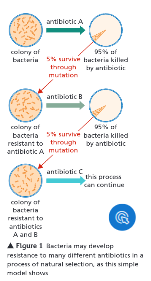
Explain how resistant bacteria form and spread. (4)
Mutations of bacterial pathogens produce new strains.
Some strains could be resistant to antibiotics → they are not killed
They survive and reproduce → increase in the population of this strain of resistant bacteria.
The resistant strain will spread because people are not immune to it — there is no effective treatment.
_________ is resistant to antibiotics.
MRSA
What are three ways to reduce the development of antibiotic resistant stains of bacteria?
Doctors shouldn’t prescribe antibiotics if unnecessary — e.g. non-serious or viral infections
Patients should complete their course of antibiotics (ensures all bacteria are killed) — none can survive, mutate, and form resistant strains
Restrict agricultural use of antibiotics
The development of new antibiotics is ________ and _______.
It is unlikely to keep up with the emergence of new ____________ _________ of bacteria.
costly
slow
resistant strains