BMS2021 - W4: Cell Talk: Communication Networks Inside and Outside the Cell
 Call Kai
 Learn
Learn Practice Test
 Spaced Repetition
 Match
Match Flashcards
 Knowt Play
1/4

There's no tags or description
Looks like no tags are added yet.
Name | Mastery | Learn | Test | Matching | Spaced | Call with Kai |
|---|
No analytics yet
Send a link to your students to track their progress
5 Terms
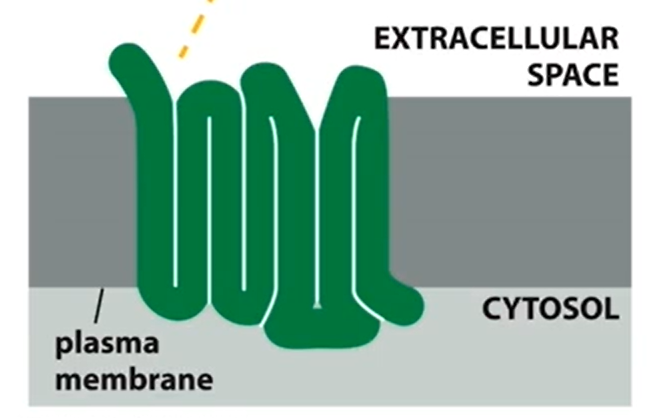
GCPR (G-Protein-Coupled Receptors)
have intracellular and extracellular component
7 transmembrane segments (protein threads itself in and out of cell membrane)
Signalling molecule can activate multiple GPCRs
All use G-proteins to relay a signal
G-proteins
GCPR interacts with a G protein (specifically Trimeric G-protein complex)
have Α, β and γ subunits
A subunit has a GDP/GTP binding site (activated through exchange of (GDP)
specific GCPRs interact with specific G proteins
G protein activation
Ligand binds to G -protein -linked receptor
Receptor changes conformation and interacts with inactive, GDP -bound G protein
Causes the G -protein to eject GDP and replace it with GTP → conformation change
G protein dissociates from receptor → Alpha subunit (with bound GTP) dissociates from beta gamma subunits
alpha subunit and beta gamma subunits can activate downstream effectors
Switch is turned off when the G protein hydrolyses its own bound GTP to GDP
Second messengers
Effector enzymes are activated in response to activation of the receptor
once activated, lead to synthesis or generation of a second messenger (small molecules or ion released into cell upon activation by effector enzymes)
Loss vs Gain of function mutations
Loss of Function mutations
Leads to the inhibition of the signalling pathway and may present with symptoms comparable to a hormone deficiency.
Gain of Function mutations
Mutations that lead to an overactive, constitutively active pathway and may present with symptoms similar to an excess of hormone or signalling molecule