Intertestamental Period and the New Testament Week 6-Week 10
 Call Kai
 Learn
Learn Practice Test
 Spaced Repetition
 Match
Match Flashcards
 Knowt Play
1/42

Earn XP
Description and Tags
Everything from the intertestamentalbook of Maccabees, to the beginning of the Jewish holiday of Hannakuh, to the differnt religous groups that the gospel authors supposed everyone know about and here we are 2000 years later looking at the gospels and confused about why are there groups such as Pharisees and Sadducees and who is the conquerors of the Jews and why do they call Simon a Zealot. Additonaly we cover the Acts of the Apostlesa nd are introduced to the 12 newest member which is Paul. paul is beleived to be the father of modern day Christianity and formed the perceptions and modern day thought about the movement. We learned of the Pauline letters written to the churches. We learned that some oauthors wer attributred to famous figures by the Catholic church traditon and lastly we cover the other letters that were not Paul's authorship, folowing the very end with the letter of Revelation
Name | Mastery | Learn | Test | Matching | Spaced | Call with Kai |
|---|
No analytics yet
Send a link to your students to track their progress
43 Terms
How Did I study for my previous midterm that I am proud that I did so well on?
Work with what you know that has been revelaed to you by GOD. ex: David got on the horse and then GOD will desire you to lean on faith and trust in Him rather than Him giving you the full story concenring how things are gonna go). But first you must get on the hores after asking GOD (praying) should I seek out the things that have been stolen of me, and should I find them. GOD never told David they are at xyz coordinate and you shall get all your stuff back. But said you will surely find them and return what was lost to you. Now its up to us. to lean on our faith in GOD and start with the little He has given us already.
Exam 2 take Home written Exam
Take Home Exam Dec 8-Dec 9 turn in
open at 6pm Friday-11:59pm Saturday
What are the Synoptic Gospels
3 out of 4 of the gospels are labeled as the Synoptics due to their similar appearing and story telling.
Etymology (the origin of a word and the historical development of its meaning) of Synoptic:
◦ Sync – together
◦ Optic – look
◦ Seen together
Week 6: Intertestamental Texts and Intro to the New Testament
Week 9 Discussion Section Review:
with Deoin Cleveland
Why do we want to know about the Unique details of the gospels?
It is to get an understanding of who is trying to convince who of what, this speaks about the intention of the gospel to gain a better understanding of the unequivocal truth.
Describe the Gospel of Matthew
1)Author: Anonymous however later ascribed to Matthew a disciple of Jesus.
2) Audience: Jewish-Christians
3) Unique Elements:
Focus on 5 major teachings of Jesus aka “5 discourses”
5 Discourses (Need to Know)
The Sermon on the Mount (5:1-7:28)
The Missionary Discourse (10:1-42)
The Parable Discourse (13:1-53)
The Community Discourse (17:22-18:35)
The Apocalyptic Discourse (24:1-25:46)—————————————————-
additionally writes of the Kingdom of Heaven rather than the Kingdom of GOD
Genealogy that traces Jesus’ lineage back to Abraham
Emphasis of Jesus as superior to Moses and as the fulfillment of the Torah
Other Unique Details that are just good to know:
this is where we introduce the Lord’s Prayer
speaks of the Virgin Birth- this is where we get the celebration of Christmas (Celebration of faith rooted in the gospel of Matthew)
trinitarian baptism (Father, Son and Holy Spirit)
Describe the Gospel of Mark
1) Author: Anonymous Later ascribed to Mark
2) Audience: Roman-Christians/ Christians in Rome (Jewish Christians in Rome, they were already of Jewish descent)
3) Unique Elements:
Gospel begins with Jesus as an adult and reveals his character as the Son of GOD who leads, teaches, heals and casts out demons with authority, but is also rejected by Jewish religious leaders (jews at this time acknowledge the corruption of the jewish community and traditions at the hands of Rome, Jesus understands so you must follow him)
Jesus is often misunderstood by everyone
Jesus came to suffer and die
Earliest manuscripts have the story ending with a presumed resurrection and the empty tomb
Describe the Gospel of Luke
1) Author: Anonymous- Later attributed to Luke
2) Audience: Gentile (non-Jewish) Christians
3) Unique Elements:
Provides a birth narrative of Jesus and John the Baptist
Provides a genealogy that traces Jesus’ lineage to Adam
Emphasizes that Jesus is the messiah for all people
Emphasis on the role of the Holy Spirit
Important Note: the Genealogy is traced back to Adam because if they traced it to David or Abraham it would mean nothing, but tracing it back to the beginning of man kind makes the emphasis of Jesus’ sacrifice all encompassing and non partial (to the Jews only)
Describe the Gospel of John
1) Author: Anonymous- later ascribed to John a disciple of Jesus
2) Audience: Written to the Johannine Community (Johannine- lovers of GOD)
written to followers of John (thus it is the Johannine Community), says I do not care if you are Jew or Gentile, non-partial and claims that the Salvation given by Jesus is for everybody.
3) Unique Elements:
No exorcisms
NO speaking in parables, speaks very plainly
7 number repeated (7 IAM’s, 7 miracles) Jesus is part of the culmination of perfection- the perfection of the world in 7 Days (7 represents perfection)
Emphasizes Jesus’ divinity
What does Synoptic Mean?
Matthew, Mark, and Luke are “Seen Together” (are similar to each other) Etymology:
1) Sync-together
2) Optic-look
Synoptic meaning: translates to “together looking”
What is the Synoptic Problem?
There is evidence of double and triple tradition in Matthew, Mark, and Luke.
There is a story behind the story. The story of how and why each gospel was written
What 2 Questions does the Synoptic Problem ask?
Of the three synoptic gospels, which was written first?
What text(s) did each gospel copy from?
What does Triple (3) Tradition mean?
Sayings or episodes that are found in Matthew, Mark, and Luke and virtually look the same.
ex: Matthew 3:13- 17; Mark 1:9-11; and Luke 3:21-22
What does Double (2) Tradition mean?
Sayings or episodes that are only found in Matthew and Luke and very radically in order.
ex:
Matthew 26:47-48; Mark 43-44
The instance of Judas’ betrayal in the Garden of Gethsemane
Why is Mark often seen as the Earliest
The simple answer is 94% of Mark is found in Matthew
What are the solutions to the Synoptic Problem?
1) The 2 Documentary Hypothesis
2) The Farrer Hypothesis
3) The Griesbach Hypothesis
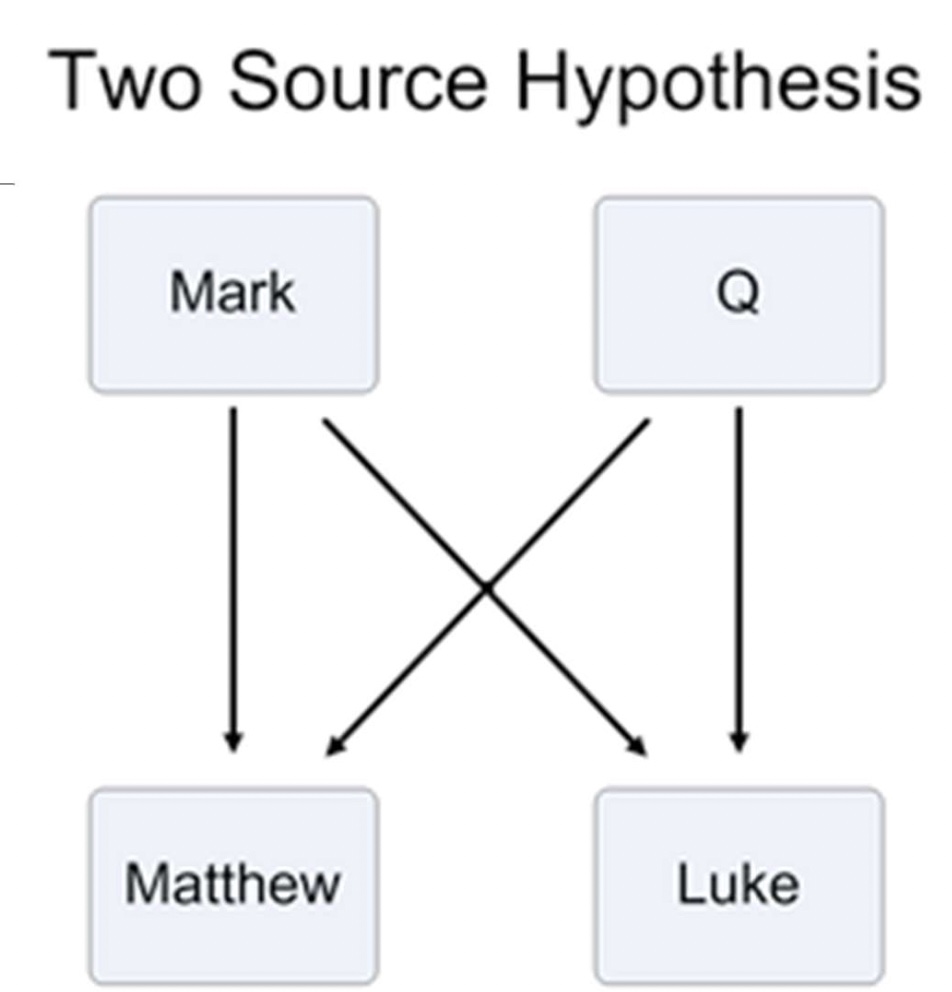
Describe the 2 Documentary Hypothesis.
Mark was written first
Q- hypothetical document
Matthew uses Mark and Q; Luke uses Mark and Q
Matthew and Luke do not know each other- otherwise there is no need for Q
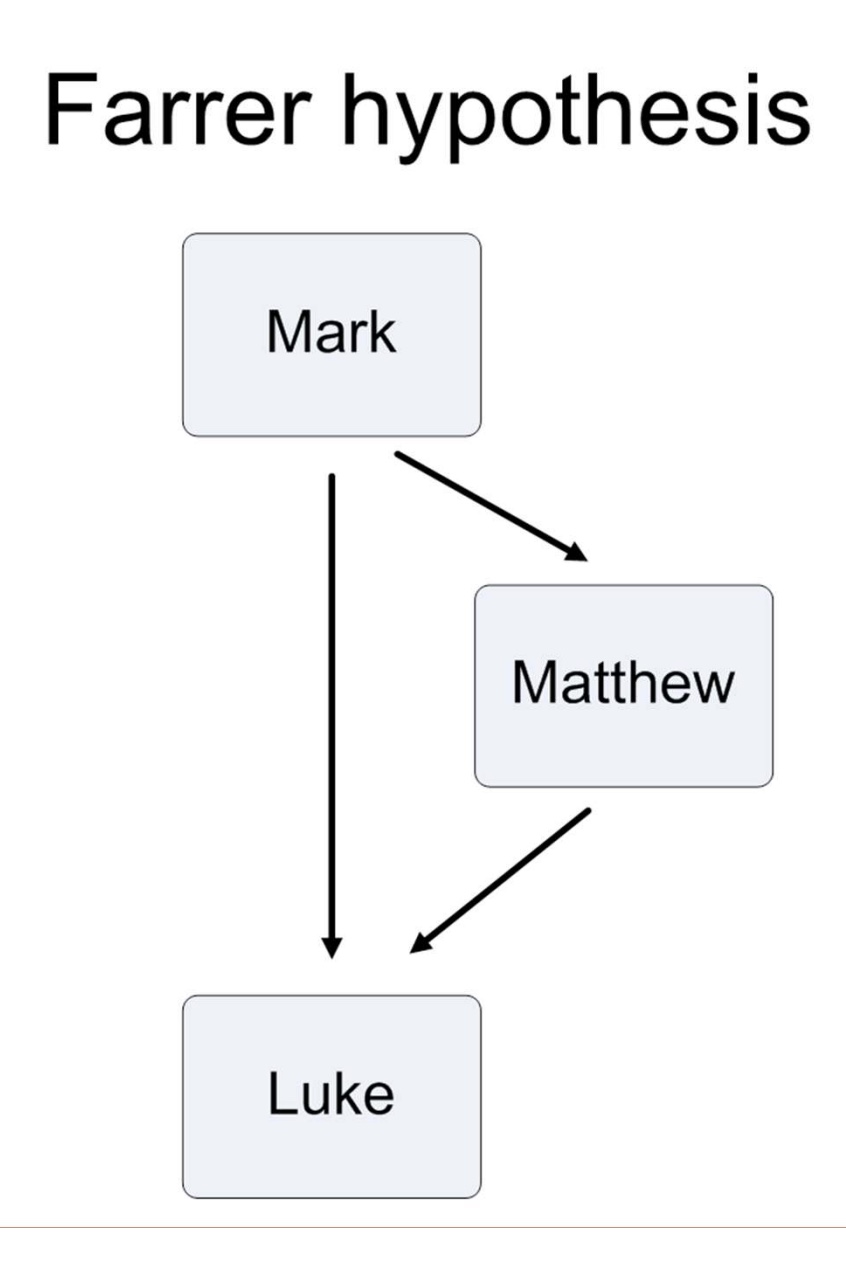
Describe the Farrer Hypothesis.
The reason Mark is still first is because there is 94% of Mark is found in Matthew (similar to the 2 Documentary Hypothesis)
Mark was written first
omits this hypothetical Q Document
Matthew was written second and uses Mark
Luke comes along and uses both Mark and Matthew
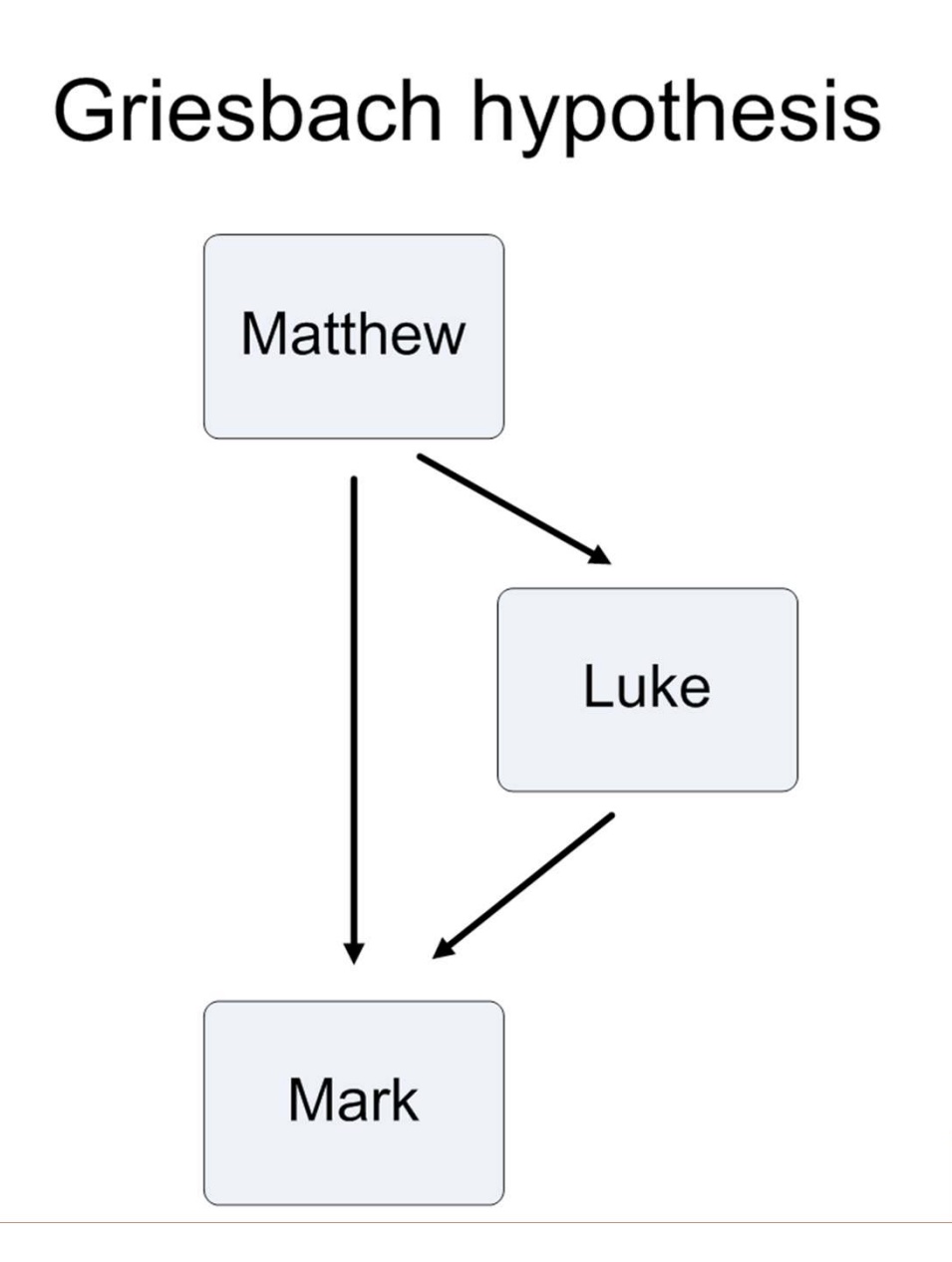
Describe the Griesbach Hypothesis.
Matthew was written first
Luke then sees Matthew and expands upon it
Mark reads both Matthew and Luke- Mark cuts it down and gives the reader a digest version
In Class Review
1
Describe at least two historical events or religious developments of Judaism during Intertestamental Period between the Old and New Testaments and explain why understanding the events of this period is important for studying the New Testament
1) Romans conquered the Middle East
2) Hellenization
3) New Religious
What genre of ancient literature is Acts of the Apostle in the New Testament and what purpose does the text serve in the New Testament canon?
1) introduces paul
2) History, literature
Deoin Cleveland Part 2 (Intertestemental and New Testament period)
Final Review
What Culture influences Judaism during the time between Testaments?
Even in Rome if you were educated you spoke Greek, latin at this time was not an educated
when the gospel writers refer to the Old testament they quote not the original Hebrew text they quote the “Septuagint”
The knowledge of this intertestamental period allows us to develop a greater context for the New Testament thus we may understand the references within the text to religious figures or other concepts that were not directly mentioned within the Old Testament.
Greek (Hellenization), because of Alexander the Great.
What document was composed during this time because of this influence?
The Septuagint (Greek translation of the Hebrew Bible)
Selucid rule of Jerusalem caused what major change to the Hebrew Traditions?
Transformation of the role of the High Priest to include Politics.
Which Empire rose during this time and continued to be dominant during the New Testament?
The Roman Empire
What Sects of Judaism develop during this time
1) Zealots
2) Essenes
3) The Sadducees
4) The Pharisees
What genre of Ancient Literature is Acts of the Apostles?
History (also identified as Narrative Literature)
What does the book of “The Acts of the Apostles” describe as expanding?
The expansion of the early church after the ascension of Jesus Christ.
Who does “The Acts of the Apostles” introduce?
The Apostle Paul
What does Paul say about Jesus Christ in accordance with the scriputres?
He died for our sins, was buried, was raised from the dead, and appeared to others.
Why does Paul say that people need to be saved
All people are doubly under GOD’s wrath because:
1) Adam is their covenantal representative (i.e. Adam’s sin is attributed to them)
2) They have their own personal sins
How does Paul say faith in Jesus Christ addresses this double wrath?
1) Jesus becomes their covenantal representative
2) Jesus endured GOD’s wrath on the cross which pays for their personal sin
What feature does Paul preach against from “false gospels”?
“Judaizers” claim Gentile converts must convert to Judaism to be part of the Christian movement.
Paul is a Roman, and he is concerned about the claims that you have to be converted to Judaism,
Paul wanted all of his Roman buddies to be accepted into the church despite them not wanting to conform to Judaism
What two churches does Paul address divisions with?
1) the Corinthian church
2) the Roman Church
What two divisions is Paul addressing?
1) Questions arising who is the leader of the Corinthian Church?; Paul, Jesus, or Cephas? This is the main problem
2) The divisions between Jews and Gentiles in the Roman Church.
Which New Testament book is apocalyptic literature?
The Book of Revelation
What is the purpose of the text?
To reveal what is animating the challenges that Christians are facing from Rome in the first and second centuries.
this is the viewpoint that Revelation is happening currently and is not addressing some future event like modern Christians believe now.
Questions that may be asked on the exam?
1) Define Paul’s Gospel. And the purpose of sin?