T-cell Activation
 Call Kai
 Learn
Learn Practice Test
 Spaced Repetition
 Match
Match Flashcards
 Knowt Play
1/18

There's no tags or description
Looks like no tags are added yet.
Name | Mastery | Learn | Test | Matching | Spaced | Call with Kai |
|---|
No analytics yet
Send a link to your students to track their progress
19 Terms
Generally what must be done for T-cell activation and what is T-cell specificity?
T-cells can recognise processed antigens called epitopes
The epitope must be presented to the T-cell for activation
Specificity: each T-cell has one TCR which is specific to one epitope and eventually can produce clone of that antigen specific T-cell.
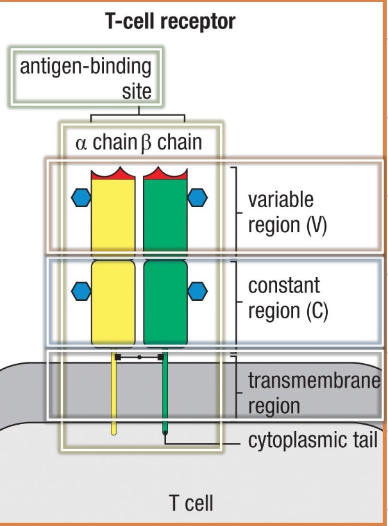
What is the structure of TCR?
membrane bound and has many subunits
no effector function
one antigen binding site
two chains (alpha and beta)
each chain has 3 regions (variable, transmembrane and constant)
What are the different TCR gene segments?
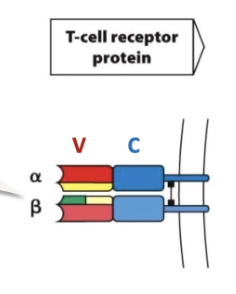
TCR constant region has one gene segment
Alpha variable region has 2 segments and beta has 3 gene segments
Why are TCRs so diverse?
high variabiliy in the antigen binding site which is specific to one TCR and epitope, also due to multiple chains
gene rearrangements induced via somatic recombination of the variable alpha and beta regions by the RAG enzyme
What does TCR resmble to in BCR?
To the Fab fragment in BCR/Antibodies
What are the two different types of T-cells that can be produced upon antigen presentation?
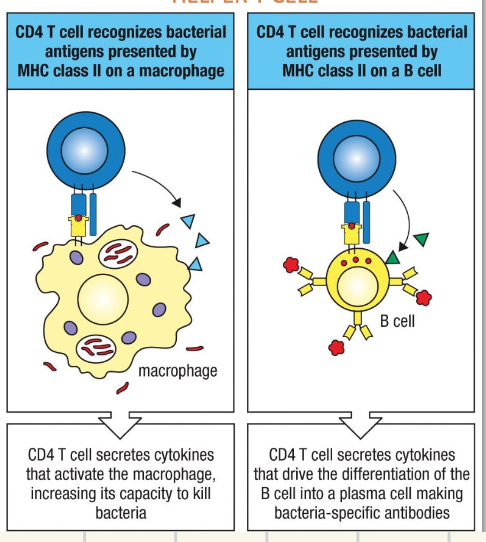
CD8+ T-cells: cytotoxic T-cells → recognise viral antigens presented by MHC I molecules on an infected cell and can subsequently kill the epithelial cell directly → intracellular
CD4+ T-cells: Helper T-cells →
intracellular: recognition of the bacterial antigen presented by a MHC II on a macrophage → secretion of cytokines to enhance cytokine production and macrophage a activity
extracellular: antigen recognisation on B-cell by MHC II → secretion of cytokines which will develop B-cells into antibody producing plasma cells.
Which HLA molecule is associated with which type of T-cell?
MHC I → CD8+ T-cells
MHC II → CD4+ T-cells
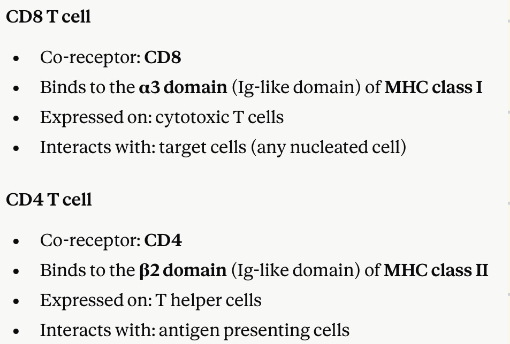
What do co-receptors do?
enures that the correct T-cell subset binds to the correct MHC molecule and cotributes to intracellular signalling needed for T-cell activation
Distinguish between CD4 and CD8 co-receptors
Can you describe exogenous antigen presentation?
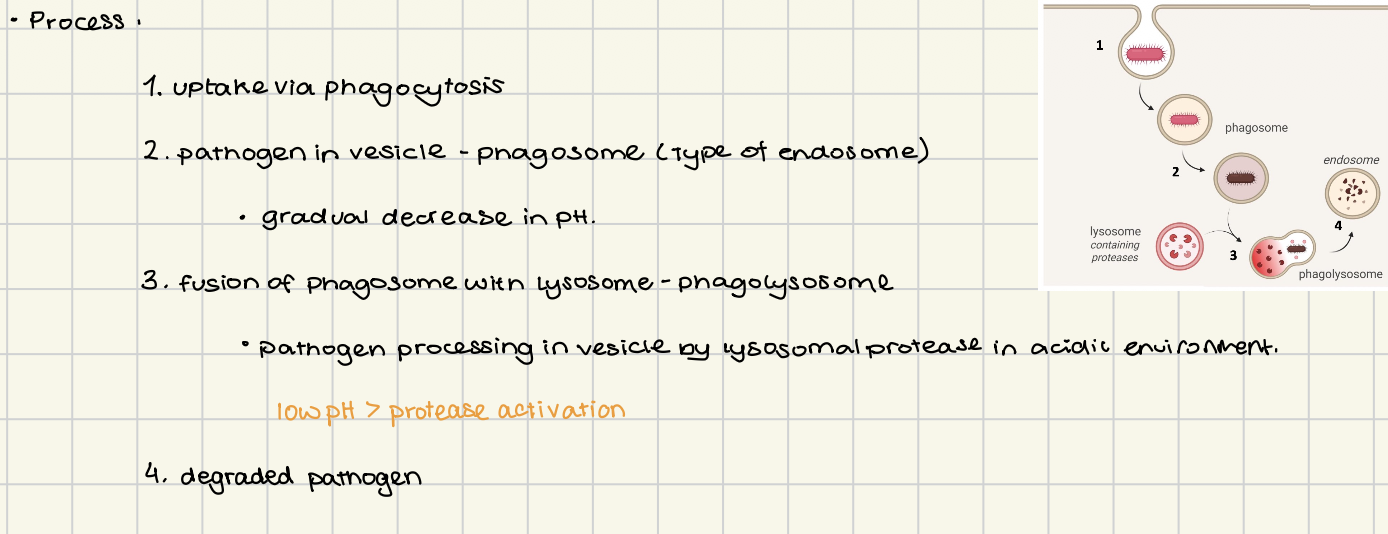
Which MHC molecule are used for the exogenous pathway and what changes are needed in the process?
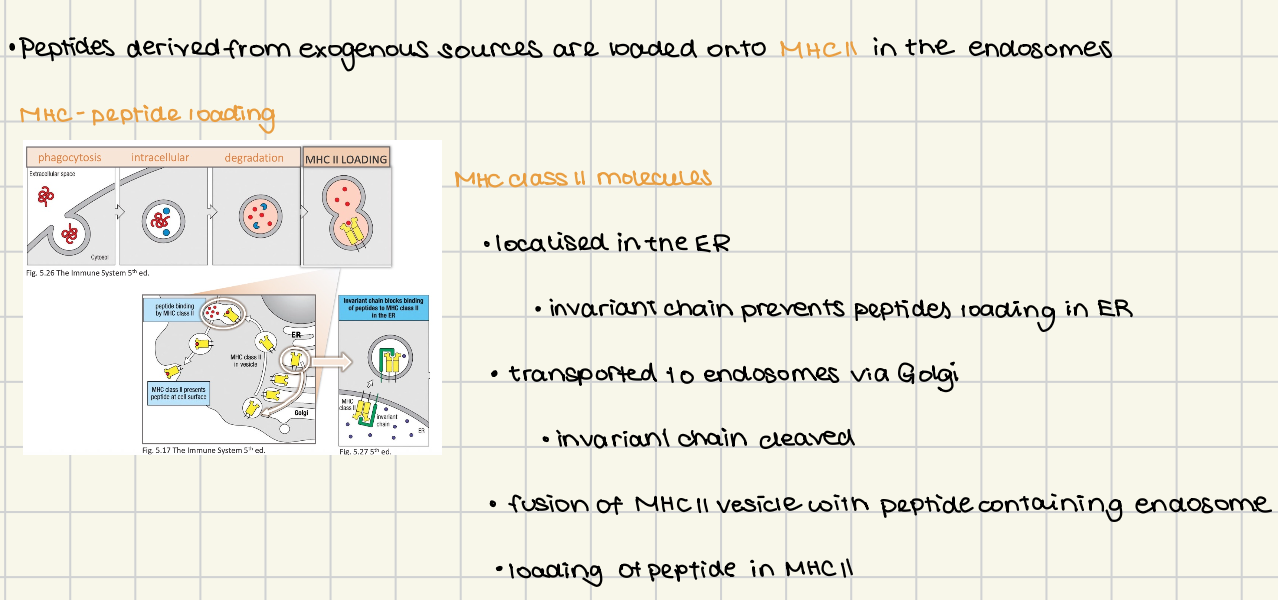
Which cells present these antigens in an exogenous manner?
its any antigen presenting cells (APCs) - dendritic cells, macrophages etc.
Which type of T-cells are activated by the exogenous pathway?
CD4+ T-cells
What is the endogenous pathway and where do the antigens come from?
These are intracellular antigens
Peptides derived from endogenous sources are processed in the cytoplasm followed by peptide loading onto MHC 1 in the ER
Explain the pathway of endogenous antigen presentation?
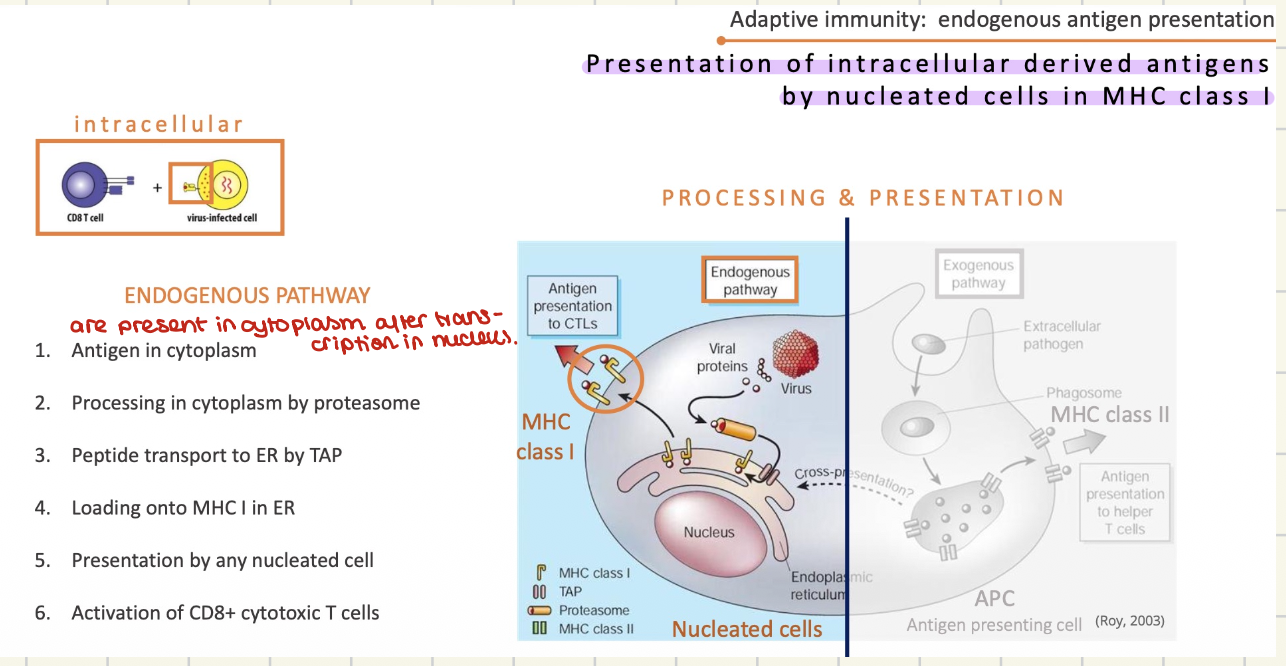
What is the peptide-loading complex?
they chaperone the peptide loading of the MHC I in the ER
the three functions are 1) stabalising the MHC molecule 2) ensuring proximity between TAP and MHC for loading 3) release of peptide loading complex so MHC can go to membrane for presentation
Which cells undergo endogenous presentation?
CD8+ cytotoxic T-cells
What is cross-presentation? Explain the pathway.
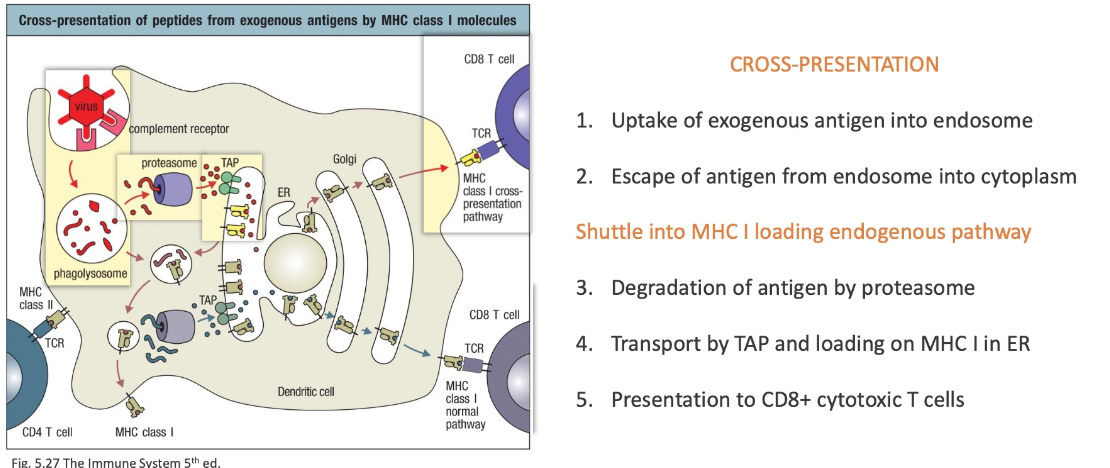
Which cells can present intracellular antigens?
All cells with a nucleus (immune and non-immune)