Astrophysics Techniques Trinity College Dublin
 Call Kai
 Learn
Learn Practice Test
 Spaced Repetition
 Match
Match Flashcards
 Knowt Play
1/55

There's no tags or description
Looks like no tags are added yet.
Name | Mastery | Learn | Test | Matching | Spaced | Call with Kai |
|---|
No analytics yet
Send a link to your students to track their progress
56 Terms
Radio
0.1 m or longer (larger)
109 Hz or less
10-5 Ev or less
Microwave
10-3 to 10-1 m
1011 to 109 Hz
10-3 to 10-5 Ev
infared
750 nm (7.5×10⁻⁹ m) to 10-3 m
4×10¹⁴Hz to 1011 Hz
1.65 eV to 10-3 eV
visible light (optical) (red longest, violet shortest)
violet to red
3.8× 10⁻⁷ m to 7.5×10⁻⁷m
7.5×10¹⁴ Hz to 4×10¹⁴ Hz
3.26 eV to 1.65 eV
UV
10-8 m to 3.8×10⁻⁷m
1016Hz to 7.5×10¹⁴ Hz
102 eV to 3.26 eV
x-ray
10-11 m to 10-8 m
1019 Hz to 1016Hz
105 eV to 102 eV
gamma ray
10-11 m or smaller
1019 Hz or greater
105 eV or greater
apparent brightness
m=-2.5log(relative flux)
faintness limit depends on
collecting aperature
more efficient detectors
longer exposure times
why drive towards larger collecting aperature
-gather more photons
-better signal to noise ratio
Why put telescope at high altitude or in space?
-wide range of em radation beyond the optical does not penetrate to earth’s surface due to scattering or absorption in earth’s atmosphere
-we need to decrease the amount of atmosphere we are seeing through
conversion from arcsec to degree
3600 arcsec in degree
conversion from degree to rad
180 degree in pi rad
angular size to real size given distance
S=(θ)⋅D
real size=angular size (radians) * distance
What is the primary purpose of an astronomical telescope?
secondary?
gather EM radiation (photons) and focus it to form a detectable image or signal
1) ability to collect a lot of photons—-increase in collecting area
2) ability to resolve signal—-electronics
secondary: look into a range of conditions
-multiwave data
-energy (thus wavelength) connection with temperature
new developments in telescopes?
-larger
-space-based telescopes
new approaches sensitive to different bands:
-GW detectors
-bolometer arrays
-etc
Three basic types of telescopes
1) Refractor
2) Reflector
3) Catadioptric (combination)
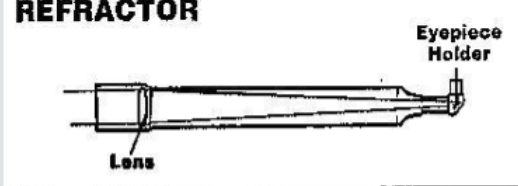
Refractor telescopes
-uses lens to collect light (positive objective lens and negative eye lens—-Galilean)
limits: lens needs to self-support and be optically pure (limits aperature to about 1 m)
also needs to be fairly long to be effective
Reflector telescopes
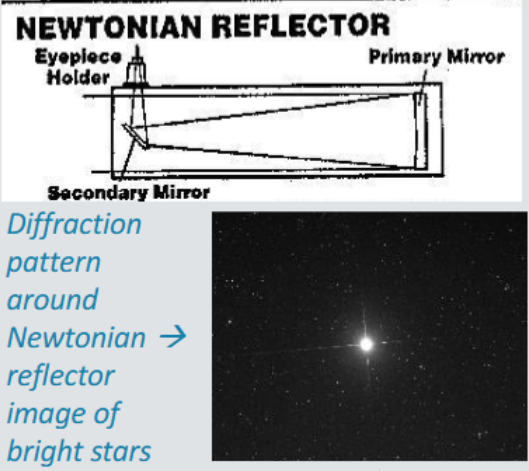
-two or more surface reflections within telescope
-first type was Newtonian
pros: quality of mirror material matters less
cons: secondary mirror support obstructs image (this is where diffraction patterns around stars occur)
Catadioptric telescope
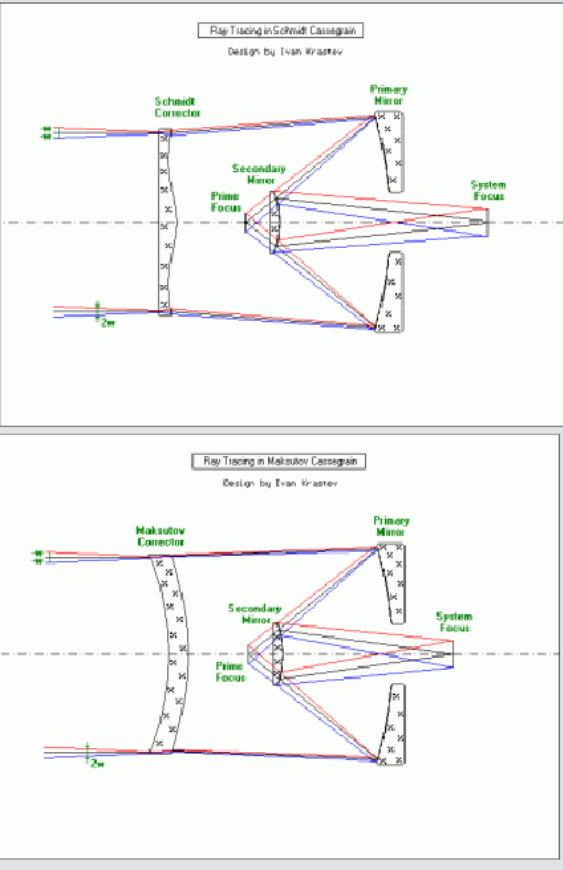
-a combination of reflector and refractor type telescopes in which the secondary mirror is mounted on top of a corrector lens
Basics of an optical telescope
1) need a large collecting area
2) need a way to direct energy to detection
3) usually need extra optics to correct for distortions in spectrum or position, match image scale to detector, etc
focal length
length from the lens or mirror at which radiation is brought into focus
image size equation
s=fL⋅α
image size=focal length*tan(angle)=focal length*angle
where angle can be described as the angular size or seperation we are trying to look at in the sky
by small angle approximation
so, small focal length gives small image size and large focal length gives large image size (or seperation between stars)
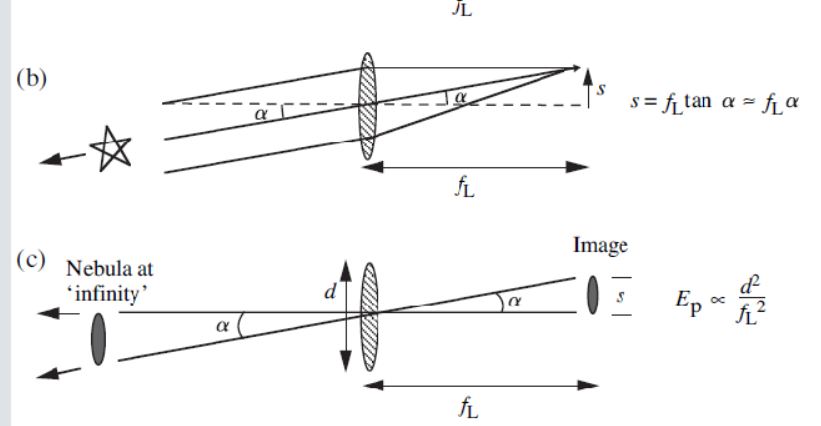
Plate scale (or image scale)
Ps=sα=fL1
where fL is in m and Ps is in rad/m
angle of sky that is imaged onto a unit length of plate
so larger plate scale means a smaller image size
in practice usually given in arcsec/mm
What is exposure time determined by in the ideal case of a point source, in a perfect atmosphere, with a perfect lens?
just the area of the aperature
What is exposure time determined by if a celestial object has significant finite angular size? Diffuse source
Both focal length and area of aperature (energy per unit time)
the image area depends inversely on the
plate scale: a smaller scale will put more energy into fewer pixels and
result in a better S/N detection for the same exposure time
Consider a circular source on the sky of angular diameter . For
telescopes with the same collecting area, but different focal length, the
energy per pixel scales as: 𝐸𝑝 ∝ 𝑠−2 ∝ 𝑓𝐿
−2

Focal ratio and what does it mean?
R=dfL
measure of how fast a system is (think energy deposited per pixel)
usually indicated by f-number, ie f/24. (f/R)
This means the focal length is 24 times the diameter
pros and cons of smaller focal ratio (fast optics) or larger focal ratio (slow optics)
smaller focal ratio: image is smaller but can get rid of background noise/shorter exposure time necessary
larger focal ratio: image is larger (better magnification) and angular resolution is improved. But longer exposure time necessary
why is the image scale important?
-it controls the amount of energy landing on each pixel, thus affecting S/N
-controls image resolution
-choice of image scale (through intermediate optics) can be used to match a detector to the telescope
Magnification
For visual observing eyepieces are used, with the magnification of the
telescope system given by the ratio of the eyepiece focal length to that
of the telescope objective: 𝑀 = 𝑓𝑂𝑏𝑗𝑒𝑐𝑡𝑖𝑣𝑒/𝑓𝐸𝑦𝑒𝑝𝑖𝑒𝑐𝑒
match image size to type of observation and for atmospheric conditions
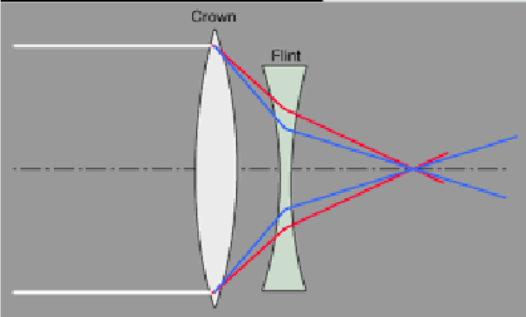
Chromatic abberation (and what is the result?)
light of different wavelengths being brought to a different focal points when passing through the material of a simple lens
-gives color fringing which varies with location relative to the optical axis and with focus
in which telescopes is chromatic aberration the worst?
-short focal length refractors (in general, fast refractors—-small f ratio)
-less resolved so image becomes hella blurry
-limits minimum size of cheap telescopes
how to limit chromatic abberation
-use two or more lens of different refractive indices to “correct” chromatic abberation
-or use chemistry: fluorite lens (tailors refractive indices to optimize the range we are trying to see) (non uniform dispersion with wavelength
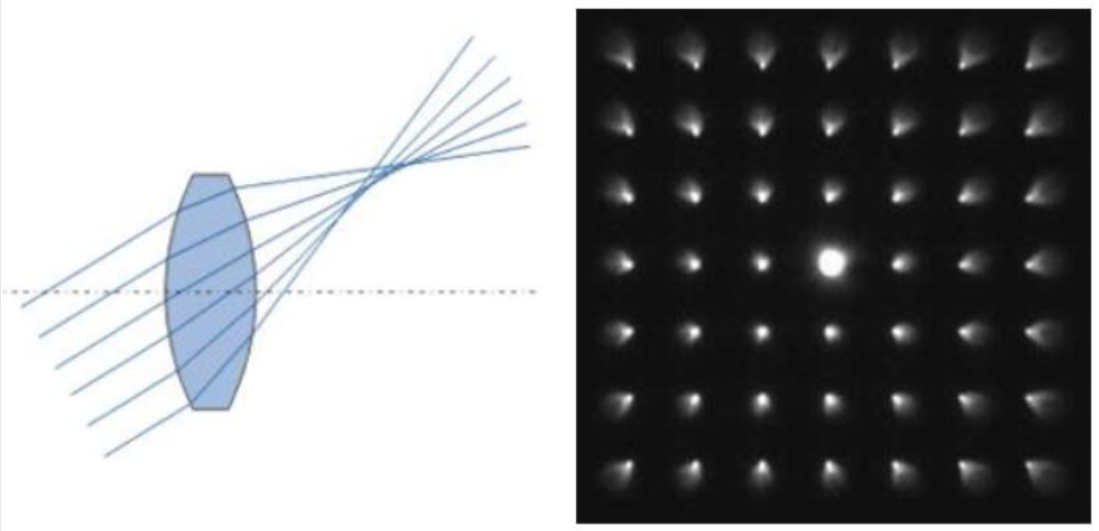
Coma
rays don’t focus in the same image plane
results in a comet like tail where the tail lies furthest from the optical axis of the instrument
-asymmentrical
-usually when point source is located off of optical axis
-off-axis rays do not come to precise focus
-function of distance from optical axis
-function of the f-ratio
coma solution
put optics within the optical tube—-reduces the scattered light
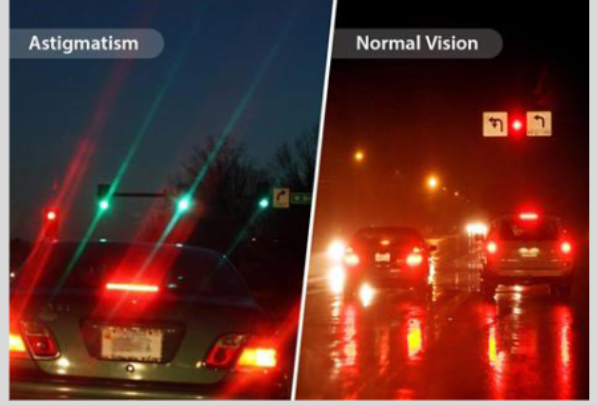
Astigmatism
rays lying in orthogonal planes are not brought to the same focus, resulting in a non-
circular image whose axis varies with a change in the focusser position
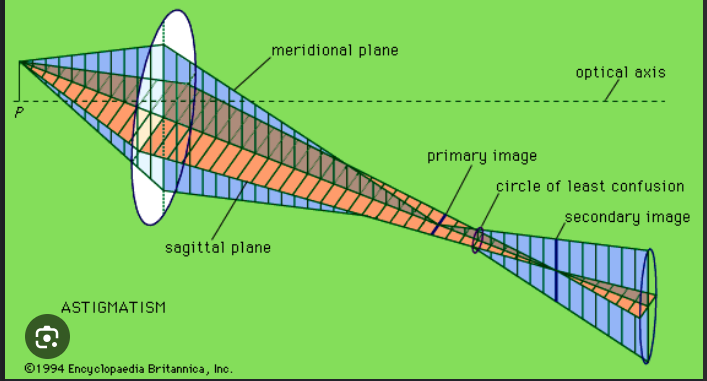
astigmatism causes
One cause can be differences in focal length for different parts of the telescope mirror/lens, perhaps caused by strain in the optics or badly made surfaces
circle of least confusion
When aberrations are present, or the system is not in focus, it can be seen that a point focus may not be possible
-stead we can define a circle of least confusion (blur disk) which is the minimum image size obtainable
Refractor pros and cons
Lens to collect and focus light
pros: stable (suitable for smaller, portable instruments)
cons: glass quality needs to be very good (more expensive, otherwise coma)
lens can be pretty thick for larger instrument (absorption can be an issue/slumping of glass for large refractors limits size)
single lens results in chromatic abberation (especially for fast lenses—-large aperature)
more expensive option: use achromatic lens (bring red & blue to common focus) and/or apochromatic lens (low dispersion glass—-bring more of spectrum to same focal point)—-con—more expensive/more surfaces to align
modern short focus refractors
Modern lens design and low dispersion materials reduces problems associated with
chromatic and other effects and enables “fast”, compact optical systems for a relatively low price (about 200 dollars)
planck’s constant in erg/s
6.63×10⁻²⁷ erg/s
c in cgs
3×1010 cm/s
boltzmann constant in cgs erg/k
1.38×10⁻¹⁶ erg/K
plack function
BV=c22hν3ekThν−11
spherical aberration
-spherical lenses or mirrors do NOT bring all incident rays to common focal point (even if they are parallel to optical axis)
-symmetric
-caused by focal length variations across diameter of the lens
-Ex: spheroidal lenses or mirrors
-looks hazy
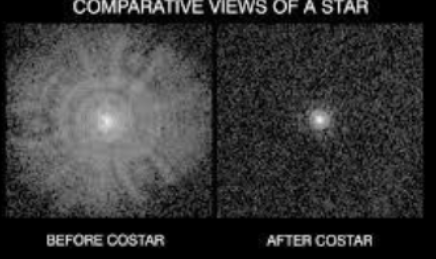
correction for spherical aberration
-using corrective lenses in the optical train
-using aspheric lenses/mirrors (parabolidal)
-deconvolution of abberated images using emperical or modelled psf (used on hubble before they put corrective optics in)
Reflecting telescopes pros and cons
pros: less surfaces to figure out
-cheaper glass
-prime mirror heavy but can be supported across back against sagging
-more compact for similar size (faster/wider field of view) (folded light path)
-achromatic by design
-cheaper to produce
cons:
-need to access focus/bring light to convinent point (more mirrors/field orientations need to be altered)
-needs to be recollminated if disturbed/transported
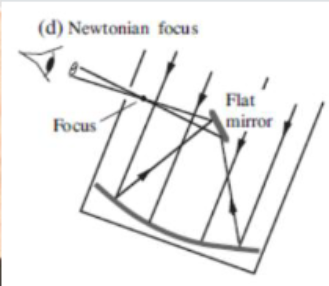
Newtonian telescope
-flat secondary mirror (causes a left-right flip of field)
-image quality: primary aberration is coma
-coma gets worse with larger aperatures: small f-ratio/fast systems
-f/4 considered the ‘fastest’ newtonian in terms of quality
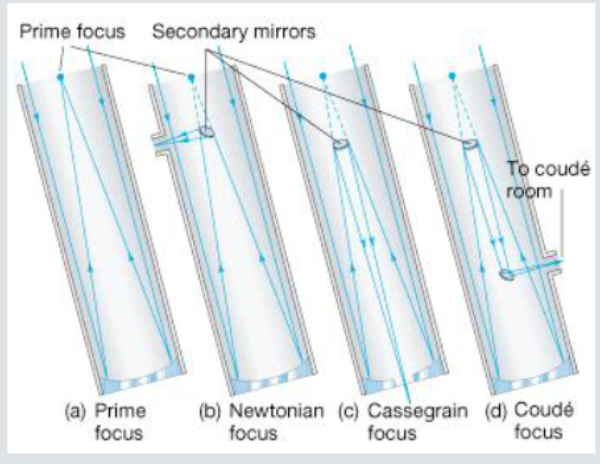
Cassegrain telescope
-convex secondary magnifies image, i.e. increases the effective focal length (e.f.l.)
-In classica (CC) design can be designed with a spherical primary (e.g. for cheapness), then use a hyperboloidal secondary to correct the spherical aberration
-Can be constructed with a paraboloidal primary and a hyperboloidal secondary, but still shows some coma, so relatively small usable field
-astigmatism a larger problem, coma less of a problem
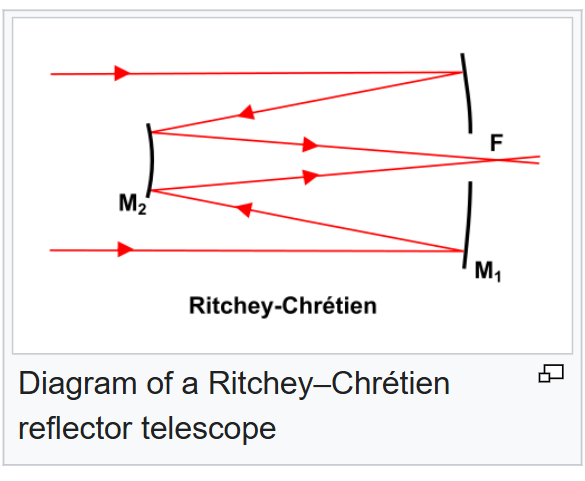
Ritchey-Chretien telescope (RC telescope) +pros and cons compared to CC
-cassegrain design with hyperbolodial primary and secondary mirrors
-well corrected for low order errors like coma
-aplanatic: only astigmatism remains (as compared to CC with coma+spherical aberration)
-secondary corrects aberrations from primary and magnifies image
HOWEVER
-RC astigmatism is larger than CC for same f ratio
-focusing between extremes of astigmatic foci produces near circular image
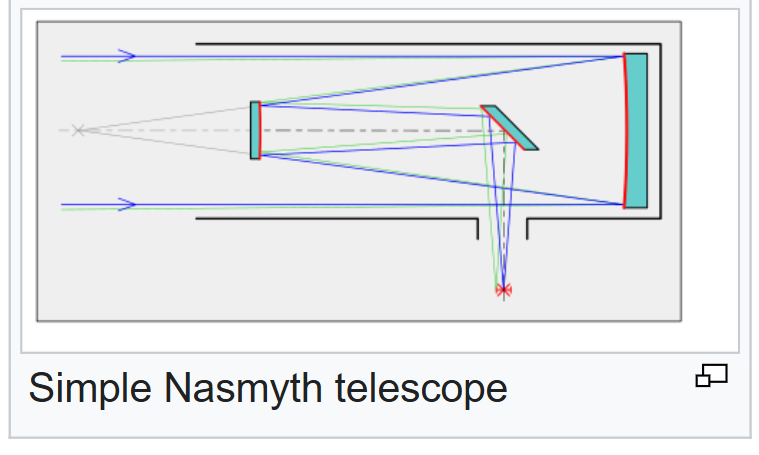
Nasmyth arrangement
-The Nasmyth arrangement uses a flat secondary to bring the Cassegrain focus to the side
-Nasmyth platform provides a stable location for the installation of heavy (tonnes) of equipment
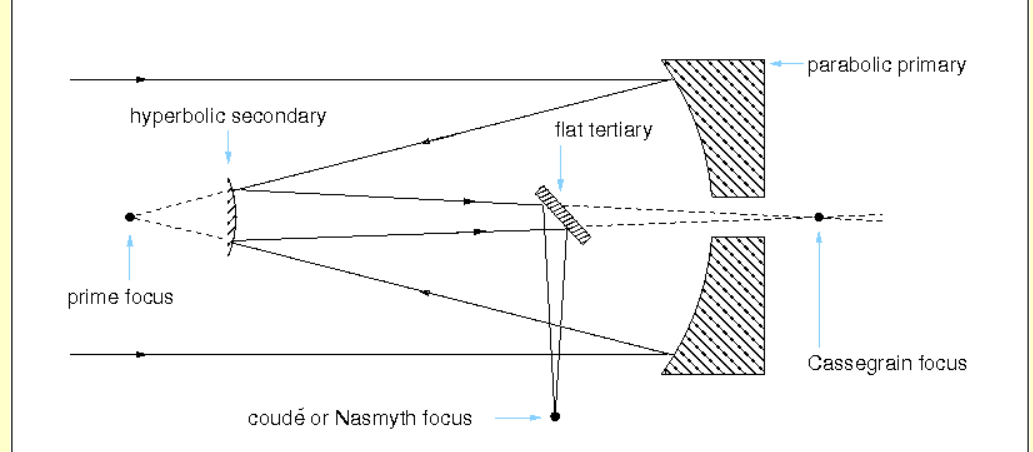
Coude arrangment
The Coudé arrangement brings the focus to a point in the basement which can be climate-controlled for more exacting high resolution spectroscopy
Can arrange so that light travels along a trunnion (supporting axle)
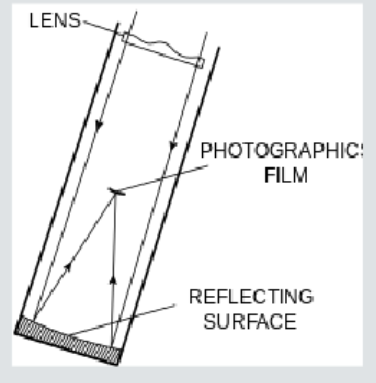
Schmidt telescope
-A wider field design
—uses a spherical primary and a corrector plate at the radius of curvature (= 2 x f.l.)
pros:
-compact and fast design
-only two optical components needed
-important for wide field surveys and short exposures
cons:
-focus is inaccessible directly—use film or ccd detector
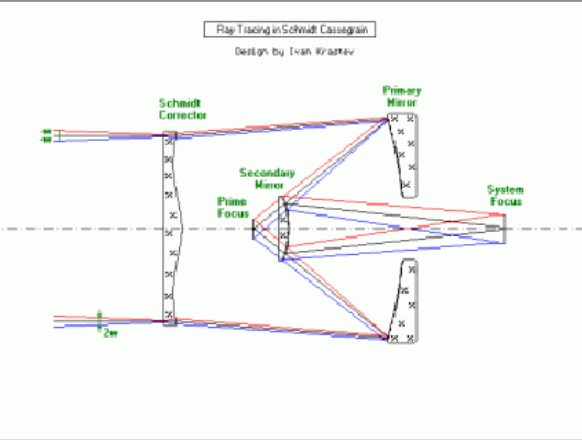
Schmidt-Cassegrain
Schmidt Cassegrain uses a specially shaped thin lens to correct for the aberrations of the spherically-shaped primary surface
-can also have schmidt newtonian: better for coma/spherical aberration than newtonian but worse than maksutov newtonian
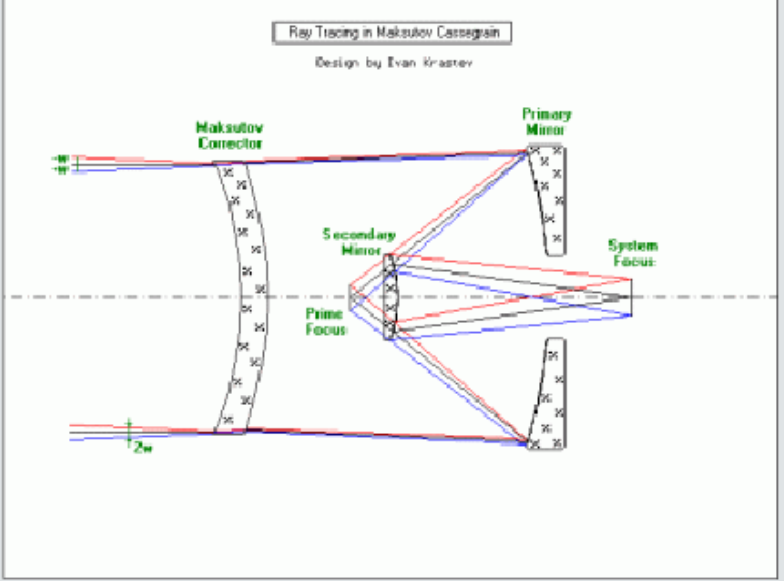
Maksutov cassegrain
The Maksutov design uses a curved, weakly negative, meniscus lens to correct for the spherical mirror aberrations
can also be maksutov newtonian—-best for spherical aberration/coma
Catadioptric pros
-mirror to collect and focus light
-lens to correct rays
-able to be even more compact than reflector types