Biology past paper questions
 Call Kai
 Learn
Learn Practice Test
 Spaced Repetition
 Match
Match Flashcards
 Knowt Play
1/43

There's no tags or description
Looks like no tags are added yet.
Name | Mastery | Learn | Test | Matching | Spaced | Call with Kai |
|---|
No analytics yet
Send a link to your students to track their progress
44 Terms
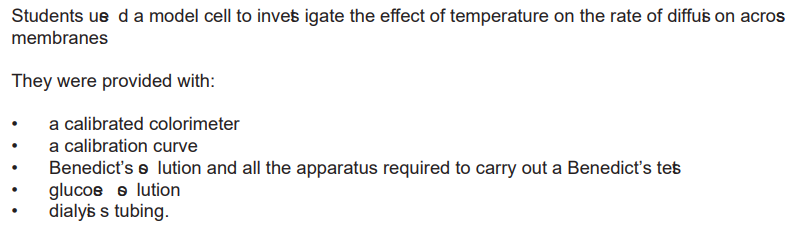
Name two more pieces of apparatus they would need to make sure this is a controlled investigation. (2)
Thermometer
Timer
Measuring cylinder
Outline the method that the students would use to carry out an investigation into the effect of temperature on the diffusion on rate in their model cells. (6)
Add glucose solution to the dialysis tubing
Secure tubing after adding glucose
Place tubing in water bath and remove sample at set time intervals
Add Benedict’s to sample to test for glucose
Use colorimeter to obtain absorption values
Use calibration curve to estimate the concentration of glucose
Repeat at different temperatures
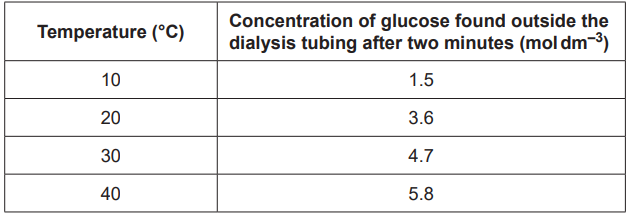
Explain these results in terms of the effect of temperature on the rate of diffusion. (3)
As the temperature increases the kinetic energy of the glucose molecules increases
Glucose molecules diffuses at a faster rate
Greater rate between 10 and 20 degrees C
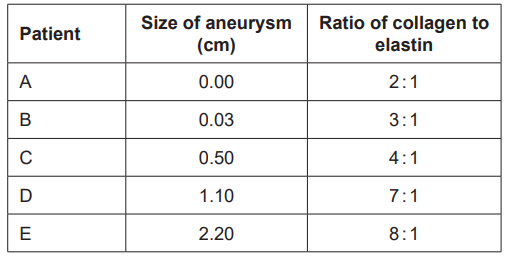
Based only on the data in the table, suggest a hypothesis on the formation of aneurysm. (1)
Higher collagen : elastin ration leads to a larger aneurysm
Explain the roles of valves in veins (2)
They prevent backflow of blood as it is at low pressure
Allows one way flow back to heart
The smooth muscle content in the arteriole walls is more than double the smooth muscle content in the walls of the arteries
Explain how arterioles are better adapted than arteries to allow the blood to flow into an individual organ (3)
Relaxation of the smooth muscle causes vasodialation
Regulates blood flow to capillaries
Pressure of blood is higher in artery
As blood flows from the artery to the arteriole, pressure falls
So capillary will not rupture

Details of hormonal and nervous control are not required (6)
SAN starts the wave of excitation
Electrical activity causes atria to contract
Non conducting tissue
Pace maker
Myogenic
AVN picks up electrical activity from SAN
AVN causes a slight delay
Delay ensures atria have stopped contracting before ventricles contract
Ventricles only contract when wave of excitation in Purkyne fibres
Makes sure blood has left the atria otherwise less blood will exit the heart
AVN stimulates Bundle of His in septum
Bundle of His conducts wave of excitation to apex of heart
Purkyne fibres in walls of ventricles
Ensure ventricles contract at same time
Explain why a large multicellular plant needs a transport system but a small multicellular plant does not. (2)
In the larger plant the SA:V ration is smaller so the diffusion pathway is longer
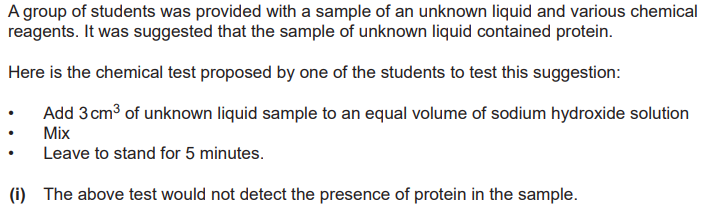
State the change that needs to be made to this test to enable protein to be detected (1)
Add Biuret instead of sodium hydroxide
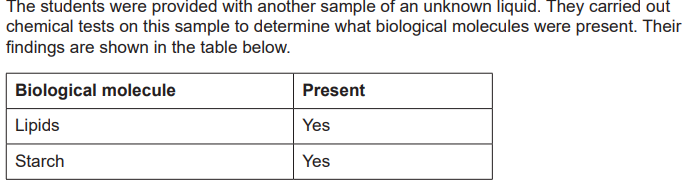
Describe the chemical test you would carry out to see if the srudents’ findings were correct. Include the apparatus and reagents you would use and the results you would expect. (6)
Lipids apparatus
Test tube
Filter paper and funnel
Pipette
Emulsion test and reagents
Add test solution to ethanol
mix with water
can filter and add water to filtrate
Clear to cloudy
Starch apparatus
Test tube
Pipette
Iodine test and reagents
Add a few drops of iodine
Orange to blue-black
The students were then asked to carry out an experiment to determine the glucose conc of another test using a colorimeter
Describe how the students would use a colorimeter in their experiment. (3)
Calibrate colorimeter with distilled water
Add red filter to colorimeter
Place samples in a curvette
Use a range of known glucose concentrations
Measure absorbance of glucose solutions
State the properties of collagen that make it suitable for it in ligaments (2)
Fibrous
Insoluble
Tensile strength
Resistant to stretching
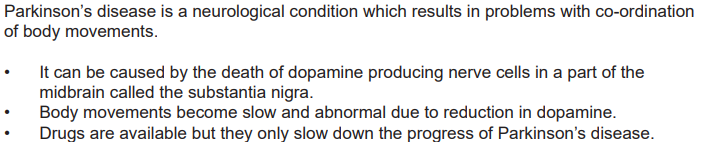
Suggest and explain how stem cells might be used to help treat parkinson’s disease (2)
Stem cells can differentiate into nerve cells
Would allow normal body movements
Describe the role of mitosis in fragmentation. (1)
Produces many genetically identical cells
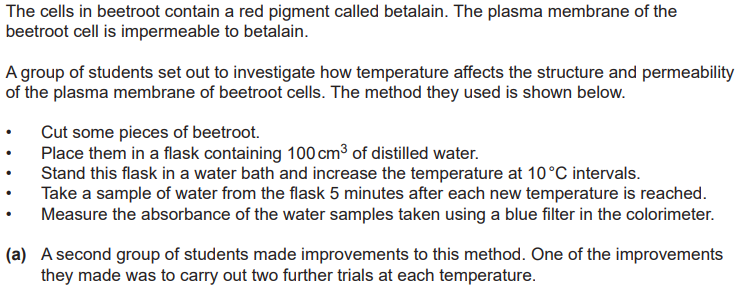
Suggest two further improvements they could have made and give reason for the improvements you have suggested. (4)
Same mass of pieces
For same surface area
Pieces from the same betroot
to control pigment conc
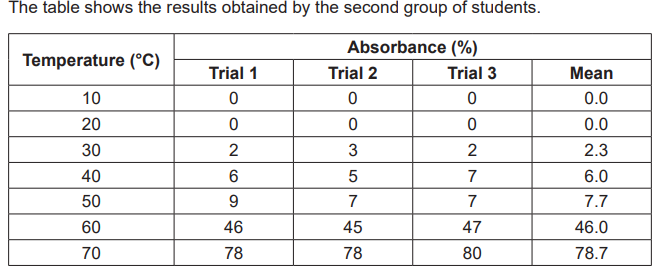
Explain the results between 20 and 70 using your knowledge of the structure and properties of phospholipid molecules in the plasma membrane. (6)
Membrane least permeable at 20
At 30/40/50 pigment escapes from gaps between moving phospholipids
As temp increases kinetic energy increases
More phospholipid movement
Membrane more permeable
More pigment loss so higher absorbance figure
60/70, membrane distrupted
Bilayer breaks down
Membrane very permeable
Large increase in pigment loss
Laege increase in absorbance figure
Include structure and properties of phospholipids
The size of the cell increases during G2 in the cell cycle
State one other process that takes place during G2 (1)
Protein synthesis
DNA checked for errors
DNA repair
Describe the importance of differential staining for observing cells undergoing mitosis (1)
Makes chromosomes visible
Name the type of bond broken by the enzyme lactase and describe what happens when the bond is broken (2)
Hydrolysis, water is added
Compare prophase in mitosis with prophase in meiosis
Similarities
Chromosomes condense
nuclear envelope breaks down
Spindle fibres form
Differences
Meiosis has two prophases
Homologous chromosomes pair in prophase 1
Crossing over occurs
A common symptom of lactose intolerance in adults is the creation of extra fluid in the large intestine suggest why. (2)
Lactose lowers the water potential
Causing water to move inside the cells by osmosis
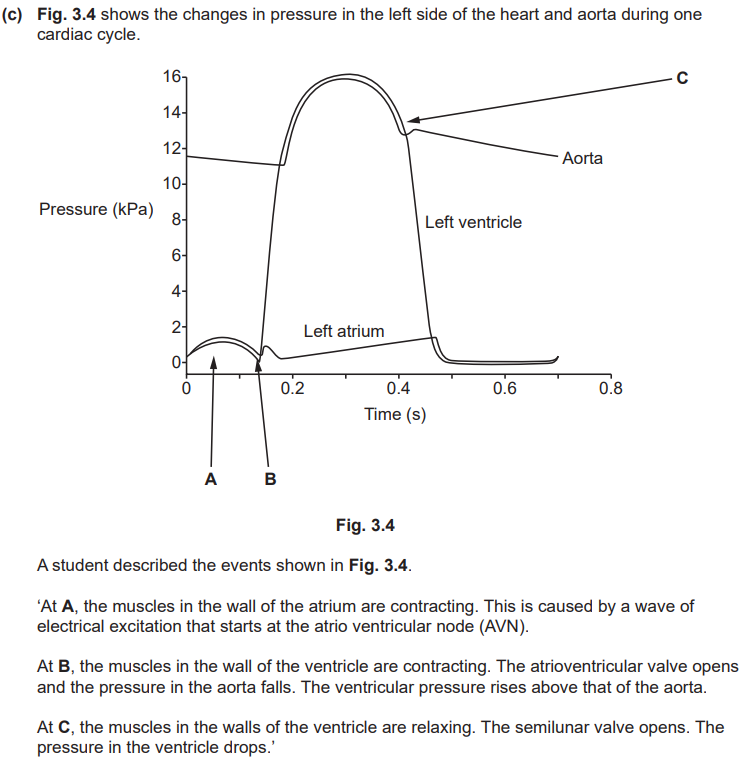
Identify three errors made in the students description and write the correction for each error (3)
starts at the SAN not AVN
at B the AV valve doesnt open, it closes
at C the semi lunar valve doesnt open, it closes
Explain how haemoglobin acts as a buffer (2)
CO2 and water form carbonic acid
Carbonic acid dissociates giving H+
H+ binds to Hb
So CO2 can be carries as HCO3-
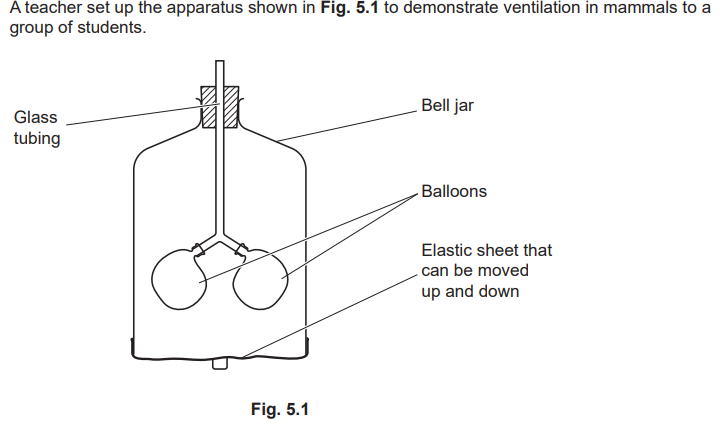
Describe how the apparatus can be used to model the changes that take part during inspiration in mammals (6)
Pull down the elastic sheet- models the diaphragm flattening
Volume in ball jar increases- models the thorax volume increasing
Pressure in bell jar gets lower- models thorax pressure decrease
Air pressure outside now higher than in bell jar- models higher pressure outside lungs
Air pushed into balloons- models air inflating lungs
Balloons → models two lungs
Elastic sheet → represents diaphragms
Glass tubing → trachea
cannot model contraction of external intercostal muscles
State two differences between the closed circulatory system of sea bass and the closed circulatory system of a mammal (2)
Sea bass blood goes through the heart once vs mammal twice
Sea bass single vs mammal double
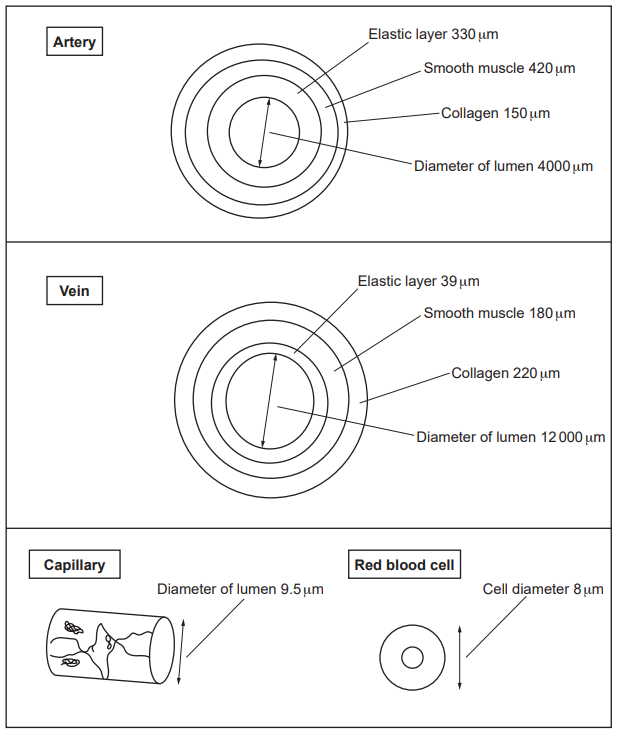
Describe how the structure of each type of blood vessel is adapted to its function (6)
Artery
Carry blood away from the heart at high pressure
Thick elastic layer / elastin enables them to withstand pressure and alllows them to stretch and recoil
Collagen provides support, maintains shape and volume
Smooth muscle contracts and relaxes to change the size of the lumen
Veins
Carry blood back to the heart
no pulse so needs to move against gravity
Thinner elastic layer, no stretch / recoil
Have valves to prevent backflow of blood
More collagen than arteries to give structural support as they carry large volumes of blood
Capillaries
Allow substances to be exchanges
Walls once cell thick
RBC travel in single file
Sjogren’s syndrome is a rare condition that can reduce the production of mucus
Suggest how the upper respiratory tract of a person with Sjorgen’s syndrome might be affected. (1)
More coughing
Describe what is meant by the term esterification (2)
Condensation reaction
Joins carboxylic acid and alcohol
Outline how respiratory systems in a bony fish and in an insect are adapted to maximise ventilation and gaseous exchange. (6)
Bony fish ventilation
Watter enters moth
Volume and pressure changed in buccal cavity
Water flows over gills
water leaves via operculum
Bony fish gas exchange
Large SA
thin
short diffusion distance
counter current system
Insect ventilation
Muscular movement
abdominal pumping
Two components in mammalian gas exchange include cartilage and elastic fibres. (2)
Cartilage stopes trachea from collapsing
Elastic fibres allow alveoli to recoil