Amnesia case studies
 Call Kai
 Learn
Learn Practice Test
 Spaced Repetition
 Match
Match Flashcards
 Knowt Play
1/30

There's no tags or description
Looks like no tags are added yet.
Name | Mastery | Learn | Test | Matching | Spaced | Call with Kai |
|---|
No analytics yet
Send a link to your students to track their progress
31 Terms
HM: what part of his brain did he have removed + why?
Medial temporal lobe (hippocampus, amygdala + surrounding medial temporal cortices) to control seizures
HM’s amnesia: 2 aspects
Anterograde amnesia
Temporally graded retrograde amnesia
Anterograde amnesia def (1)
Inability to form/store new episodic or semantic memories (after surgery)
Temporally graded retrograde amnesia def (1)
Events closer to surgery more likely to be forgotten (known as Ribot’s law)
What type of memory was intact in HM?
Short-term/WM
Procedural
Double dissociation def (1)
A neuroscientific concept used to prove that two different mental functions are independent of one another and rely on distinct brain regions
Example of double dissociation: named, description (2)
Opposite memory impairments in amnesia vs Parkinson’s patients
Amnesic Patients (MTL Damage): Deficit in episodic memory (recognition of task features) but intact procedural learning
Parkinson’s Patients (Basal Ganglia Damage): Deficit in procedural/reward learning but intact episodic recognition of task features
What is the basal ganglia implicated in?
Reward learning + procedural learning
What does fMRI data suggest about relationship between MTL and caudate (basal ganglia) activation?
Negative correlation
MTL highly active early in task → rely heavily on episodic memory
Throughout task, MTL activity decreases + basal ganglia activity increases
What does the fMRI finding suggest?
There may be a third brain region that is actively modulating activity between MTL + caudate to resolve competition
2 levels at which we can consider memory storage
Synaptic consolidation
Systems consolidation (what psych is interested in)
Synaptic consolidation mechanism (1→1, 1)
Initial encoding relies on synaptic plasticity / flexibility of synapse
Through receptor changes: increased conductance or number of receptors to make it
Stabilisation of new receptors
Synaptic consolidation timeframe
Hours
Systems consolidation timeframe
Days, weeks, months
Systems consolidation theories (3)
Standard consolidation theory
Multiple trace/trace transformation theory
Cognitive map theory
Simplified explanation of where info is stored based on how recent
More recent info → hippocampus
Less recent info → cortex
Systems consolidation explained (1)
Storage of info shifted from hippocampus to cortical regions
Standard consolidation theory explained (3)
Different aspects of an event are stored in separate cortical regions
Hippocampus binds together info from different cortical areas
Over time, cortical regions form direct links between themselves and no longer require hippocampus as a ‘binder’
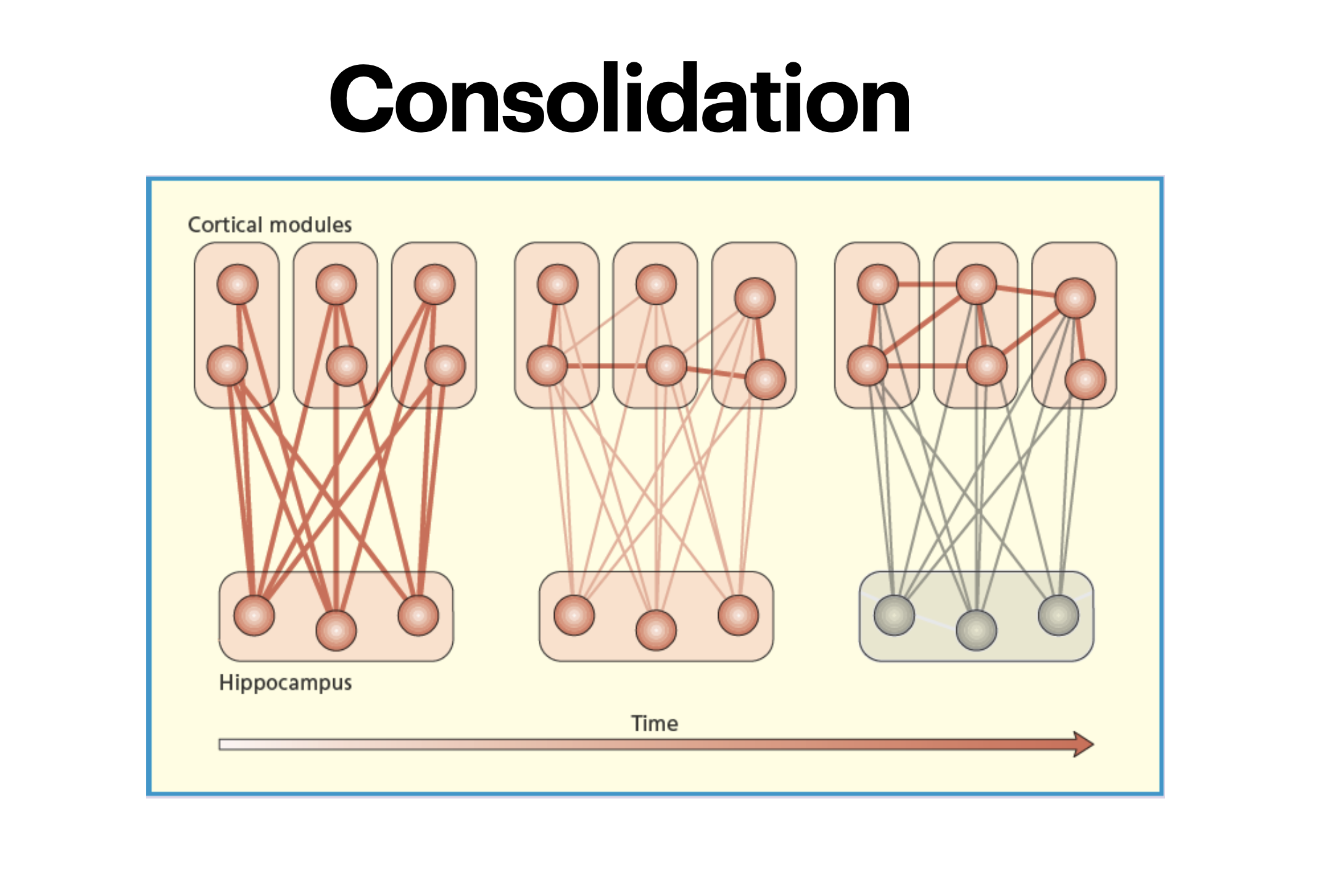
How standard consolidation theory can account for temporally graded retrograde amnesia (1)
Less recent memories stored in cortex rather hippocampus → can survive hippocampal damage often experienced by amnesia patients
Catastrophic interference def
A fundamental problem in neural networks where newly learned information rapidly overwrites or displaces old information
Solution to catastrophic interference (name)
Complementary learning systems
Complementary learning systems explained: neocortex + hippocampus
The Neocortex:
Slow to learn, relying on gradual and repetitive training. By learning slowly, it avoids the massive weight shifts that lead to catastrophic interference, allowing it to build stable, long-term representations
The Hippocampus:
This system is capable of rapid learning. It stores new information quickly and then acts as a "teacher," gradually "training" the neocortex over time so the information can be integrated without destroying existing memories
Reversed temporal gradient in semantic dementia vs amnesia patients (1)
Semantic dementia patients have better memory for more recent events rather than older events (because cortex (LTM) is atrophying, rather than hippocampus (which is relatively intact))
Multiple trace theory description (2)
Hippocampus stores initial, highly contextualised episodic memory
Over time, info is created into ‘schematic’ (general knowledge/gist) memory + stored in cortex
Evidence for multiple trace theory?
In fMRI, hippocampus is activated by remote as well as recent memories
Suggests LT episodic memory might be stored there
Multiple trace theory benefit (1)
Schematic memories important because they help us generalise + make sense of the world
Cognitive map theory purpose
Doesn’t explain intricacies of memory systems, but rather why we might have episodic memory
Core role of hippocampus in cognitive map theory
To facilitate navigation
Cog map theory description (2)
Posits that the hippocampus stores "spatial maps" of the environment
which are “allocentric” (represent space independently of the individual's specific viewpoint or direction, opposite of egocentric)
Evidence for cog map theory (2)
Place Cells: Foundationally, the theory is supported by the discovery of "place cells" in the rat hippocampus. These are specific neurons that fire only when an animal is in a particular region of space
Navigation Deficits: Behavioral evidence comes from tasks like the Morris water maze. Rats with hippocampal lesions are unable to find a hidden platform because they cannot remember the spatial layout of the pool, whereas those with intact hippocampi navigate directly to it
Function of cog. maps (3)
Represent physical space
but also temporal maps
and relationships