Atomic & Electronic Structure Q banks
 Call Kai
 Learn
Learn Practice Test
 Spaced Repetition
 Match
Match Flashcards
 Knowt Play
1/102

There's no tags or description
Looks like no tags are added yet.
Name | Mastery | Learn | Test | Matching | Spaced | Call with Kai |
|---|
No analytics yet
Send a link to your students to track their progress
103 Terms
Ionic compounds are great conductors of electricity dissolved in an aqueous solution. Which statement best explains this phenomenon?
A. An extensive sea of electrons is released in solution
B. Water is a conducting polar covalent compound
C. Ionic compounds dissociate into component ions
D. The ionic bonds form a conductive chain in solution
E. Crystalline lattices are formed with water molecules
C. Ionic compounds dissociate into component ions
when ionic compounds are dissolved in aqueous solutions, they dissociate into their component cations and anions. These ions make their aqueous solutions great conductors of electricity because they help relay electric currents due to their mobility in the aqueous solution.
In contrast, when an ionic compound is in its solid state, it is a poor conductor because the ions are fixed in place and cannot move to relay electric currents.
Which of the following pairs of atoms is most likely to form an ionic bond?
A. C and H
B. N and O
C. Mg and Cl
D. F and Ne
E. Li and Na
C. Mg and Cl
ionic bonds (metal - nonmetal)
Magnesium (Mg) has low electronegativity because it is a metal, and as a result will lose electrons to become a cation.
Chlorine (Cl) has high electronegativity because it is a nonmetal, and as a result will gain an electron to become an anion.
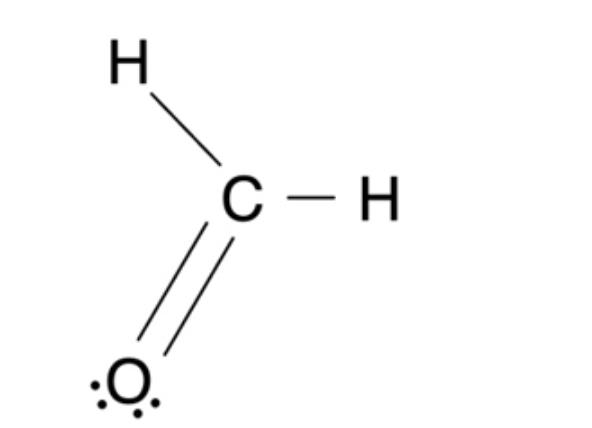
How many single bonds does formaldehyde (OCH2) have?
A. 1
B. 2
C. 3
D. 4
E. 5
B. 2
formaldehyde (OCH2) has 2 single bonds.
Which of the following is a physical change?
A. Burning of wood
B. Rusting of iron
C. Melting of ice
D. Digestion of food in the stomach
E. Mixing vinegar and baking soda to produce carbon dioxide gas
C. Melting of ice
Physical Changes involve a change in the physical properties of a substance (such as state) without changing its chemical composition. At the molecular level, no new chemical bonds are broken or formed. This is often reversible.
Chemical Reactions involve a change in the chemical composition to form new substances with different chemical properties. At the molecular level, new chemical bonds are broken and formed. This is often not easily reversible.
What is the electron configuration of Mo+?
A. [Kr] 5s24d3
B. [Kr] 4d5
C. [Kr] 5s14d4
D. [Kr] 5s24d4
E. [Kr] 4d4
B. [Kr] 4d5
The structure of a metallic compound can be best described as
A. a crystal lattice.
B. an amorphous substance.
C. a covalent network.
D. an ionic lattice.
E. a random assortment.
A. a crystal lattice.
Metallic compounds have highly ordered crystalline structures, characterized by regular and repeating arrangement of metal atoms in a crystal lattice. They have a long-range, predictable molecular structure.
Both diamond and graphite are composed of pure carbon atoms. Which of the following best explains why diamond is a harder substance?
A. Diamond is connected by ionic bonds, graphite is connected by covalent bonds
B. Diamond has an extensive 3D network covalent solid, graphite has layered rings
C. Diamond is made of pure carbon atoms, graphite has carbon and impurities
D. Diamond has smaller carbon atoms, graphite has larger, bulky carbon atoms
E. Diamond is made of alternating carbon cations and anions, graphite is not
B. Diamond has an extensive 3D network covalent solid, graphite has layered rings
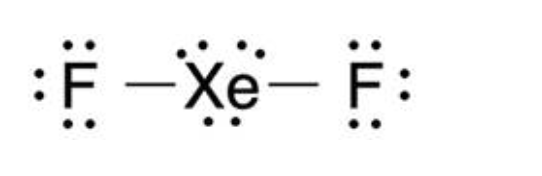
How many non-bonding electrons does XeF2 have?
A. 12
B. 16
C. 18
D. 20
E. 22
C. 18
Xe = 8 valence electrons
2 F = 2(7)=14 Valence electrons
Total = 8 + 14 = 22 electrons
Xe forms two single bonds with the two F atoms:
2 bonds × 2 electrons = 4 bonding electrons
Remaining electrons:
22−4=18 non-bonding electrons
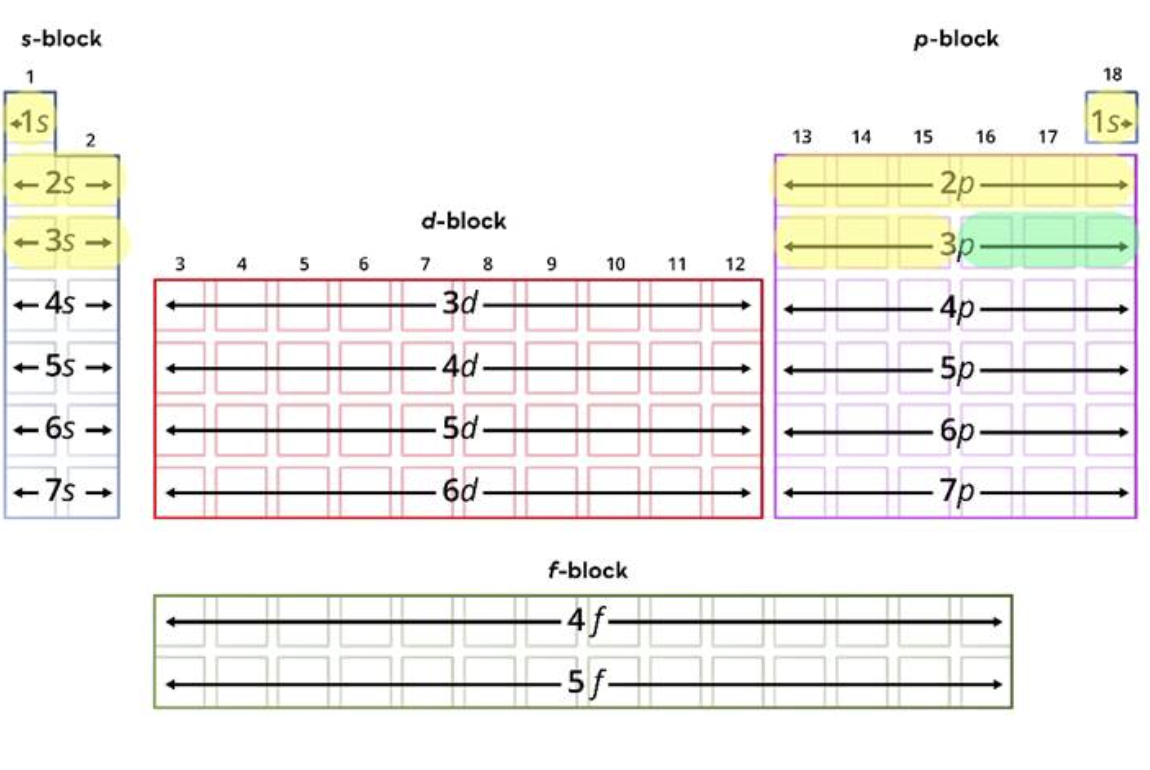
Which of the following is the ground state electron configuration for phosphorus ion (P3-)?
A. 1s22s22p63s2
B. 1s22s22p63s23p3
C. 1s22s22p63s23p5
D. 1s22s22p63s23p6
E.1s22s22p63s23p64s1
D. 1s22s22p63s23p6
When compared to metallic compounds, ionic compounds are more
A. ductile.
B. malleable.
C. lustrous.
D. brittle.
E. flexible.
D. brittle.
metallic compounds:
Good conductors of electricity – this is because of their “sea” of delocalized electrons
Ductile – can be drawn into thin wires
Malleable – can be hammered into sheets
Lustrous – can be polished to become shiny
properties of ionic compounds:
Crystalline solids – the component ions are held together by electrostatic attraction into a regular lattice
High melting/boiling points – due to strong electrostatic interactions between ions
Soluble in water – ionic compounds readily dissociate into component ions in water
Conduct electricity – in its aqueous form, the dissociated ions conduct electricity in solution or when melted
Each of the following is a property of KNO3 EXCEPT one. Which one is the EXCEPTION?
A. Crystalline solid
B. High melting point
C. Insoluble in water
D. Conducts electricity in aqueous solution
E. High boiling point
C. Insoluble in water
ionic compounds are soluble in water
Which of the following correctly labels the hybrid orbital formed in the given molecules?
A. C in CH3OH; sp2
B. O in CH3OH; sp2
C. C in CH4; sp
D. C in CO2; sp3
E. O in CO2; sp2
E. O in CO2; sp2
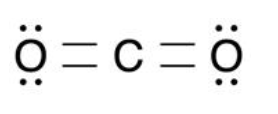
Each of the following molecules depicts an exception to the octet rule EXCEPT one. Which one is the EXCEPTION?
A. AlCl3
B. BeH2
C. AsBr3
D. SF4
E. XeF4
C. AsBr3
He, Li, Be, B and Al have an incomplete octet because these atoms do not have enough electrons to achieve an octet each time.
Hybridization involves
A. the formation of new elements.
B. a physical change in matter.
C. a change in the mass of an atom.
D. the mixing of atomic orbitals.
E. no change in geometry of orbitals.
D. the mixing of atomic orbitals.
Hybridization combines the atomic orbitals of an atom to create new hybrid orbitals. These hybrid orbitals have different shapes and energies than the original atomic orbitals.
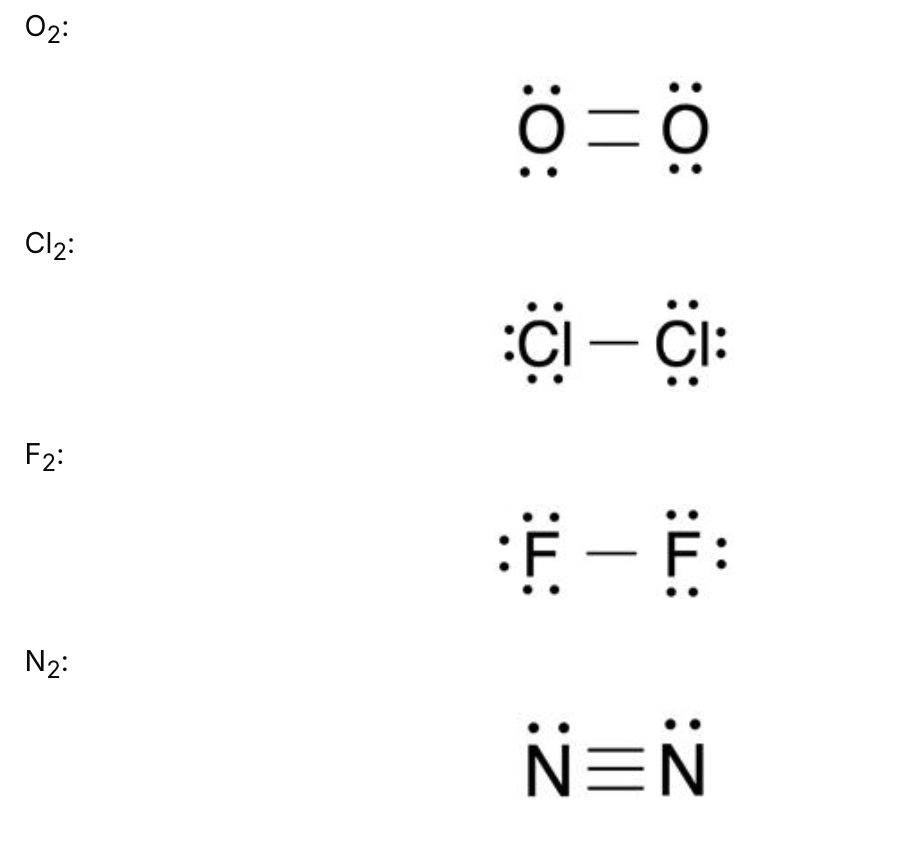
Consider the following diatomic molecules: O2, Cl2, F2, and N2. Which of the following statements about their bond orders and strengths is correct?
A. N2 has the strongest bond strength because of its lowest bond order
B. O2 has a lower bond order and weaker bond than F2
C. Cl2 and F2 share the same bond order, thus they have the same atomic radii
D. The following bond strength order is correct N2 > O2 > F2
E. F2 has a lower bond order and stronger bond than N2
D. The following bond strength order is correct N2 > O2 > F2
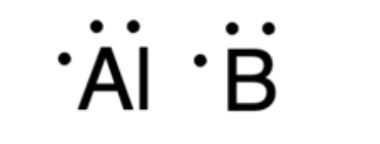
Which of the following elements has the same Lewis dot structure as a boron atom?
A. Sodium
B. Magnesium
C. Aluminum
D. Silicon
E. Sulfur
C. Aluminum
According to the Aufbau Principle, each of the following electron configurations is valid EXCEPT one. Which one is the EXCEPTION?
A. 1s22s22p63s23p4
B. 1s22s22p63s23p44s2
C. 1s22s22p63s23p64s23d104p1
D. 1s22s22p63s23p64s23d104p2
E. 1s22s22p63s23p64s23d104p5
B. 1s22s22p63s23p44s2
the 2 additional electrons should be completed in the 3p orbital, giving us 1s22s22p63s23p6.
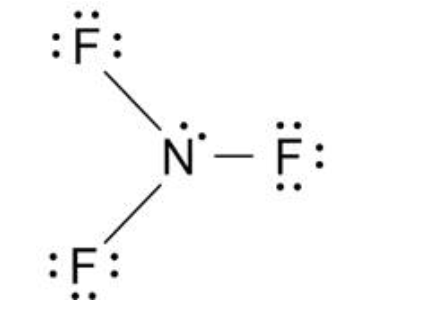
Which of the following molecules exhibits the most significant degree of polarity?
A. SiF4
B. PCl5
C. NF3
D. CBr4
E. SF6
C. NF3
NF3 contains polar covalent N-F bonds and is polar due to its trigonal pyramidal molecular geometry:
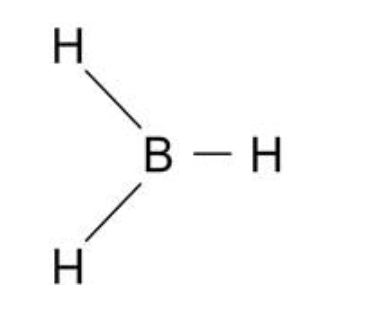
Which species has a trigonal planar molecular geometry?
A. SF6
B. CH4
C. HCN
D. PCl5
E. BH3
E. BH3
How many unpaired electrons can be found in a neutral atom with an electron configuration of 1s22s22p63s23p4?
A. 0
B. 1
C. 2
D. 3
E. 4
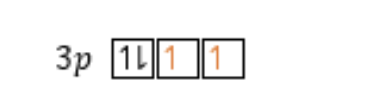
C. 2
A p subshell has 3 orbitals, each holding 2 electrons.
For 3p4, apply Hund's rule:
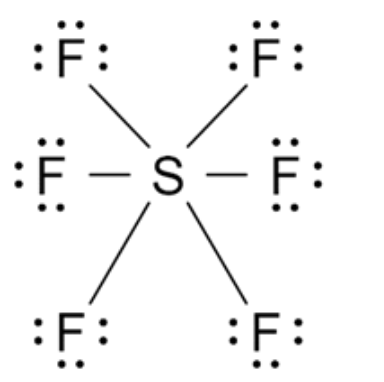
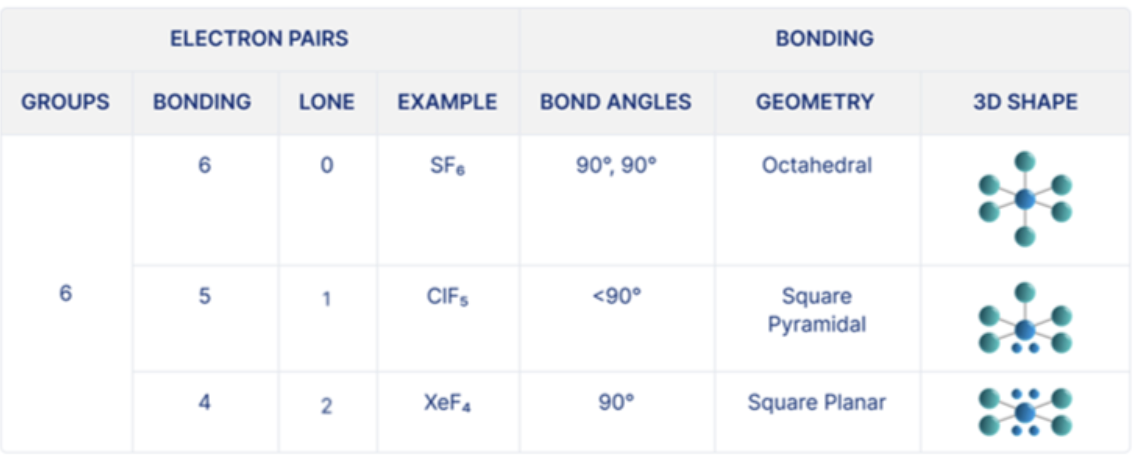
What is the molecular geometry and polarity of an SF6 molecule?
A. Octahedral and polar
B. Trigonal bipyramidal and polar
C. Octahedral and nonpolar
D. Trigonal bipyramidal and nonpolar
E. Square pyramidal and polar
C. Octahedral and nonpolar
For the reaction below, which of the following correctly describes the reaction?
AgNO3(aq) + NaCl(aq) à AgCl(s) + NaNO3(aq)
A. Double displacement
B. Decomposition
C. Single displacement
D. Combustion
E. Synthesis
A. Double displacement
Each of the following molecules is correctly matched with its respective molecular geometry EXCEPT one. Which one is the EXCEPTION?
A. SO2 - bent
B. NH3 - trigonal pyramidal
C. BrF3 - T-shaped
D. SF4 - seesaw
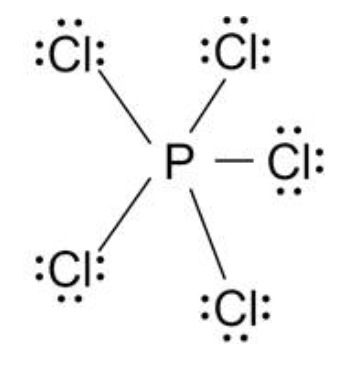
E. PCl5 – square pyramidal
E. PCl5 – square pyramidal
Because there are 5 bonding pairs, this corresponds to a trigonal bipyramidal molecular geometry, not a square pyramidal molecular geometry:
Which of the following is the correct Lewis dot structure for fluorine?
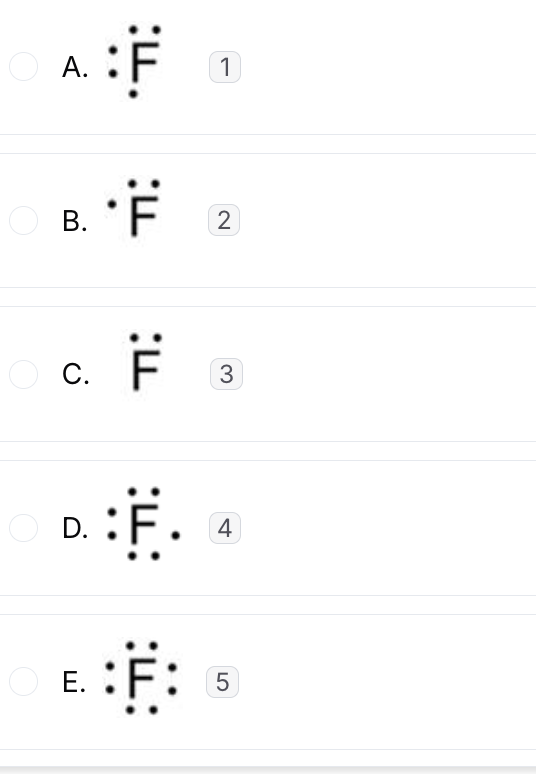
D
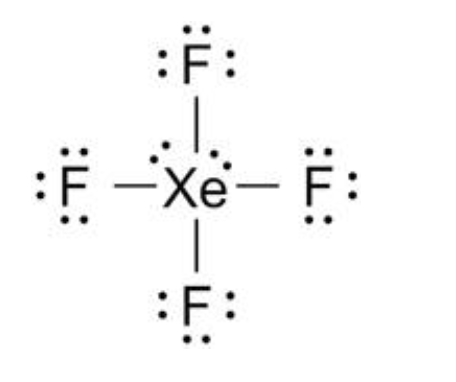
Which of the following molecules has a square planar molecular geometry?
A. CH2S
B. SF4
C. H2O
D. CO2
E. XeF4
E. XeF4
4 single bonds and 2 lone pairs on the Xe. This corresponds to a square planar molecular structure:
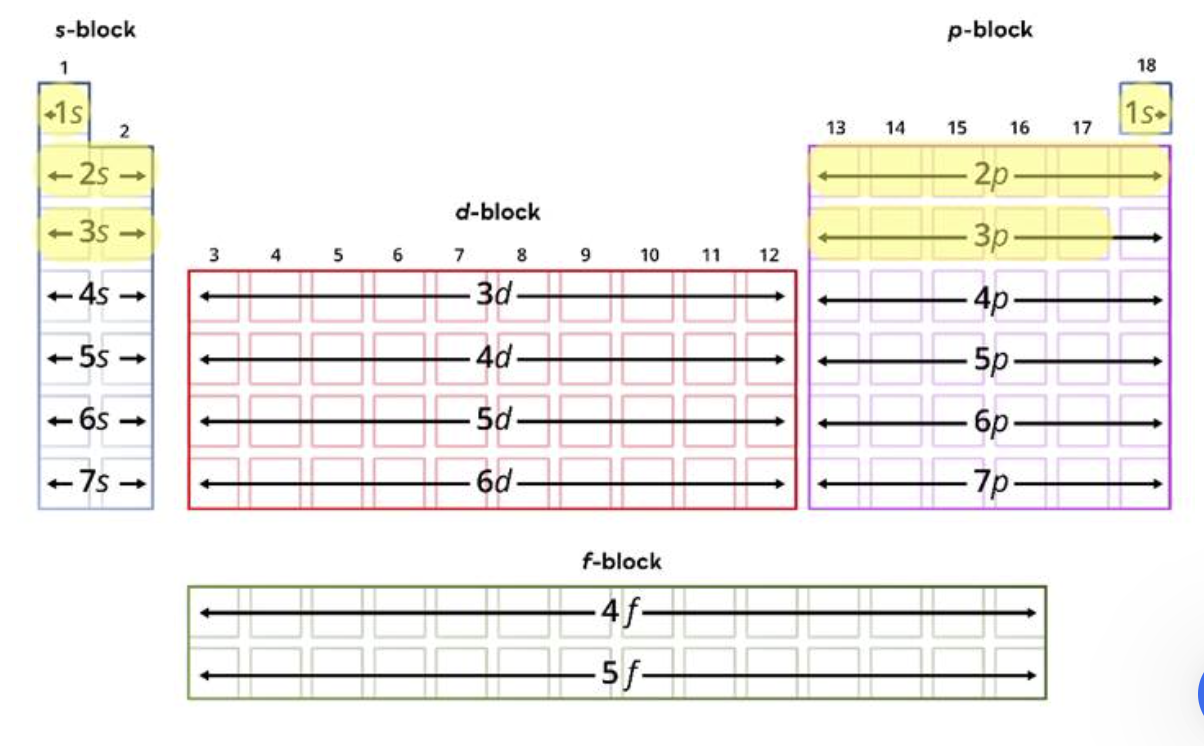
Which of the following elements has the electron configuration [Ne] 3s2?
A. Lithium (Li)
B. Beryllium (Be)
C. Aluminum (Al)
D. Sodium (Na)
E.Magnesium (Mg)
E.Magnesium (Mg)
STEP 1: First we can determine that Ne is on period 2 of the periodic table.
STEP 2: Moving on, we need to determine the element in period 3 with 2 electrons in the 3s2 subshell, which is Mg.
Which of the following is the correct orbital diagram for N (atomic number = 7)?
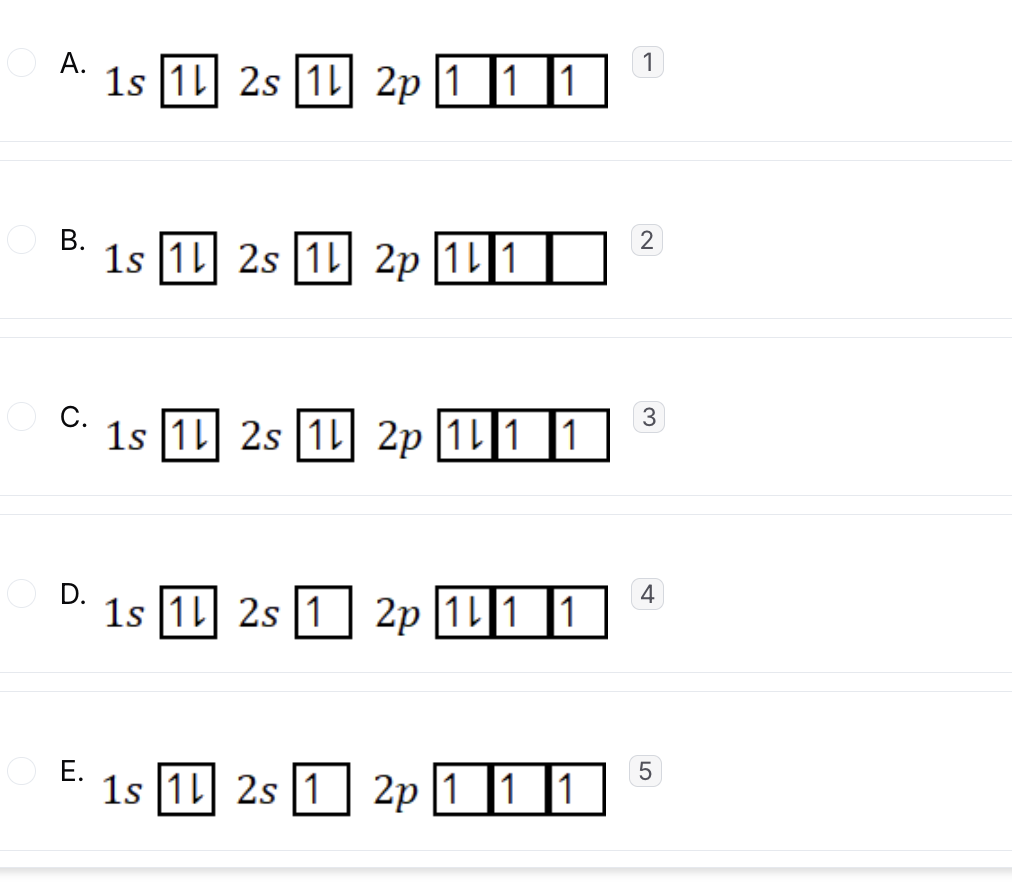
A
A sample of which of the following compounds will exhibit the lowest boiling point?
A. HF
B. H2S
C. CH3OH
D. SiH4
E. PH3
D. SiH4
Incorrect. HF is a linear polar molecule that exhibits dispersion forces, dipole-dipole interactions, and hydrogen bonding.
Incorrect. H2S is a bent polar molecule that exhibits dispersion forces and dipole-dipole interactions.
Incorrect. CH3OH is a tetrahedral polar molecule that exhibits dispersion forces, dipole-dipole interactions, and hydrogen bonding.
Correct. SiH4 is a tetrahedral non-polar molecule that only exhibits dispersion forces. Because it is the only option that participates in only dispersion forces, it has the weakest intermolecular forces and consequently, the lowest boiling point. The other molecules participate in stronger intermolecular forces, such as dipole-dipole interactions and hydrogen bonding.
Incorrect. PH3 is a trigonal pyramidal polar molecule that exhibits dispersion forces and dipole-dipole interactions.
Ionic, covalent, and metallic bonds primarily differ in the way
A. electrons are transferred or shared.
B. atoms are arranged in the structure.
C. bond energy is distributed in the molecule.
D. they dissolve in water.
E. they react with other compounds.
A. electrons are transferred or shared.
Which of the following statements most accurately accounts for the smaller bond angles in a trigonal pyramidal structure compared to a tetrahedral molecule?
A. Lone pairs have greater electron repulsion
B. Trigonal planar molecules have tighter bonds
C. Bond lengths in trigonal planar molecules are smaller
D. Tetrahedral molecules have more lone pairs
E. Stronger London dispersion forces exist in trigonal planar molecules
A. Lone pairs have greater electron repulsion
A tetrahedral molecule has 4 bonding pairs, while a trigonal pyramidal molecular structure has 3 bonding pairs and a lone pair. The smaller bond angles can be most accurately accounted for by the presence of the lone pair of electrons, which exerts a stronger repulsion on the bonding pairs than the bonding pairs exert on each other.
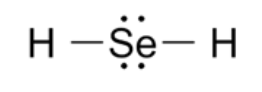
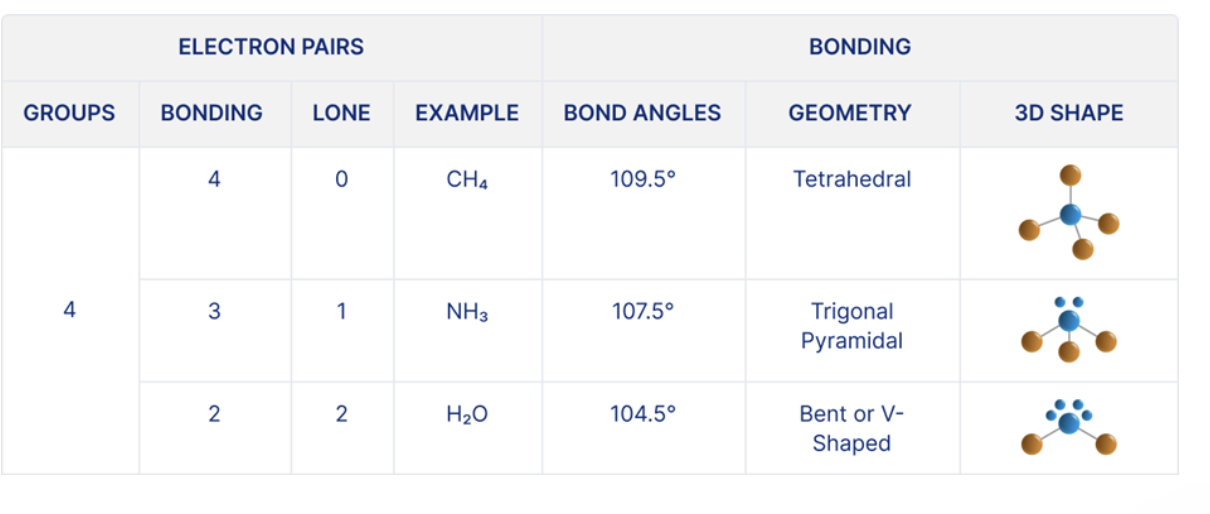
Which of the following describes the molecular geometry of H2Se?
A. Linear
B. Bent
C. Trigonal planar
D. Tetrahedral
E. Seesaw
B. Bent
2 bonds & 2 Lone Pairs
Which of the following molecular shapes is always polar, assuming all outer atoms are identical and are significantly lower in electronegativity compared with the central atom?
A. Tetrahedral
B. Trigonal bipyramidal
C. Square pyramidal
D. Trigonal planar
E. Octahedral
C. Square pyramidal
When a candle burns, the hydrocarbon molecules in the wax break into CO2 and H2O vapor. Then, the H2O vapor condenses into droplets. Lastly, CO2 absorbed by NaOH solution, resulting in the formation of Na2CO3. Which of the following orders correctly describes the process of candle burning?
A. chemical reaction; physical change; chemical reaction
B. chemical reaction; chemical reaction; physical change
C. chemical reaction; chemical reaction; chemical reaction
D. physical change; chemical reaction; chemical reaction
E. physical change; physical change; chemical reaction
A. chemical reaction; physical change; chemical reaction
What is the formal charge of Xe in XeF4?
A. -2
B. -1
C. 0
D. +1
E. +2
C. 0
Formal Charge = (# of valence e-) – (# of nonbonding e-) – (# of bonds)
Formal charge = 8 – 4 – 4 = 0
Which pair would give the bond with the most ionic character?
A. C and Cl
B. Si and P
C. B and Cl
D. Na and O
E. Al and S
D. Na and O
ionic bonds (metal - nonmetal)
The bond angle of C2H2 is 180 degrees. This phenomenon is best explained by C2H2’s
A. sp hybrid orbitals.
B. sp2 hybrid orbitals.
C. sp3 hybrid orbitals.
D. sp3d hybrid orbitals.
E. sp3d2 hybrid orbitals.
A. sp hybrid orbitals.
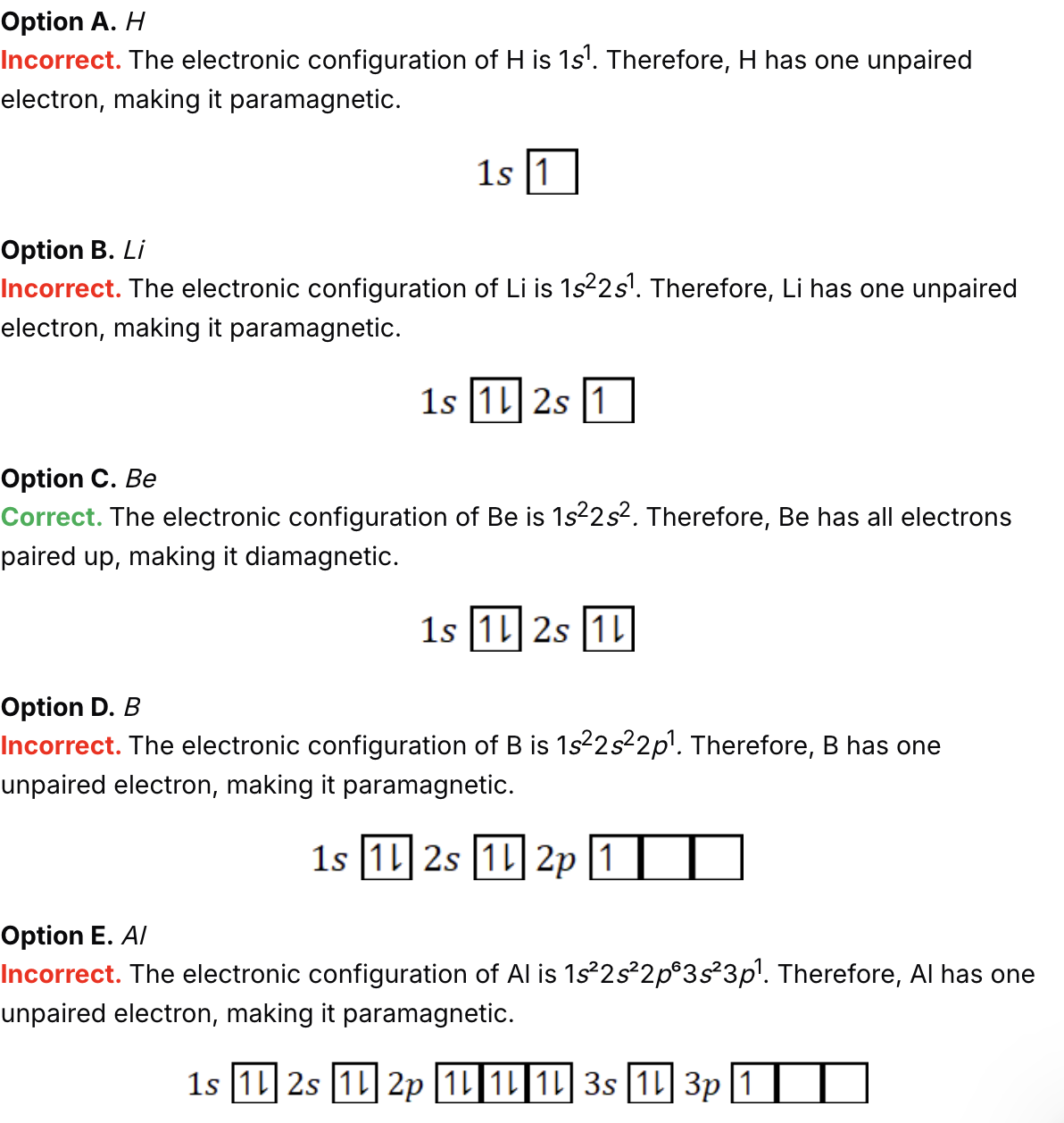
Which of the following elements is diamagnetic?
A. H
B. Li
C. Be
D. B
E. Al
C. Be
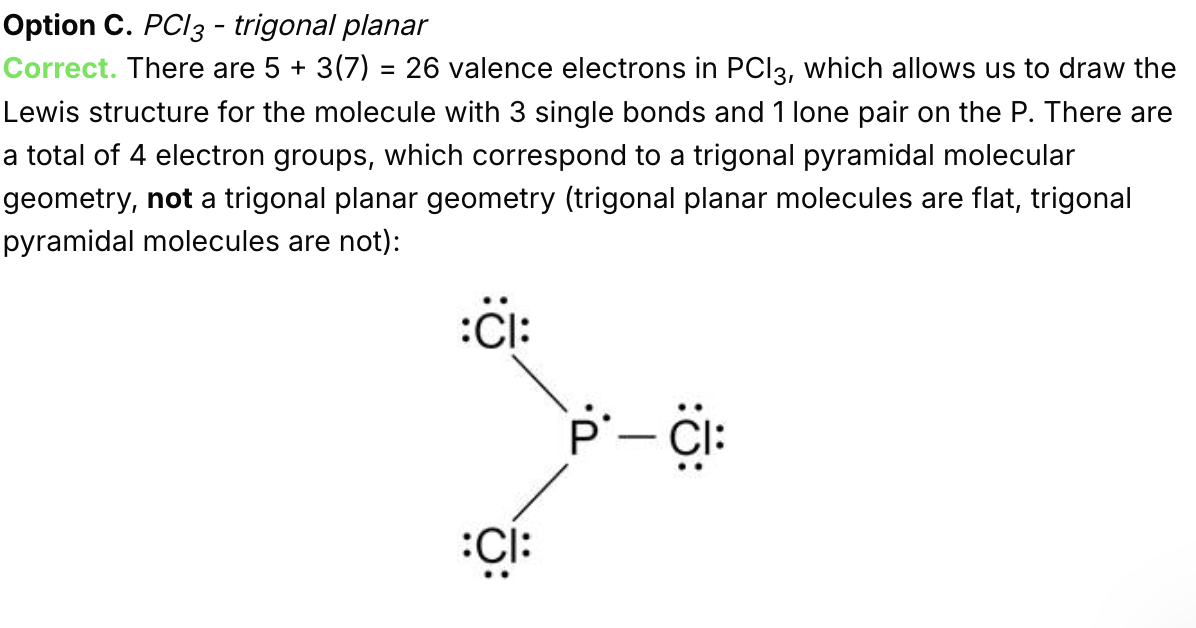
Each of the following molecules is correctly matched with its respective molecular geometry EXCEPT one. Which one is the EXCEPTION?
A. CO2 - linear
B. SO42- - tetrahedral
C. PCl3 - trigonal planar
D. PCl5 - trigonal bipyramidal
E. SF6 – octahedral
C. PCl3 - trigonal planar
In the lab, a student can cause a physical change in water found in a cup by
A. passing an electric current through the water.
B. putting the water into a freezer.
C. adding more water.
D. adding HCl.
E. putting active metals into the water.
B. putting the water into a freezer.
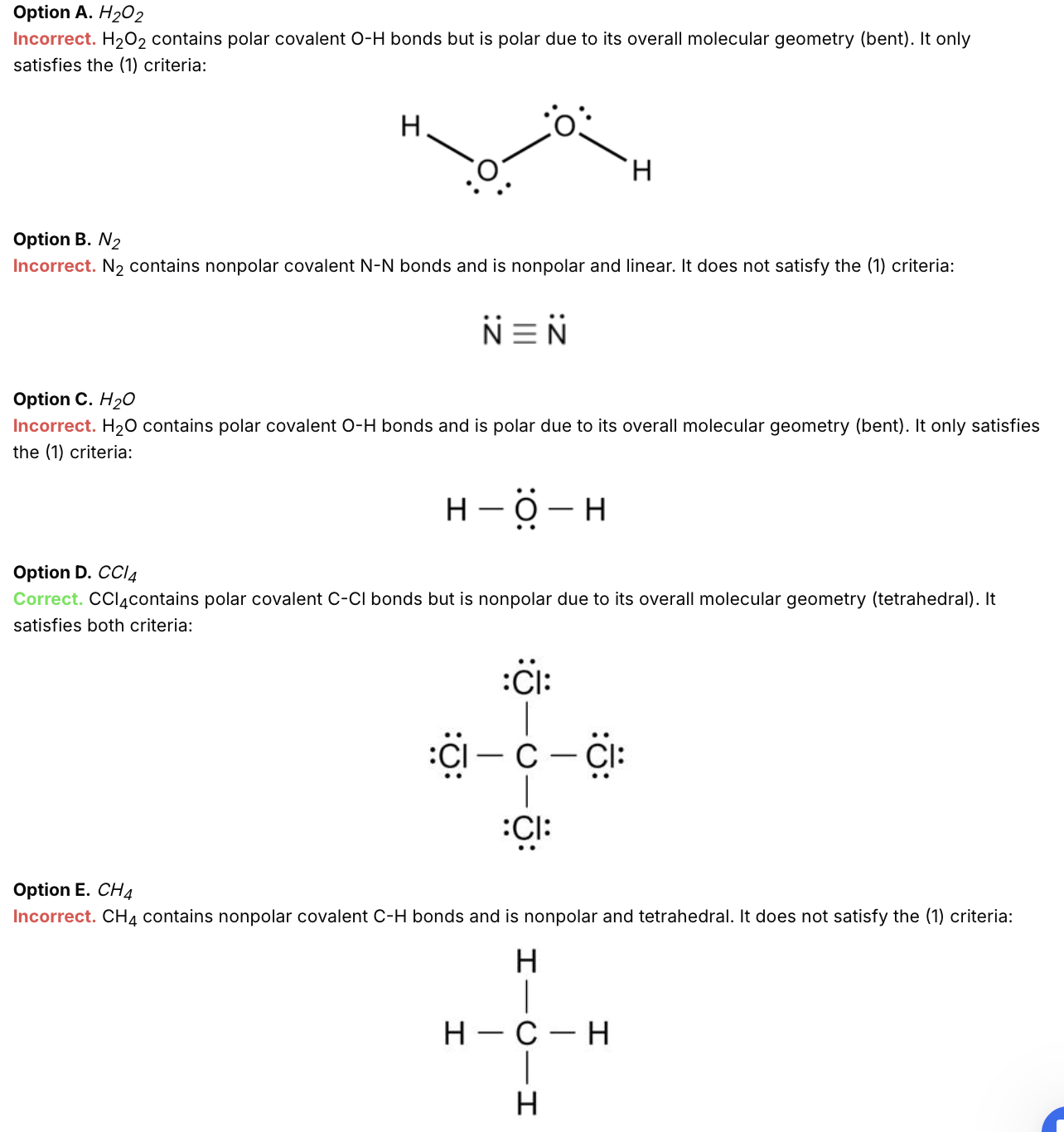
Which of the following molecules contains polar covalent bonds but is still considered a nonpolar molecule due to its overall molecular geometry?
A. H2O2
B. N2
C. H2O
D. CCl4
E. CH4
D. CCl4
Which of the following statements best explains why ionic compounds are brittle and metallic compounds are malleable?
A. They differ in their size
B. They differ in their conductivity
C. They differ in their bond strength
D. They differ in their bond length
E. They differ in their arrangement of ions
E. They differ in their arrangement of ions
Which of the following is the correct noble gas orbital diagram for Fe (atomic number = 26)?
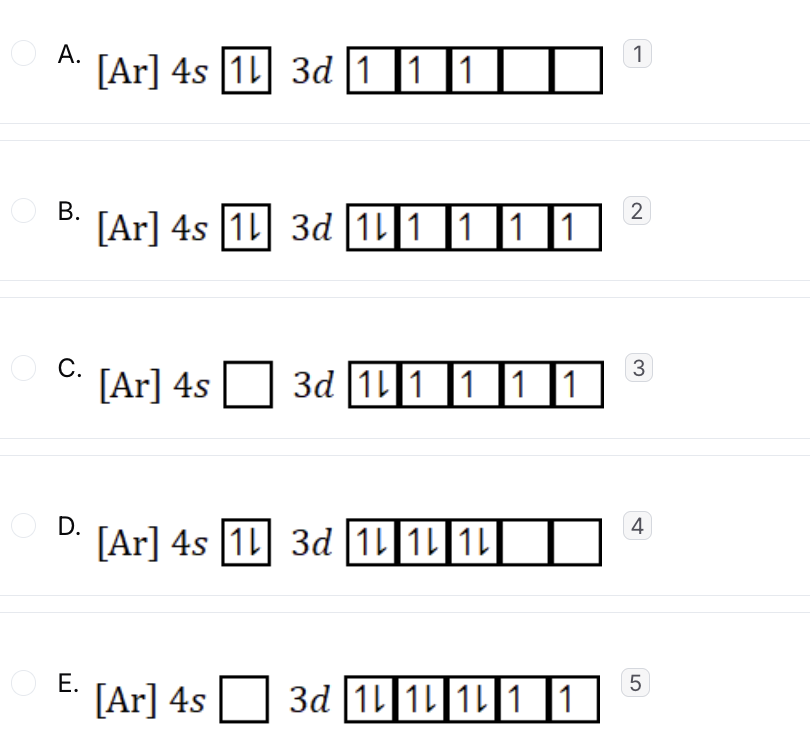
B
Which of the following correctly arranges the intermolecular forces in decreasing order of strength, from strongest to weakest?
A. Dipole-dipole > ion-dipole > London dispersion
B. Dipole-dipole > London dispersion > ion-dipole
C. Ion-dipole > dipole-dipole > London dispersion
D. Ion-dipole > London dispersion > dipole-dipole
E. London dispersion > dipole-dipole > ion-dipole
C. Ion-dipole > dipole-dipole > London dispersion
Among the following, which process is best described as a chemical reaction?
A. Boiling water to form steam
B. Melting candle wax
C. Dissolving sugar in water
D. Electrolysis of water to produce hydrogen and oxygen gases
E. Grinding rocks into smaller pieces
D. Electrolysis of water to produce hydrogen and oxygen gases
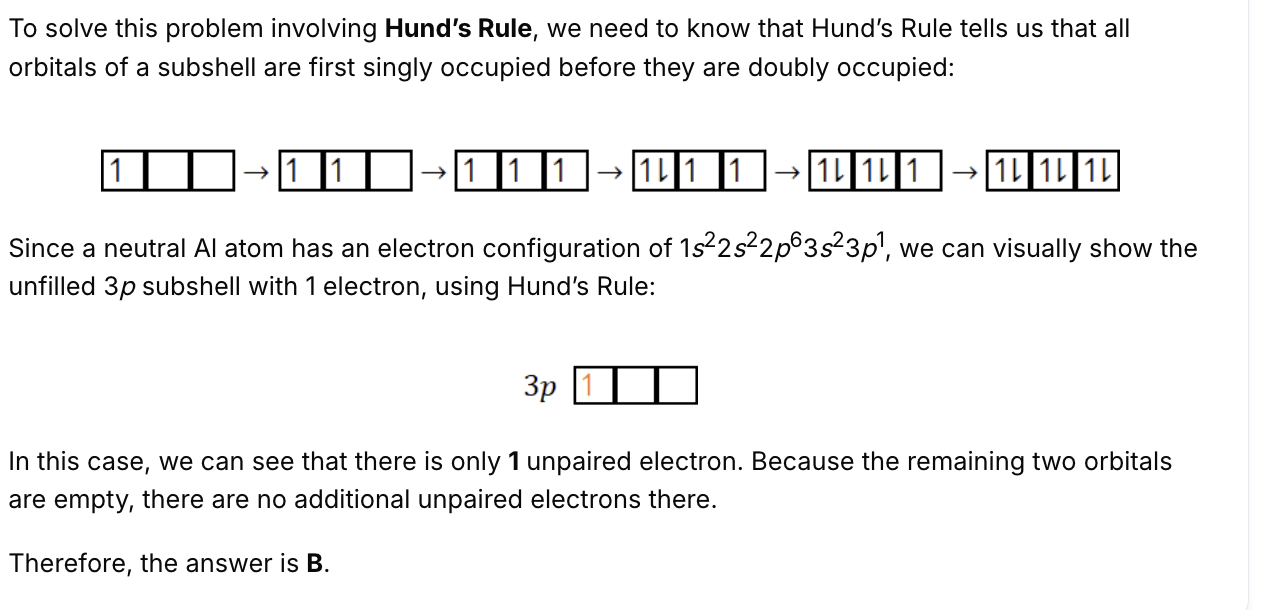
How many unpaired electrons can be found in a neutral Al atom?
A. 0
B. 1
C. 2
D. 3
E. 4
B. 1
Which of the following statements best distinguishes between ionic and covalent compounds?
A. Ionic compounds are formed between nonmetals, covalent compounds are formed between metals and nonmetals
B. Ionic compounds share electrons, covalent compounds transfer electrons
C. Ionic compounds are insulators, covalent compounds have high conductivity in solution
D. Ionic compounds are usually soluble in water, covalent compounds usually are not
E. Ionic compounds have a molecular structure, covalent compounds have a lattice structure
D. Ionic compounds are usually soluble in water, covalent compounds usually are not
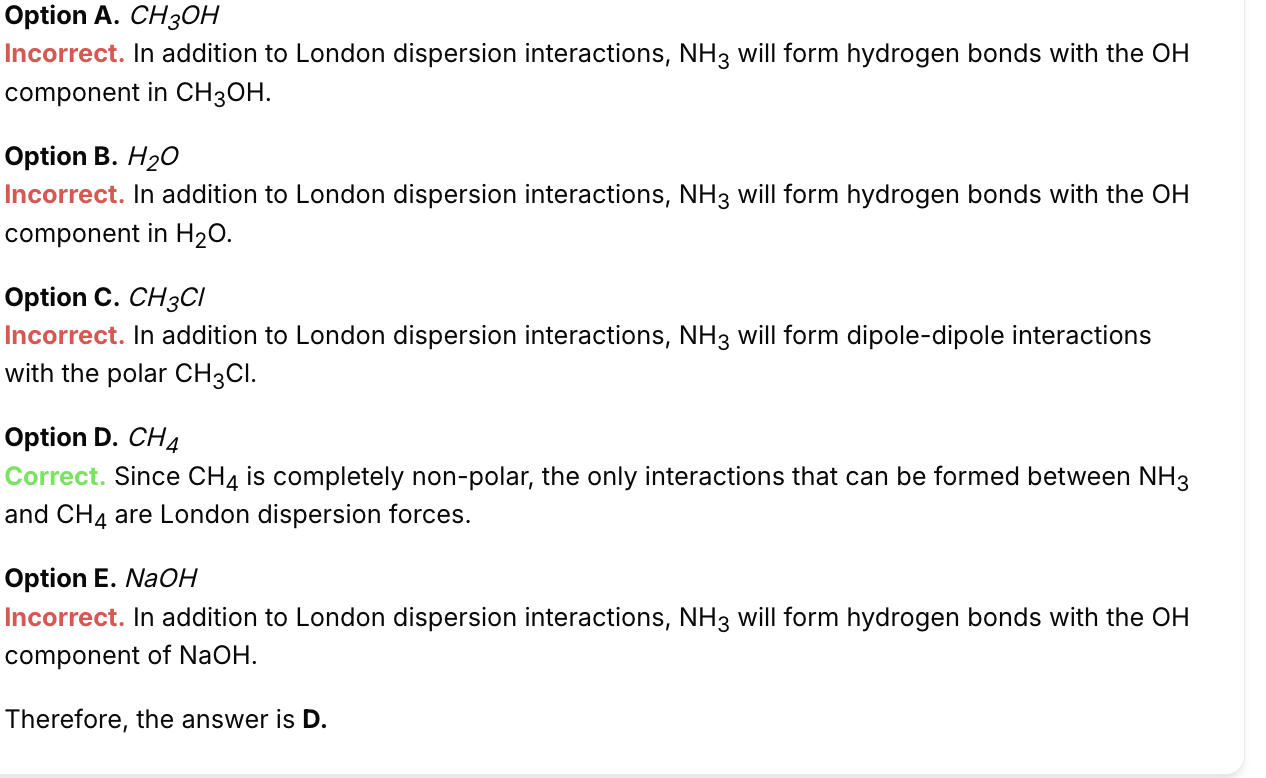
Which of the following compounds will experience only London dispersion interactions with NH3?
A. CH3OH
B. H2O
C. CH3Cl
D. CH4
E. NaOH
D. CH4
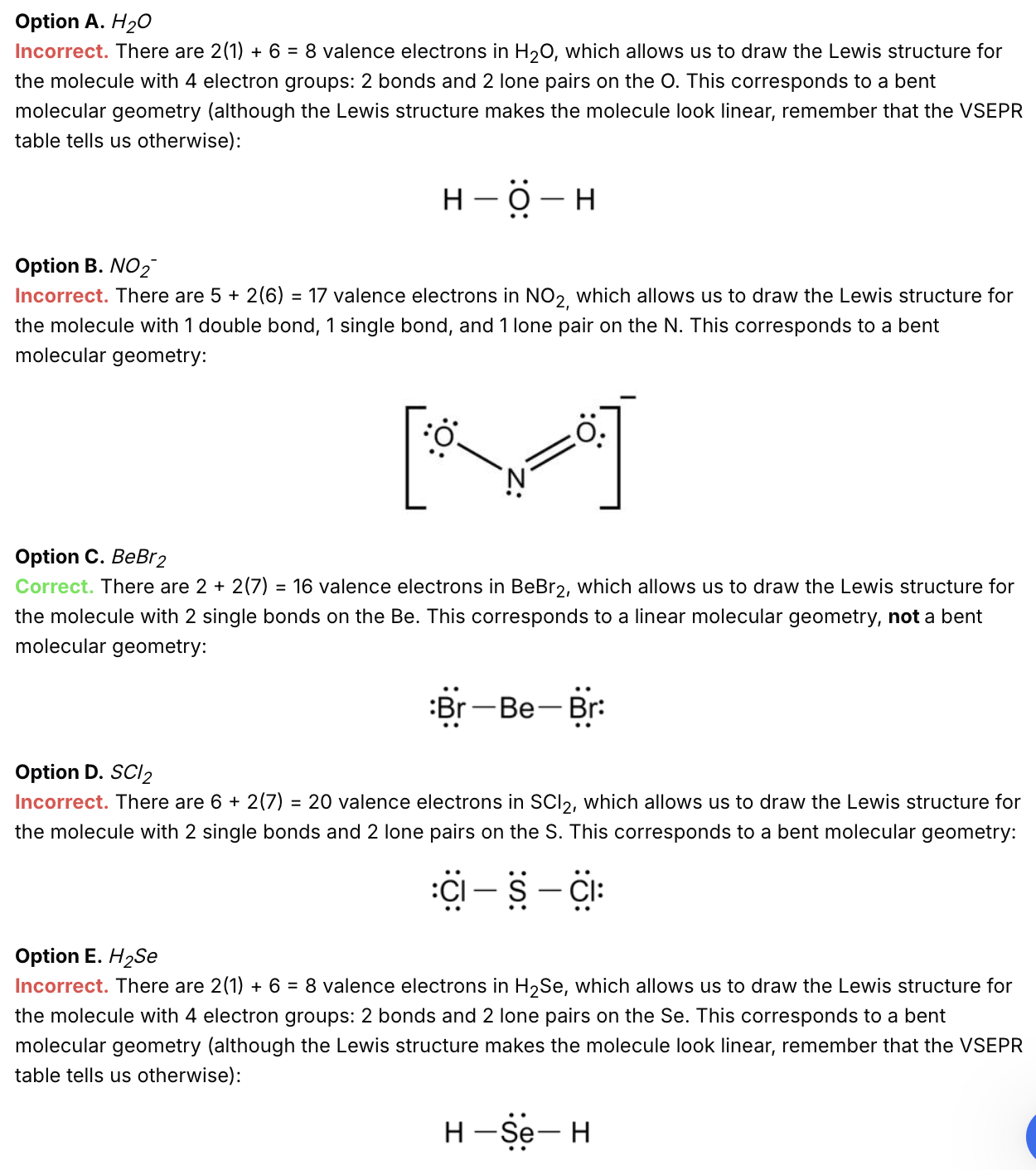
Each of the following molecules have a bent molecular structure EXCEPT one. Which one is the EXCEPTION?
A. H2O
B. NO2-
C. BeBr2
D. SCl2
E. H2Se
C. BeBr2
Which of the following molecules has a central atom with sp hybridization?
A. CO2
B. CH4
C. C2H4
D. BF3
E. SF6
A. CO2