1.3 Greeks and Barbarians OCR A Level Classical Civilisation
 Call Kai
 Learn
Learn Practice Test
 Spaced Repetition
 Match
Match Flashcards
 Knowt Play
1/25

There's no tags or description
Looks like no tags are added yet.
Name | Mastery | Learn | Test | Matching | Spaced | Call with Kai |
|---|
No analytics yet
Send a link to your students to track their progress
26 Terms
Barbarophonoi
The origin of the word barbarian in Homer, meaning to speak in a foreign language (linguistic difference before binary opposition, 8th century BCE)
Greeks' language pride
They believed that if the barbarians could not speak like them, they could not speak like them. Language capable of expressing complex ideas, men used it everywhere like in the assembly. Expression of what it meant to be Greek, led to highly developed literature
Iliad Greek language source
Peleus sent Pheonix to Troy to teach Achilles to be a "speaker of words and a doer of deeds"
Foreign origins of Greek gods
Herodotus said most gods were originally from Egypt and Poseidon was originally from Libya, then were developed by Homer and Hesiod
Egyptian inspiration in Greek statues
They originally took techniques from Egyptian statues: the original technique, blocky statues. Then the Greeks developed it to a more dynamic statue style made "in the round". Also Egyptian statues were often clothed while Greek statues were often nude
Egyptian inspiration in Greek architecture
When the Greeks started making stone temples instead of wooden ones, they took stone-working techniques from the Egyptians
Barbaros
6-5th BCE forward, word for foreigner meaning unintelligible sounds, more derogatory than the previous barbarophonoi
Binary opposition
Greeks are non barbarians, Barbarians are non Greeks. Similar parallels between men and women
Barbarians and slavery
'Barbarians' originally became associated with slavery because many of the slaves that Greeks had were barbarians
Greeks and freedom
Increasing democracy in the 6th century (particularly in Athens) created even more division between their idea of Greeks and Barbarians -- the Greek is 'free' while the Barbarian is 'slavish'.
Idiot
This word comes from a Greek word for someone uninterested in politics
Herodotus source for Greek freedom
Herodotus uses the idea of Greek freedom when Demaratus said that the Persians are stronger than the Greeks because they fight freely for the law not out of fear from a king
Barbarian women
Often portrayed as strong, opposite to how Greek women were viewed, varyingly caused fear (Medea) and attraction (Amazons)
Herodotus source for Xerxes talking about women
"My men have become women and my women men" when Artemisia rammed what he thought was an enemy ship
Standard depiction of Barbarians in art
Greek men naked while barbarians in patterned clothes (sometimes trousers for horse riding); also using bow and arrow, often dead/being killed/fleeing
Kylix of a Persian and a Greek fighting prescribed source
5th century BCE red-figure kylix. Shows a Persian (phrygian cap, pattenred outfit), being defeated by the Greek. The Greek is visually centred with the shield and the Persian is below the Greek
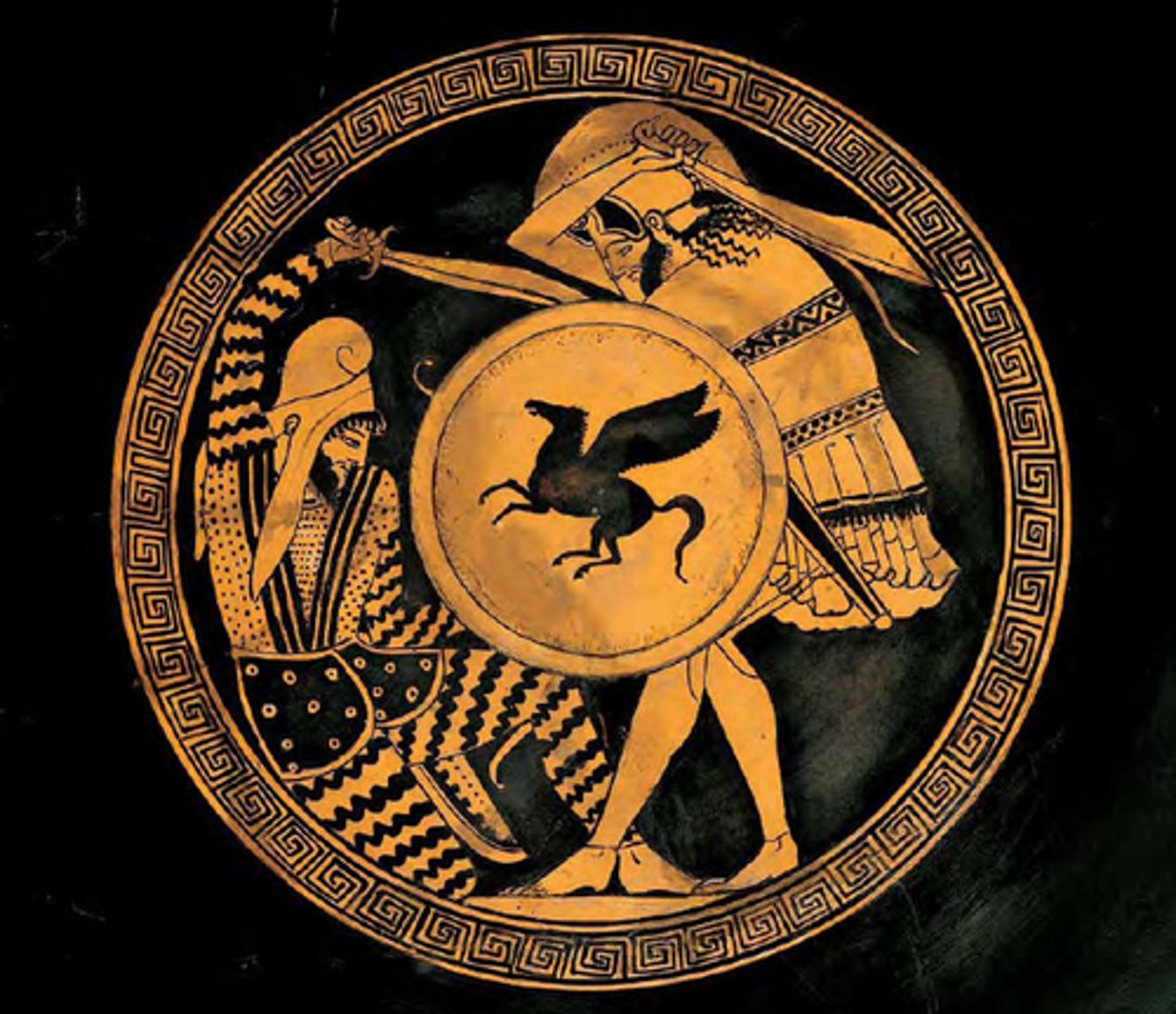
Tondo
Circular painting inside a kylix
Frieze from Temple of Athena Nike (Athens) prescribed source
5th century BCE, Greeks are naked ('heroic') while Persians are clothed, bodies of dead Persians, Persians in submissive positions
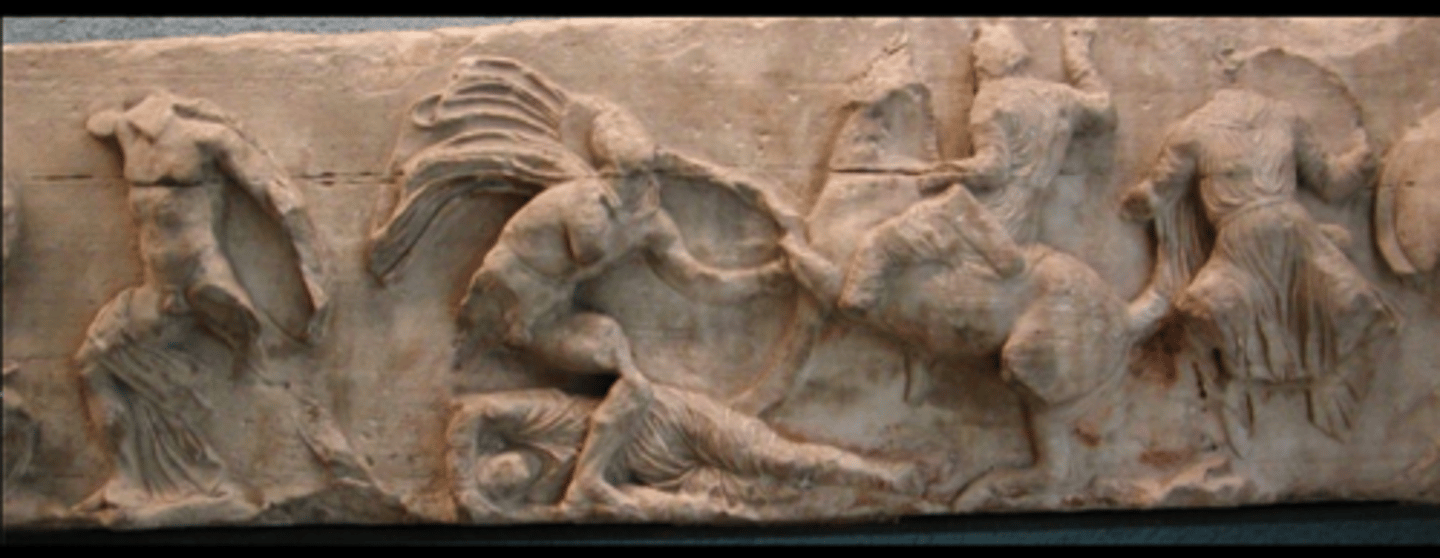
Pediment of Aphaia at Aegina
Greeks and Trojans in warring pairs, suggesting an equally matched war
Polygnotus' painting in Stoa Poikile
Showed Marathon next to Theseus' and Herakles' defeating of monsters -- Persians as formidable enemies
Customs of the Persians according to Herodotus
Have non-anthropomorphic gods so no temples/statues, no altar offerings, lavish birthday feast with whole animal and desserts, can't vomit or relieve self in front of someone, discuss decision once drunk and once sober, kiss equal on mouth and close in rank on cheek but prostrate self to higher rank, think selves superior but still adopt customs from others, polygamous AND mistresses, have many sons, education 5-20, learn riding archery and truth-telling, father and son don't meet until age 5, revere rivers
5th century BCE view on Persian character
Excesses (lust, anger, decadence), slavish (master, impulses), uncivilised
Herodotus criticism and praise of Persian customs
Herodotus criticises their practise of castration (many of Xerxes' staff were castrated 'eunuchs', seen as trustworthy) , but praises their principle that no man can be put to death for only one act (not even a king, but the kings he writes about disobey this?)
Persians and spirituality
Sometimes Persians were depicted as more spiritual, Xerxes saying their empire is due to a God's approval in Herodotus. However while Darius being raised from the death in Persians seems foreign Greeks also do this in plays
Athens' representation of barbarians after Persian wars
In plays and propaganda, an idea of Greek unity pushed while Persians are foreign, and the war was punishing the Persians for their hubris
The Acropolis and barbarism
It being rebuilt was a reminder that the Persians burnt the old stuff, many of the sculptures depict the theme of civilisation vs barbarism (centaurs, amazons, trojans, titans)