Chap 8-13: Exam 2 review Med and Vet entomology
 Call Kai
 Learn
Learn Practice Test
 Spaced Repetition
 Match
Match Flashcards
 Knowt Play
1/105

There's no tags or description
Looks like no tags are added yet.
Name | Mastery | Learn | Test | Matching | Spaced | Call with Kai |
|---|
No analytics yet
Send a link to your students to track their progress
106 Terms
T or F: Yellow fever is caused by a positive single strand RNA virus of the family Flaviviridae
True
Is yellow fever considered to be transmissible by rodents?
No; it is transmissible by filtered human serum and mosquitoes and was discovered by Walter Reed
Yellow virus infects what?
monocytes, macrophages, Schwann cells and dendritic cells
What are the vectors of Yellow Fever?
Aedes spp. Africanus spp. Haemagogus spp. and Sabates spp.
T or F: Yellow fever is treatable and cannot kill anyone
F; Yellow Fever can kill up to 60% of people who develop severe disease
What are the host for yellow fever?
non-human primates and humans
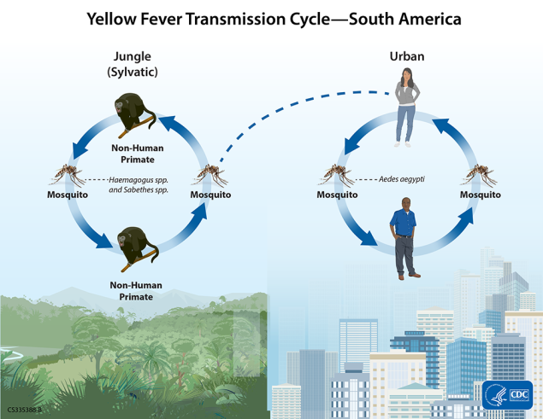
Where can yellow fever be transmitted? How is yellow fever transmitted?
South America and Africa
In South America, have jungle (sylvatic cycle and urban area); Haomogogous spp. and Sabethes spp. are repsonisble for the transmission in non-human primates Aedes aegypti is responsible for urban transmission
In Africa, Aedes Africanus transmits in sylvatic cycle, Aedes Aegypti transmits in Urban cycle and then Semi-domestic Aedes spp. transmit in intermediate (Savanna) region
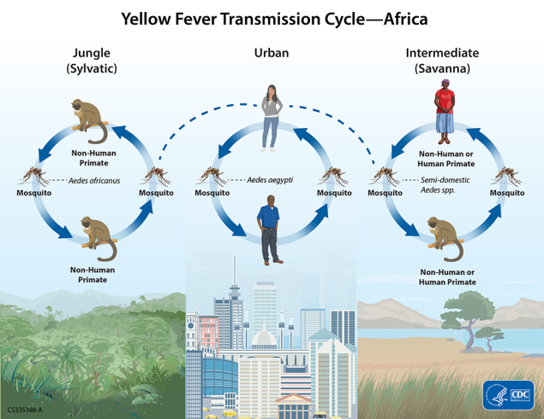
In sylvatic transmission cycle, what is the primary natural reservoir of yellow fever virus?
Non-human primates
Which mosquitoes genera are the principal vectors of sylvatic yellow fever in South America? Africa?
Haemagogus and Sabethes→ South America
Africanus→ Africa
Aedes aegypti
T or F: Once you have been infected with Yellow Fever, you are most likely going to get it again in the future
F; once you’ve been infected, you are protected from getting Yellow Fever in the future
Symptoms of Yellow Fever? Vaccine?
Symptoms (fabrile illnesses): fever, chills, severe headache, back pain, body aches, nausea, vomiting, fatigue and weakness, muscle pain
Severe symptoms: Jaundice (makes you yellow) *yellow eyes, bleeding, shock, high fever, organ failure
Vaccine: a single dose provides a lifelong protection for most people; weakens pathogen of fever; if you get sick again, no treatment but supportive care!!!
Why should you avoid getting anti-inflammatory drugs when being infected with Yellow Fever?
May increase the risk of bleeding; severe yellow fever causes bleeding to occur
T or F: Yellow Fever is also known as Break Bone Fever
False
Vector of Malaria?
Anopheles mosquitoes
What are the 5 species that infect humans with Malaria? Which one is the most lethal (pathogenic) to humans?
1) P. malariae
2) P. ovale
3) P. vivax
4) P. falciparum
5) P. knowlesi
P. falciparum is the most lethal causes a hundred of thousands of deaths per year
Sporozoites? Schizonts? Merozoites?
Sporozoites: motile spore-like stage in life cycle of parasitic sporozoans are the infective agents that are introduced in the host
Schizonts: cells that divide by schizogony to form daughter cells
Merozoites: protozoan cell, produced by a sporozoan by merogony→ either meront or gamont (female or male)
Hypnozoites? Trophozoite? Gametocyte?
Hypnozoites: dormant stage in the life cycle of some species of the malaria parasite
Trophozoite: activated, feeding stage in the life cycle of certain protozoa that causes malaria
Gametocyte: eukaryotic germ cell that divides by mitosis into other gametocytes
Ookinete? Oocyst?
Ookinete: motile zygote of a parasite of the malaria mosquito that forms an oocyst in the Anopheles midgut
Oocyst: a cyst that contains a zygote formed by parasitic protozoan
The nurturing/feeding stage of the malaria parasite in erythrocytes is known as……
trophozoites
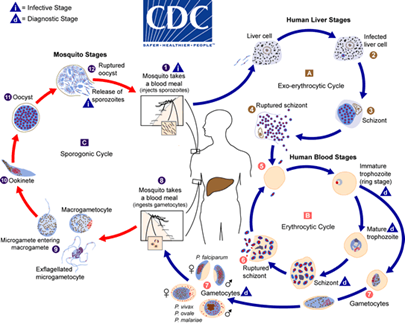
Explain the life cycle of malaria.
Sporozoites infect liver cells→ mature into schizonts → rupture and release merozoites
hypnozoites can infect the liver if left untreated=> invade into bloodstream→ parasites undergo asexual reproduction in erythrocytes (red blood cells)
Merozoites infect erythrocytes and ring stage (trophozoites mature into schizonts=> release merozoites)
Blood stage parasites are responsible for: clinical manifestations of disease; gametocytes, male microgametocytes and female gametocytes ingested by Anopheles during blood meal!!!
parasites multiplication happens within the Anopheles mosquito now! (sporogonic cycle); microgametes penetrate macrogametes=> zygotes
zygotes turn into=> ookinetes; invade the midgut wall of Anopheles mosquito→ develop into oocysts
oocysts grow, rupture and release sporozoites→ make their way to salivary glands; travel into new human host to infect malaria
In the malaria life cycle, what is the sporogonic cycle and what does it do?
Sporogonic cycle: the parasite multiplication happens in the mosquito
It occurs within the vector
What is the agent of Malaria? Where is Malaria distributed?
eukaryotic protozoan
Anopheles distribution is limited to: temperate, tropical, and subtropical areas (worldwide distribution of Anopheles)
Why is there malaria in certain places like the USA? How come it wasn’t able to irradicate the vector?
USA was able to irradicate the disease; however didn’t irradicate the vector because targetted the breeding sites using areosal sprays (mosquito control)
How can malaria be transmitted?
blood transfusion, contaminated needles and syringes, and congenitally (from birth)
Malaria relapses can occur in which species?
P. vivax and P. ovale; have dormant liver-stage parasites (hypnozoites) that can be reactivated
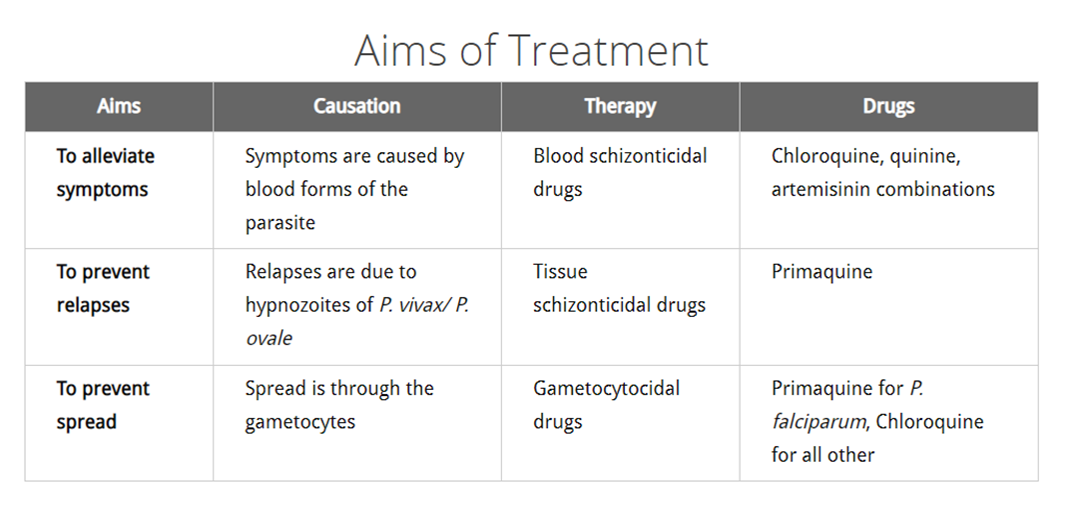
Is there a treatment for malaria? vaccine for malaria?
Yes there is treatment and vaccine for malaria
Treatment for malaria:
complicated treatment→
uncomplicated vs severe, host: child/pregnant women, drug resistance, goal of treatment
Vaccine for malaria: mosquirix
Malaria treatment traditionally is involved with the usage of______.
Chloroquine, quinine, atovaquone, and clindamycin
Fleas belong to the order __.
Siphonaptera.
T or F: Fleas are closely related to Mecoptera
True
Flea bodies are flattened __, which helps them jump effectively.
sideways.
Fleas have a powerful mechanism for jumping that resembles a spring. This is due to what?
a protein called resilin
Most flea species are specific to their __, such as dogs and cats.
hosts.
A female flea requires a __ to become fertile and lay eggs.
blood meal.
Biology of fleas and how can it affect the flea control?
population structure of fleas: 50% eggs and 5% adults;
The majority of a flea population exists in the form of eggs rather than adults. How much percentage do the adult fleas represent? How much percentage do the egg fleas represent?
5% of adults
50% of eggs
Fleas are:
Holometabolous
Pick the correct statement:
C; fleas have 3 body parts: head, thorax and abdomen
At what stage, does fleas become resistant to insecticides?
pupae
T or F: Feral Cats can transmit fleas to domestic cats
True
What does the first screening of insecticides do to fleas?
1st screening of insecticides on fleas are carried out using in Virto studies
Fleas have several nymphal stages that are called instar. Is this true or false?
False
What does the variation of LD50 do? LD90?
little dosage that kills 50% of the population
little dosage that kills 90% of the population
What is considered to be false about LD50?
Variation of LD50 among strain cannot be higher than 10% for product validation purposes
Early flea control strategies primarily involved __ methods.
environmental.
The efficacy of insecticides can be affected by the __ being tested.
substrate.
Flea larvae that are younger may be more __ to insecticides than older larvae.
susceptible.
In tests, the __ of a flea product is crucial for assessing its effectiveness. Kill the emerging adults from the pupae stage.
residual activity.
Products designed to control fleas in pets may also cause dermatitis due to __ in their saliva.
proteins.
The two main factors considered when evaluating new flea compounds are speed of action and __.
residual protection.
Environmental control measures for fleas can include __ and humidity factors.
carpet types.
Some fungi have demonstrated the ability to __ fleas in laboratory settings.
kill.
Not all carpet types provide the __ for pesticide effectiveness in controlling fleas.
environment.
CSD symptoms that are commonly found in healthy patients are:
regional lymphadenopathy
How is bartonella species transmitted?
transmitted by both fleas and lice
What are the signs and symptoms of cat scratch disease (CSD)?
Signs→ regional lymphadenopathy (swollen tender lymph nodes near the site of inoculating bite/scratch or on the neck area) *occurs 1-3 weeks after scratch/ getting bitten
Symptoms→ malaise, decrease appetite, headache, chills, muscular & joint pains, arthritis back ache and abdominal pain
How does HIV play a role in identification of the causative agent for CSD?
1) immunocompromised patients that were exposed= develop bacillary angiomatosis or bacillary peliosis
Bacillary angiomatosis? Bacillary peliosis?
Bacillary angiomatosis: benign tumors that derived from the cells of vascular/lymphatic vessels (endothelium) or from endothelial cells
Bacillary peliosis: uncommon vascular condition, has multiple randomly distributed blood-filled cavities throughout the liver (rare)
CSD agents are similar to what species?
Bartonella species; Bartonella quintana (trench fever)
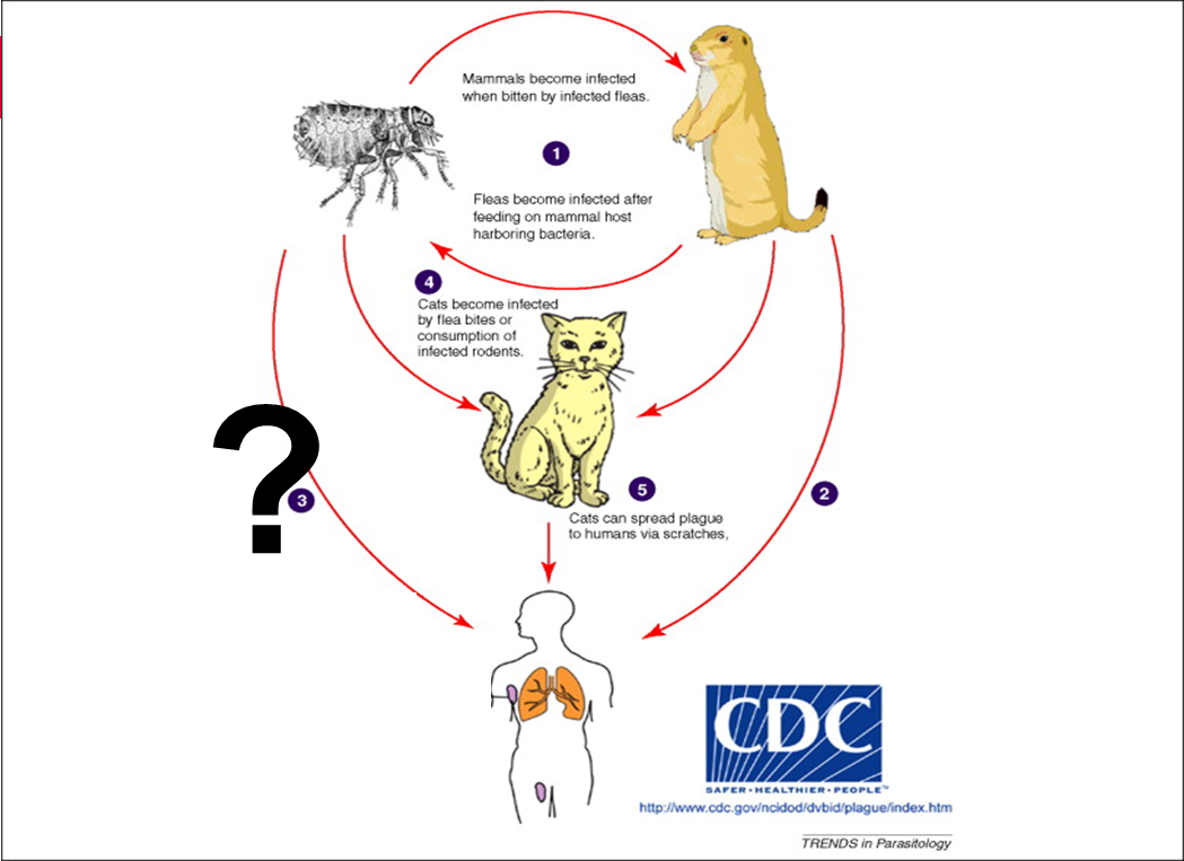
How is CSD transmitted?
1) involves cats!
2) fleas get blood meal and get infected; don’t transmit the pathogens through feeding but through their feces (poop!!!)
3) poop on the cat’s/animals’ fur that is infected w/lesions of the skin as it enters the entrance to Bacilli (how the pathogen enters through the host!)
4) humans can get infected by bites/scratches of feral cats; fleas can’t transmit disease to humans but however, cats and rodents can transmit the disease
*can transmit as long as their fur is infected w/disease
Bartonella genus? Characteristics of Bartonella genus?
Bartonella henselae (Rochalimaea) proteobacterium and agent of CSD
B. henselae is a member of the genus Bartonella (one of the most diverese bacteria genera are: fleas, body lice, ticks etc)
Characteristics:
Flagellated
Faculative intracellular
Gram-negative
Baccilus
Aerobic
Pleomorphic
T or F: treatments including rifampin, trimethoprim-sulfisoxazole and ciprofloxacin are antibiotic regimens for CSD
True
Murine typhus?
1) present in enxootic cycle in urban settings
2) transmitted by rodent and cat fleas
T or F: Murine typhus and Cat flea typhus both have diseases that are transmitted by flies
F; transmitted by fleas
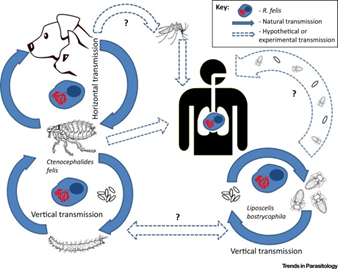
Explain the tranmission of murine typhus and cat flea typhus using the picture provided.
1) both diseases are transmitted by fleas
2) caused by Rickettsia typhi and Rickettsia felis (found in infected fleas and their feces)
3) Murine typhus and cat-flea typhus have different vectors but produce similar diseases in humans
Rickettsia felis is found in regions: Sub-saharan Africa
Other free-living species that transmit Rickettsia felis→ mites, ticks and sucking lice
Rickettsia typhi has:
a sylvatic cycle and urban cycles
What type of transmission does Rickettsia felis have?
transovarial transmission (vertical transmission)
What is the causative agent for murine typhus?
Rickettsia spp.
Treatment for murine and cat flea typhus?
Doxycycline and other antibiotics can be used
Black Plague? 3 plague outbreaks?
Black Plague: lymph nodes that are enlarged (black colored)
3 plague outbreaks:
1) Justinian plague
2) Great plague
3) Modern plague
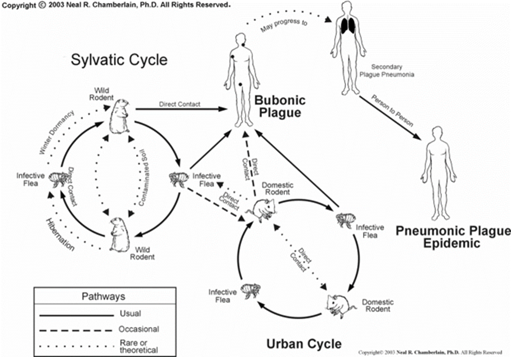
Plague life cycle? What is the main vector of the plague?
Main vector: Xenopsylla cheopis
sylvatic cylcle wild rodent and infected flea make direct contact with human ; urban cycle has rats and infected flea; can go from rat to human (Bubonic plague)
Bubonic plague may progress to Plague Pneuomonia (spread person to person)=> Pneumonic Plague epidemeic
How is plague used as a weapon of war?
capitulating corpses over city walls
dropping infected fleas from airplanes
aerosolizing the bacteria during the Cold War
What is the most dangerous plague out of: bubonic, septicemic, and pneumonic plague?
Pneumonic plague
The plague is caused by what? (causative agent)
Yersinia pestis (Y.pestis)
What is the diagnostic testing for Y. pestis?
lymph node aspirate→ an affected bubo should contain numerous organism that can be evaluated microscopically and by culture
blood culture→ organisms may be seen in blood smears if the patient is septicemic; blood smears taken from suspected bubonic plague patients early in the course of illness are usually negative for bacteria by microscopic examination but may be positive by culture
sputum→ culture is possible from sputum of very ill pneumonic plague patients; however blood is usually culture-positive at this time as well
The plague is still present in where?
Madagascar
What are the chracteristcs of lice?
1) 0.35-10mm in the adult stage
2) Wingless (apterous)
3) Extoparasites
4) 3 nymphal instars!!!
5) Hemimetobolous (have a simple metamorphosois *no pupa stage)
6) Mouthparts-> mandibles for chewing lice, stylets for sucking lice
7) Tarsi 1 or 2 segmented (1 in Anoplurans); Dorsoventally flattened head
8) Development of operculum in egg stage; reduced labial pals
9) Reduced compound eyes and no ocelli
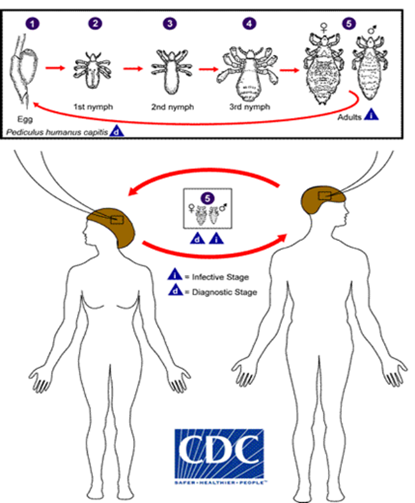
Explain the life cycle of lice?
Eggs→ nits are head lie eggs; hard to see and are often confused for dandruff or hair spray droplets! Nits are laid byt the audlt female and are cemebted at the base of the hair shaft near the scalp. They are: 0.8mm by 0.3mm oval and usually yellow to white color. (very small!!!) Nits take about 1 week to hatch (6-9days) viable eggs are located within 6mm of the scalp
Nymphs→ egg hatches to release a nymph; the nit shell then becomes more visible and dull yellow; remains attachwed to the hair shaft, the nymp looks like an adult head louse (but very small still) Nymphs mature after 3 molts and become adults about 7 days
Adults→ adult louse is about the size of a sesame seed; has 6 legs (each w/claws and is tan to grayish-white; people w/dark hair adult louse is darker!!! Females are usually larger than the meales and can lay up to 8 nits per day!!!! Adult lice can live up to 1 month on a person’s head; to live, the adult lice need to feed on blood several times a day! W/out blood meals, the louse will die within 1-2 days off the host
Difference btwn chewing lice and sucking lice?
Sucking lice: solenophages (feed directly on blood from blood vessels)
CANNOT survive more than a few hours away from host
Chewing lice: use their mandibles for feeding on fur/ feathers
skin debris and secretion
they can be facultative hematophagous
can last for a longer period time away from host
Stragglers
lice found on an atypical host ( accidental/ abnormal host) pathogen infects a host that it doesn’t normally infect
T or F: most lice are host specific
True
What are the 3 different species of sucking lice that can affect humans?
1) Pediculus humanus humanus (body louse)
2) Pediculus humans capitis (head louse)
3) Phtrius pubis (crab louse)
T or F: Pthrisu pubis is similar to primates’ lice
True
T or F: Mallophaga is a group of ectoparastie insects that feed on skin/feeders but rarely or circumstantially on blood
True
Are all lice parasitic?
Yes
What are some key concepts of head louse vs body louse?
1) Head louse does not survive off host
2) Head louse feeds several times a day
T or F: Head louse eggs are not glued to the hair making them evadingly visible and able to get rid of
F; Head louse eggs are glued onto the hair
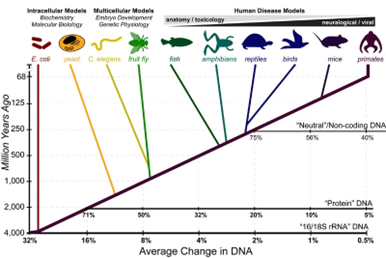
Molecular clock
the average rate at which a species’ genome accumulates mutations, sued to measure their evolutionary divergence and in other calculations
How does louse effect the human evolution of life? What is the coevolution and degradation btween humans and louse? (short answer)
1) Lice live close to their hosts (permanent association with their hosts) evolutionary history reflects mirrors on the host species. *They spend their entire life on the human body and are transmitted through direct physical contact. They’re closely dependent on humans which means that their evolutionary history reflects important events in human history such as: changes in body morphology, behavior, migration, and cultural practices.
2) Coevolution of humans and lice go back in time towards 5-7 million years ago; with lice parasitizing humans and chimps. The coevolution of lice to humans is host-parasite coevolution; lice evolve alongside their hominin hosts.
3) Humans have less body hair compared to primates; lice were dependent on body hair for attachment and reproduction. Once inhabited by the early hominins, the lice either have disappeared throughout time, or adapted to the remaining hair coverage regions of the body.
Body louse vs head louse vs crab louse
Body louse→ infested in clothes and crawl on body to feed; females poop on clothes (cause irritation)
Head louse→ infest the sclap and head region; lay eggs on the base of hair; glued onto hair
Crab louse→ infest coarse hair (NOT JUST PUBIC HAIR) can be mustaches, eyelashes, chest hair, armpits and beards
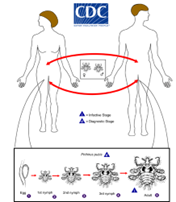
crab louse life cycle
Transmitted through direct contact during (intercourse) transsion by other means is rare: bed linen, toilet, sofas
It is rare since louse can only survive for a few hours off the host
Which louse is the only louse that acts as a vector of human diseases?
body louse
epidemic typhus
rickettsia is the genus name initially given by Henrique da Rocha Lima to intracellular microorganisms found in lice
epidemic typhus transmission?
· Transmission of R. prowazekii does not occur directly by bites, but by contamination of bite site, conjunctivae and mucous membranes with the feces or crushed bodies of infected lice
· Infection through aerosols of fecul dust has been reported and proides the main risk of epidemic typhus contamination for physicsians
Lice can also suffer from R. prowazekii infection; after feeding on infected person,
What is the vector for Rickettsia prowazekii?
flying squirrels
clinical manifestations of epidemic typhus? treatment?
· CNS manifestions (delirium, coma, and seizures) can are occur in up to 80% of cases
· Skin lesions are also distributed mostly on the truck, starting int the axilla, and may spread centrifugally to involve the extremities (not found on the face, palms and soles but found on the soft palate)
· Eschars absent
· Brill-Zinsser disease
Treatment:
· Serology
· Doxycycline
Trench Fever? What is the causative agent for Trench Fever?
Trench fever: disease that was involved with the trenches during WWI
Bartonella quintana
What is the vector of Trench Fever?
Pediculus humanus humanus
Symptoms of trench fever?
· Headache
· Dizziness
· Knee and ankle pain
· Macular truncal rash
· Fatigue
· Lumbago
· Stiffness of thighs
· Severe shin pain
· Splenomegaly-> inflammation/enlargement of the spleen
Diagnosis and sequelae?
Louse-borne relapsing fever? Bed bugs?