Microbiology Ch 20, 21, 23, 24
 Call Kai
 Learn
Learn Practice Test
 Spaced Repetition
 Match
Match Flashcards
 Knowt Play
1/232

Earn XP
Description and Tags
Chapter 20, 21
Name | Mastery | Learn | Test | Matching | Spaced | Call with Kai |
|---|
No analytics yet
Send a link to your students to track their progress
233 Terms
Penicillin was considered a "miracle drug" for all of the following reasons EXCEPT
A) it was the first antibiotic.
B) it does not affect eukaryotic cells.
C) it inhibits gram-positive cell wall synthesis.
D) it has selective toxicity.
E) it kills bacteria.
A
A drug that inhibits mitosis, such as griseofulvin, would be more effective against
A) gram-positive bacteria.
B) gram-negative bacteria.
C) fungi.
D) wall-less bacteria.
E) mycobacteria.
C
Most of the available antimicrobial agents are effective against
A) viruses.
B) bacteria.
C) fungi.
D) protozoa.
B
Antimicrobial peptides (AMPs) frequently work by
A) inhibiting protein synthesis.
B) disrupting the plasma membrane.
C) complementary base pairing with DNA.
D) inhibiting cell-wall synthesis.
E) hydrolyzing peptidoglycan.
B
In what way are semisynthetic penicillins and natural penicillins alike?
A) Both are broad spectrum.
B) Both are resistant to penicillinase.
C) Both are resistant to stomach acids.
D) Both are bactericidal.
E) Both are based on β-lactam.
E
Which one of the following antibiotics is NOT bactericidal?
A) aminoglycosides
B) cephalosporins
C) polyenes
D) rifampins
E) penicillin
C
Which one of the following does NOT belong with the others?
A) bacitracin
B) cephalosporin
C) monobactam
D) penicillin
E) streptomycin
E
Which of the following antimicrobial agents has the fewest side effects?
A) streptomycin
B) tetracycline
C) penicillin
D) erythromycin
E) chloramphenicol
C
Which of the following drugs does NOT act by competitive inhibition?
A) ethambutol
B) isoniazid
C) streptomycin
D) sulfonamide
E) trimethoprim
C
Which of the following methods of action would be bacteriostatic?
A) competitive inhibition with folic acid synthesis
B) inhibition of protein synthesis
C) injury to plasma membrane
D) inhibition of cell wall synthesis
E) competitive inhibition with DNA gyrase
B
Which of the following antibiotics is recommended for use against gram-negative bacteria?
A) polyenes
B) bacitracin
C) cephalosporin
D) penicillin
E) polymyxin
E
Which of the following antimicrobial agents is recommended for use against fungal infections?
A) amphotericin B
B) bacitracin
C) cephalosporin
D) penicillin
E) polymyxin
A
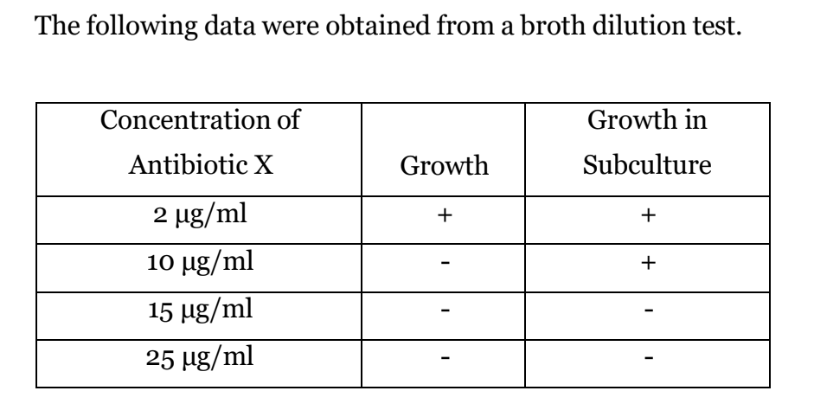
In Table 20.1, as illustrated by the data shown, the minimal bactericidal
concentration of antibiotic X is
A) 2 μg/ml.
B) 10 μg/ml.
C) 15 μg/ml.
D) 25 μg/ml.
E) The answer cannot be determined based on the information provided.
C
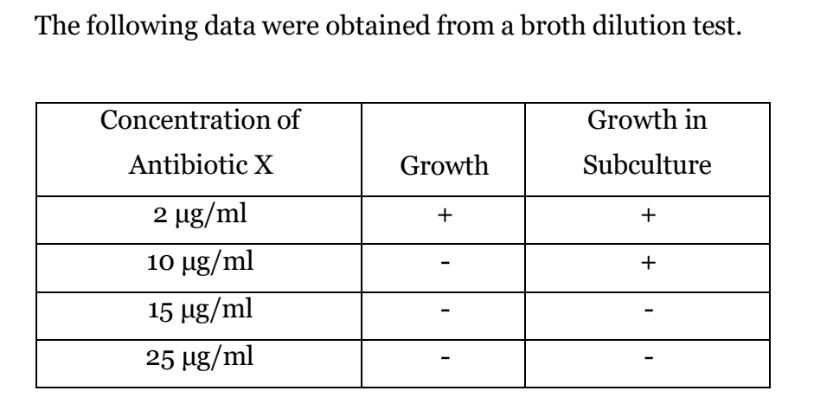
In Table 20.1, the minimal inhibitory concentration of antibiotic X is
A) 2 μg/ml.
B) 10 μg/ml.
C) 15 μg/ml.
D) 25 μg/ml.
E) The answer cannot be determined based on the information provided.
B
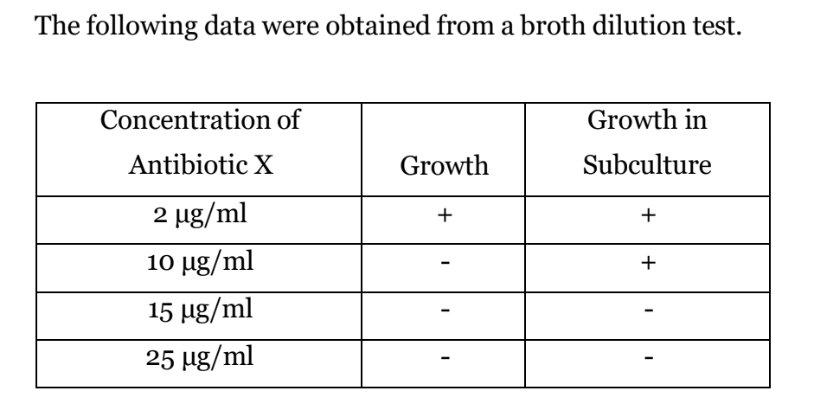
From the data in Table 20.1, you can predict that the effect of the drug on a different microbe
A) will be the same.
B) will be weaker.
C) will be stronger.
D) can't be predicted from the information provided.
D
More than half of our antibiotics are
A) produced by fungi.
B) produced by bacteria.
C) synthesized in laboratories.
D) produced by Fleming.
E) produced by eukaryotic organisms.
B
To date, most of our natural antibiotics have been found to be produced by members of what genus?
A) Streptomyces
B) Bacillus
C) Penicillium
D) Paenibacillus
E) Cephalosporium
A
Which of the following is mismatched?
A) Ehrlich – "magic bullet" theory
B) Fleming – initial identification of penicillin's effect on gram-positive microbial
growth
C) Florey and Chain – identification of Penicillium as the producer of penicillin
D) Kirby and Bauer – disc-diffusion method
E) None of these is mismatched.
C
Which compound would be the most useful to treat candidiasis?
A) uracil
B) thymine
C) flucytosine
D) guanine
E) penicillin
C
Which of the following antibiotics are used to treat fungal infections?
1. aminoglycosides
2. cephalosporins
3. griseofulvin
4. polyenes
5. bacitracin
A) 1, 2, and 3
B) 3 and 4
C) 3, 4, and 5
D) 4 and 5
E) All of these antibiotics are used to treat fungal infections.
B
Which of the following antibiotics does NOT interfere with cell wall synthesis?
A) cephalosporins
B) macrolides
C) natural penicillins
D) semisynthetic penicillins
E) vancomycin
B
The antimicrobial drugs with the broadest spectrum of activity are
A) aminoglycosides.
B) chloramphenicol.
C) penicillin G.
D) macrolides.
E) tetracyclines.
E
Which of the following statements is FALSE?
A) Fluoroquinolone inhibits DNA synthesis.
B) Acyclovir inhibits DNA synthesis.
C) Amantadine inhibits the release of viral nucleic acid.
D) Interferon inhibits glycolysis.
E) Azoles inhibit plasma membrane synthesis.
D
Protozoan and helminthic diseases are difficult to treat because
A) their cells are structurally and functionally similar to human cells.
B) they replicate inside human cells.
C) they do not have ribosomes.
D) they do not reproduce.
E) they have more genes than bacteria.
A
Which of the following organisms would MOST likely be sensitive to natural penicillin?
A) helminths
B) Streptococcus pyogenes
C) penicillinase-producing Neisseria gonorrhoeae
D) Penicillium
E) Mycoplasma
B
"Strep Says Please"
Think:
“Strep = Sensitive to penicillin”
When you see Streptococcus pyogenes, imagine it saying:
Which of the following statements about drug resistance is FALSE?
A) It may be carried on a plasmid.
B) It may be transferred from one bacterium to another during conjugation.
C) It may be due to enzymes that degrade some antibiotics.
D) It is found only in gram-negative bacteria.
E) It may be due to decreased uptake of a drug.
D
Which of the following does NOT constitute an advantage of using two antibiotics
together?
A) It can prevent drug resistance.
B) It lessens the toxicity of individual drugs.
C) Two are always twice as effective as one.
D) It allows treatment to be provided prior to diagnosis.
E) All of these are advantages of using two antibiotics together.
C
32) Drug resistance occurs
A) because bacteria are normal microbiota.
B) when antibiotics are used indiscriminately.
C) against antibiotics and not against synthetic chemotherapeutic agents.
D) when antibiotics are taken after the symptoms disappear.
E) All of the answers are correct.
B
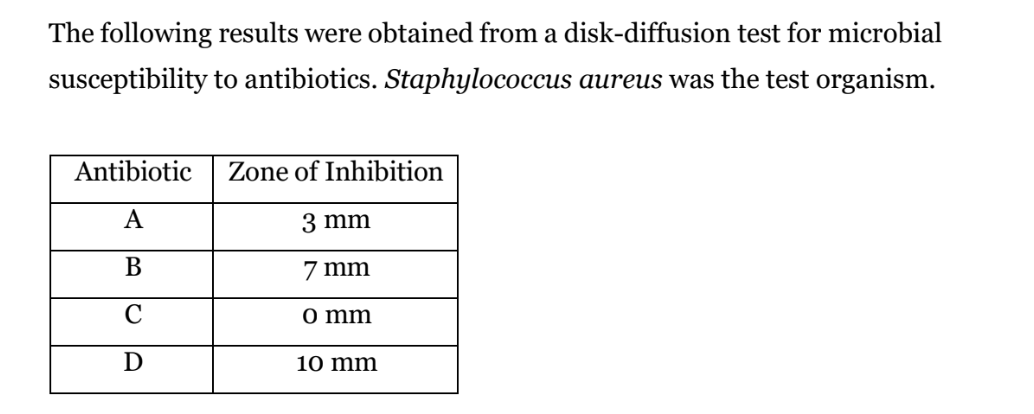
In Table 20.2, the most effective antibiotic tested was
A) A.
B) B.
C) C.
D) D.
E) The answer cannot be determined based on the information provided.
D
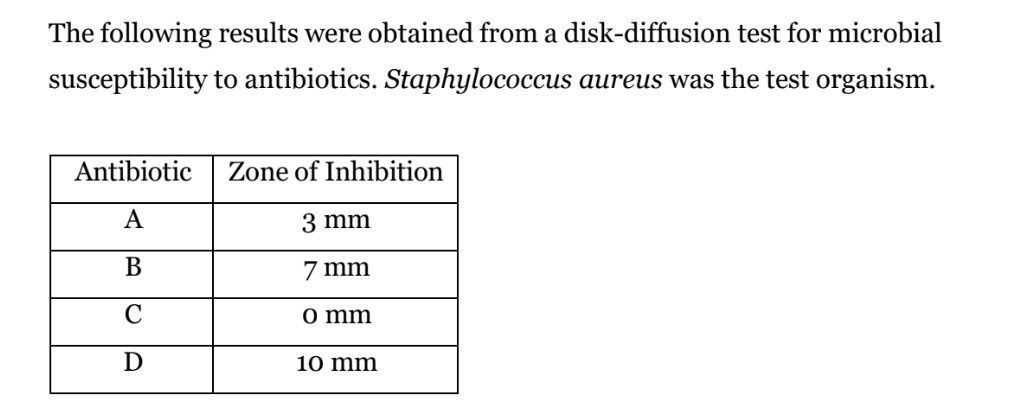
In Table 20.2, the antibiotic that exhibited bactericidal action was
A) A.
B) B.
C) C.
D) D.
E) The answer cannot be determined based on the information provided.
E
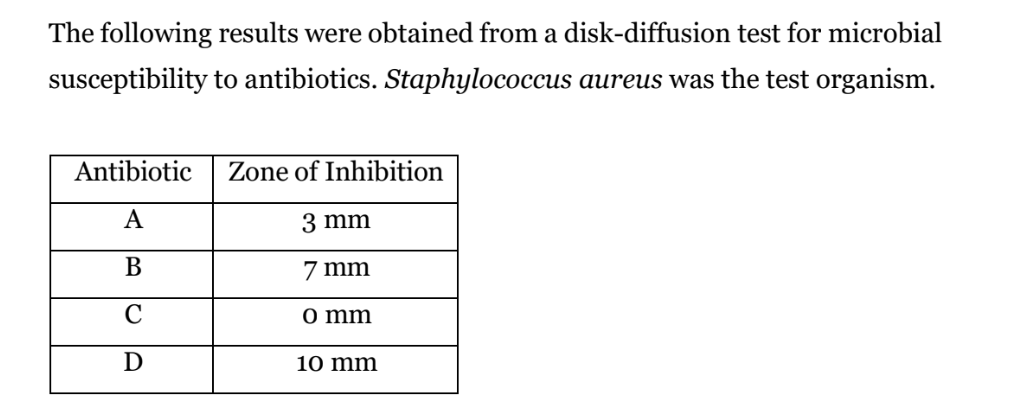
In Table 20.2, which antibiotic would be most useful for treating a Salmonella
infection?
A) A
B) B
C) C
D) D
E) The answer cannot be determined based on the information provided.
E
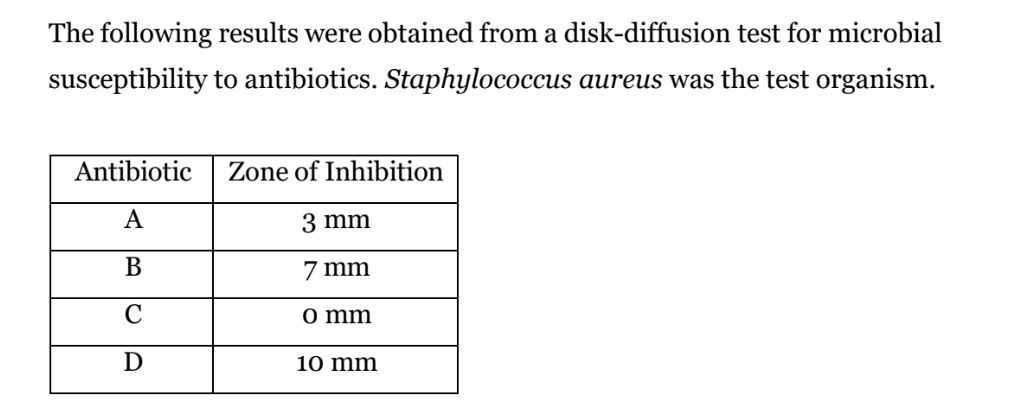
If you tested a 2nd strain of S. aureus with the same method and concentrations of
drugs as indicated in Table 20.2, but you found that the zone of inhibition caused by
drug D had dropped to 2 mm, what does this indicate?
A) The 2nd strain of bacteria is likely resistant to drug D.
B) The 2nd strain of bacteria is much more sensitive to drug D.
C) The experiment wasn't conducted properly, and is giving inaccurate results.
D) There is no functional difference between how the 2 strains react to the drug.
A
Which of the following would be selective against the tubercle bacillus?
A) bacitracin – inhibits peptidoglycan synthesis
B) ethambutol – inhibits mycolic acid synthesis
C) streptogramin – inhibits protein synthesis
D) streptomycin – inhibits protein synthesis
E) vancomycin – inhibits peptidoglycan synthesis
B
In the presence of penicillin, a cell dies because
A) it lacks a cell wall.
B) it plasmolyzes.
C) it undergoes lysis.
D) it lacks a cell membrane.
E) its contents leak out.
C
Lamisil is an allylamine used to treat dermatomycoses. Lamisil's method of action is
similar to that of
A) polymyxin B.
B) azole antibiotics.
C) echinocandins.
D) griseofulvin.
E) bacitracin.
B
Niclosamide prevents ATP generation in mitochondria. You would expect this drug to be effective against
A) gram-negative bacteria.
B) gram-positive bacteria.
C) helminths.
D) Mycobacterium tuberculosis.
E) viruses.
C
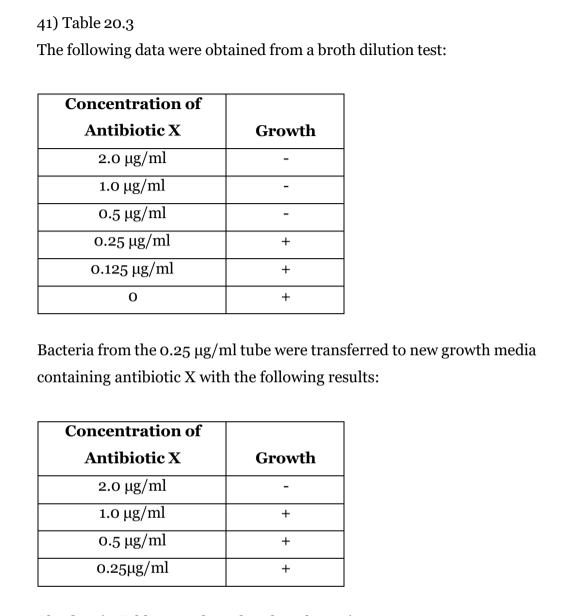
The data in Table 20.3 show that these bacteria
A) are pathogenic.
B) developed resistance to antibiotics.
C) were killed by 0.125 μg/ml of antibiotic X.
D) were killed by 0.5 μg/ml of antibiotic X.
E) were resistant to 1.0 μg/ml at the start of the
B
Which of the following statements about drugs that competitively inhibit DNA polymerase or RNA polymerase is FALSE?
A) They can potentially cause mutations.
B) They are used against viral infections.
C) They can affect host cell DNA synthesis.
D) They cause cellular plasmolysis.
E) They interfere with protein synthesis.
D
Which of the following does NOT affect eukaryotic cells?
A) antiprotozoan drugs
B) antihelminthic drugs
C) antifungal drugs
D) nucleotide analogs
E) semisynthetic penicillins
E
Mebendazole is used to treat cestode infections. It interferes with microtubule formation; therefore, it would NOT affect
A) bacteria.
B) fungi.
C) helminths.
D) human cells.
E) protozoa.
A
"MicroTUBES are for BIG cells"
Think of a giant tube slide at a playground:
👨 Humans
🪱 Helminths
🦠 Protozoa
🍄 Fungi
All the big (eukaryotic) cells can use the tube.
🚫 Bacteria are too small to ride the tube because they don't have microtubules.
So:
Microtubules → Eukaryotes
No microtubules → Bacteria
➡ Answer = A) bacteria
Quick Test Trick
When you see microtubules, ask:
"Which choice is NOT a eukaryote?"
Which of the following antibiotics causes misreading of mRNA?
A) aminoglycoside – changes shape of 30S units
B) chloramphenicol – inhibits peptide bonds at 50S subunit
C) oxazolidinone – prevents formation of 70S ribosome
D) streptogamin – prevents release of peptide from 70S ribosome
E) tetracyclines – bind with 30S subunit
A
The antibiotic actinomycin D binds between adjacent G-C pairs, thus interfering
with
A) transcription.
B) translation.
C) cellular respiration.
D) plasma membrane function.
E) peptide bond formation.
A
Use of antibiotics in animal feed leads to antibiotic-resistant bacteria because
A) bacteria from other animals replace those killed by the antibiotics.
B) the few surviving bacteria that are affected by the antibiotics develop immunity to the
antibiotics, which they pass on to their progeny.
C) the antibiotics cause new mutations to occur in the surviving bacteria, which results
in resistance to antibiotics.
D) the antibiotics kill susceptible bacteria, but the few that are naturally resistant live
and reproduce, and their progeny repopulate the host animal.
E) the antibiotics persist in soil and water.
D
Which one of the following anti-protozoan drugs was a traditional Chinese medicine
for controlling fevers, but which has also exhibited useful anti-malarial properties?
A) Quinacrine
B) Metronidazole
C) Miltefosine
D) Mebendazole
E) Artemisinin
E
TRUE OR FALSE
An antibiotic that attacks the LPS layer would be expected to have a broad spectrum of activity, effective against Gram negative and Gram positive cells.
FALSE
TRUE OR FALSE
PABA serves as the competitive inhibitor in the action of sulfanilamides.
FALSE
TRUE OR FALSE
Undergrowth of fungi after antibiotic use is commonly referred to as a superinfection.
FALSE
TRUE OR FALSE
Due to its target, rifamycins such as rifampin can be effective over a broad spectrum.
TRUE
TRUE OR FALSE
Both trimethoprim and sulfamethoxazole inhibit reactions along the same metabolic pathway.
TRUE
TRUE OR FALSE
Penicillin and streptomycin are commonly used in synergism because they display
the same mode of action.
FALSE
TRUE OR FALSE
Only microbes produce antimicrobial peptides.
FALSE
TRUE OR FALSE
Community-acquired MRSA is typically less virulent than healthcare-associated MRSA.
FALSE
TRUE OR FALSE
Antiviral drugs target viral processes that occur during viral infection.
TRUE
TRUE OR FALSE
Phage therapy has been used in the past as an effective, common antiviral treatment.
FALSE
₊˚ ✧ ━━━━⊱⋆⊰━━━━ ✧ ₊˚
Phage therapy is not an antiviral treatment.
It is a therapy that uses bacteriophages—viruses that infect bacteria, not human cells.
All of the following are normal microbiota of the skin EXCEPT
A) Streptococcus.
B) Micrococcus.
C) Staphylococcus.
D) Propionibacterium.
E) Corynebacterium.
A
An eight-year-old girl has scabs and pus-filled vesicles on her face and throat. Three
weeks earlier she had visited her grandmother, who had shingles. What infection does
the eight-year-old have?
A) chickenpox
B) measles
C) fever blisters
D) scabies
E) rubella
A
Which of the following is NOT true of acne?
A) It can be treated by eliminating fatty foods from the diet.
B) It is often due to the action of Propionibacterium.
C) Drugs that inhibit sebum formation are useful in treating inflammatory acne.
D) Mild cases are treated with topical agents.
E) Antibiotics may be prescribed for moderate cases.
A
Warts are caused by
A) papillomavirus.
B) poxvirus.
C) herpesvirus.
D) parvovirus.
E) Staphylococcus aureus.
A
All of the following are characteristic of Pseudomonas aeruginosa EXCEPT
A) gram-positive cell wall.
B) resistance to many types of disinfectants and antibiotics.
C) growth in moist environments.
D) production of pyocyanin.
E) rod-shaped.
A
Koplik spots are a diagnostic indicator of
A) chickenpox.
B) smallpox.
C) fifth disease.
D) rubella.
E) measles.
E
All of the following are transmitted via the respiratory route EXCEPT
A) smallpox.
B) chickenpox.
C) rubella.
D) tinea.
E) measles.
D
All of the following are protective factors of the skin and its secretions EXCEPT
A) keratin.
B) tightly packed cells.
C) lysozyme production.
D) pyocyanin production.
E) salt.
D
。゚•┈꒰ა ♡ ໒꒱┈• 。゚
The question asks for the one that is NOT a normal protective factor of the skin.
Protective skin defenses:
✅ Keratin — tough protein that creates a physical barrier.
✅ Tightly packed cells — make it difficult for microbes to penetrate.
✅ Lysozyme production — enzyme that breaks down bacterial cell walls.
✅ Salt — sweat contains salt, creating an environment that inhibits many microbes.
Pyocyanin is different:
❌ It is a blue-green pigment and toxin produced by the bacterium Pseudomonas aeruginosa.
It is not produced by the skin as a defense mechanism.
In fact, it is a virulence factor that helps the bacterium cause disease.
Thrush and vaginitis are caused by
A) herpesvirus.
B) Chlamydia trachomatis.
C) Candida albicans.
D) Staphylococcus aureus.
E) Streptococcus pyogenes.
C
The greatest single cause of blindness in the world is
A) neonatal gonorrheal ophthalmia.
B) keratoconjunctivitis.
C) trachoma.
D) inclusion conjunctivitis.
E) pinkeye.
C
All of the following are characteristic of the Group A beta-hemolytic streptococci
EXCEPT
A) methicillin resistance.
B) M proteins.
C) the ability to damage cell membranes.
D) the ability to dissolve blood clots.
E) hyaluronidase production.
A
Which of the following cause(s) ringworm?
A) Microsporum
B) Epidermophyton
C) Mycobacterium
D) Microsporum and Epidermophyton
E) Microsporum, Epidermophyton, and Mycobacterium
D
Newborns' eyes are treated with an antibiotic
A) when Neisseria gonorrhoeae is isolated from the eyes.
B) when the mother is blind.
C) when the mother has genital herpes.
D) when the mother has gonorrhea.
E) as a routine precaution.
E
A possible complication of chickenpox is
A) encephalitis.
B) fever blisters.
C) subacute sclerosing panencephalitis.
D) congenital rubella syndrome.
E) macular rash.
A
Which of the following is a subcutaneous mycosis?
A) tinea capitis
B) sporotrichosis
C) erysipelas
D) athlete's foot
E) Buruli ulcer
B
Which region of the skin supports the largest bacterial population?
A) armpits
B) scalp
C) forearms
D) feet
E) All of these support similarly sized bacterial populations.
A
Staphylococcus aureus is responsible for all of the following EXCEPT
A) pimples.
B) sties.
C) boils.
D) carbuncles.
E) acne.
E
Exfoliative toxin is responsible for
A) otitis externa.
B) impetigo.
C) fever blisters.
D) scalded skin syndrome.
E) thrush.
D
All of the following are causative agents of conjunctivitis EXCEPT
A) Chlamydia trachomatis.
B) herpes simplex.
C) adenovirus.
D) Neisseria gonorrhoeae.
E) Haemophilus influenzae.
B
In which of the following respects is measles similar to German measles (rubella)?
A) They have a similar type of rash.
B) They are caused by the same virus.
C) Encephalitis is a possible complication.
D) Congenital complications may occur.
E) They can be controlled by vaccination.
E
Why is vaccination for rubella recommended?
A) It has a high mortality rate in school-age children.
B) Death from secondary infections is common.
C) There is a high incidence of congenital infections and birth defects.
D) Health care workers have a high incidence of infection.
E) It is no longer recommended; rubella has been eradicated.
C
Which of the following statements about congenital rubella syndrome is FALSE?
A) It is contracted during the first trimester of pregnancy.
B) It may be fatal to the unborn child.
C) It may result in deafness, blindness, and mental retardation.
D) It does not occur with subclinical infections.
E) It can be prevented by vaccinating women prior to pregnancy.
D
Which of the following are incorrectly matched?
A) varicella-zoster – chickenpox
B) parvovirus – fifth disease
C) HHV-6 – roseola
D) herpes zoster – shingles
E) poxvirus – fever blisters
E
Which of the following is NOT caused by HSV-1?
A) cold sores
B) canker sores
C) herpes gladiatorum
D) herpes whitlow
E) herpes encephalitis
B
Which of the following statements about Reye syndrome is FALSE?
A) It is associated with aspirin use.
B) It is a complication that may occur in chickenpox infection.
C) It mostly affects older adults.
D) Symptoms may include vomiting, drowsiness, or behavior changes.
E) Prolonged neurological problems may occur.
C
The eradication of smallpox was possible because
A) it was a relatively mild disease.
B) insect vectors were eliminated.
C) there are no animal reservoirs of the virus.
D) it can be prevented with the same vaccine used to prevent chickenpox.
E) it occurs only in the tropics.
C
Which of the following is used to treat herpetic keratitis?
A) penicillin
B) sulfonamide
C) trifluridine
D) fungicide
E) acyclovir
C
Which of the following is used to treat shingles?
A) penicillin
B) sulfonamide
C) trifluridine
D) fungicide
E) acyclovir
E
Which of the following is used to treat sporotrichosis?
A) penicillin
B) sulfonamide
C) trifluridine
D) oral potassium iodide
E) acyclovir
D
Which of the following is used to treat candidiasis of the skin or mucous membranes?
A) penicillin
B) sulfonamide
C) trifluridine
D) miconazole
E) acyclovir
D
。゚•┈꒰ა ♡ ໒꒱┈• 。゚
"MICO kills MYCO"
Miconazole = antifungal
Think: "MICO for MYCO (fungus)"
Or:
"Candida = Can-DIE-da with Miconazole"
Whenever you see:
Candida → fungus → antifungal → Miconazole
Scabies is a skin disease caused by a
A) slow virus.
B) protozoan.
C) mite.
D) bacterium.
E) prion.
C
Scabies is transmitted by
A) fomites.
B) food.
C) water.
D) soil.
E) respiratory secretions.
A
A patient has pus-filled vesicles and scabs on her face, throat, and lower back. She
most likely has
A) measles.
B) mumps.
C) chickenpox.
D) rubella.
E) smallpox.
C
Furuncles, toxic shock syndrome, and scalded skin syndrome all are caused by
A) Streptococcus pyogenes.
B) Staphylococcus aureus.
C) Pseudomonas aeruginosa.
D) Candida albicans.
E) Propionibacterium acnes.
B
。゚•┈꒰ა ♡ ໒꒱┈• 。゚
"Staph Scalds, Staph Shocks, Staph Swells"
Think:
Scalded skin syndrome
Shock (toxic shock syndrome)
Skin boils (furuncles)
👉 All 3 S’s = Staph
Or simpler:
"S.A. = Skin Attacker"
Staphylococcus aureus = major skin disease bacteria
Buruli ulcer is caused by
A) gram-positive bacteria.
B) acid-fast bacteria.
C) a fungus.
D) a virus.
E) a mite.
B
The patient has a papular rash. Microscopic examination of skin scrapings reveals
small eight-legged animals. The etiology is
A) Candida.
B) Microsporum.
C) Pseudomonas aeruginosa.
D) Staphylococcus aureus.
E) Sarcoptes.
E
The patient has vesicles and scabs over her forehead. Microscopic examination of
skin scrapings shows gram-positive cocci in clusters. The etiology is
A) Candida.
B) Microsporum.
C) Pseudomonas aeruginosa.
D) Staphylococcus aureus.
E) Sarcoptes.
D
The patient has scaling skin on his fingers. Conidiospores are seen in microscopic
examination of skin scrapings. The etiology is
A) Candida.
B) Microsporum.
C) Pseudomonas aeruginosa.
D) Staphylococcus aureus.
E) Mycobacterium ulcerans.
B
A 45-year-old man has pus-filled vesicles distributed over his back in the upper right
quadrant, over his right shoulder, and upper right quadrant of his chest. His symptoms
are most likely due to
A) Candida albicans.
B) herpes simplex virus.
C) Staphylococcus aureus.
D) Streptococcus pyogenes.
E) varicella-zoster virus.
E
A 35-year-old woman has a red, raised rash on the inside of her thighs. Gram-
stained skin scrapings show large budding cells with pseudohyphae. The infection is
caused by
A) Candida albicans.
B) herpes simplex virus.
C) Staphylococcus aureus.
D) Streptococcus pyogenes.
E) varicella-zoster virus.
A
41) Which of the following is incorrectly matched?
A) Haemophilus influenzae – pinkeye
B) Chlamydia trachomatis – trachoma
C) Neisseria gonorrhea – opthalmia neonatorum
D) Acanthamoeba – keratitis
E) Pseudomonas – inclusion conjunctivitis
E
。゚•┈꒰ა ♡ ໒꒱┈• 。゚
✅ A) Haemophilus influenzae – pinkeye
→ Correct. It can cause conjunctivitis (pinkeye), especially in children.✅ B) Chlamydia trachomatis – trachoma
→ Correct. Causes trachoma, a chronic eye infection and major cause of blindness worldwide.✅ C) Neisseria gonorrhoeae – ophthalmia neonatorum
→ Correct. Causes severe newborn conjunctivitis during birth.✅ D) Acanthamoeba – keratitis
→ Correct. Causes painful corneal infection, often in contact lens users.❌ E) Pseudomonas – inclusion conjunctivitis
→ Incorrect.Pseudomonas aeruginosa is associated with:
contact lens–related keratitis
burn wound infections
hospital-acquired infections
Assume that your lab partner swabs the side of his face and uses the swab to
inoculate a nutrient agar plate. The next day, he performs a Gram stain on the colonies.
They are gram-positive cocci. You advise him that he should next look for
A) an acid-fast reaction.
B) a coagulase reaction.
C) conidiospores.
D) pseudohyphae.
E) pseudopods.
B
Which of the following pairs is mismatched?
A) chickenpox – poxvirus
B) conjunctivitis – Chlamydia trachomatis
C) keratitis – Acanthamoeba
D) otitis externa - Pseudomonas
E) Buruli ulcer – Mycobacterium
A
A 17-year-old boy has pus-filled cysts on his face and upper back. Microscopic
examination reveals gram-positive rods. This infection is caused by
A) Acanthamoeba.
B) herpes simplex virus.
C) Propionibacterium acnes.
D) Staphylococcus aureus.
E) Streptococcus pyogenes.
C
Which of the following is likely to spread MRSA among athletes?
A) physical contact
B) whirlpool baths
C) taping gels
D) shared equipment
E) All of the answers are correct.
E
46) Inflammation of the thin clear membrane lining the eyelid and eye is properly
termed
A) keratititis.
B) trachoma.
C) ophthalmia neonatorum.
D) conjunctivitis.
E) whitlow.
D