Marketing week 10 (Price,,,,,marketing step #3)
 Call Kai
 Learn
Learn Practice Test
 Spaced Repetition
 Match
Match Flashcards
 Knowt Play
1/76

Earn XP
Description and Tags
go back to slides and learn hoe to calculate
Name | Mastery | Learn | Test | Matching | Spaced | Call with Kai |
|---|
No analytics yet
Send a link to your students to track their progress
77 Terms
2 types of Prices
firm-centric
customer centric
Price,,,,Firm-centric explain
the amount of money charged for a product
price,,,,Customer- centric
The sum of the values that customers exchange for the benefits of having or using the product
price is the most…..
dynamic element of the marketing matrix
Price is harder to
change the product, produce an ad, and shift the placement
why is low price not always best?
pricing needs to be consistent with the company's marketing strategy
price plays a key role in a company’s value propoosition
what are the major considerations in setting price?
list 3
Product costs—price floor ( no profits below this set price)
competition and other external factors—Competitors' strategies and prices; Marketing strategy, objectives, and mix; Nature of the market and demand
Consumer perception of value —Price ceiling (no demand above this set price)
What is cost-based pricing?
Setting prices based on the costs of producing, distributing, and selling the product plus a fair rate of return for effort and risk.
what is the sequence for cost-based pricing?
Design a good product
Determine product costs
Set price based on cost
Convince buyers of product's value.
Types of Costs (4)
fixed costs
variable costs
total costs
unit cost
fixed costs are
costs that DONT vary with production or sales level
variable costs are
costs that vary directly with the level of production
Total costs is
the sum of the fixed and variable costs for any given level of production
how to calculate total cost?
fixed costs + variable costs
what is unit cost?
total costs divided by the level of production)
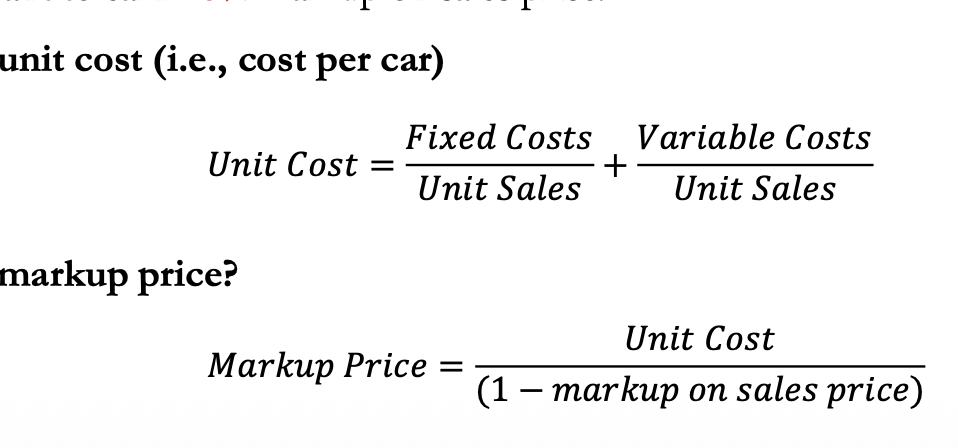
How to calculate Unit cost
=total cost / # production
What is cost-plus (or markup) pricing?
Adding a standard markup to the cost of the product.
Calaculating cost based pricing:
• the car costs us $1MM to develop (fixed costs) and $14K to make a car (var. costs/unit)
• we expect to sell 500 cars.
• we want to earn 20% markup on sales price.
what is break even pricing ( or target return pricing)
Setting price to break even on the costs of making and marketing a product (or setting price to make a target return)
break even point is when
rev= cost
you made enough revuenue to cover ur fixed costs
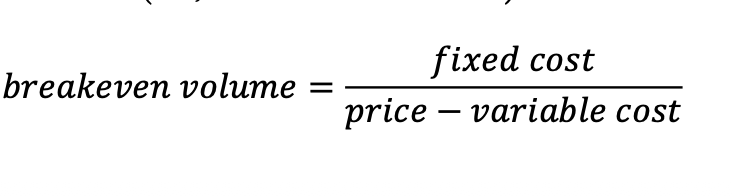
step 1- how to calculate break-even volume?
this car costs us $1MM to develop (fixed cost) and $15K to make a car (var. cost/unit)
• if we set the price at $20K, how many cars would we need to sell at this price to cover
the total cost (i.e., break-even volume)?
step 2 - how to caculate target return volume?
• this car costs us $1MM to develop (fixed cost) and $15K to make a car (var. cost/unit).
• if we set the price at $20K, how many units would we need to sell at this price to
make $200K in profit (i.e., target return of $200K)?

when price increases,,,, demand????
decreases
What is a demand curve?
A curve that shows the # of units the market will buy in a given time period (ie Demand ) at different prices that might be charged
What is price elasticity of demand? and how is it measured?
How responsive demand tis o changes in price;
measured as percent change in demand generated by a 1% change in price
highly elastic means
ppl are VERY sensitive to price so Demand changes drastically
An elasticity of -1.6% means….
that a 1% increase in price would result in a DECREASE of 1.6% sales
what does 1.6% elasticity mean?
that a 1% decrease in price would price sales up by 1.6%
when demand is inelastic? A product is what (6)
When a product is:
unique or has few substitutes or competitors
high in quality or prestige
a necessity
low in cost relative to the consumer's income
when customers are brand loyal
addictive
How can elasticity vary?
By time frame
by consumer
For Time frame,,,using Gas as an EX in the short term is the demand elastic or inelastic?
inelastic.,,,,because its a necesity so even if price changes you still need to go get gas
For Time frame,,,using Gas as an EX in the long term is the demand elastic or inelastic?
more Elastic
what do you mean by consumer? use cigarettes as ex
cigarettes to adult smokers (-0.32) vs. cigarettes to teens (-1.43)
What is customer value-based pricing?
Setting price based on buyers' perceptions of value rather than on the seller's or manufacturer's cost.
What is the sequence for Value-based pricing?
Assess customer needs and value perceptions
Set target price to match customer-perceived value
Determine costs that can be incurred
Design product to deliver desired value at target price
What are the advantages of customer value-based pricing?
if assessment on consumer's value is correct, sales will be guaranteed;
potentially can generate high profit if cost is much lower than price customers are willing to pay
What are the disadvantages of customer value-based pricing?
difficult to measure (survey, experiment);
might not be feasible to design product at desired price level
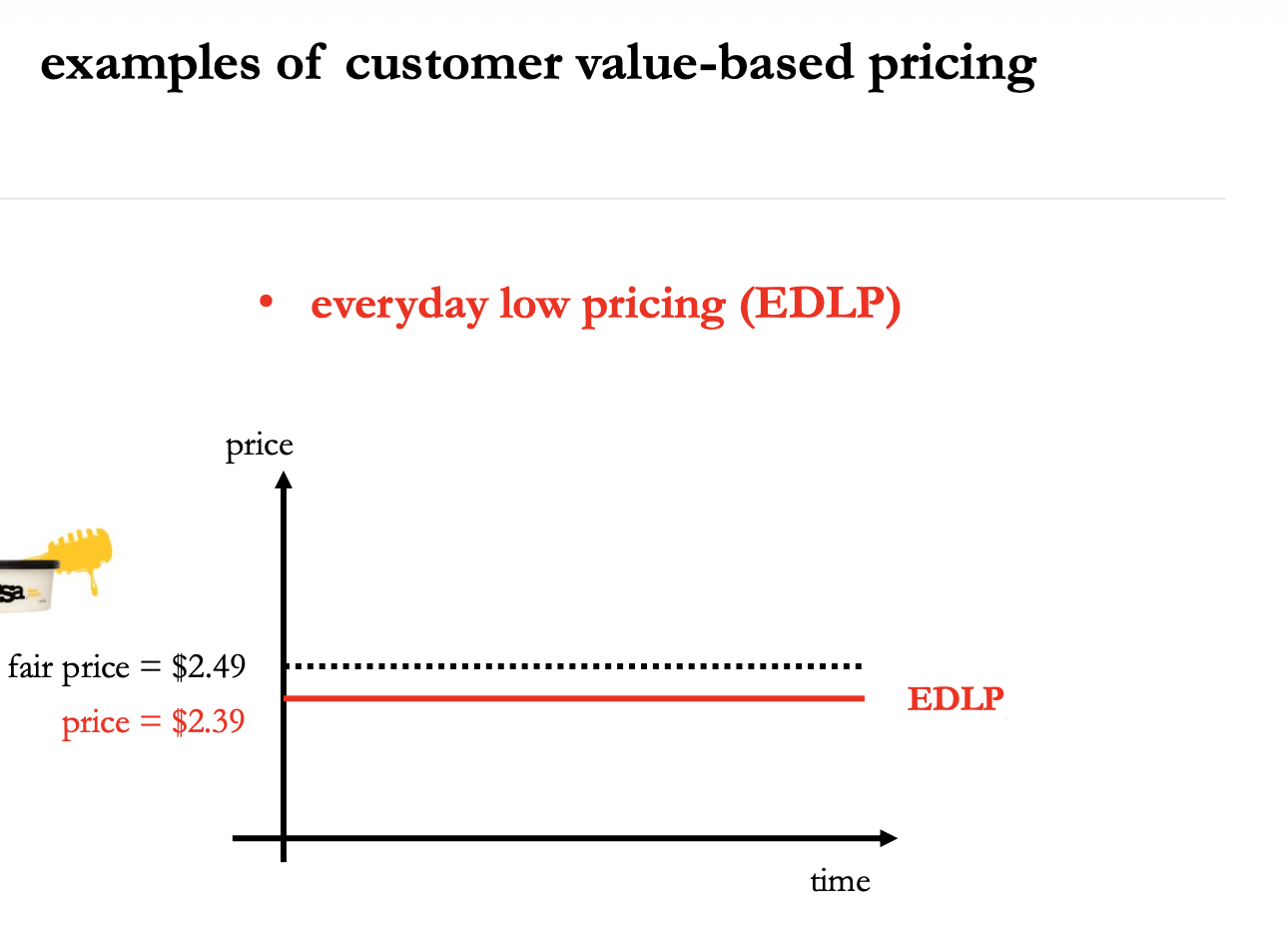
Define Everyday Low Pricing (EDLP)
: charging a constant, everyday low price with few or no temporary price discounts
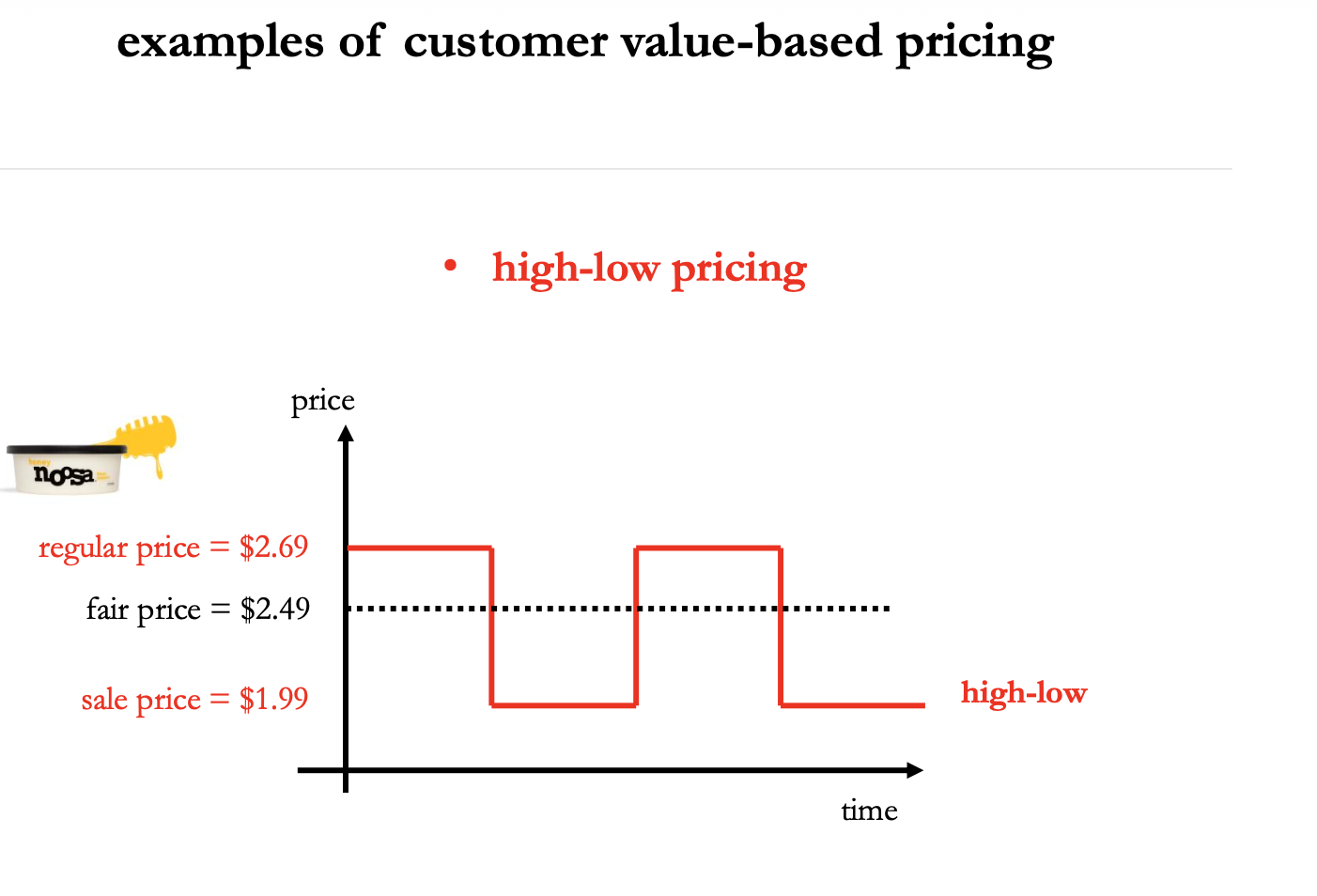
define high-low pricing
harging higher prices on an everyday basis but running frequent promotions to temporarily lower prices below the fair value level (ex: regular price
What are the two new product pricing strategies?
market skimming pricing
market penetration pricing
What is market-skimming pricing (= price skimming) and how is the process?
• set high initial price to “skim the cream” off the top
• innovators and early adopters are normally less price sensitive
• eventually reduce price after innovators/early adopters pay more
What is market-skimming pricing (= price skimming) requirements?
product's quality/image support higher price;
enough innovators/early adopters want it at that price;
unit costs cannot be so high in early stages;
competitors cannot enter easily and undercut
What is market-penetration pricing & example
low initial price in order to rapidly gain market share
• Amazon’s Kindle Fire – $199 introductory price was a $10
loss per unit
Market penetretation pricing requirements
market must be highly price sensitive
• production and distribution costs must decrease as sales
volume increases
• the low price must help keep out the competition
market penetration advantages
rapidly builds market share and name recognition
market penetration disadvantages
requires a large initial investment
• requires a high promotional budget
• high risk if demand is not as strong as anticipated
what is product mix pricing stratgeies?
firms attempt to maximize profit for the whole product line or full product mix
What are the 5 product mix pricing strategies?
1) product line pricing
2) optional product pricing
3) captive product pricing
4) by-product pricing
5) product bundle pricing
product line pricing is and ex
setting prices across an entire product line;
decide on price steps between products
ex= iPad, iPad mini, iPad Air, iPad Pro for different prices
optional product pricing is
pricing of optional or accessory products or features that go along with a main product
With optional product pricing you must ensure that + give example
customers only pay for the features and benefits
they want from a product
cars – have base model, then add-on moon roof, sport packages, etc.
captive product pricing + ex
setting a price for products that must be used along with main product;
(e.g., blades for a razor, games for a video console)
in captive product pricing often the main product
is sold at low profit margin,,,,while “captive products” are sold at a high profit margin
By product pricing is + ex
something produced in the making of our main product
(e.g., coffee ground)
by-product pricing is FULLY explained
setting a price for by-products to help offset the costs of disposing of them and help make the main product's price more competitive
product bundle pricing is
combining several products (related or not) and offering the bundle at a single price (often at a reduced price relative to buying those items separately)
With Product bundling pricing it ,,,,,BUT
sometimes offers greater value to consumer and marketers
but doesn’t always increase customers’ willingness-to-pay
What are the findings on product bundling?
Bundling affects not just purchase, but consumption;
like instead of buying 4day tickets you buy a 4day pass
it is difficult to allocate a single payment across multiple benefits
meaning that even though u have a 4day pass you might not skii on the last day
What is cross price elasticity of demand?
The percentage change in the demand of a given product given one percent change in the price of another "related" product.
What is the price adjustment strategies?
Adjusting prices to account for customer differences and changing situations
pricing strategies are
▪ new product pricing strategies
▪ product mix pricing strategies
▪ price adjustment strategies
list the price adjustment strategies?
1) segmented pricing
2) dynamic pricing
3) promotional pricing
4) psychological pricing
segmented pricing
selling a product or service at two or more prices, where the
difference in prices is NOT based on differences in cost to the seller
dynamic pricing:
adjusting prices continually to meet changing conditions and
situations in the marketplace
(e.g., changes in demand, costs, or
competitor pricing)
promotional pricing
emporarily pricing products below the list price, and sometimes even below cost, to increase short-run sales
What are the dangers of promotional pricing?
Generally not a great way to differentiate business long-term;
can erode brand value,
doesn't build brand loyalty,
and creates "deal-prone" customers who wait for sales
psychological pricing:
pricing that considers the psychology of prices, not simply the traditional economics
under Psychological pricing—-reference prices is
prices that buyers carry in their minds and
refer to when they look at a given product
what determines the reference price for a product?
• memories of past prices
• prices set by market leader
• price of related products and services
• nature of industry
• other products in the product line
What is the compromise effect? + ex
People resolve uncertainty by buying the mid-range object.
Companies can drive sales of higher-priced items by introducing an even more expensive extreme option.
Basically customer choose the medium size drink when in between options
Williams-Sonoma had two bread makers at $275 and $400.
how do they get more people to purchase the $400 bread maker?
introduce one at $525