2. GENERAL ELEMENTS OF CRIMINAL LIABILITY
 Call Kai
 Learn
Learn Practice Test
 Spaced Repetition
 Match
Match Flashcards
 Knowt Play
1/15

There's no tags or description
Looks like no tags are added yet.
Name | Mastery | Learn | Test | Matching | Spaced | Call with Kai |
|---|
No analytics yet
Send a link to your students to track their progress
16 Terms
Actus reus meaning
The guilty act + physical part of an offence
What makes an offence
Actually rea + men’s rea =criminal liability
Mens rea meaning
Conduct crime meaning
The actus rea is enough to be liable of a criminal act
the actus reus is the defendant’s behaviour itself, not the result
Causation doesn’t have ti be proven (factual/legal)
Ex: drink driving
What is consequences crimes
the actus reus requires proof that the defendant’s conduct caused a specific result.
defendant’s act must cause a prohibited result.
Murder
Criminal damage
defendant’s act must cause a prohibited result.
Considers causation
What is a voluntary act
D has full control over body movement = chosen to act
Hill v baxter:
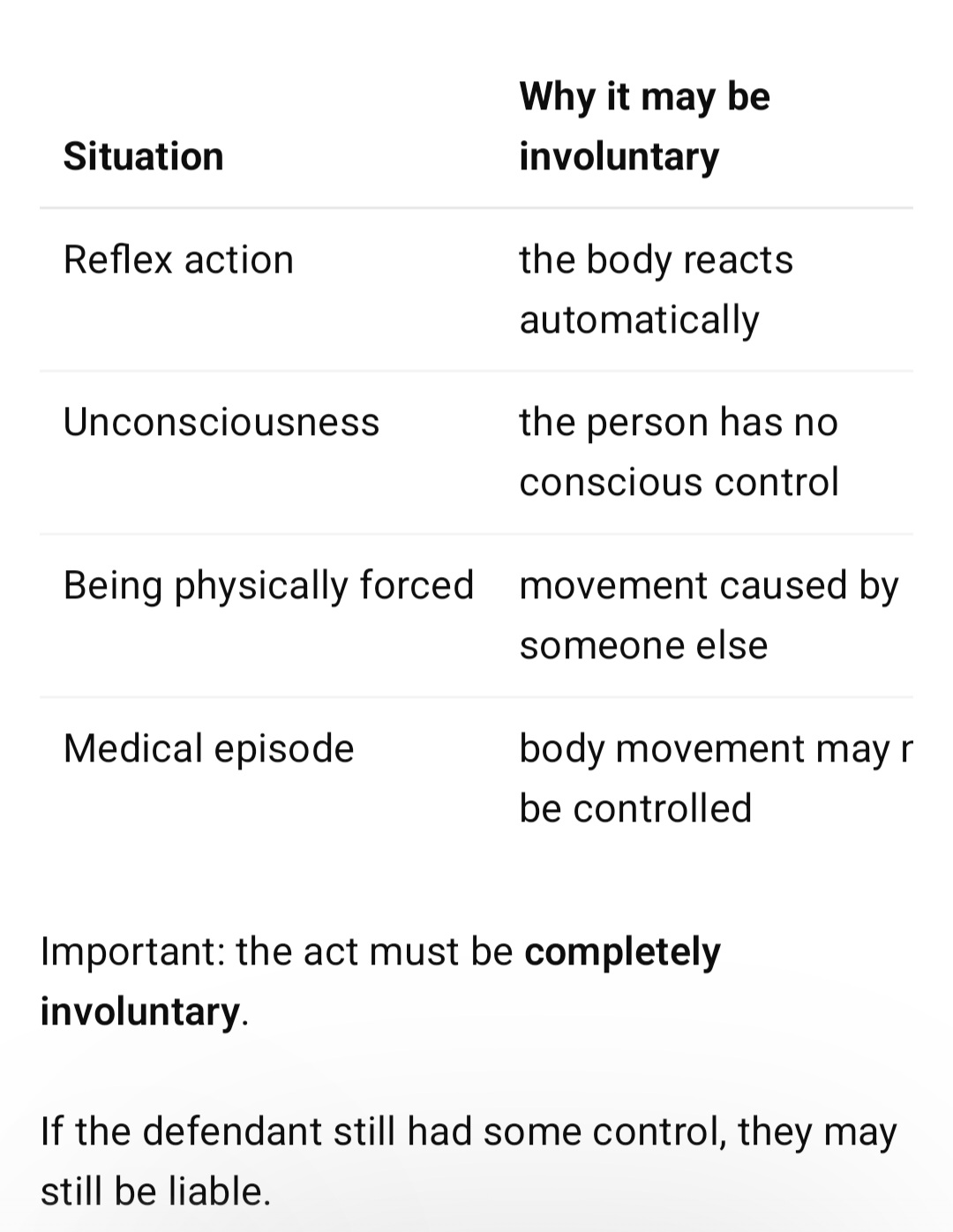
A person is not guilty if their act was completely involuntary.
Involuntary act meaning
D's bodily movement wasn’t controlled by conscious decision = no actus reus
Leicester v Pearson
Where the defendant’s act is involuntary, there is no actus reus.
Omission meaning
Failure to act when you have a legal duty of care to do so
When can omissions create liability
A) Duty from statute
Parliament sets out who has a duty of care owed to another
(Road traffic act)
B) Duty from contract
Legally enforceable agreement
R v Pitwood
C) Duty from relationship
Family (children - parent)
R v Givson + proctor
D) Duty voluntarily accepted
defendant voluntarily takes responsibility for someone
R v stone + Robson
E) Duty from creating a dangerous situation
Duty to prevent harm
R v Miller
F) Professional Duty
R v Dytham
Occupation requires d to act
List the causation + meanings
Factual causation : but for test
But for the Ds actions would V suffered harm
R v White
Legal causation
D's act must be an defendant’s act must be an operating and substantial cause of the result. and substantial cause of the result.
Operating: D’s conduct must still be contributing to the result at the time it occurs. (An active cause) R v Smith
Substantial: D’s conduct must be more than minimal or trivial; it does not have to be the only or main cause. R v Pagett
Thin skull rule explain
TSR: D must take victim as they find them
(including mental, religious + physical characteristics )
If D has characteristic/condition that makes them more susceptible to harm: D is still liable
No break in the chain if causation
R v Blaue
What is breaking the chain of causation
Link between Ds actions + result
Something new happened after Ds actions =real cause of result
Broken by new interviewing act
(Novis actus interveniens)
D can still be liable if they contributed as well as other things
Medical treatment + chain of causation
Medical treatment
Doesnt break chain
only if :so independent and potentially that ds og act is insignificant t
R v Smith : even if treatment is bad D is still liable
R v Jordan: chain broken if treatment is obviously wrong ! = og injury is not longer operating cause
R v Cheshire: chain is broken
List what breaks chain of causation
Rarely medical treatment
Victims own act
Third party acts
(Thin skull rule doesn’t break)
Victims own act and chain of causation
V reacting to Ds conduct, causing/worsening harm
Was V reaction reasonably foreseeable
✅️= not broken (liable) R v Roberts
❌️= broken (not liable) R v Williams + Davis
Williams + davis":
Vs action was unreasonable / disproportionate
Third party acts and chain of causation
Third party: someone other than D and V
Is 3rd party’s act independent enough to break chain
Break chain if act was:
Free
deliberate
Informed
=Independent choice woth knowledge of whst they were doing