Eduqas A level Biology Component 3
 Call Kai
 Learn
Learn Practice Test
 Spaced Repetition
 Match
Match Flashcards
 Knowt Play
1/274

There's no tags or description
Looks like no tags are added yet.
Name | Mastery | Learn | Test | Matching | Spaced | Call with Kai | Chat |
|---|
No analytics yet
Send a link to your students to track their progress
275 Terms
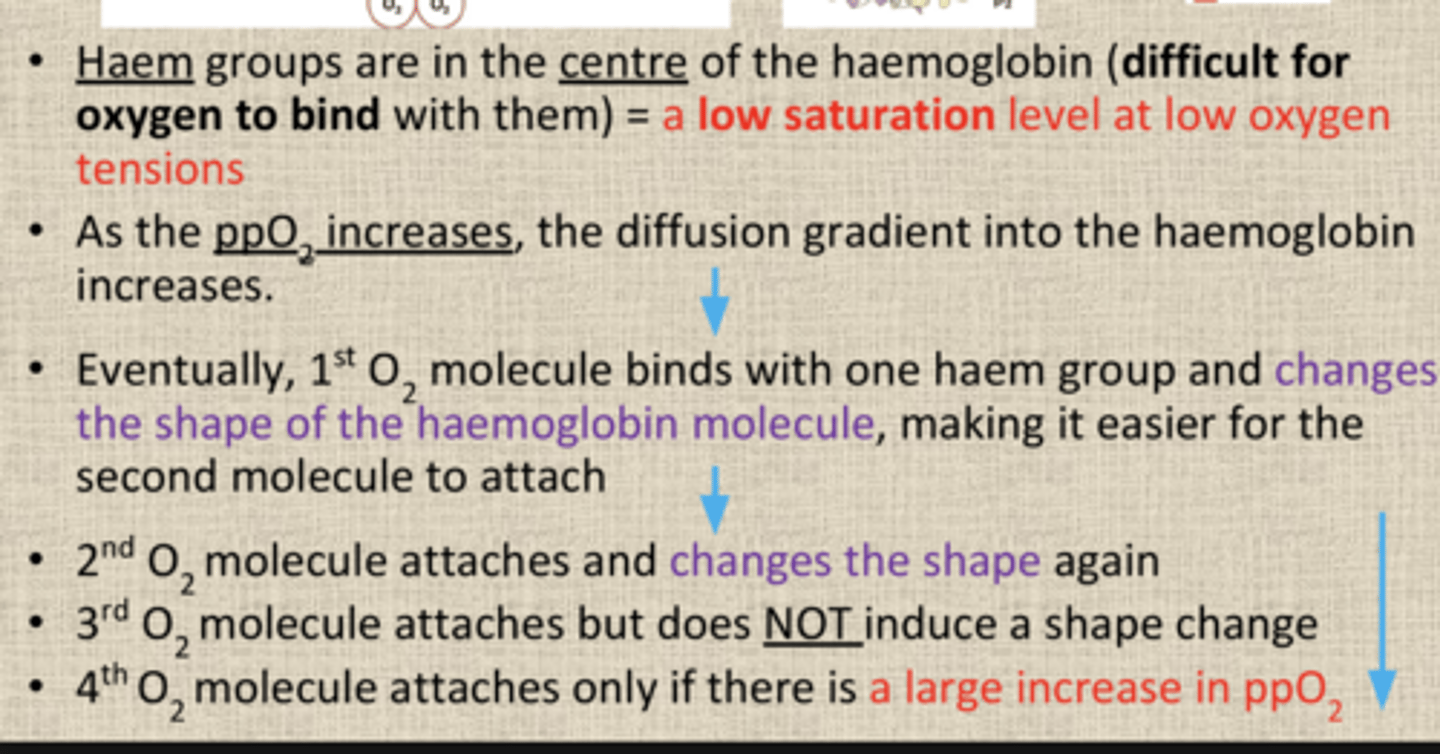
Describe the oxyhaemoglobin dissociation curve
What are saprotrophs?
• Feed on dead and decaying matter
• Fungi and most bacteria
• Carry out extracellular digestion
• Enzymes are secreted onto food outside the body and then soluble products of digestion are absorbed by diffusion across the cell membranes
What are holozoic feeders/animals?
• Food is processed as it passes along the gut
• Simple organisms with one type of food (aphids) have an undifferentiated gut
• Advanced organisms with a varied diet (humans) have a divided gut with each part specialised for a specific function : ingestion, digestion, absorption and egestion
• Includes herbivores, carnivores and detritivores
What are the layers of the gut?
1. Serosa
2. Muscle
3. Sub-mucosa
4. Mucosa
What is the brunners gland?
its found in the sub-mucosa layer at the base of the crypts of liebekuhn of the duodenum and secretes mucus which is alkaline and neutralizes the stomach acid. it also protects the duodenal lining
What are the glands in the wall of the gut?
1. Gastric gland
2. Brunners gland
3. Crypts of leiburkuhn
What are the glands outside the gut?
1. Salivary gland
2. Pancreas
3. Liver
What does bile consist of?
bile salts, mucus and water
Where is bile stored?
stored in the gall bladder and flows along the bile duct into the duodenum
What are the functions of the liver?
• Emulsification of fats, bile breaks down fats into tiny droplets which increases their surface area so that the enzyme lipase can digest them more readily
• Bicarbonate slats help to neutralise stomach acid. The ph of the small intestine becomes alkaline which favours the action of various enzymes
What happens in the pancreas?
the pancreas produces pancreatic juice which flows into the duodenum from the pancreas via the pancreatic duct
main enzymes ares:
pancreatic amylase - breaks down starch to maltose
lipase - breaks down fats to glycerol and fatty acids
endopeptidases - hydrolyse proteins to peptides
Where do digestive enzymes come from?
duodenum and ileum - enzymes are released from secretory cells at the tip of the villi and are also embedded in the cell membrane and in the cytoplasm of epithelial cells
What happens in the stomach?
absorption
Describe absorption
• Once digested food is absorbed by the ileum into the bloodstream
• Monosaccharides, amino acids, minerals and vitamins are absorbed through the plasma membrane into the bloodstream
• Fatty acids and glycerol are absorbed into lacteals
• Molecules are absorbed by simple and facilitated diffusion and active transport
What happens to monosaccharides in digestion?
• They pass into capillaries surrounding the villi
• Blood carrying the dissolved food travels to the hepatic portal vein to the liver
What happens to fatty acids and glycerol in digestion?
• Passed into the lacteal
• The lacteal is a lymph capillary found in the centre of each villus which leads into the lymphatic system which opens into the bloodstream at the thoracic duct
What happens to water, ions and minerals in digestion?
• Water soluble vitamins and minerals pass through the epithelial membrane via facilitated diffusion through transport proteins
• Fat soluble vitamins and minerals diffuse through the phospholipid membrane
What are the adaptations of the large intestine?
• No villi
• Goblet cells
• Deep intestinal glands
Describe what happens in the large intestine (colon)
• Most water and soluble nutrients are absorbed in the small intestine
• The large intestine absorbs the remaining water with vitamins, vitamin k and folic acid to produce solidified faeces
• Undigested cellulose, bacteria and sloughed off cells pass out with the faeces
• The cellulose bulks out the faeces and stimulates peristalsis
What happens to lipids in digestion?
used to produce phospholipids in cell membrane hormones or stored as excess fat
What happens to glucose in digestion?
absorbed from the blood and used in aerobic respiration in cells, excess glucose is converted to glycogen or fat for storage
What happens to amino acids in digestion?
absorbed by cells for protein synthesis. any excess cant be stored and is deaminated, the nh2 group is removed and converted to urea for excretion. the remaining c, h and o is converted to carbohydrate and respired or stored
What is tissue fluid and what is it made from?
it is the immediate environment of body cells.
its formed from blood plasma and supplies nutrients and removes waste
What is an exocrine gland?
a gland that secretes substances (often enzymes) into a duct
What is the function of the kidney?
filtering the blood to remove nitrogenous waste from the body e.g. urea
What is uric acid?
insects, birds excrete uric acid as nitrogenous waste, less soluble in water than ammonia or urea and is excreted as a precipitate after nearly all water has been reabsorbed from urine. paste like urine if eliminated along with faeces from the intestine
What is ultrafiltration and where does it occur?
it is the filtration of small molecules from the blood plasma of the glomerulus to the lumen of the bowmans capsule (nephron) under pressure.
it occurs at the bowmans capsule
Describe ultrafiltration
The afferent arteriole is wider than the efferent arteriole creating a higher blood pressure than normal in the glomerulus. Substances <68000rmm forced out into bowmans capsule, such as glucose, amino acids, salt, water which form glomerular filtrate. >68000rmm remain in the blood such as proteins, exception of hcg hormone.
movement of filtrate resisted by:
capillary epithelium with pores called fenestrae
basement membrane - glycoproteins and collagen-of bowmans capsule acting as a sieve
wall of bowmans capsule made up of highly specialised squamous epithelial cells called podocytes. filtrate passes between their brances
hydrostatic pressure in capsule
low water potential of blood in glomerulus, lowered by loss of water into bowmans capsule
What is selective reabsorption and where does it occur?
it is the reabsorption of glucose, amino acids, ions, water and vitamins from the nephron into the blood plasma. glucose and amino acids are transported by secondary active transport which involves a co-transport mechanism with na+.
mineral ions and salts by facilitated diffusion and active transport into epithelial cells. water by osmosis. some proteins and urea by diffusion.
it occurs in the pct
What are the characteristics of pct cells?
They have a large surface area due to microvilli and basal channels so there are lots of carrier proteins in the membrane
They contain lots of mitochondria to provide atp for active transport
Capillaries lie close to pct cells so there is a short diffusion distance between the cell and the blood
Tight junctions between adjacent cells prevents seepage of reabsorbed materials back into filtrate
Describe the co-transport mechanism
1. Na+ is pumped out of the cell and k+ is pumped in by active transport
2. There is now a higher concentration of Na+ in the filtrate than inside the cell, so Na+ moves into the cell via facilitated diffusion. The protein only allows Na+ to enter if its 'coupled' to glucose, hence transporting Na+ out has provided a gradient which brings glucose from the filtrate back into the tissues.
3. A channel protein allows glucose to pass into the blood down its concentration gradient via facilitated diffusion. This is secondary active transport
What is the loop of henle?
• It's a hairpin counter-current multiplier
• Its function is to conserve water
• It concentrates salts in the medulla by active transport
• It causes water to be reabsorbed into the blood from the loop of henle
• The ascending limb is impermeable to water while the descending limb is permeable to water
How is the permeability of the DCT regulated?
by using hormones
Why are kidney treatments needed if both kidneys are compromised?
1. Reduce the concentration of toxic waste products
2. Regulate the volume of body fluids and therefore the solute concentration
What do calcium channel blockers do?
dilate blood vessels which reduces the pressure of blood flowing through them
What do beta blockers do?
reduce the effects of adrenaline which increases heart rate and thus blood pressure
What do angiotensin-converting enzyme (ACE's) inhibitors and angiotensin receptor blockers (ARB's) do?
reduce the effect of the hormone angiotensin which causes blood vessel constriction and thus increased blood pressure inside the blood vessels
What happens when there is reduced kidney function?
1. High blood potassium concentration leads to heart arrhythmias. Glucose and insulin are used to treat high potassium concentration with intravenous calcium
2. High blood calcium concentration is linked to an increased risk of heart disease, kidney stones
Kidney transplant cons
After a transplant, the patient must take immunosuppressive drugs for the rest of their lives - but rejection may still occur in the first 6 weeks
As their immune system is supressed, patients are more susceptible to infection
What is the reflex arc?
the pathway taken by a nerve impulse during a reflex reaction. the co-ordinator is the spinal cord, not the brain. it is used for protection of the organism from dangerous situations
What is a nerve impulse?
the movement of ions in and out of the axon membrane.
its based on the movement of Na+ and k+ across the membrane of the axon
What are the types of transport protein in the axon membrane?
1. Na+/k+ pump which requires atp
2. Voltage gated Na+ channels
3. Voltage gated K+ channels
4. K+ channels
Describe the process of homeostasis
1. Each factor of homeostasis has a set point
2. A receptor monitors the level of the factor and detects any deviation from the set point
3. If the factor deviates, the receptor provides input to a control centre (co-ordinator)
4. The co-ordinator evaluates the information and provides output to one or more effectors
5. The effectors (muscle or gland) carry out corrective procedures to bring it back to the set point
6. Deviations from the set point are controlled by negative feedback which restores conditions to the original level
7. Once its returned to its set point, information is fed back to the detector and is 'switched off' and no longer alerted to deviations
Why are there fluctuations of the factor around the set point?
There are time delays (due to transport in the blood) so the correction mechanism continues for longer than required and the value of the factor overshoots its set point. this results in fluctuations of the factor within acceptable limits around its set point
What are the things that use positive feedback in the body?
1. Labour
2. Blood clotting - platelets secrete signalling molecules which attracts more platelets
What are hormones?
molecules (often proteins) that are released by endocrine glands directly into the blood that travels to target cells/organs to produce an effect
What is the endocrine gland?
a ductless gland that secretes hormones directly into the blood
What are target cells?
cells that have receptors embedded in their plasma membrane which are complementary in shape to specific hormone molecules, only these cells can respond to that hormone
Describe the production of urea
If there is too much protein in the diet, the excess must be broken down. amino acids are toxic and cant be stored. surplus amino acids are deaminated in the liver to produce ammonia and then urea. the urea is released into the blood and stays there until its removed by the kidneys and excreted as urine
What is ammonia?
it is a toxic waste product that is very small and soluble.
some animals excrete their ammonia directly and others convert it to less toxic waste products such as urea or uric acid. most aquatic animals excrete ammonia
how do freshwater fish get rid of ammonia?
most of it is lost as ammonium ions across the gills, with kidneys only playing a minor role in excretion of nitrogenous waste
What is a kidney nephron?
the functional unit of the kidney. there are approx 1 million nephrons in each kidney
describe the movement of blood in the kidney
1. Each kidney receives blood from the aorta via the renal artery and returns blood to the vena cava via the renal vein
2. Blood is supplied to each nephron in an afferent arteriole where it splits into a capillary network called a glomerulus
3. From the glomerulus, blood is carried away from the nephron by an efferent arteriole to two other capillary structures known as peritubular capillaries
What processes does the kidney perform?
1. Ultrafiltration
2. Selective reabsorption
3. Osmoregulation
Describe what happens win the loop of henle
1. Na+ and Cl- are actively pumped out of the ascending limb, causing the solute potential in the medulla tissue fluid to increase
2. Water moves out of the descending limb by osmosis. It doesn't dilute the solute potential of the medulla because the water moves directly into the blood capillaries of the nearby vasa recta
3. The fluid in the descending limb becomes more concentrated as it moves down due to this loss of water and also because some NaCl diffuses into it.
4. The filtrate in the descending limb and the tissue fluid are most concentrated at the tip of the loop of henle
What is osmoregulation and where does it occur?
it is the homeostatic control of water and solute composition of the blood under hormonal control.
it occurs in the collecting duct and dct
Describe what happens when you're dehydrated
1. There is a decrease in water potential of blood plasma
2. Osmoreceptors in the hypothalamus detect the decrease in water potential of blood flowing through it
3. The posterior lobe of the pituitary gland releases ADH
4. Cells of the collecting duct and DCT of the kidney nephrons become more permeable to water due to aquaporins fusing with the cell membranes
5. More water is reabsorbed from the collecting duct into the blood
6. A small volume of concentrated urine is produced
Describe what happens when you're hydrated
1. Increase in water potential of blood plasma
2. Osmoreceptors in the hypothalamus detect the increase in water potential of blood flowing through it
3. The posterior lobe of the pituitary gland stops the release of ADH
4. Cells of the collecting duct and DCT of the kidney nephron become less permeable to water as aquaporins move out of the membrane
5. Less water is reabsorbed from the collecting duct into the blood
6. A large volume of dilute urine is produced
What happens if the kidneys fail?
urea builds up to toxic levels and excess water in the body fluids causes reactants for chemical reactions to become diluted
What are the main causes of kidney disease?
• High blood pressure causes damage to glomeruli capillaries and prevent ultrafiltration
• Infection e.g. e.coli
• Low blood pressure due to dehydration or blood loss
• Auto-immune diseases make the body make antibodies against its own tissues
• Injury
• Diabetes
What are drugs that reduce blood pressure?
• Calcium channel blockers
• Beta blockers
• Angiotensin-converting enzyme (ACE) inhibitors and angiotensin receptor blockers (ARB's)
What is dialysis?
the process of removing nitrogenous waste and excess water from the blood and is used as an artificial replacement for lost kidney function
What is xenotransplantation?
animals such as pigs can be gentically engineered so that their cells do not carry the antigens that would be attacked by our immune system so that we could use them to grow organs.
however, there are ethical issues attached to these organ sources
What is a sensory neurone?
it carries nerve impulses from receptor cells to the co-ordinator which is the cns
What is a relay neurone?
they receive impulses from the sensory neurones and send impulses to motor neurones. they lie in the cns .
What is a motor neurone?
they acarry impulses from the cns to the effector organs. the effector brings about a repsonse.
if the effector is a muscle, the effect will be contraction.
if the effector is a gland, the response will be secretion of hormones
What is an axon?
long, cytoplasmic extension which transmits impulses away from the cell body
What is a cell body?
part of the neurone which contains the nucleus, rer, mitochondria and other cell organelles
What is the resting potential?
the potential difference between the inside and outside of a membrane when a nerve impulse is not being conducted
Describe resting potential
1. Na+/K+ pump actively transports Na+ out of the axon and K+ ions in. for every 3 Na+ out, only 2 K+ in
2. This makes concentration gradients for Na+ and K+ (Na+ high outside axon, K+ high inside axon)
3. The K+ channels that are always open allow some K+ to diffuse out of the axon down the concentration gradient that has been established by the Na+/K+ pump
4. As a result of both these events, the outside of the axon ends up having more positive ions than the inside of the axon
5. The membrane is aid to be polarised
Describe how temperature affects the speed of nerve impulses
as the temperature increase to 40oc, speed of transmission increases because generation of impulses involves active transport and requires atp from respiration. anything that speeds up the respiration rate also speeds up the transmission of nerve impulses
What is acetylcholinesterase?
an enzyme which hydrolyses acetylcholine in the synaptic cleft into choline and ethanoic acid. these molecules diffuse back across the synaptic cleft and atp is used to re-form neurotransmitter molecules and store them in vesicles.
acetylcholine is released at cholinergic synapses and neurotransmitter junctions
What do organophosphorus insecticides do?
• They inhibit the enzyme acetylcholinesterase
• This prolongs the effects of acetylcholine which remains in the synaptic cleft and causes repeated firing of action potentials
• If this occurs at a neuromuscular junction, repeated contractions of the muscle will occur
• Results in depletion of atp, paralysis and death
What do psychoactive drugs do?
act on the cns where they alter brain function causing changes in perception, mood etc e.e.g cocaine
What is a nerve net?
• Made of only one type of cell with short extensions joined to each other and branching in different directions
• Unmyelinated axons slow down impulse transmission
• Responds to a limited number of stimuli
e.g. jellyfish
What is the tracheal system?
provides the insect with a large surface area for gas exchange.
small insects rely on diffusion through the tracheal system alone to take in oxygen and remove co2.
large insects ventilate their tracheal system by rhythmical body movements that suck air in and pump it out
Describe ventilation in insects
1. The abdomen expands and the thoracic spiracles open
2. Air enters through the thoracic spiracles
3. The abdomen contracts and forces air out of the open abdominal spiracles
What is the gill arch?
a bony structure to support the gill filaments and gill rakers
What are gill filaments?
• Provide a large surface area
• Filled with blood
• Provide a short diffusion pathway
What are gill rakers?
they filter water and trap prey
What do the blood vessels in fish do?
blood vessels bring deoxygenated blood to the gill lamellae
What is the process of gas exchange in fish?
• Blood passes through tiny capillaries in the gill plates
• Oxygen passes through the gill plates into the capillaries and c02 passes out into the water
• Blood vessels carry deoxygenated blood away
What are the features of root hair cells?
• Large surface area for water to enter by osmosis
• Cellulose cell wall is freely permeable to water
• Large numbers of mitochondria to provide atp for active transport of mineral ions
• Large numbers of protein carriers embedded in membrane for active transport of mineral ions
What is the structure of the xylem?
• 2 types of water conducting tissue: vessels and tracheids
• Vessels and tracheids form continuous tubes - no end walls where cells join, column of water travels up in one direction
• Dead cells lack cytoplasm so it's easier for water to flow up
What are pits in the xylem?
pits occur where no lignin is deposited - these allow sideways movement between vessels
What are vessels in the xylem?
vessels form main conducting tubes made up of wide cells with reduced or absent end walls. this means they form a continuous tube
What are tracheids in the xylem?
tracheids are slightly narrower than vessels, and have perforated end walls. the water flow is more obstructed than in vessels but tracheids provide more support than vessels
What are fibres in the xylem?
they are only used for support and do not transport water
Describe depolarisation
1. Stimulation of an axon results in a brief reversal in the potential difference across the membrane from -70mv to 40mv
2. This rapid fleeting change in potential difference across the membrane is called an action potential
3. The stimulation causes voltage gated Na+ channels to open
4. Na+ diffuses into the axon down their concentration gradient. The influx of sodium ions into the axon causes the inside of the axon to become more positive and the potential difference from the outside to the inside of the axon membrane becomes 40mv. At this point, the axon membrane is said to be depolarised
Describe repolarisation
1. A fraction of a second later, voltage gated K+ channels open and the voltage gated Na+ channels close and the membrane becomes more permeable to K+ which diffuses out of the axon down their concentration gradient. This removal of the positive charge from inside the axon starts to repolarise the membrane
2. Due to so many K+ leaving the axon, the inside of the membrane briefly becomes more negative that at normal resting potential. This is called hyperpolarisation
3. The voltage gated k+ channels close and the Na+/K+ pump restarts and restores the resting potential. The membrane is now polarised again
What is saltatory conduction
depolarisation only occurs at the nodes of ranvier. the result is that the impulse jumps from one node to the next speeding up transmission.
Describe synaptic transmission
1. The arrival of the nerve impulse depolarises the presynaptic membrane causing voltage gated Ca2+ channels to open
2. Calcium enters the pre-synaptic cell down a concentration gradient
3. The influx of Ca2+ causes vesicles of neurotransmitter to move towards and fuse with the pre-synaptic membrane and release their contents into the synaptic cleft
4. Neurotransmitter diffuses across the cleft
5. Neurotransmitter binds to complementary receptors on the post-synaptic membrane
6. This causes voltage-gated Na+ channels to open in the post-synaptic membrane, Na+ diffuses in. This depolarises the post-synaptic membrane and initiates an action potential in the post-synaptic neurone
What is the effect of using cocaine?
in impulse transmission, dopamine is released by a neurone into the synapse where it binds to dopamine receptors. normally, dopamine is recycled back into the transmitting neurone by a dopamine transporter. if cocaine is present, it attaches to the dopamine transporter and blocks the normal recycling process, resulting in a build up of dopamine in the synapse which contributes to the pleasurable effects of cocaine
What are tracheal tubes?
a system of tubes throughout an insects body
What are spiracles?
opening at the side of the body which open into a branching system of chitin lined air-tubes known as tracheae
What is at the end of each tracheole?
a s mall amount of fluid in which the gases dissolve
What happens when the muscles are active in insects?
When muscles are active (during flight), the fluid at the end of each tracheole is drawn into the tissue, supplying it with oxygen
What happens when the muscles are at rest in insects?
When the muscle is at rest, the fluid id released back into the tracheole so Co2 can be removed
What are gills?
There are 4 pairs of gills in the pharynx.
Each gill is supported by a bony gill arch.
Along each gill is a double row of gill lamellae
What is transported in the phloem?
Sugars and amino acids