Global Economics
 Call Kai
 Learn
Learn Practice Test
 Spaced Repetition
 Match
Match Flashcards
 Knowt Play
1/48

There's no tags or description
Looks like no tags are added yet.
Name | Mastery | Learn | Test | Matching | Spaced | Call with Kai |
|---|
No analytics yet
Send a link to your students to track their progress
49 Terms
Arguments for Trade Protection
Infant industry argument
National Security
Health, safety and environmental standards
The efforts of a developing country to diversify
Anti-dumping
Unfair competition
*Correcting a balance of payments deficit
Tariffs as a source of government revenue
Protection of domestic jobs
Arguments Against Trade Protection
Domestic Producers and workers gain from all types of trade protectionism, but it harms foreign producers and workers
Higher Production costs and reduced efficiency
Consumers lose in most cases
Income distribution, in most cases, worsens: Tariffs and Quotas
Foreign producers are worse off in all cases
Domestic and global resource allocation loss
Negative effects on the price level, real GDP and employment
Negative effects on a country’s export competitiveness
Trade Protection may give rise to trade wars through retaliation
Trade protection creates a potential for corruption
Economic Integration
Economic Interdependence between countries, usually achieved by agreement between countries to reduce or eliminate trade and other barriers between them.
Degrees of Integration
Preferential Trade Agreement
Free Trade Area
Customs Union
Common Market
Economic and Monetary Union
Complete Economic Integration
Preferential Trade Agreement: Trade Liberalization
The policy of liberalizing (freeing up) international trade by eliminating trade protection and barriers to trade (tariffs, quotas, etc.)
Preferential Trade Agreement (PTA)
An agreement between two or more countries to lower trade barriers between them on particular products.
Trade barriers may remain on the rest of the products, and on imports from non-member countries.
Results in easier access to the markets of other members for the selected products, compared with the access of countries that are not members.
PTAs sometimes involve co-operation between members on other issues, such as labour standards, environmental issues or intellectual property laws.
Preferential Trade Agreement (PTA): Bilateral Trade Agreement
Any agreement to lower internal trade barriers involving two trading partners usually two countries.
could also be between one country and another group of countries when this groups acts as a single unit (European Union)
Preferential Trade Agreement (PTA): Multilateral Trade Agreement
A trade agreement to lower international trade barriers between many countries.
Mainly Carried out within the framework of the World Trade Organization (WTO), and involve agreements between WTO member countries.
Preferential Trade Agreement (PTA): Regional Trade Agreements
A trade agreement (or agreement to lower international trade barriers) between several countries between several countries that are located within a geographical region.
Trading Bloc
A group of countries that have agreed to reduce tariffs and other barriers to trade for the purpose of encouraging free trade or freer trade and cooperation between them.
Trading Bloc: Free Trade Area (agreement)
Consisting of a group of countries that agree to eliminate trade barriers between themselves.
There may be free trade in some products, and some protection in other products.
Each country maintains its own trade policy towards non-member countries (to impose its own trade barriers).
One problem that arises in free trade areas is that a product may be imported into an FTA by the country that has the lowest external trade barriers, and then sold to countries within the FTA that have higher external trade barriers.
Trading Bloc: Customs Union
Consisting of a group of countries that fulfil the requirements of a free trade area (elimination of trade barriers between members) and, in addition, adopt a common policy towards all non-member countries.
Act as a group in all trade negotiations and agreements.
Avoid creating complication “rules of origin” for imports, same common external barriers.
Must face the problem together and coordinate their policies toward non-members
Trading Bloc: Common Market
A type of trading bloc in which countries that have formed a customs union proceed to eliminate any remaining tariffs in trade between them.
Have the same external policy, and agree to eliminate all restrictions on movements of any production within them; factors affected are mainly labour and capital.
Workers are free to move and work in any member country without restrictions, and capital (physical and financial) can also flow from country to country without restrictions.
Requires member of the bloc to give up some of their policy-making authority to an organization with power over all member governments.
Trading Bloc: Monetary Union
A high form of economic integration, involving the adoption y a group of countries of a single currency.
involves the adoption of a common monetary policy carried out by a single central bank, which is necessitated by the use of a single currency.
Trading Bloc: Advantages
Trade Creation - replace higher cost products
Increased Competition - increased competition between producers within member countries
Expansion into larger markets - sell beyond national barriers, increasing exports.
Economic of Scale - Increase in exports and the size of the market expands.
Lower Prices for consumers & greater consumer choice
Increased Investment - more incentive for outsider firms to set up production unit within the bloc.
Improved resource allocation & greater economic growth
Improved Efficiency & Greater Economic Growth
Stronger bargaining power
Political advantages - reduced tensions with surrounding countries, more interdependent through increased trade, investment, labour, and financial flows.
Trading Bloc: Disadvantages
Trade diversion - the replacement of lower-cost products (imported or domestically produced) by higher cost imports that results when a trading bloc is formed and trade barriers are removed.
Challenges multilateral Trading Negotiations
Unequal distribution of gains
Economic Integration involves loss of sovereignty.
Sustainable Development
Development involving the use of resource in the present to meet present needs and wants in ways that do not deplete or degrade them, so that future generations will have enough resources to meet their own needs.
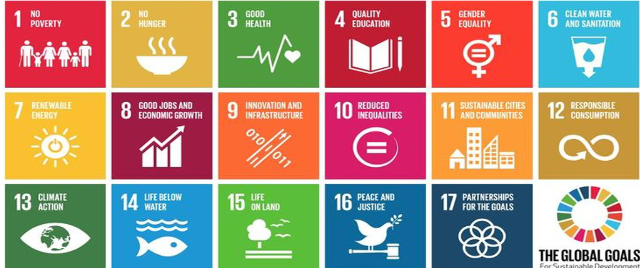
Sustainable Development Goals (SDGs)
A set of seventeen goals that were developed by the United Nations.
1. End Poverty in all its forms everywhere.
End hunger, achieve security and improved nutrition and promote sustainable agriculture.
Ensure healthy lives and promote well-being for all at all ages.
Ensure inclusive and equitable quality education and promote lifelong learning opportunities for all.
Achieve gender equality and empower all women and girls.
Ensure availability and sustainable management of water and sanitation for all.
Ensure access to affordable, reliable, sustainable and modern energy for all.
Promote sustained, inclusive and sustainable economic growth, full and productive employment and decent for all.
Build resilient infrastructure, promote inclusive and sustainable industrialization and foster innovation.
Reduce inequality within and among countries.
Make cities and human settlements inclusive, safe, resilient and sustainable.
Ensure sustainable consumption and production patterns.
Take urgent action to combat climate chance and its impacts.
Conserve and sustainably use the oceans, seas and marine resources for sustainable development.
Protect, restore, and promote sustainable use of terrestrial ecosystems, sustainably manage forests, combat desertification, and halt reserve land degradation and halt biodiversity loss.
Promote Peaceful and inclusive societies for sustainable development, provide access to justice for all and build effective, accountable and inclusive institutions at all levels.
Strengthen the means of implementation and revitalize the global partnership for sustainable development.
Economic Development
The process where increase in real per capita output and incomes are accompanied by:
1. Improvements in standards of living of the population
Reduction in poverty
Increased access to goods and services that satisfy basic needs
Improved gender equality
Increased employment opportunities and a reduction in unemployment.
Reduction of serious inequalities in incomes and wealth
Human Development
Life Sustenance - Access to basic services (merit goods) such as education and health care services, as well as satisfaction of basic needs like food, clothing, and shelter.
Self-esteem - The feeling of self-respect
Freedom - free from want, ignorance and squalor
Economic Development: Indicator
Measurable variable that indicates the state or level of something.
Monitoring how a country changes (develops) over time with respect to the attribute measured by the indicator
Making comparisons between countries with respect to the attribute
Assessing how well a country is performing with respect to particular goals or targets of development.
Devising appropriate policy measures to deal with specific problems.
Economic Development
GDP per capita & GNP per capita
GDP per capita & GNP per capita in terms of PPPs
Health Indicators: (Life expectancy at birth, Infant Mortality, Maternal Mortality)
Education Indicators: (Adult literacy, primary school enrollment, lower secondary school enrollment)
Economic Inequality Indicators (Lorenz Curve, Gini Coefficient, Minimum Income Standards, Multidimensional Poverty Index)
Social Inequality indicators (Adolescent fertility rates, prevalence of undernourishment, inequality in life expectancy, inequality in education, gender inequalities, gender inequalities, populations vulnerable to poverty, child malnutrition, infants lacking, immunization, child labour, old-age pension recipients, homeless people due to natural disaster, birth registration.
Energy Indicators: Social dimension, economic dimension, and environmental dimension.
Environmental Indicators: Describe developments affecting the environment that can be used to monitor changes and progress toward meeting environmental objectives.
Composite Indicators
Summary Measures of More than One Dimension of Development
Human Development Index (HDI)
best-known and widely use index of the United Nations of Development Programme (UNDP)
average achievement across the three equally-weighted dimensions, with 0 being the lowest value and 1 being the highest in the dimension.
Long and Healthy Life
Access to Knowledge
Decent Standard of Living
Comparisons between HDIs and GNI per capita
Inequality-adjusted Human Development Index (IHDI)
- Adjusted for inequality in the corresponding dimension.Gender Inequality Index
- Reproductive Health
- Empowerment
- Labour Market ParticipationHappy Planet Index (HPI)
- from 0 to 100
- Based on 4 dimensions
- Life Expectancy: the average number of years a person expects to live, based on United Nations Data.
- Well-being: The population’s satisfaction is measured by data collected by the Gallup World Poll.
- Ecological footprint: the impact on the environment of each individual in a society, on average. The higher the footprint, the lower the HPI.

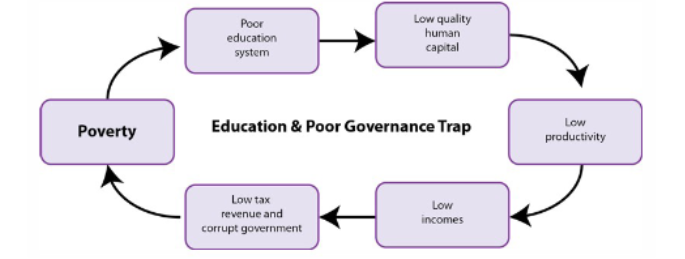
Poverty Cycle (Poverty Trap)
When low income result in low (or zero) savings, permitting only low (or zero) investments in physical, human and natural capital, and therefore low productivity of labour and of land.
Poverty: Economic Barriers to Development
Limited Access to Infrastructure
Infrastructure - Numerous types of physical capital resulting from investments, making major contributions to economic growth and development by lowering costs of production and increasing productivity.
Problems of financing: the government charges users for using the infrastructure.
Inadequate maintenance and poor quality
Limited Access by poor
Misallocation of resources
Neglect of the environment
Limited Access to appropriate technology
Appropriate technologies are technologies that are well-suited to a country’s particular economic, geographical, ecological and climate conditions.
Labour-intensive (Labour- using) technologies
Capital-intensive (Capital-using) technologies
Low Levels of Human Capital
Human Capital - the skills, abilities, and knowledge acquired by people, as well as good levels of health, all of which make them more productive.
Insufficient funding for education
Insufficient teachers or untrained teachers
Insufficient classrooms and basic facilities
Lack of teaching materials
Children with disabilities excluded
Gender Discrimination
Conflict or risk of conflict
Distance of the school from home
Inability to pay for education
Barriers to achieving good health:
Insufficient funding for health care
Insufficient access to health care services
Private payments for healthcare
Geographical access
Insufficient number of trained medical practitioners
Insufficient medical facilities and medical practitioners
Acceptability of modern medical practices
Insufficient access to clean water and sanitation
Dependence of production and exports on the primary sector
Primary Sector is a part of the economy that produces primary commodities and is dominated by agriculture, also including fishing, froestry and all extractive activities (such as mining).
Limited Access to International Markets
Developing countries have faced high-tariff barriers.
Tariff Escalation - both developing countries impose low tariffs on raw materials and much higher tariffs on processed products.
Vertical Diversification -
Agricultural trade and rich country subsidies
Global misallocation of resources
Global inefficiency
Lower export earnings of developing countries
Increased poverty among affected farmers
Informal Economy
Formal Economy - part of an economy that is registered and legally regulated
Informal economy - outside the formal economy, illegal wages are given under the table and are legally unregulated.
Capital Flight
Capital Flight - large-scale transfer of privately-owned financial capital (funds) to another country resulting from fear and uncertainty of holding domestic assets.
Indebtedness
Debt Relief - the cancellation or forgiveness of all or a portion of a country’s debt. The World Bank and International Monetary Fund (IMF) facilitate debt forgiveness in developing countries.
Geography and Landlocked Countries
Landlocked developed coutnries (LLDCs) are particularly disadvantages since in order to access ports for their exports and import activities they depend on their neighbouring countries, which they may sometimes have poor relations, or which may have poor road infrastructure, or which may face conflict and political instability.
World Trade Organization (WTO)
An international organization that provides the institutional and legal framework for the trading system that exists between member nations worldwide.
World Trade Organization (WTO): Functions and Objectives
Administers WTO trade agreements
Provides a forum for trade negotiations
Handles Trade Disputes
Monitors National Trade Policies
Provide Technical Assistance to developing nations
Facilitates cooperation with other international organizations
World Trade Organization (WTO): Criticisms and Challenges
Accused of promoting trade rules unfavourable to ELDCs
Unable to reach an agreement on agricultural protection
Accused of not distinguishing between developed & ELDCs
Accused of ignoring environmental and labour issues
Members have unequal bargaining power
Fragmentation of global trade
Blocking of its power of resolve disputes
Foreign Exchange
Refers to the Foreign National Currencies, any currencies other than its own.
Foreign exchange market (FOREX) are competitive markets linked to all domestic and foreign prices, where foreigners and domestic citizens swap dollars for foreign currency.
Exchange Rates
The rate at which on currency can be exchanged for another.
The number of units of foreign currency that correspond to the domestic currency.
The “price” of a currency, which is expressed in terms of another currency.
Example: 1 USD : 1.27 CAD ←→ 1 CAD : 0.79 USD
Demand of Foreign Exchange
Foreign households, firms, and investors buy goods and services, capital, and assets from that country.
As currency becomes less expensive, the products of that country depreciate, so people will want to buy more of its goods and services. Therefore, foreigners demand larger quantities of the currency as it depreciates.
The demand for the domestic currency generates a supply of foreign currencies.
Supply of Foreign Exchange
Domestic households, firms, and investors supply their currency on the Forex market to exchange for foreign currencies so they can buy goods and services, capital, and assets in foreign countries.
The demand for foreign currencies generates a supply of domestic currency.
Floating Exchange Rate System
An exchange rate determined entirely by market forces, or the forces of supply and demand.
No government intervention in the Forex market to influence the value of the exchange rate.
Appreciation - an increase in the value of a currency in the context of a floating exchange rate system or managed exchange rate system.
when one appreciates, it does so against all others, meaning that others will depreciate
Depreciation - a decrease in the value of a currency in the context of a floating exchange rate system or managed exchange rate system.
when one depreciates, it does so against all others, meaning that others will appreciate relative to that currency.
Causes of Changes in Exchange Rates
T - Tastes and Preferences
I - Relative Income Changes
P - Relative Price Levels
(Relative High Inflation Leads to currency depreciation)
S - Speculation
Expectation that a currency will appreciate or depreciate will lead to more or less buying of the currency.
I - Relative Interest Rates
Same direction as the value of its currency change
Other Determinants
Investment from Abroad
Appreciation of the currency
Central Bank Intervention
Buying foreign currency, results in depreciation, vice versa.
Fixed Exchange Rate System
An exchange rate system where exchange rates are fixed by the central bank of each country.
Not permitted to change freely
Still determined by demand and supply but manipulated by the central bank or government to arrive at the equilibrium that will give the desired exchange rate.
Forced to adjust to the predetermined “price”, or fixed exchange rate.
Requires constant intervention to maintain at its fixed exchange rate.
Fixed Exchange Rate System: Revaluation
Refers to an increase in the value of a currency in the context of a fixed or pegged exchange rate system.
Fewer exports and more imports
Overvalued Currency
too high relative to its free market value
used to access cheap imports for foreign countries.
Fixed Exchange Rate Systems: Devaluation
Refers to a decrease in the value of a currency in the context of a fixed or pegged exchange rate system.
Cheaper exports for foreigners and more expensive imports for domestic residents, more exports, fewer imports.
Undervaluation - a method to expand export industries, expand the economy and therefore increase employment levels.
Achieving these objectives by means of a n under value currency is considered to involve the creation of an unfair competitive advantage.
Intervention to Maintain Fixed Exchange Rates
Intervention takes the form of buying and selling reserve currencies by the central bank, as well as making other adjustments in the domestic economy.
Using Official Reserves to maintain the exchange rate
- When there is upward pressure because of excess demand, the central bank can keep on selling domestic currency and buying foreign exchangeChanging Interest Rates
- Increases in interest rates involve contractionary monetary policy and may lead to a recession in the domestic economy.
Borrowing from abroad
- Increases demand because funds come in the form of foreign currency, increasing domestic currency.
Efforts to limit imports
- Reduces the supply of the domestic currency, causing a leftward shift of the currency supply curve.
- May use contractionary fiscal and monetary policies (expenditure-reducing), which lowers AD, lowering incomes, and therefore result in fewer imports.- May use trade protection policies (expenditure-switching) which work to directly lower the quantity of imports that can enter a country.
- Contractionary policies may lead to a recession, while trade protection comes with the possibility of retaliation by trading partners.
Managed Exchange Rate Systems (Managed Float)
Exchange rates that are, for the most part, free to float to their market levels over long periods of time; however, central banks periodically intervene in order to stabilize them over the short run.
Prevent large and abrupt fluctuations in exchange rates that could arise if currencies were left entirely to market forces.
Large and abrupt exchange rate changes disrupt international trade flows and economic activity.
Many countries peg (fix) their currencies to the US dollar, and float together with it, while a few other economies peg their currencies to the euro, and float in relation to all other currencies.
Pegged currency is allowed to fluctuate only within a narrow range above and below the target exchange rate, so that if the actual exchange rate hits the upper or lower limit of the range, the central bank intervenes to keep it within the limits.
Consequences of Changes in Exchange Rates
Effects on the balance of trade
Appreciation (Increase in net exports)
Depreciation (Increase in net imports)
Demand-pull inflation
Currency appreciation will work to reduce demand-pull inflationary pressures in an economy due to a decrease in net exports.
Cost-push inflation
Currency appreciation makes imports less expensive, resulting in a rightward shift of the SRAS curve, lowering inflationary pressures in the economy.
Effects of Economic Growth
Currency Depreciation increases net exports, increasing AD.
Growth of export industries leads to increased investment spending in the domestic economy; there may be effects on aggregate supply.
The effect on GDP depends on the extent of cost-push inflation and the increase in net exports.
Effect on Unemployment
Currency Depreciation causes a fall in cyclical unemployment if the economy is in a recessionary gap, or a temporary decrease in the natural unemployment.
More employment in export industries.
More employment in industries competing with imports.
Effects on the current account balance
Depreciation closes trade deficit (more imports than exports) or expand trade surplus (more exports than imports).
Appreciation will have the opposite effect.
Effects of foreign debt
Depreciation causes foreign debt to rise, appreciation causes it to fall
Effects on living standards
More expensive to purchase imported products as real income decreases when currency depreciates.
Vice versa for currency appreciation.
Advantages of Fixed Exchange Rates
Stability
Businesses and investor prefer certainty and stability in prices.
They do not have to take into account possible changes in exchange rate when calculating costs and sales.
This simplifies business plans and reduces the costs for MNCs.
Inflation
Changes in import prices will not occur due to exchange rate fluctuations, therefore they cannot threaten internal inflation.
Exports are vulnerable to domestic inflation, which could raise export prices and reduce the demand for those exports.
The government is compelled to manage inflation to keep export prices competitive.
Speculation
There is no place for speculation to de-stabilize the exchange rate because the exchange rate is fixed.
Increased Trade
Businesses are more willing to trade due to increased certainty of a fixed exchange rate.
Disadvantages of Fixed Exchange Rates
Domestic Policy dictated by the world economy
The fixed-rate system is managed largely by manipulation of interest rates. Cannot use it for monetary policy
Inflation is dictated by world inflation.
When exchange rates are low, it might cause continuous buying of high-priced imports, which would cause imported inflation
When currency is fixed too high, it can cause a trade deficit because exports are priced uncompetitively.
Limited options with external shocks
Limit the range of options available to respond to a crisis.
Supply-side shocks become a major issue, and balance of payment disequilibrium requires government intervention.
Reserves
Large stocks of hold and foreign reserves have to be held to be able to intervene in the market to support the currency.
These resources are used to protect against speculators and instill confidence that the government can properly defend the currency.
These resources could be better used to buy and sell needed resources.
Difficulty setting the rate
The ultimate fixed rate is a complex decision, and includes many unknown factors.
A high rate can hurt exporters and the domestic industry, while a low rate may help exports but cause imported inflation.
Vulnerability to charges of unfair competition
Sustaining an undervalued currency that increases exports may encounter resentment from competitor nations. This can result in poor trade relations, trade sanctions or protectionist policies being levied against them.
Advantages of Floating Exchange Rate Systems
Domestic Policy Freedom
Auto-correction
No surplus currency reserves
Flexible responses to external shocks
Disadvantages of Floating Exchange Rate Systems
Increase uncertainty
Influence of random events
Risk of imported inflation
Destabilization
Increased Speculation
Monetary Union
A high form of economic integration involving the adoption by a group of countries of a single currency.
The adoption of a common monetary policy carried out by a single central bank, which is necessitated by the use of a single currency.
Advantages of a Monetary Union
Eliminates exchange rate risk and uncertainty
Encourages price transparency
Refers to the ability of consumers and firms to compare prices in all countries that have adopted a common currency without having to make exchange rate calculations and conversions.
Eliminates transaction costs
Significant savings that have the effect of encouraging trade, investment and financial flows of all kinds.
Promotes a higher level of inward investment
Refers to investments from outside towards the member countries with a common currency, and these can be expected to rise because of the absence of currency risk within an expanded market, resulting in greater economic growth.
Low interest rates, more investment and increased output
If a member country has a high rate of inflation, its exports become less competitive, possibly resulting in a current account deficit.
No possibility of currency depreciation to regain competitiveness since there is no domestic currency.
Member countries become committed to maintaining a low rate of inflation.
Disadvantages of a Monetary Union
Loss of domestic monetary policy
Countries are unable to carry out their own monetary policy to influence the rate of interest and hence the level of economic acitivity within their boundaries.
Undifferentiated monetary policy
Have different impact of a single monetary policy pursued by a single central bank will have varying impacts on different countries.
Loss of exchanges as a mechanism for adjustment
Cannot depreciate or devalue their own currency to pay off their debt or correct the imbalance.
They must use contractionary fiscal policy to correct the imbalance, which leads to recession
Fiscal policy is constrained by convergence requirements
Certain restrictions imposed by convergence, even if they can carry out their own fiscal policy.
Example: European Monetary Union, total public debt cannot be greater than 60% of GDP, and the budget cannot be greater than 3% of GDP.
Loss of domestic sovereignty
No longer a national central bank or government, but rather the central bank that oversees the monetary system of all the member countries of the monetary union.
Balance of Payments
Balance of payments of a country is a record (usually for a year) of all transactions between the residents of the country and the residents of all other countries.
shows credit (all payments received from other countries)
shows debits (all payments made to other countries called debits)
In the course of a year, all inflows of payments (credits) must exactly equal to the outflow of payments (debits).
The sum of all credits is equal to the sum of all debits.
All credits (inflows of money into the country) create a foreign demand for the country’s currency.
All debits (outflows of money from the country) create a supply of the domestic currency.
Structure of the Balance of Payments
Current Account - consists of the balance of trade in goods and services, net change in income and the net change in current transfers.
Capital Account - Records the transcations