MGMT 300 Exam 3 Textbook Definitions
 Call Kai
 Learn
Learn Practice Test
 Spaced Repetition
 Match
Match Flashcards
 Knowt Play
1/59

There's no tags or description
Looks like no tags are added yet.
Name | Mastery | Learn | Test | Matching | Spaced | Call with Kai |
|---|
No analytics yet
Send a link to your students to track their progress
60 Terms
CH 1
Management
The attainment of organizational goals in an effective and efficient manner through planning, organizing, leading, and controlling organizational resources.
Planning
The management function concerned with defining goals for future performance and how to attain them.
Organizing
The deployment of organizational resources to achieve strategic goals involves assigning tasks, grouping tasks into departments, and allocating resources.
Leading
Using influence to motivate employees to achieve the organization's goals.
Controlling (POLC) framework
Is concerned with monitoring employees' activities, keeping the organization on track toward meeting its goal and making corrections as necessary.
Effectiveness vs Efficiency
Effectiveness: The degree to which the organization achieves a stated goal.
Efficiency: The amount of resources—raw materials, money, and people—used to produce a desired volume of output.
Technical Skills
The understanding of and proficiency in the performance of specific tasks.
Human/Interpersonal Skills
A manager's ability to work with and through other people and to work effectively as part of a group.
Conceptual Skills
The cognitive ability to see the organization as a whole and the relationships among its parts.
Functional vs. General Manager
General: Indirectly influences all organizations within an industry; includes five dimensions.
Functional: A manager responsible for a department that performs a single functional task, such as finance or marketing.
Top vs Middle Manager
Top: A manager who is at the top of the organizational hierarchy and is responsible for the entire organization.
Middle: A manager who works at the middle level of the organization and is responsible for a major division or department.
Important vs Urgent
Important: Long-term goals, strategy
Urgent: Immediate issues
Gabarro & Kotter—Managing Your Boss:
Nature of the Boss-Subordinate Relationship
- Not top-down only
- Both sides need each other to succeed
Mutual Dependence
Boss and subordinate depend on each other.
Work Style Compatibility
Understand how your boss works (communication, decision style)
Mutual Expectations
Clarify:
- What your boss expects from you
- What you need from your boss
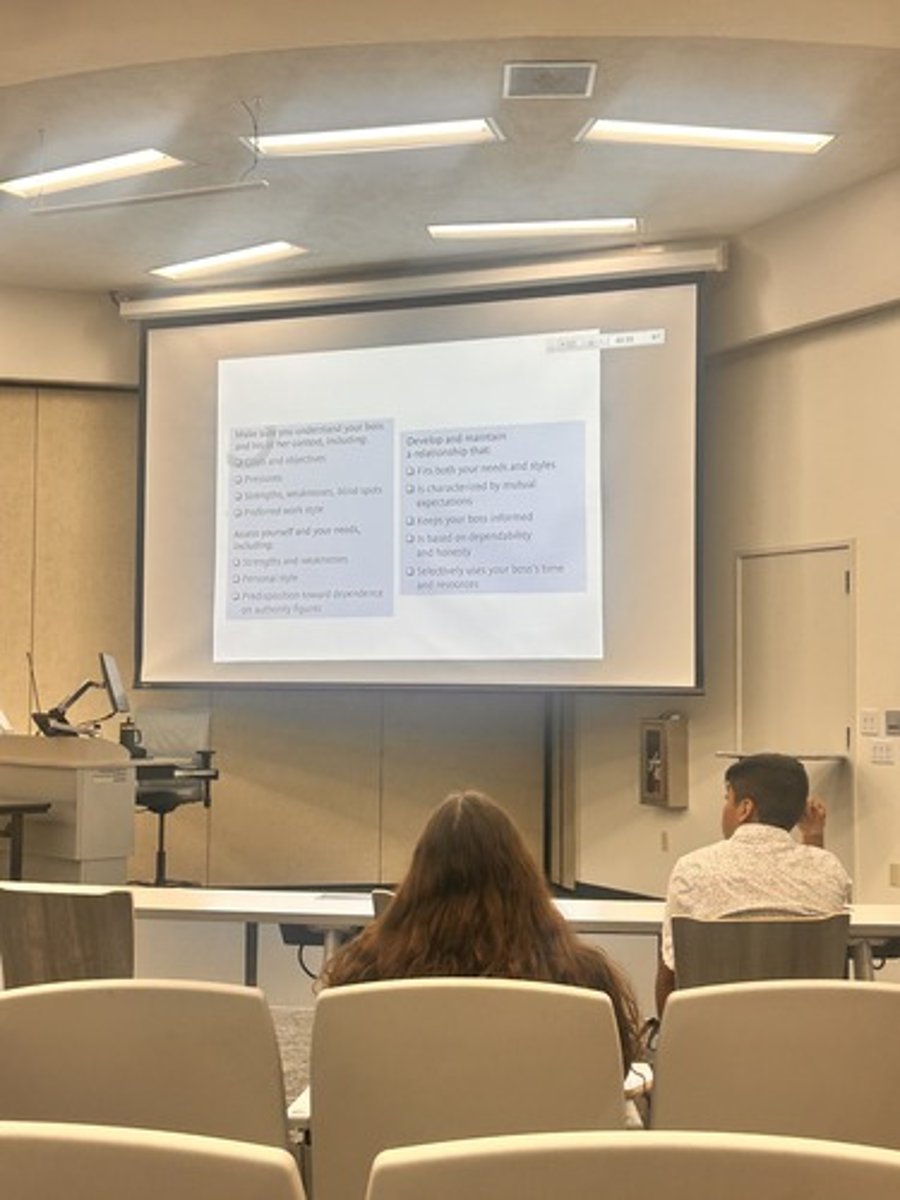
All Items on the Checklist for Managing Your Boss (page 9)
CH 7:
Goals/plans
Goal: A desired future state that the organization wants to realize.
Organizational Planning Process
Steps managers take to:
- Set goals
- Develop plans
- Allocate resources
Strategic vs Operational Plans
Strategic: Action steps by which an organization intends to attain strategic goals.
Operational: A specific, measurable result that is expected from departments, work groups, and individuals.
Benefits/Limitations of Planning
Benefits:
- Direction
- Coordination
- Reduced uncertainty
Limitations:
- Time-consuming
- Can reduce flexibility
- May become outdated
Contingency Plans and Scenario Planning
Contingency Plan: Identifies important factors in the environment and defines a range of alternative responses to be taken in the case of emergencies, setbacks, or unexpected conditions.
Scenario Planning: An approach where managers look at trends and discontinuities and imagine possible alternative futures to build a framework within which unexpected future events can be managed.
Crisis Prevention vs Preparation
Crisis Prevention: Avoiding crisis
Crisis Preparation: Planning response when crisis occurs
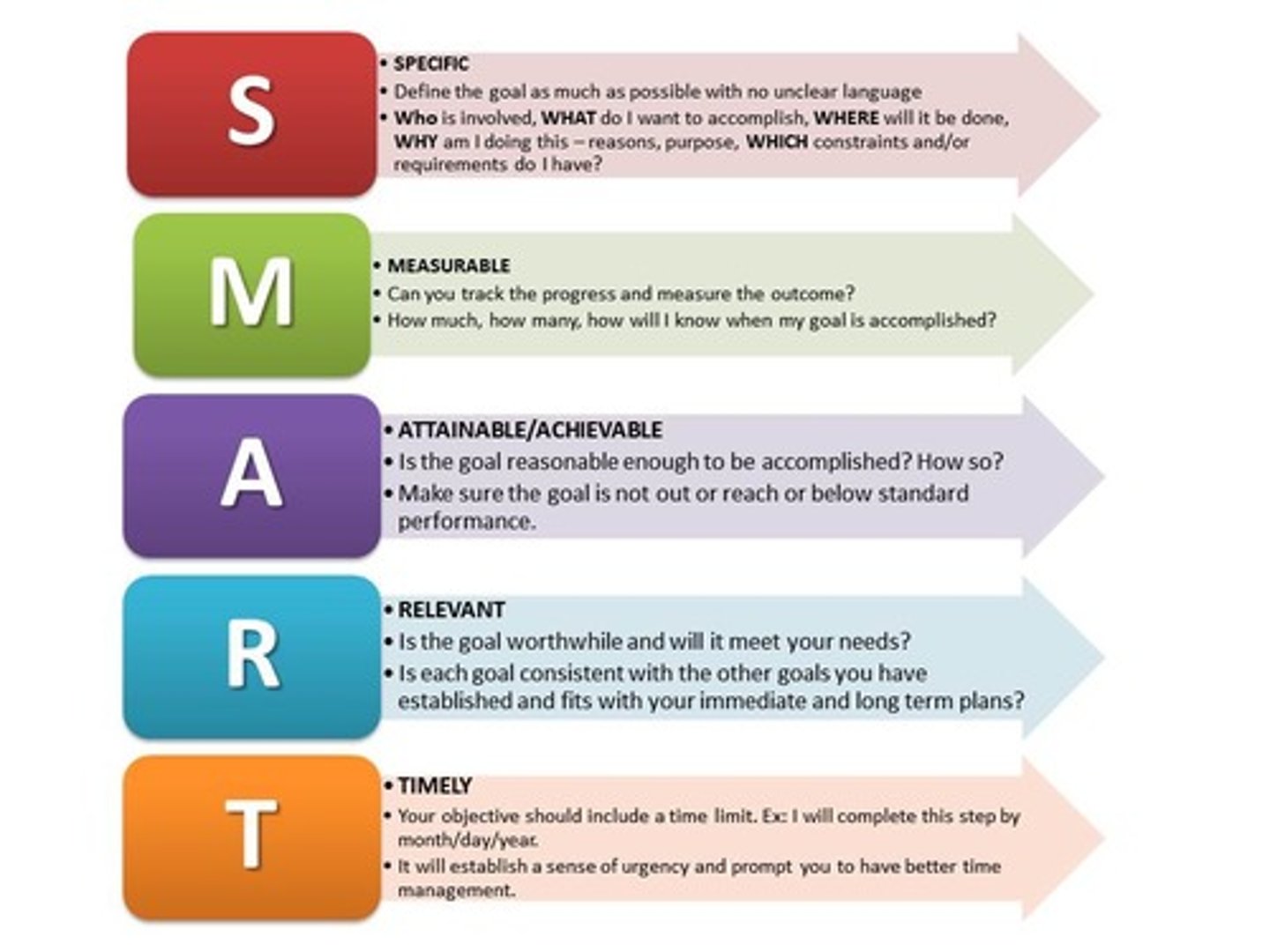
Effective Goal Criteria (Exhibit 7.5)
Stretch Goal
A reasonable yet highly ambitious and compelling goal that energizes people and inspires excellence.
CH 8:
Competitive Advantage
Refers to what sets the organization apart from others and provides it with a distinctive edge in the marketplace.
Core Competence
Something that the organization does particularly well in comparison to others.
Corporate Level Strategy
Pertains to the organization as a whole and the combination of business units and products that make it up.
Business Level Strategy
Pertains to each business unit or product line within the organization.
Functional Level Strategy
Pertains to the major functional departments within each business unit, such as manufacturing, marketing, and research and development (R & D).
SWOT Analysis
An audit or careful examination of strengths, weaknesses, opportunities, and threats that affect organizational performance.
Strategic Business Unit
A division of the organization that has a unique business, mission, product or service line, competitors, and markets relative to other units of the same organization.
Related vs. Unrelated Diversification
Diversification: The strategy of moving into new lines of business.
Related:
- Businesses are connected
Unrelated:
- Businesses are not connected
Vertical Integration
A strategy of expanding into businesses that either provide the supplies needed to make products or distribute and sell the company's products.
Porter's five competitive forces + complements (know/understand all five forces)
1. Rivalry among competitors
2. Threat of new entrants
3. Threat of substitutes
4. Buyer power
5. Supplier power
(+ complements = products that increase value)
Differentiation Strategy
A strategy with which managers seek to distinguish the organization's products and services from those of others in the industry.
Cost Leadership Strategy
A strategy with which managers aggressively seek efficient facilities, cut costs, and use tight cost controls to be more efficient than others in the industry.
CH 10:
Organization Structure
The framework in which an organization defines how tasks are divided, resources are deployed, and departments are coordinated.
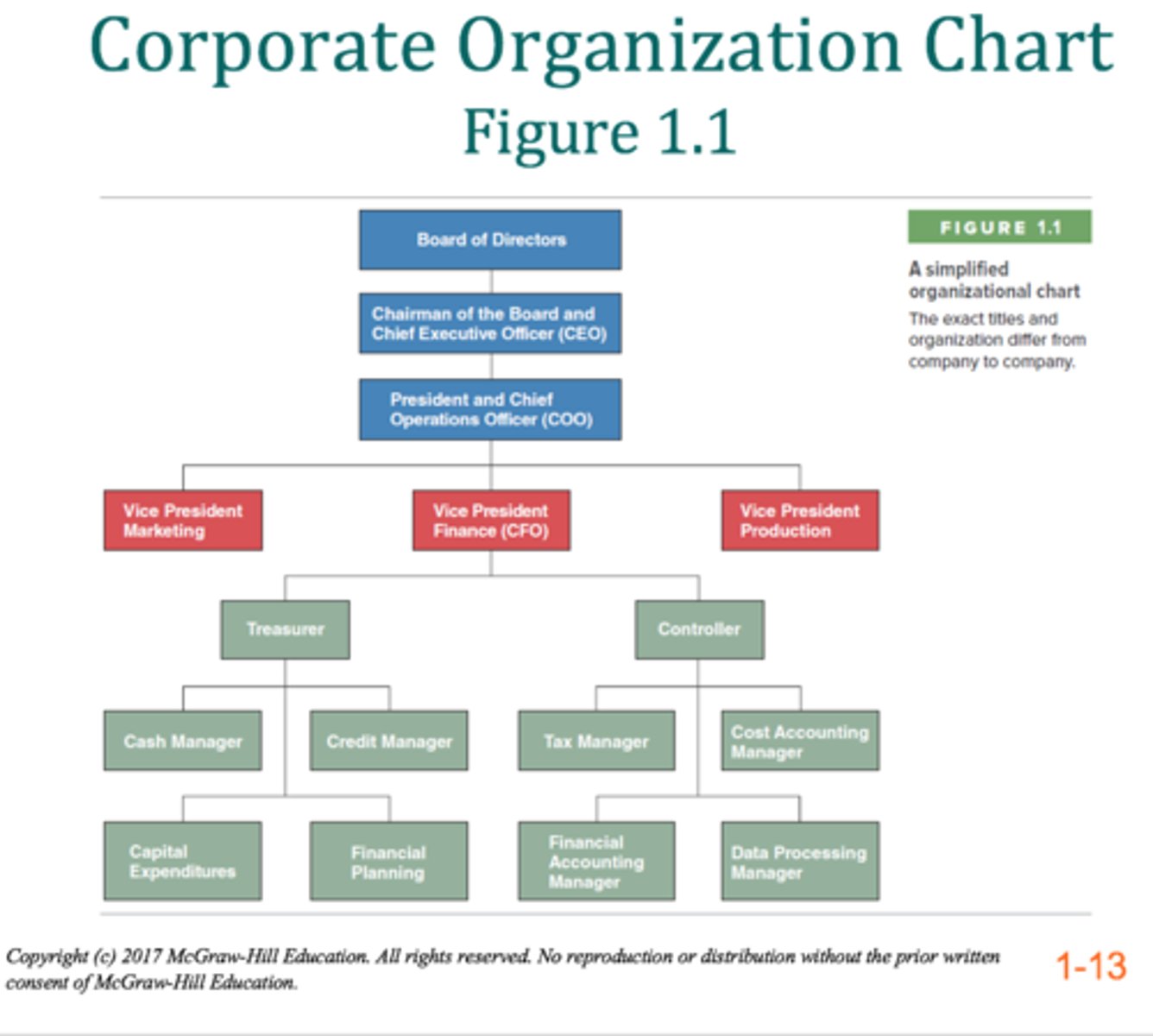
Organization Chart
Specialization
Sometimes called division of labor, it is the degree to which organizational tasks are subdivided into separate jobs.
Chain of Command
An unbroken line of authority that links all individuals in the organization and specifies who reports to whom.
Unity of Command
Means that each employee is held accountable to only one supervisor.
Authority vs. Power
Authority: The formal and legitimate right of a manager to make decisions, issue orders, and allocate outcomes desired by the organization.
Power: The potential ability to influence the behavior of others.
Delegation
When managers transfer authority and responsibility to positions below them in the hierarchy.
Reporting Relationship
Who reports to whom.
Vertical Linkages
Connect levels of hierarchy.
Horizontal Linkages
Connect across departments.
Line vs Staff
Line:
- Directly involved in core work.
Staff:
- Support roles (HR, legal, etc.)
Tall vs Flat Structure
Tall structure: An organizational structure characterized by an overall narrow span of management and a relatively large number of hierarchal levels.
Flat structure: An organizational structure characterized by an overall broad span of management and relatively few hierarchical levels.
Centralization vs. Decentralization
(and reason for having one vs the other)
Centralization: Means that decision authority is located near top organization levels.
Decentralization: Means that decision authority is pushed down to lower organization levels.
Functional Structure
An organizational structure in which activities are grouped together by common function from the bottom to the top of the organization.
Divisional Structure
An organizational structure that groups employees and departments based on similar organizational outputs (products or services), such that each division has a mix of functional skills and tasks.
Matrix Structure
Combines aspects of both functional and divisional structures simultaneously in the same part of the organization. It has evolved as a way to improve horizontal coordination and information sharing.
Task Force
A temporary team or committee designed to solve a problem involving several departments.
Service Technology
Characterized by intangible outputs and direct contact between employees and customers.