Economics 4.0-4.8 Macro
 Call Kai
 Learn
Learn Practice Test
 Spaced Repetition
 Match
Match Flashcards
 Knowt Play
1/51

There's no tags or description
Looks like no tags are added yet.
Name | Mastery | Learn | Test | Matching | Spaced | Call with Kai |
|---|
No analytics yet
Send a link to your students to track their progress
52 Terms
Local government role
Public activities- provide g/s eg. public libraries, housing, public parks, hospitals, schools
Collect taxes, toll charges, financial grants for budget
Implement local budget- spent on welfare of local area
National government role
Employs workers- Macro aim: increase employment levels
Price controls and wages
Training and pension schemes- increase productivity
Essential public services where huge input costs are involved
Provide merit goods- demand g/s from private sector.
Natural monopoly
Single firms that can produce for the entire market (rather than two or more smaller firms)
eg. utilities like water and electricity, railroads
Strategic industries
An industry needed to protect or feed the country.
eg military, agriculture
International government role
International trade- economic growth and development
Tariffs and quotas (trade restrictions)
Trading bloc (Free trade policies to increase mobility of FoP)
5 macro aims of the government
Price stability - low and stable inflation
Low Unemployment
Economic growth- raise living standards and increase PP
Trade- balance of payments stability
Public Welfare - redistribution of income
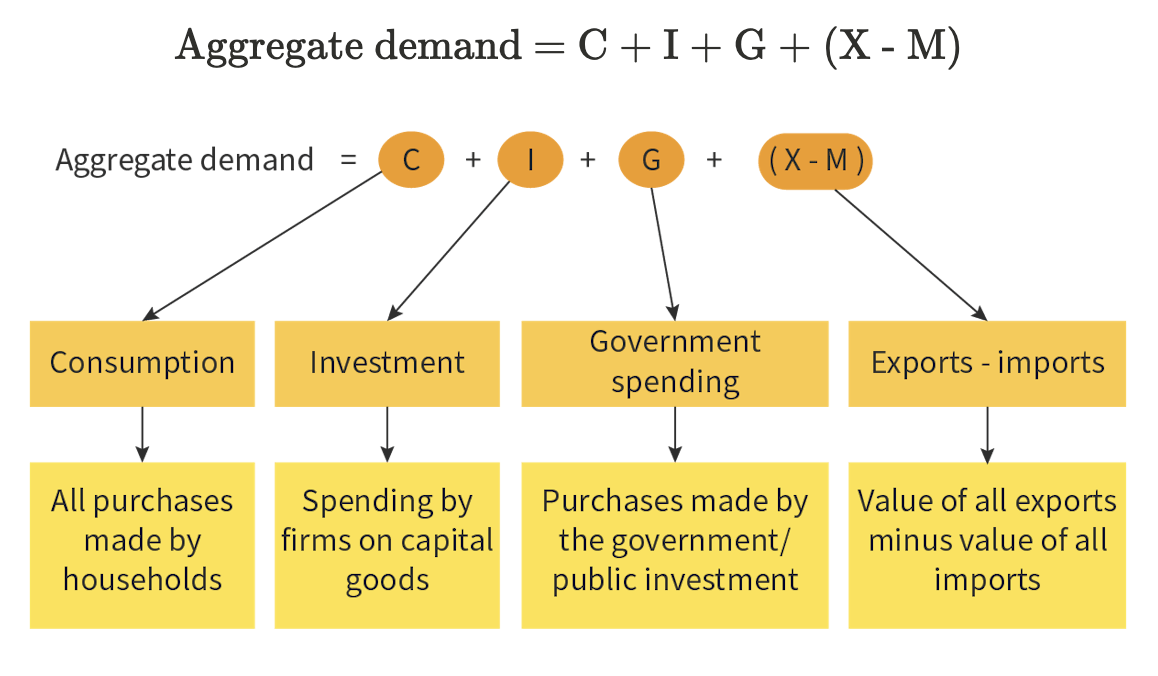
Aggregate demand and how to measure it
Total quantity of goods and services that are demanded in an economy over a period of time at a given price level.
Increases whenever any one of the components increase, shifting to the right.
Aggregate supply
Total amount of goods and services produced in an economy over a period of time at a given price level.
Long term causes of economic growth
Discovery of natural resources
Technological advancements - Increased productivity
Population growth- expand labour force and increase AD
Training and up-skilling - increase efficiency, more output with same inputs due to more skilled workforce
Productive capacity
the maximum potential output of goods and services an economy can produce when all its resources are fully employed
Short Term causes of economic growth
(Policies to promote economic growth)
Expansionary Monetary policy: lower interest rates,
Expansionary Fiscal policy: lower taxes, increase gov spending
More infrastructure will lower costs for businesses and increase economic activity and efficiency
Limitations of demand side policy and
Only effective if the economy has spare capacity.
If taxes and interest rates are already low in the economy, there may be no room to reduce them further, impacting tax revenues.
Recession: Consumer and business confidence is low
Spare capacity
Physical capital that businesses have which is not used in production; the unemployment of resources.
When the economy is not working at full potential and all factors of production are not fully employed.
Benefits of economic growth
Increase in employment as demand and output increases (derived demand)
Increased income—> more tax revenue —> government provide public goods eg healthcare and education—> increased life expectancy
Increased tax revenue—> gov help redistribute income—> reduced poverty levels
Stable price levels as increased output can match increased demand created in economy
Increase in exports as more businesses are attracted to invest in high EG countries, bringing more export revenue
Costs of economic growth
Destroys environment by depleting natural resources - deforestation, pollution decreases non-material SOL
Higher income inequality- skilled workers have higher demand but low skilled will not.
Inflation: more employment—> increases AD for g/s—> prices of g/s increasing in the market—> if no increase in AS—> demand pull inflation
Gov in debt: lower tax and higher spending (fiscal) causes budget deficit.
Causes of recession: Demand side shocks
Sudden changes that increase or decrease demand for goods or services in the economy in the short term.
Falling consumer and business confidence: not optimistic about the future
Higher interest rates: disincentive to firms and consumers to borrow money
Increased rates of unemployment: low profits lead to businesses cutting wages or laying off workers.
Causes of recession: Supply side shocks
Sudden and unexpected changes in the cost of factor inputs, such as oil prices, commodity prices or wages.
Bad weather: poor harvest, more exp to buy raw materials
Worker strikes: lower productivity and industrial halts
Consequences of recession
High unemployment: increased gov spending to provide unemployment benefits
Lower wages
Reduced tax revenue
Reduced investment and consumption
Types of inflation
Demand pull
Cost push
Imported
Monetary
Inflation definition
The sustained increase in the general/average price level in an economy over a period of time
CPI and its purpose (idk this bru)
Measures inflation: weighted average of prices for a "basket" of goods and services that an average household purchases.
Purposes:
Economic indicator: measures price inflation and changes in cost of living
Adjusting Incomes: adjusts wages, pensions, and benefits to ensure purchasing power is maintained
Calculating Real Values: It is used to calculate "real" economic data, such as real wages or real GDP, by stripping out the effects of price changes.
Deflation- negative inflation
Sustained decrease in general price level in an economy over a given period of time
Disinflation
Fall in the rate of inflation.
It simply means that prices are still rising in the economy but at a slower pace than the year before.
Hyper inflation
Occurs when the prices of goods and services rise at a very high rate and are out of control.
Decreases purchasing power of currency
Demand pull inflation
Persistent increase in AD (due to CIGX-M factors), rising faster than the AS of g/s
Depreciation of domestic currency→ reduced price of exports→ increased demand from foreign countries→ exports>imports
More expensive for locals to buy imported goods→ reduced demand for imports→ rising exports, lower imports→ increased AD for domestic products
Cost push inflation
Causes:
Rising wages (trade unions bargaining)
Higher cost of production due to shortage of FoP
Supply chain disruptions (trade routes closures)
Imported inflation
Causes:
Trading partner experiences inflation and overheating in economy
Domestic currency of foreign country appreciates
Locals have to pay a higher price for imported goods
Monetary inflation
Causes:
Excessive printing of money
How to reduce demand pull inflation
Contractionary fiscal policy
Contractionary monetary policy
Limitations of policies to reduce demand pull inflation
Reduces GDP and economic growth
Increases unemployment
Unpopular
How to reduce cost push inflation
Supply side policies
- Retraining and upskilling workers
- Switch to technology
-Get rid of trade unions
-Reduce wastage
-Provide subsidies and tax cuts
-Reduce trade barriers: sign agreements w countries abundant in FoP
Limitations of policies to reduce cost push inflation
Takes a long time to retrain workers
Requires a lot of resources (high opp cost)
Uncertain
Expensive
Switching to tech causes unemployment
Getting rid of trade unions causes strikes and worker exploitation
Subsidies may lead to budget deficit and gov debt
Agreements take a long time
How to reduce imported inflation
Appreciate domestic currency to make it cheaper to buy foreign goods
Find alternative trading partners
Limitations of policies to reduce imported inflation
Takes a long time to find partners
Lower exports and higher imports decreases AD, decreases real GDP and increases unemployment
How to reduce monetary inflation
Contractionary monetary policy: reduce supply of money and increase interest rates
Strengthen exchange rates
Unemployment rate and formula
Those who are not employed but are willing and able to work
Expressed as a percentage of country labour force

Labour force
The total number of workers available for employment. Includes unemployed who are actively seeking work.
Participation rate
Labour force as a proportion of total working age population
Employment status
Whether people are fully employed, part time or temporarily
Cyclical unemployment
Causes:
Recession: falling consumer demand for g/s→firms lose profits→ reduce output→lay off workers or cut wages→unemployment
Policies:
Expansionary fiscal policy
Expansionary monetary policy
Structural unemployment
Cause:
Changes in industrial structure: decline or closure due to permanent fall in demand for g/s
When an industry relocates to another country and people cannot move with it due to commitments usually family.
Policies:
Supply side policies
Frictional unemployment
Cause:
Short lived unemployment when people quit jobs or move to higher paid jobs or move homes
eg. grad students
Policies: (no exact)
Career guidance
Improve job information services
Job matching platforms
Seasonal unemployment
Cause:
Consumer demand changes according to seasons
eg. ski instructor
Policies:
Supply side: training and improve geographical mobility
Technological unemployment
Cause:
Labour is replaced by technology
Policies:
Supply side: Training and education
Labour market reforms to increase efficiency of workforce (gov role)
Decrease unemployment benefits: encourages people to work
End minimum wage: businesses will be incentivised to hire more workers
Weaken trade unions: less strikes and industrial halts that reduce output
Privatisation: transfer of ownership from the public sector to the private sector to increase the efficiency of resources employed and total supply of g/s demanded by consumers. (profit motivated)
How to measure unemployment (Claimant method)
Claimant count: measure of the number of people who are out of work and eligible to claim unemployment benefits.
Limitation:
Does not count those people who cannot apply for benefits eg students, high savings, under government training schemes, part timers
A few people claim unemployment benefits by fraud
How to measure unemployment (Labour Force Survey method)
Collect information on the no. of people employed in a household. Employment status, educational qualifications and government training opportunities.
Limitations:
It is difficult for the government to decide whether a person is sick or whether he/she is actively looking for work.
It takes time to get info and analyse it
Sampling errors can occur. Results may not truly represent the entire population.
Consequences of unemployment
will not contribute to a nation’s GDP and consumption (loss of income)
tax revenues for the government will fall
more people claiming unemployment benefits
Stress, debt, homelessness, increased crime
Limitations of CPI
Over time, the typical household and basket of g/s will change
change tastes
Introduction of new g/s
change in population
change in quality of g/s
international comparisons are difficult
How can be alleviate limitations of CPI
Updating basket of goods, weighting, base year but this can make more comparisons difficult over longer periods of time and internationally.
What is the difference between Real GDP and Nominal GDP
Nominal GDP measures the value of all g/s produced within an economy at current market prices without adjusting for inflation.
Real GDP adjusts this value for inflation, providing a more accurate reflection of actual output growth over time.