cH 11-2 Jupiter vital stats atmosphere
 Call Kai
 Learn
Learn Practice Test
 Spaced Repetition
 Match
Match Flashcards
 Knowt Play
1/75

There's no tags or description
Looks like no tags are added yet.
76 Terms
Jupiter
5th largest planet
200x that of all planets combined
oldest
dust and gas from Suns formation
2nd brightest
roman god of sky
if hollowed out it can fit roughly 1000 Earths fit
Where are the Jovian planets located in the Solar System?
In the outer Solar System, beyond the asteroid belt.
Which planets are classified as Jovian planets?
Jupiter, Saturn, Uranus, and Neptune.
What separates the terrestrial planets from the Jovian planets?
The asteroid belt.
Why were Jovian planets able to become much larger than terrestrial planets?
They formed in the colder outer Solar System, where ice and gas were abundant.
how long does it take for the sun to reach Jupiter?
43 minuets become it is outside asteroid belt but inside Kuiper
some characteristics of Jupiter
orbital period 8.6 years
orbit: 5.2 AU
closest Jovian to Sun
many moons that vary in site and properties
What do observations of Jupiter reveal about its atmosphere?
Jupiter has a dynamic atmosphere with cloud bands, strong winds, and large storms such as the Great Red Spot.
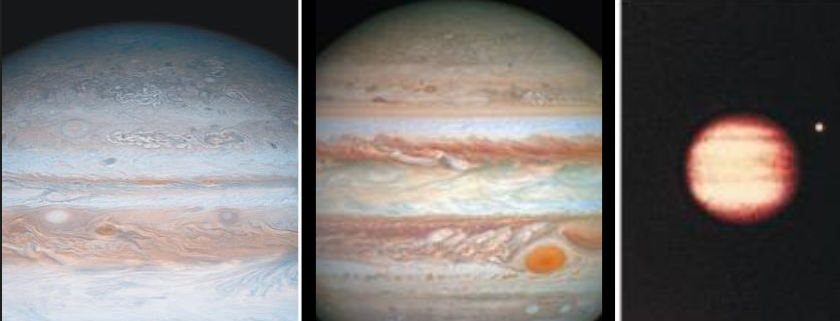
What are three ways Jupiter has been observed (L-R)?
By spacecraft, space telescopes, and ground-based telescopes.
Cassini spacecraft
Hubble space telescope
small telescope from Earth
why is Jupiter easy to locate?
because bright
light and dark bands due to atmosphere
giant “eye”
what is the mass of Jupiter?
1.9 × 1027 kg (more than twice as much as all other planets put together)
2 ½ x of all planets combined
what is the radius of Jupiter?
69,886 km (10.9 times Earth’s)
11x wider than Earth
what is the density of Jupiter?
1300 kg/m3 (cannot be rocky or metallic)
¼ average of Earths primarily H and He (lower d)
size comparison of Jupiter to Earth
if Earth was a grape, Jupiter would be a basketball
Why is Jupiter's rotation period difficult to determine?
Jupiter has no solid surface, and different parts of its atmosphere rotate at different rates.
How do scientists determine Jupiter's true rotation period?
By measuring the rotation of Jupiter's magnetic field.
What is Jupiter's rotation period?
Approximately 9 hours 55 minutes.
shortest day in Solar System
how long would it take Jupiter to orbit?
12 Earth years
how is Jupiter tilted to orbital path?
3°
spins upright
what is the result of Jupiter’s short rotation period?
less extreme seasons
equatorial atmosphere rotates faster
Jupiter’s atmosphere
colourful stirpes and spots
ever changing bands of cloud circular planets, parallel to equator
cyclonic storms pole to pole
chemical composition of Jupiter
86.1% molecular H (CH2)
13.8% He
small amounts of methane, ammonia, and water vapor
What are Jupiter's zones?
Bright, cooler, high-altitude bands in Jupiter's atmosphere.
above upward moving convection currents
What are Jupiter's belts?
Dark, warmer, lower-altitude bands in Jupiter's atmosphere.
regions representing the other part of convection cycle material generally shrinking
How do zones differ from belts on Jupiter?
Zones are brighter, cooler, and higher, while belts are darker, warmer, and lower.
What is zonal flow?
A stable pattern of east-west atmospheric circulation that produces Jupiter's zones and belts.
Which are higher in Jupiter's atmosphere: zones or belts?
Zones are higher than belts.
What causes Jupiter's bands?
Different wind speeds and directions in Jupiter's atmosphere create alternating zones and belts.
How many major atmospheric bands does Jupiter have?
About 16 major bands, which can change over time.
What are Jupiter's bright zones believed to contain?
Ammonia ice clouds.
What gases make up most of Jupiter's atmosphere?
Hydrogen and helium.
What are Jupiter's jet streams like?
They reach extreme speeds and help maintain the planet's zones and belts.
What is zonal flow on Jupiter?
The motion of Jupiter's atmospheric bands relative to the planet's internal rotation rate.
What causes Jupiter's zones and belts?
Strong east-west winds called zonal flows.
How is zonal flow measured?
By comparing atmospheric wind speeds to Jupiter's internal rotation rate.
where do zones lie?
slightly higher in atmosphere than belts
How do Jupiter's atmospheric winds vary with latitude?
They alternate between eastward and westward jet streams.
What happens to Jupiter's wind speeds toward the poles?
Wind speeds generally decrease toward the poles.
What creates Jupiter's zones and belts?
Alternating eastward and westward zonal winds create the banded appearance.
what is the composition of Jupiter’s atmosphere
mostly molecular hydrogen (90%) and helium (10%); small amounts of methane, ammonia, and water vapor
cannot account for color
what may be the result of Jupiter’s colour?
probably due to complex chemical reactions
colorful plumes of sulfurs containing gases raising from interior and ammonia ice clouds
Does Jupiter have a solid surface?
No. Jupiter is a gas giant with no solid surface.
What is considered 0 km on Jupiter?
The top of Jupiter's troposphere.
Why can't optical telescopes see Jupiter's lowest cloud layer?
The upper cloud layers block the view.
What did the Galileo probe discover about Jupiter's winds?
Wind speeds remain very high even deep within the atmosphere.
What is the likely source of Jupiter's atmospheric energy?
Internal heat from the planet rather than solar heating.
where does the troposphere lie?
thin faint layer of haze created by photochemical reactions
Jupiter’s stratopshere
dynamic
temp. inversion
polar winds
4-5 years
Jupiter’s haze layer
sunlight reaction with methane
thin
what are the three cloud layers of Jupiter?
ammonia ice
ammonium hydrosulfide ice
sulfur
water ice
lowest cloud
80km below troposphere
What is the Great Red Spot?
A giant, long-lived storm in Jupiter's atmosphere.
How long has the Great Red Spot existed?
At least 300 years and possibly much longer.
Why is the Great Red Spot scientifically interesting?
its red color and long-term energy source are still not fully understood.
Why can the Great Red Spot last for centuries?
Jupiter has no solid surface to slow the storm or remove its energy.
How large is the Great Red Spot?
It is larger than Earth.
What are conditions like at the center of the Great Red Spot?
the center is relatively calm compared with the surrounding winds.
What is upwelling in the Great Red Spot?
The upward movement of gas that cools and forms ammonia clouds.
Why is the Great Red Spot able to persist for centuries?
Jupiter lacks a solid surface to weaken storms, and internal energy helps maintain the giant atmospheric vortex.
great red spot visually anominated by 2 features?
ever changing atmosphere bands arranged parallel to equator
oval atm. blob
What evidence suggests Jupiter experiences thunderstorms?
Lightning-like flashes have been observed in Jupiter's atmosphere.
occurs on increased altitudes in extreme conditions
similar as Earth
Does Jupiter have storms other than the Great Red Spot?
Yes. Jupiter has many smaller rotating storms that are generally shorter-lived.
What is the Brown Oval on Jupiter?
A feature located deeper in Jupiter's atmosphere that can be seen through a large gap in the upper cloud layers.
often appear green due to mixing of water and ammonia
Why is the Brown Oval visible?
Because a large opening in Jupiter's clouds allows us to see deeper atmospheric layers.
Does Jupiter radiate more energy than it receives from the Sun?
Yes. Jupiter emits more energy than it absorbs from sunlight.
Why does Jupiter emit more energy than it receives from the Sun?
Because it is still releasing heat generated during gravitational compression when it formed.
What is gravitational compression?
The squeezing of material by gravity, which generates heat.
Is Jupiter's extra energy produced by nuclear fusion?
No. Jupiter's extra energy comes from gravitational compression and slow cooling.
what does the internal structure of Jupiter tell us about its evolution
no direct interpretation but by measurements taken from SC and Theo model
what does movements and density variations cause?
thick gas can alter gravitation field above surface
what is theorized about Jupiter’s excess energy?
is the slow escape of gravitational energy
as the planet took shape, some gravitational energy was converted into the heat interior
slowly leaking out
star-like composition
what are the layers of Jupiter?
atmosphere
outer interior
turbulent
liquid H and He
interior
liquid metallic H
extreme temp. and increase force H to conductive state
electrical dynamo
core
large and fuzzy
mix dilute and non-uniform region that blends gradually into surround liquid H
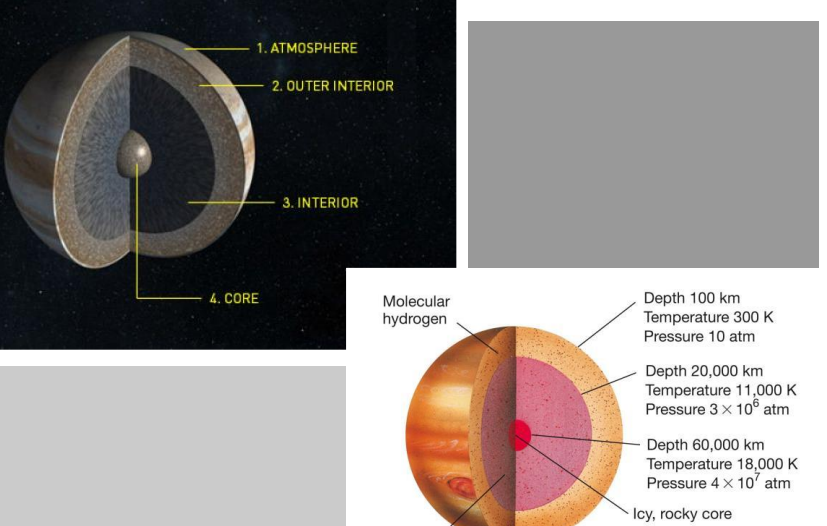
what does temp. and density of Jupiter’s atm increase with?
with depth below cloud cover
What happened to Comet Shoemaker–Levy 9 in 1994?
It broke into fragments and collided with Jupiter.
When did Comet Shoemaker–Levy 9 impact Jupiter?
July 1994.
Why was the Shoemaker–Levy 9 impact scientifically important?
it provided a rare opportunity to directly observe a major comet impact and study its effects on Jupiter.
What happened to Shoemaker–Levy 9 before it struck Jupiter?
Jupiter's gravity pulled the comet apart into multiple fragments.