body fluid compartments
 Call Kai
 Learn
Learn Practice Test
 Spaced Repetition
 Match
Match Flashcards
 Knowt Play
1/12

There's no tags or description
Looks like no tags are added yet.
Name | Mastery | Learn | Test | Matching | Spaced | Call with Kai |
|---|
No analytics yet
Send a link to your students to track their progress
13 Terms
examples of where fluid can exist in the body
intracellular (inside the cells)
extracellular
plasma
interstitial
transcellular (fluid trapped in spaces surrounded by epithelial cells)
examples of trenscellular fluid
Fluids trapped within spaces are surrounded completely by epithelial cells:
Synovial fluid
Cerebrospinal fluid
Aqueous humour
Pericardial fluid
Pleural fluid
how can you measure a compartments volume
requirements for the tracer
Measurement of compartment volume:
Inject knows volume of a tracer substance at a known concentration into the compartment
Allow it to equilibrate through the compartment and then measure the concentration in that compartment
The tracer needs to be:
Non-toxic and easy to assay
Doesn’t alter normal fluid distribution
Doesn’t get metabolised/ taken up by cells
Rapidly/ evenly distributed through compartment
Not significantly excreted during equilibrium period
fluid compartment calculation equation
Tracer vol. X tracer conc. = compartment vol. X final conc.
Compartment vol = (tracer vol. X tracer conc.)/ final conc.
if you want plasma volume, what should the tracer be able to bind to
Use tracers that bind to albumin in the blood (evans blue)
what are starling forces
P,O
explains the physical pressures that determine how fluid moves between the bloodstream and surrounding tissues
hydrostatic pressure (pusher)
osmotic pressure (puller)
what determines osmotic pressure in plasma
what does Kf represent in filtration equation
what is the reflection coefficient and what symbol is it represented by
albumin protein
filtration coefficient - permeability of the capillary to water
reflection coefficient - how impermeable the capillary is to proteins (σ)
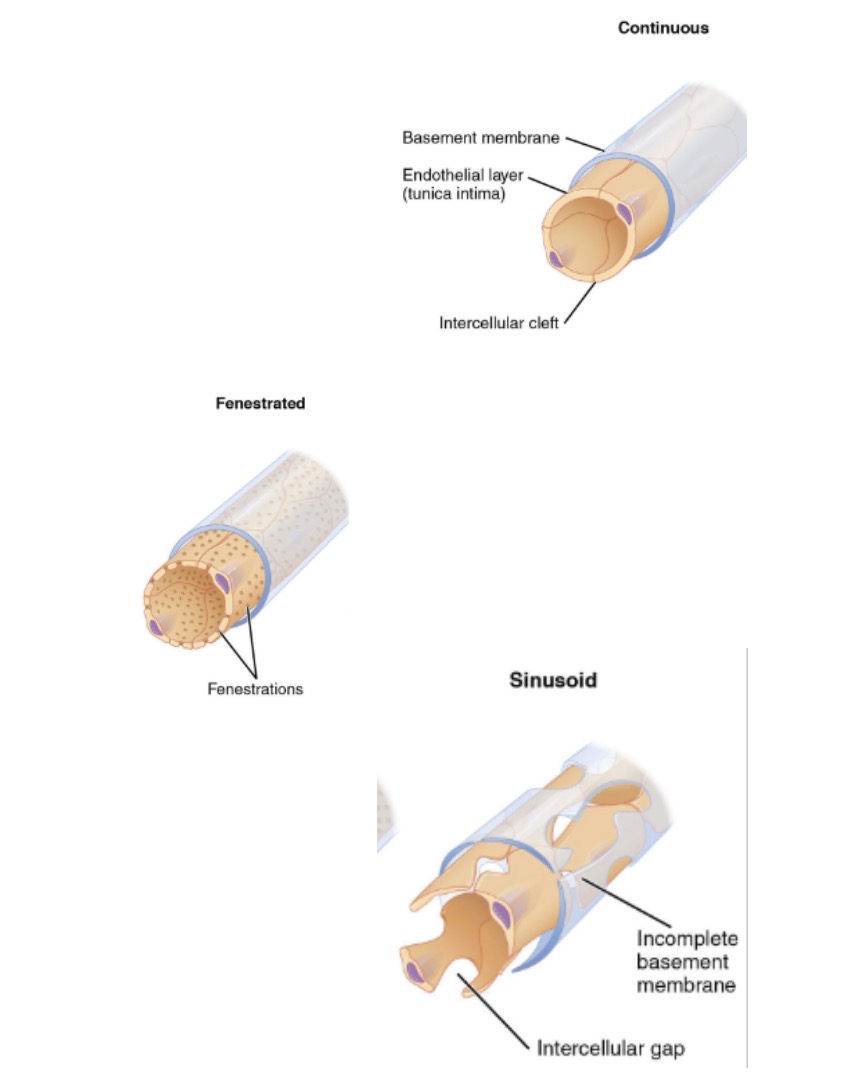
what feature of capillaries affects the capillary Kf
name the 3 types
more of these affects the Kf how
Endothelial structure affects capillary Kf (fenestrations/permeability)
Continuous
Most capillary beds
Fenestrated
Kidneys
Sinusoidal/discontinuous
Liver/ spleen
More fenestrations------> higher Kf
inflammation
how does it affect Kf
how does it affect σ
what happens during inflammation
endothelium
BF
what exits the blood stream
what plasma protein leaks
Inflammation:
Inflammatory mediators trigger increased Kf and decreased 𝜎 , via activation of endothelial cells
During inflammation
WBCs cause the activation of endothelial cells causing:
Activation of smooth muscle cells = vasodilation
Breakdown of tight junctions
Inflammatory mediator production/secretion
Increased blood flow
Leukocytes leave the blood stream
Neutrophils, NK cells
Leakage of plasma proteins
Complement
lymphatic system
where does filtrate travel to
venous plasma
osmotic pressure
what channel protein allows water to travel through cells
what is one unit of osmotic concentration
what is normal plasma osmolarity
what is the process of managing osmosis called
Water shifts between intracellular and extracellular compartments along an osmotic pressure gradient, using aquaporins.
Osmole= unit of osmotic concentration
Normal plasma osmolarity is 290 mOsmoles/L
osmoregulation
what are the 3 states of osmosis
HYPERTONIC:
Cells loose water by osmosis
Interferes with cellular function
ISOTONIC:
There is an equal amount of water leaving and entering the cell
HYPOTONIC:
Cells take up water by osmosis and expand
Could cause lysis
rehydration
2 routes
Orally (enters through the GIT)
IV fluid resuscitation (intravenously)
Crystalloid (solutions containing Nacl)
Colloid (albumin, starches, gelatin solutions)
water