Astro Spectroscopy
 Call Kai
 Learn
Learn Practice Test
 Spaced Repetition
 Match
Match Flashcards
 Knowt Play
1/18

There's no tags or description
Looks like no tags are added yet.
Name | Mastery | Learn | Test | Matching | Spaced | Call with Kai |
|---|
No analytics yet
Send a link to your students to track their progress
19 Terms
Black body
idealized physical body that absorbs all incident EM radiation, regardless of wavelength or angle of incidence.
Planck function
describes the spectral density of electromagnetic radiation emitted by a black body in thermal equilibrium at a given temperature. (radiation spectrum of a black body)
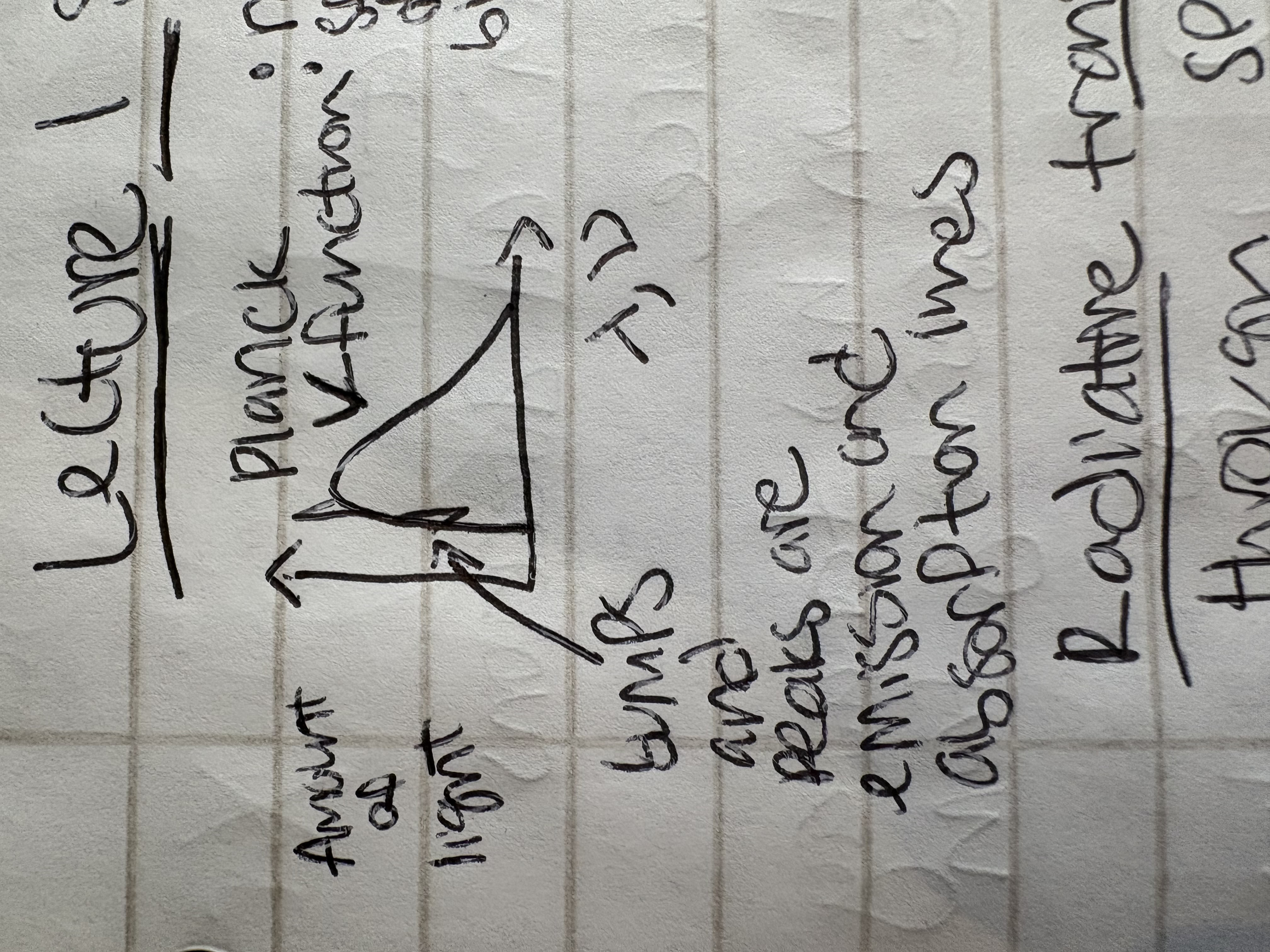
radiative transfer
the process by which light propagates through space
spectrum
amount of light as a function of wavelength or frequency
erg
cgs unit for energy =10-7 J
[g cm²/s²]
luminosity [L]
[erg/s]
power output of astrophysical object
total energy per time emitted in all directions
intrinsic to astrophysical source (invariant with distance)
Monochromatic luminosity [Lv]
[erg s-1 Hz-1]
power output of astrophysical object per unit frequency
![<p>[erg s<sup>-1</sup> Hz<sup>-1</sup>]</p><p>power output of astrophysical object per unit frequency</p>](https://assets.knowt.com/user-attachments/fa01ea41-ca8e-4157-a036-8fc437f14b98.jpg)
Why do we care about quantities per unit frequency??
-most detectors have a finite bandwidth
-only detect photons that arrive in a certain range of frequencies
-we are limiting our model to what our detector should see
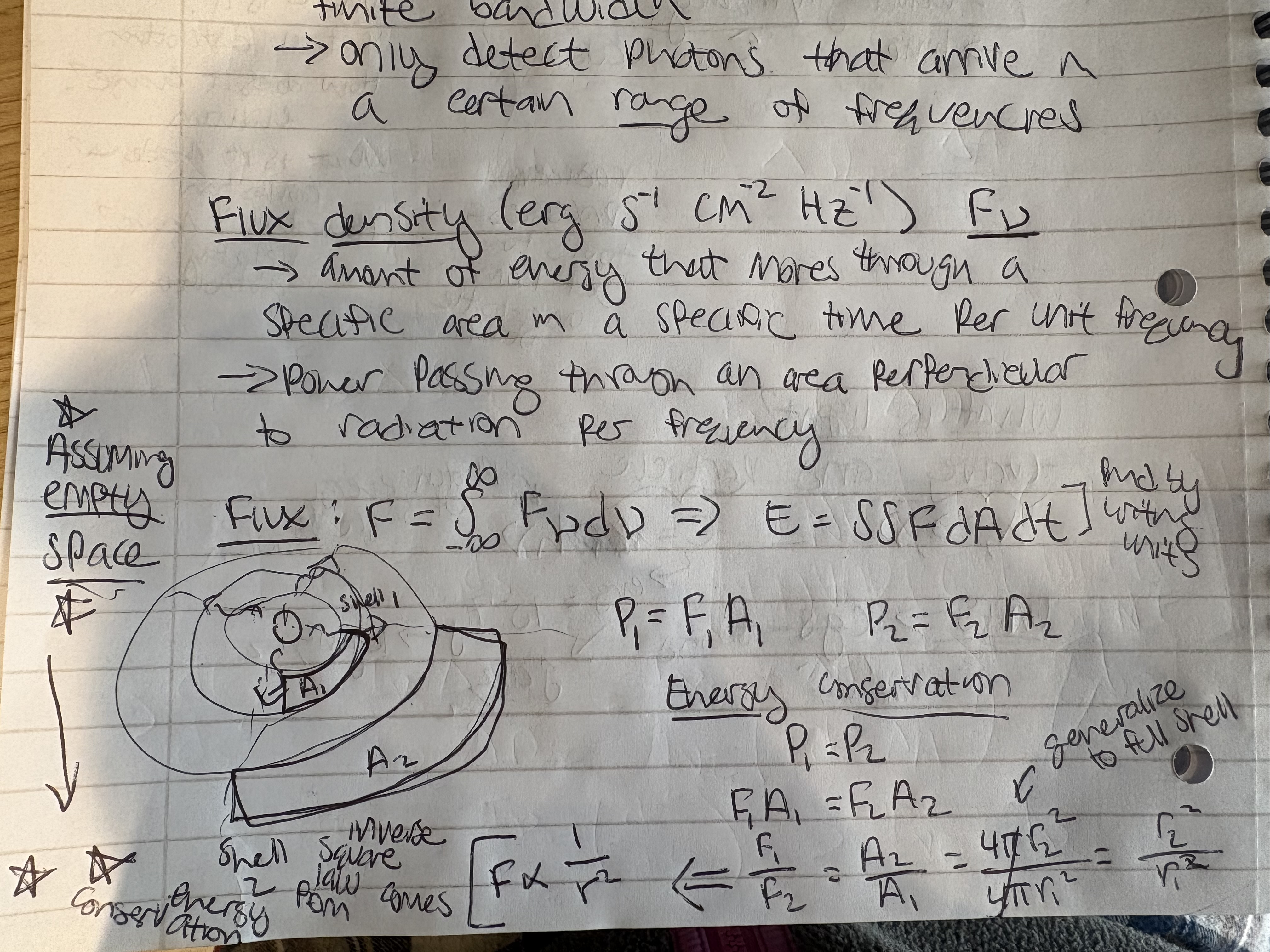
Flux Density [Fv]
[erg s-1 cm-2 Hz-1]
-power [erg s-1] passing through an area perpendicular to the radiation [cm-2] per frequency [Hz-1]
Given the units of flux density (or rather, flux—→ disregard per unit wavelength), what relation can be found between energy, flux, area, and time?
E=double integral of F dA dt
or, given uniform distribution and assuming empty space
P=F A
given the units of flux, prove that flux follows the inverse square law wrt distance
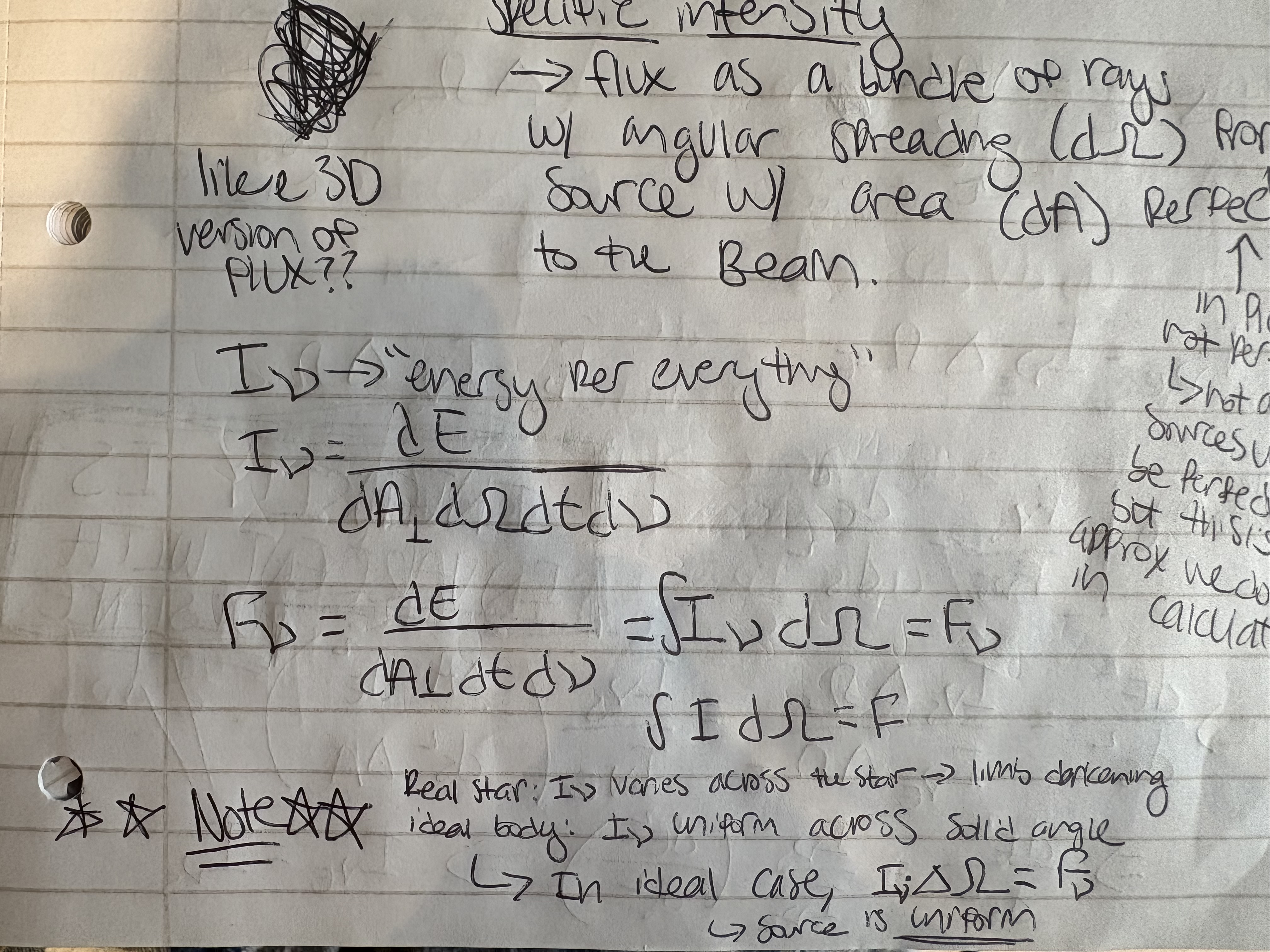
Specific Intensity [Iv] or Surface Brightness
[erg cm-2 s-1 Hz-1 sr-1]
energy per everything
flux as a bundle of rays with angular spreading from source with area perpendicular to beam
Specific intensity written out as formula, flux density written out as formula (both from units), relation of specific intensity to flux density
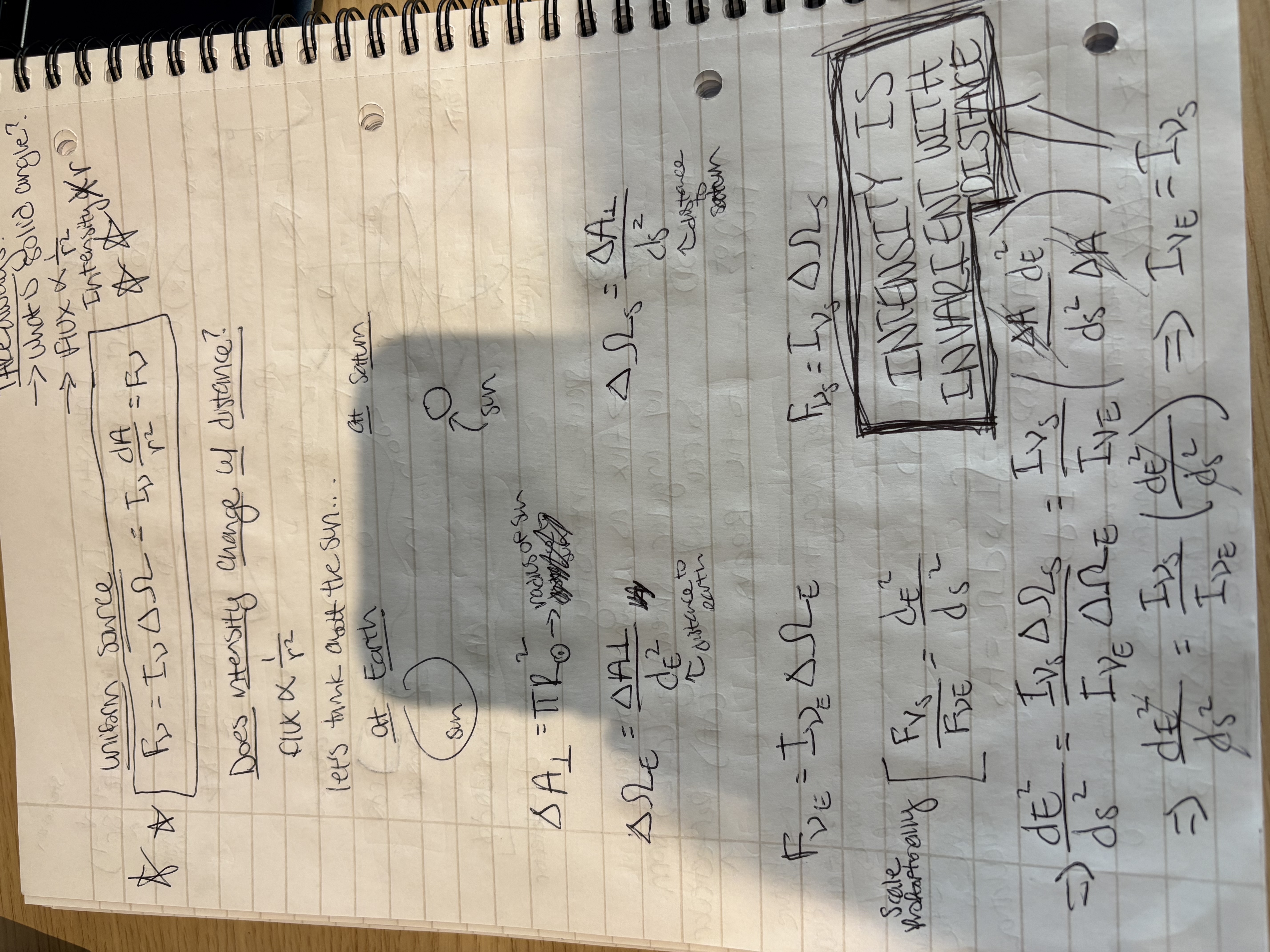
For a uniform source, Fv=Iv*Omega=Iv*dA/r2
What da helly is a steradian?
steradian=dA/r2
Does intensity change with distance?
Nah dog…it be invariant with distance
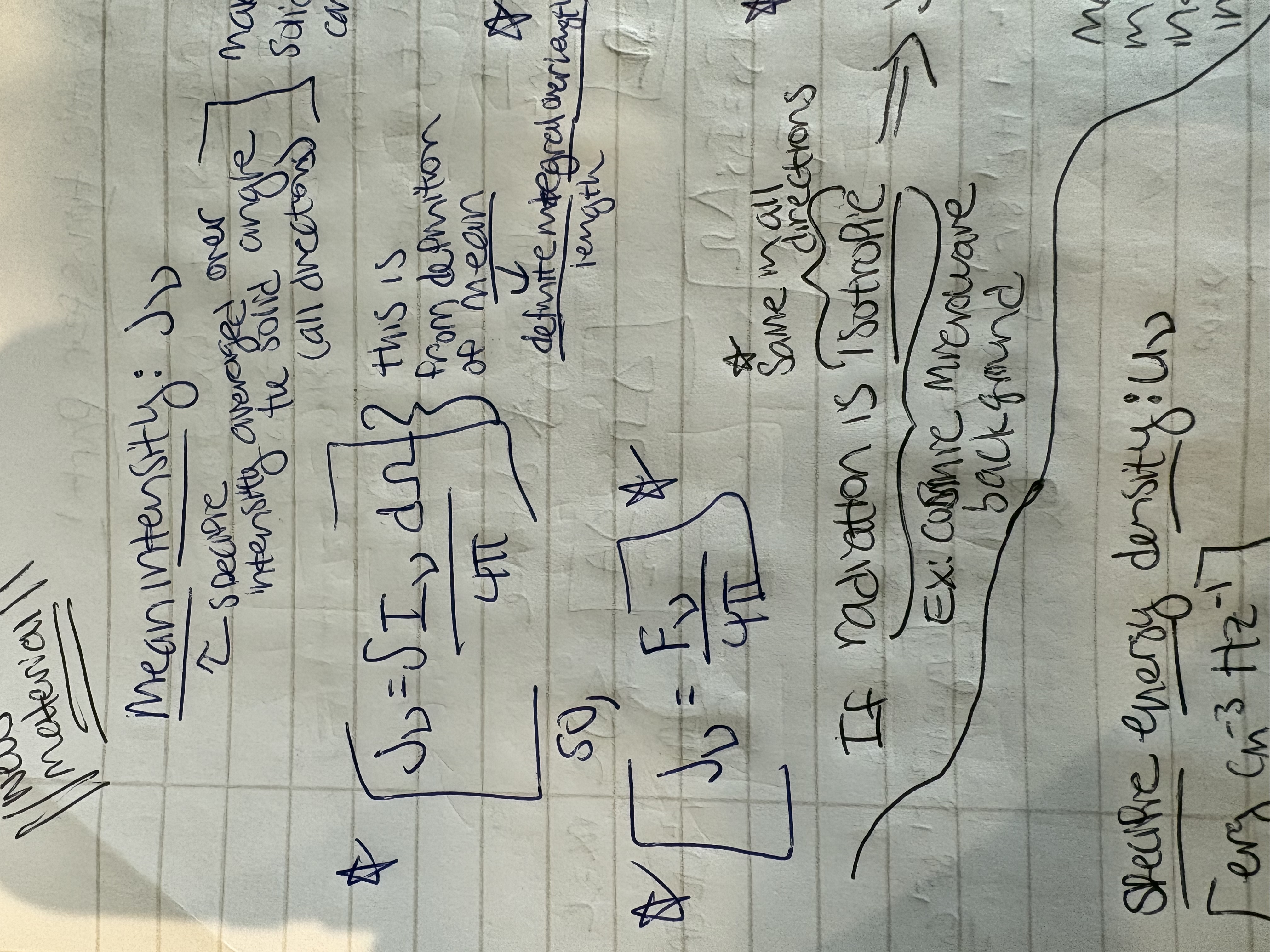
Mean intensity [Jv]
specific intensity averaged over the solid angle (all directions)
Maximum solid angle=entire sky=4*pi (note that the r2 cancels)
If radiation is isotropic, Jv=Iv
isotropic
same in all directions
like the cosmic microwave background!
specific energy density [uv]
[erg cm-3 Hz-1]
![<p>[erg cm<sup>-3</sup> Hz<sup>-1</sup>]</p>](https://assets.knowt.com/user-attachments/90a8d1ae-e830-4af6-900d-def6fc44e490.jpg)
Radiation Pressure [pv]
[erg cm-3 Hz-1]
-same as specific energy density, even though may physically seem like different quantities
![<p>[erg cm<sup>-3</sup> Hz<sup>-1</sup>]</p><p>-same as specific energy density, even though may physically seem like different quantities</p>](https://assets.knowt.com/user-attachments/609e734f-cfd1-4734-8247-6a480c69b099.jpg)