memory
 Call Kai
 Learn
Learn Practice Test
 Spaced Repetition
 Match
Match Flashcards
 Knowt Play
1/70

There's no tags or description
Looks like no tags are added yet.
Name | Mastery | Learn | Test | Matching | Spaced | Call with Kai |
|---|
No analytics yet
Send a link to your students to track their progress
71 Terms
short term memory
the limited capacity memory store
coding is mainly acoustic
capacity is between 7 plus or minus 2
duration is 18 seconds
Long term memory
The permanent memory
coding is mainly sematic
unlimited capacity
store memories
coding
the format in which information is stored in various memory stores
capacity
The amount of information that can be held in a memory store
Duration
The length of time information can be held in memory
research on coding
Baddeley gave different lists of words to 4 groups
Group 1- acoustically similar words
Group 2 - acoustically dissimilar words
Group 3 - semantically similar
Group 4 - semantically dissimilar words
Pps were shown the OG words then asked to recall them in the correct order.
ST - worse with acoustically similar
LT- worse with semantically similar
evaluation of research on coding
+Identifies clear difference between 2 stores
later studies to Baddeley’s research showed that STM mainly acoustic and LTM mainly sematic
led to an important step in the MSM
-BADDELEY’S STUDY USED ARTIFICIAL STIMULI
The word lists had no personal meaning to participants
Baddeley’s findings may not tell us much about coding in every day life
findings have limited applications
Research on capacity
Jacobs found out by measuring digit span
For example the researcher reads out 4 digits and the pps recalls these out loud in the correct order
If this is correct the researcher reads out 5 digits and so until the pps can not recall the order correctly
mean spam for letters= 7.3
mean span for digits = 9.3
evaluation of research on capacity
+ITS A VALID STUDY
study has been replicated
Jacobs study was old and early research, his findings have been confirmed by other better controlled studies
a valid test of the digit span
-MILLERS STUDY MAY HAVE OVERESTIMATED STM CAPACITY
Cowarn reviewed other research and concluded that the STM is only about 4 plus or minus 1
suggests the lower end of Millers estimate is more appropriate than seven items
Research on STM duration
Peterson- 24 students in 8 trials each
On each trial the student was given a consonant syllable to remember and a 3 digit number
The student counted backwards from the number until they were told to stop to avoid mental rehersal
after 3 seconds average recall- 80%
after 18 seconds- 3%
Evaluation of Research of duration
-STM THE TEST WAS ARTIFICIAL STIMULI
The study was not completely irrelevant because we do sometimes try to remember fairly meaningless material
even so recalling constant syllables doesnt reflect most everyday memory
study lacks external validity
+BAHRICK’S STUDY HAS HIGH EXTERNAL VALIDITY
Because the researchers investigated meaningful memories
When studies on LTM were conducted with meaningless pictures to be remembered , recall rates were lower
Bahrick’s findings reflect a real estimate of the duration of LTM
Multi store model
A representation of how memory works in terms of 3 stores
Describes how information is transferred from one store to another
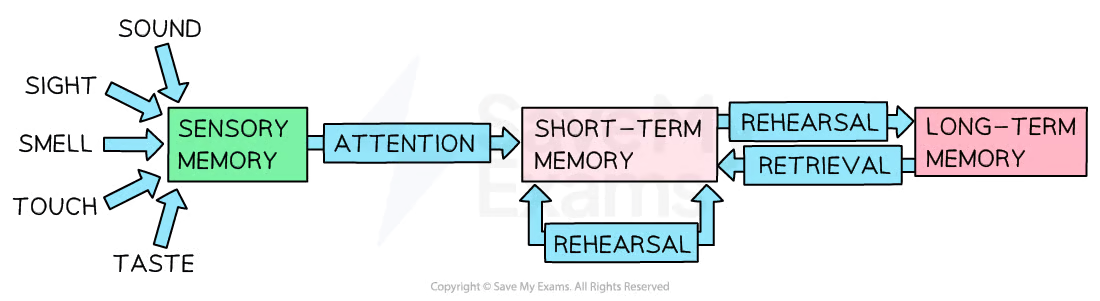
Sensory register
Where all sensory information from the environment passes into or is held
iconic and echoic
high capacity
held for a millisecond
Key process connecting SR to STM
STM
coded mainly acoustic
lasts about 18seconds
capacity of 7 +- 2
mental rehearsal
occurs when we repeat material to ourselves
if we repeat it enough it passes to LTM
LTM
Coded semantically
duration of a lifetime
when we recall info it has to be transferred back to STM
strengths of MSM
+SUPPORTED BY CONTROLLED LAB STUDIES
Baddeley found we tend to mix up words with similar meanings using LTM and mic up similar sounding words with STM
Controlled lab studies on coding, capacity and duration support the theory of having separate memory stores
Suggests that there is a clear distinction between STM and LTM
+THE CASE OF HM
suffered from epilepsy and underwent brain surgery by removing his hippocampus
Following this surgery, HM could remember events and some information and details from before the surgery (LTM) but he could not form new memories (STM could not be transferred to LTM)
This adds weight to the argument that the brain uses separate regions or structures for STM and LTM
Weaknesses of MSM
-OVERSIMPLIFIED
Warrington studied a client referred to as KF who had amnesia
His STM for digits was poor when he read out outloud but better when he read the digits to himself
suggests that STM and LTM are made up of more than one store
Much of the research into the MSM uses artificial tasks such as recalling a string of digits/letters
Baddeley (1966)used artificial stimuli instead of meaningful material
This suggests there is a limited application to real world memory use
The use of artificial tasks and application means that the study lacks ecological validity
Types of LTM
episodic
semantic
procedural
Episodic memory
recall events or "episodes" in the life of a person
involves personal events and experiences
emotions felt at time of event can be felt
Semantic memory
recall facts and the meaning of the world around us
the capital city of France is Paris
Procedural memory
how to carry out certain tasks or skills
Little conscious thought
riding a bike
Strengths of types of LTM
+SUPPORTING STUDIES
Case of HM- suffered from epilepsy and underwent brain surgery to correct this, removing his hippocampus
findings show that episodic memory was affected by brain damage, however semantic memory and procedural memory were not
shows how there are different LT memory stores
+BRAIN SCANS
indicate that each type of LTM may be stored in different areas of the brain
Episodic memory is associated with the hippocampus
Semantic memory is associated with the temporal lobe
Procedural memory is associated with the cerebellum
This clinical evidence is high in reliability as it is objective i.e. scientific
Limitations of types of LT memory
Case studies cannot be generalised beyond their immediate subject to the general population
HM
This weakens their use as supporting evidence for separate LTM stores as a sample of one participant cannot come near to being representative of a wider population
WMM
Baddeley and Hitch
criticised the (MSM) as overly simplistic
shows that STM can be sub-divided into distinct components and is not a unitary store
explains memories related to working on tasks that require immediate memory formation
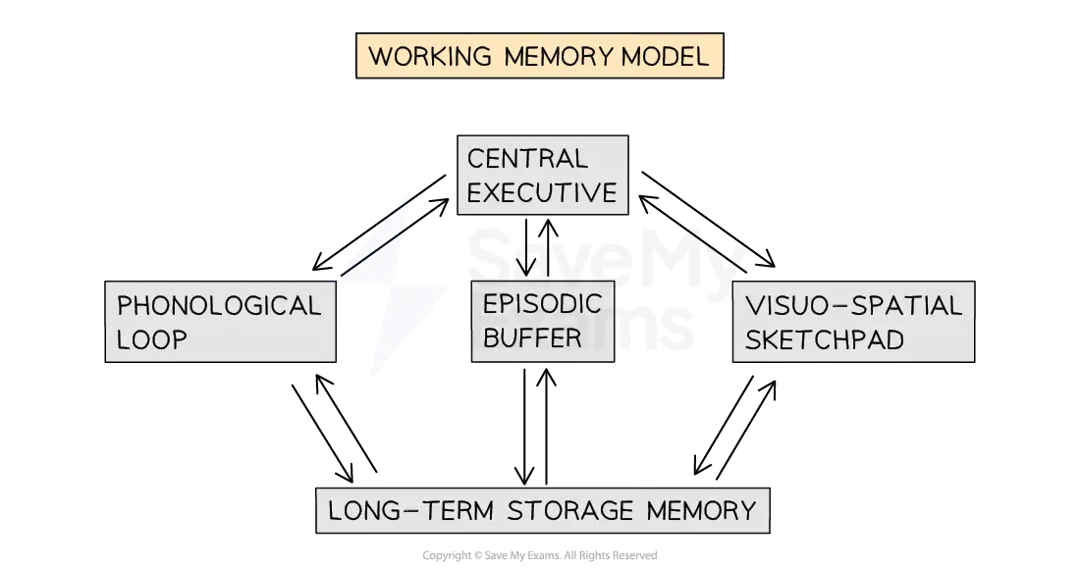
central executive
co ordinates the activities of the 3 subsystems in memory
focuses and divides our limited attention and allocates subsystems to tasks
Phonological loop
Deals with auditory information
Phonological store- stores the words you hear
Phonological process- allows mental rehearsal
episodic buffer
info is stored temporarily
provides a bridge between WM and LTM
Capacity is limited
Visuo- spatial sketchpad
storing visual and spatial info
‘inner eye’
Strengths of WMM
Point: Research supports separate components in working memory.
Evidence: Baddeley & Hitch found people could do a visual and verbal task together better than two visual tasks.
Explain: This shows the phonological loop and visuospatial sketchpad are separate with their own capacity.
Link: Supports the WMM structure rather than one single memory store.
Point: The WMM helps explain learning difficulties.
Evidence: Dyslexic individuals often have a weaker phonological loop, affecting reading and spelling.
Explain: This has led to teaching strategies like giving shorter instructions to avoid overload.
Link: Shows the model has practical value, increasing its usefulness.
weaknesses of WMM
Point: The model may not fully explain memory.
Evidence: The episodic buffer was added later to explain links with long-term memory. It does not clearly explain how information transfers between working memory and long-term memory.
Explain: This suggests the original model was incomplete.
Link: Therefore, the WMM may oversimplify how memory really works.
Point: The central executive lacks detail.
Evidence: Baddeley called it “a bit of a mystery.”
Explain: Its role is unclear and hard to test scientifically because the CE is difficult to operationalise and measure.
Link: This weakens the model because a key component is poorly explained no empirical evidence.
Forgetting
refers to a person's loss of ability to recall information and store memories
Interference
when one memory prevents the retrieval of another memory
proactive interference
retroactive interference
Proactive interference
Older memories interfere with a new memory
Teacher forgets the name of current class with old class
Retroactive interference
When a new memory prevents the recall of an older memory
forgetting the names of your old class because of your new class
McGeoch and McDonald (1931) – Interference and forgetting (retroactive interference)
Participants first learned a list of adjectives. Later, they learned a second list. For different groups, the second list varied (6 groups):
Synonyms (similar meaning)
Antonyms (opposites)
Unrelated words
Nonsense syllables
Numbers (control)
When asked to recall the original list, performance was worst when the second list had similar meanings (synonyms).
Forgetting is more likely when new information is similar to old information.
Strengths of interference theory
+RWA
Baddeley & Hitch asked rugby players to recall the names of teams they had played against
Players who had played in the most games had the worst recall
The researchers found that the later, more recent games had interfered with recall of the earlier games
Baddeley & Hitch concluded that interference had occurred to prevent accurate recall
The use of real players recalling real games gives this study good ecological validity
Interference may explain why it is often more difficult to learn a language (e.g. French) if a previous language has been learnt (e.g. Spanish)
The above observation gives the theory good external validity
Limitations of interference theory
-INTERFERENCE IS TEMPORARY AND CAN BE OVERCOME BY USING CUES
Tulving’s research showed that without cues 70% of PPs forget an artificial list of words
However recall rose again to 70% when participant were given cues about the words
Shows that interference causes a temporary loss of accesibility to material that is still in LTM, a finding not predicted by the interference theory
-RESEARCH IS BASED ON LAB BASED ARTIFICIAL TASKS
recalling word lists
low ecological validity
retrieval failure
If there are not enough cues a person may forget certain memories
The memory is still available but it is not accessible, due to the absence of cues
cue
A hint or trigger that can help retrieve a memory
external- linked to environment
internal- linked to mood
Tulving encoding specificity principle
Proposed that if a cue is to be helpful in remembering info it must be:
present during encoding
present during retrieval
Other cues can be encoded at the time of learning that are not meaningful:
Context-dependent forgetting
State-dependent forgetting
Context dependent forgetting
occurs when recall depends on an external cue e.g the environment
Godden and Baddeley contextual cues on deep sea divers
18 Pps- asked to learn a set of words either on land or underwater
4 variables- l/l, l/u, u/u, u/l
results showed that words recalled underwater were better recalled underwater and words learned on land were better recalled on land
context is key for for retrieval to happen
state dependent forgetting
Occurs when recall depends on an internal cue
the feelings/emotions involved
Goodwin state dependent forgetting alcohol
Male participants learnt a set of words either drunk or sober and were asked to recall the set of words 24 hours later when either drunk or sober again
The results showed that information learned when under the influence of alcohol was recalled better when the participant was under the influence of alcohol
strengths of retrieval failure
+RWA
can help overcome some forgetting in everyday situations
studying for exams should be conducted in the same room in which the exam is to take place to aid recall
when we have trouble remembering, it helps to make an effort to remember the environment you recalled it in
- shows how research can remind us of strategies we use in the real world to improve our recall
+RESEARCH SUPPORT
Gooden and baddley- show that a lack of relevant cues at recall can lead to context dependent forgetting in everyday life
eysenck argues that retrieval failure is the main reason for forgetting in LTM
This evidence shows that retrieval failure occurs in RW situations as well as highly controlled situations
Limitations of Retrieval failure
-CONTEXT EFFECTS MAY DEPEND SUBSTANTIALLY ON TYPE OF MEMORY BEING TESTED
Baddeley replicated their underwater experiment but used a recognition test instead of recall
with recall, performance was the same in all conditions
suggests that retrieval failure is a limited explanation for forgetting because it only applies when a person has to recall information rather than recognise it
Many of the studies involve learning lists of words which is an artificial task, meaning that the studies lack ecological validity and real-world application
eye witness testimony
The ability of people to remember details of events they have observed
accuracy of EWT can be affected by misleading and anxiety
Misleading infomation
Incorrect information given to an EW after the event
post event discussion
leading questions
leading questions
a question because of the way it is phrased, suggests a certain answer
results in response bias
Loftus & Palmer investigated the effect of leading questions procedure
45 participants (split into 5 groups) were shown films of car traffic accidents
After the films, each group was given a questionnaire to complete, which included a critical question in which the verb used to describe the car accident was changed:
'How fast was the car travelling when it _____ the other car?
The verbs were: hit, contacted, smashed, collided, bumped
Each group had a different verb as part of their questionnaire
Loftus & Palmer findings
The dependent variable was measured as estimated speed in miles per hour
The lowest estimated speed was for 'contacted' = 31.8 mph
The highest estimated speed was for 'smashed' = 40.8 mph
The researchers concluded that information after the event in the form of a leading question can result in unreliable EWT
post event discussion
occurs when there is more than one witness to an event
witness may discuss what they have seen with co-witness or other people
Gabbert PED procedure
Pairs of participants (students and older adults) each watched a different film clip of the same crime so each had a unique view of the event
Pairs were able to discuss what they had witnessed before carrying out a recall test of the event seen in the video
Gabbert findings PED
A large proportion (71%) of eyewitnesses who had discussed the crime made mistakes when recalling the events
In pairs where no discussion had taken place, 0% of mistakes in recall were made
This suggests that PED can lead to inaccurate eyewitness testimony
Strengths of misleading information research
Point: Misleading information studies often use highly controlled experiments.
Evidence: Loftus and Palmer (1974) changed just one word in a question (“smashed” vs “hit”) and measured speed estimates.
Explain: Because variables are carefully controlled, researchers can show a clear cause-and-effect relationship between leading questions and memory distortion.
Link: This gives the research high internal validity and supports the reliability of findings
Point: The research has helped improve the criminal justice system.
Evidence: It has led to better police interview techniques, such as the Cognitive Interview, which avoids leading questions.
Explain: This reduces the risk of false memories and wrongful convictions.
Link: The practical value of the research increases its usefulness and importance.
weaknesses of misleading information research
Point: Lab studies do not reflect real-life eyewitness situations.
Evidence: Watching short video clips of car crashes is less emotional than witnessing a real crime.
Explain: Real-life memories may be more detailed or resistant to distortion because of emotional arousal.
Link: Therefore, findings may not fully generalise to real eyewitness testimony.
Point: Participants may guess the aim of the study.
Evidence: In Loftus and Palmer’s study, participants might realise the question wording is important and adjust their answers.
Explain: This means their responses may be influenced by expectations rather than genuine memory distortion.
Link: This reduces the validity of the conclusions about how memory works in real life
What is anxiety
An emotion that brigs on feelings of tension, worry and physical changes such as raised blood sugar
negative effects of anxiety on accuracy
Anxiety can reduce the accuracy of eyewitness testimony because of the weapon focus effect.
When a weapon is present, a witness focuses on it due to fear and the fight-or-flight response.
This intense attention on the weapon means they pay less attention to the offender’s appearance, so recall of the perpetrator’s details is poo
Johnson & Scott weapon focus effect procedure
Participants were told they were taking part in a lab study and were asked to sit down in a waiting area
The low-anxiety group heard a normal conversation and saw a man leave holding a pen with grease on his hands.
The high-anxiety group heard an argument and saw a man leave holding a knife with blood on his hands.
Afterwards, all participants had to identify the man from a set of photos.
Johnson & Scott findings
The low-anxiety group correctly identified the man with a mean accuracy of 49%
Accuracy dropped to 33% in the high-anxiety group
The researchers concluded that anxiety focuses attention on the weapon and away from other details of the event
positive effects of anxiety on accuracy
Due to an increase in adrenaline during fight or flight
results in a state of high alertness
Yuille & Cutshall procedure
Witnesses of a real-life crime shooting were asked to take part in the study (13 witnesses agreed)
Participants were interviewed four to five months following the shooting; the interviews were compared to police interviews
Accuracy was measured by the number of matching details in each interview
Participants were also asked to rate their stress levels at the time of the incident (using a seven-point scale) and related issues, such as insomnia
Yuille & Cutshall findings
The witness's recall was accurate as events recalled four to five months later matched original police reports
Witnesses who reported high-stress at the time of the incident had the most accurate recall, with 88% accuracy
Low-stress witnesses had less accurate recall, with 75% accuracy
The findings stress that anxiety does not have a negative effect on the recall of events or the accuracy of EWT; in fact, it may enhance the accuracy of recall
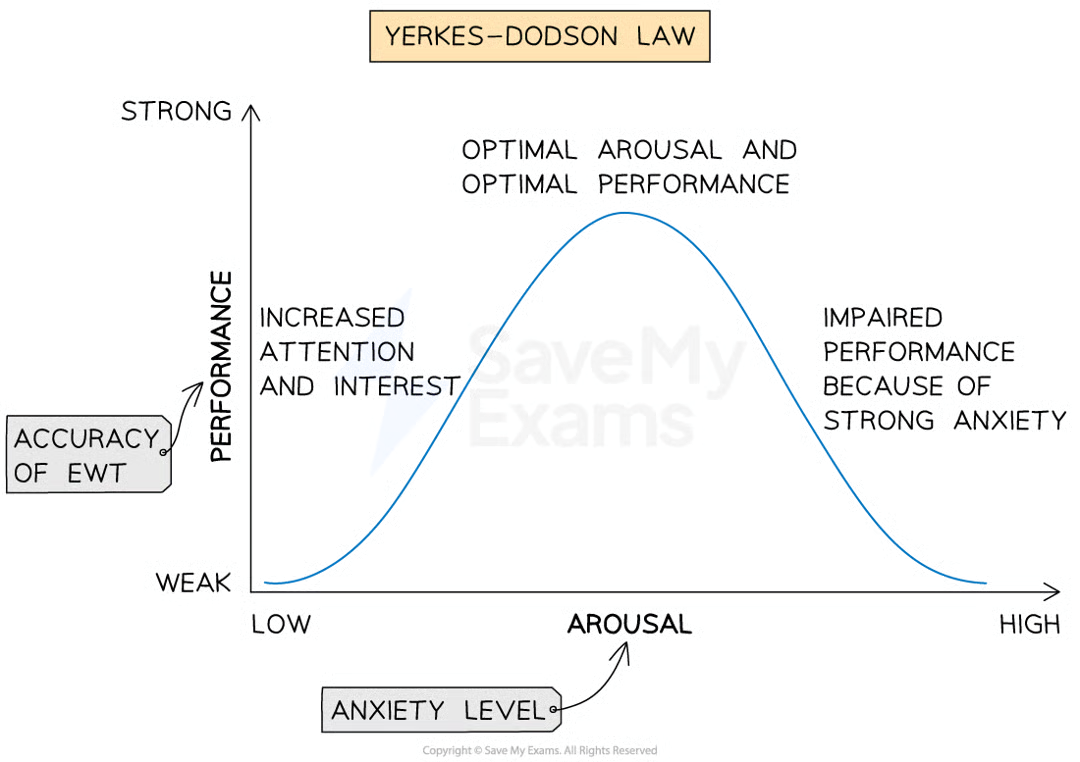
Yerkes & Dodson law
When a crime is witnessed, a person becomes emotionally (anxiety) and physiologically (adrenaline release) aroused
Low levels of arousal (anxiety) are associated with low levels of performance (recall and accuracy of EWT)
As arousal increases performance increases up to an optimum
After this point, as arousal continues, performance begins to decrease
strengths of research into anxiety on EWT
Point: Research into anxiety and EWT often uses controlled experiments.
Evidence: In Johnson & Scott’s study, the only real difference was whether participants saw a man with a pen (low anxiety) or a knife (high anxiety).
Explain: This control means researchers can be more confident that anxiety caused differences in recall, not other variables.
Link: This gives the research good internal validity and supports the link between anxiety and memory accuracy.
Point: Findings help improve legal procedures.
Evidence: Understanding weapon focus has influenced how police treat eyewitness testimony, especially in violent crimes.
Explain: It shows that anxious witnesses may be less reliable when a weapon is involved.
Link: This practical application increases the value of the research.
weaknesses of research into anxiety on recall
Point: Lab studies may not reflect real-life crimes.
Evidence: Seeing a staged event in a lab is less stressful than witnessing a real violent crime.
Explain: Real anxiety might affect memory differently, possibly making it more accurate for central details.
Link: This limits how well findings generalise to real eyewitness situations.
Point: Some research shows anxiety can improve recall.
Evidence: The Yerkes-Dodson law suggests memory is best at moderate levels of anxiety.
Explain: This means anxiety does not always harm eyewitness accuracy; the relationship is more complex.
Link: Therefore, the effect of anxiety on recall may be oversimplified in some research.
Cognitive interview
A procedure used in police investigations when interviewing eyewitnesses. Developed by Geiselman et al. (1985) to:
improve the effectiveness of police interviews
to improve the accuracy and completeness of eyewitness testimony
components of cognitive interview
Context - eyewitness being asked to recall and recreate the physical and psychological environment of the incident mentally. Giving contextual and emotional cues
Order- EW asked to recall events in reverse- to remove schemas that influence perspective
Perspective- recall events from the perspective of other witnesses or the perpetrator- distrupt schmeas
Everything- the eyewitness is asked to report all details of the event without any editing of seemingly irrelevant details
strengths of cognitive interview
Point: The Cognitive Interview improves eyewitness recall.
Evidence: Geiselman et al. found that witnesses recalled more correct information using the CI than with standard police interviews.
Explain: Techniques like context reinstatement and varied recall help access different memory cues.
Link: This supports the CI as an effective method for improving eyewitness testimony.
Point: The CI reduces the risk of misleading information.
Evidence: The CI encourages open-ended questions and allows witnesses to control the flow of information.
Explain: This lowers the chance of memory distortion caused by interviewer bias.
Link: This increases the reliability of eyewitness evidence.
weaknesses of cognitive interview
Point: The CI takes longer than standard interviews.
Evidence: Police officers need special training to use it properly.
Explain: This makes it expensive and difficult to use in every investigation.
Link: This limits how practical the CI is in real policing.
Point: The CI may also increase incorrect information.
Evidence: Some studies show witnesses recall more information overall, including some errors.
Explain: This can make it harder for police to separate accurate details from mistakes.
Link: Therefore, the CI is not always more reliable than standard interviews