Histology Final Material
 Call Kai
 Learn
Learn Practice Test
 Spaced Repetition
 Match
Match Flashcards
 Knowt Play
1/204

Earn XP
Description and Tags
Bone, Muscle, Nerve
Name | Mastery | Learn | Test | Matching | Spaced | Call with Kai |
|---|
No analytics yet
Send a link to your students to track their progress
205 Terms
What tissue type are ligaments made of?
dense regular connective tissue
What tissue type are tendons made of?
dense regular connective tissue and elastic
What are the weakest parts of the skeleton?
joints
What is the most common type of joint?
synovial joints
What is another name for synovial joints?
diarthroses
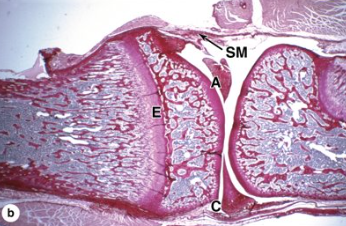
What type of joint is this?
synovial
What type of cartilage is found in synovial joints?
hyaline
Define osteopenia
thinning of bones
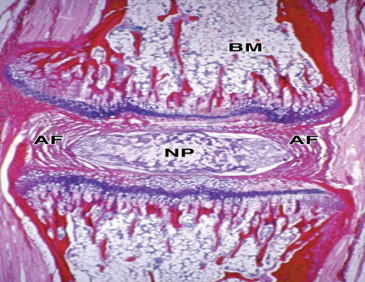
What structure is shown?
intervertebral disc
Women lose ___% of bone mass per decade and men lose ___%.
8% and 3%
What two hormones help maintain bone mass?
estrogen and androgens
Cancerous tissues release what that stimulates osteoclasts and produces severe osteoporosis?
osteoclast-activating factor
Osteomalacia and Rickets are both caused by what?
lack of calcium and vitamin D
What is the difference between osteomalacia and rickets?
osteomalacia is in adults and rickets is in children
Osteoporosis
blood calcium is low so bone is broken down constantly and susceptible to fracture
Paget’s disease
excessive osteoblast activity next to waning osteoclast activity
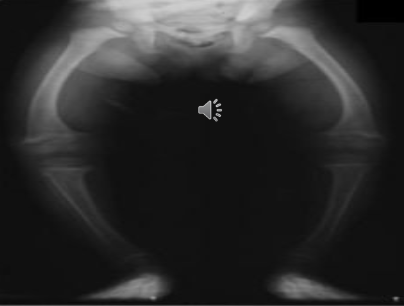
What is the pathology?
rickets
Osteoporosis affects __% of women over 45.
29
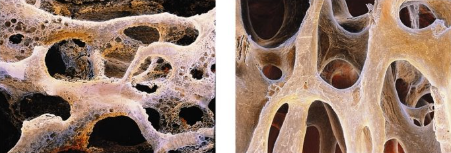
What is the pathology?
osteoporosis
What are the treatments for osteoporosis?
calcium and vitamin D supplements
What is the cause of Paget’s disease?
unknown cause (possibly viral)
Where is Paget’s disease usually localized?
spine, pelvis, femur, and skull
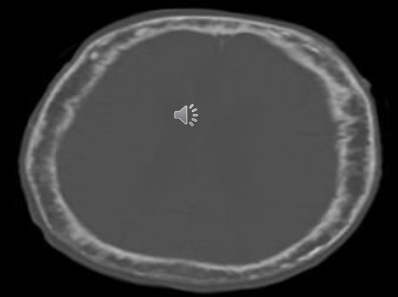
What is the pathology?
Paget’s disease
What is bursitis?
the protective sac (bursa) between tendons and bones is inflammed
What is tendonitis?
the tendon (muscle to bone attachment) is inflammed
What is the common cause of bursitis?
a direct blow or friction
What is the common cause of tendonitis?
overuse
What should you not treat tendonitis with?
steroids
What is the most common form of arthritis?
osteoarthritis
What % of all Americans develop OA?
85%
What is the cause of osteoarthritis?
wear and tear / overuse
What is an osteophyte?
bone spur
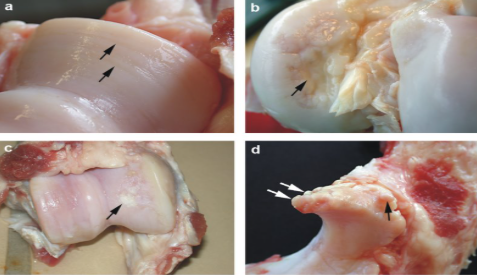
What is the pathology?
osteoarthritis
What is proximal osteoarthritis?
Bouchard’s nodes
What is distal osteoarthritis?
Heberden’s nodes
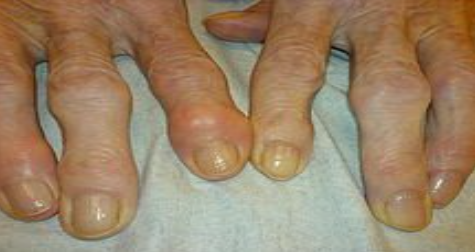
What type of arthritis is this?
osteoarthritis (node the presence of Bouchard’s nodes and Heberden’s nodes)
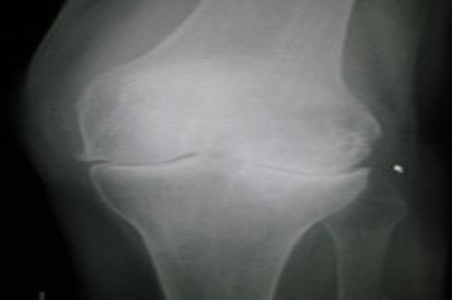
What is the pathology?
osteoarthritis
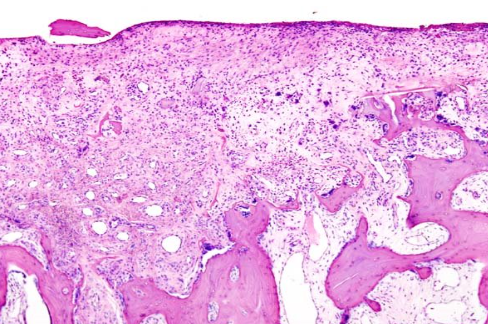
What is the pathology?
osteoarthritis
What is the cause of rheumatoid arthritis (RA)?
autoimmune disease of unknown cause
What is the pathology of RA?
synovial membrane is attached and is inflamed; thickens into a pannus
The pannus erodes _______.
cartilage
Where is RA found?
metacarpal phalangeal joints
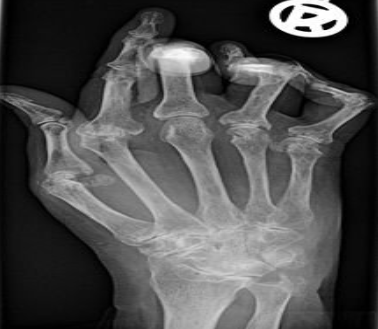
What is the pathology shown?
RA
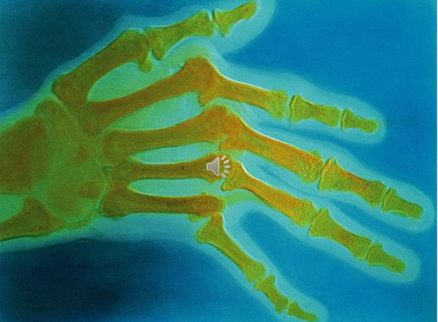
What is the end result of RA?
ankylosis (fusion of bone within a joint)
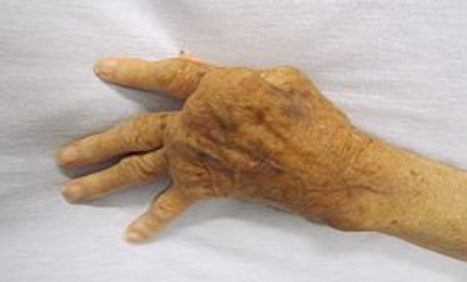
What is the pathology shown?
RA
What happens to those with gouty arthritis?
uric acid crystals are deposited in joints
If gouty arthritis is untreated, what happens to bone ends?
fuse and immobilize the joint
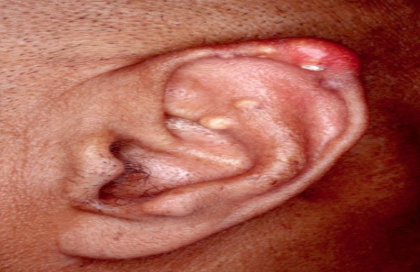
What pathology is shown?
gouty tophi
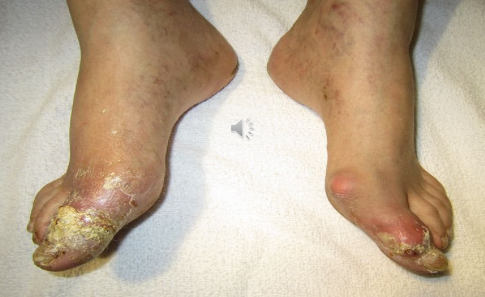
What pathology is shown?
gouty arthritis
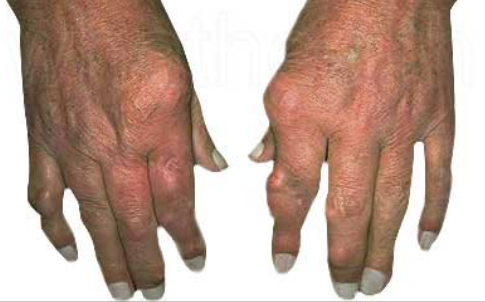
What pathology is shown?
gouty arthritis
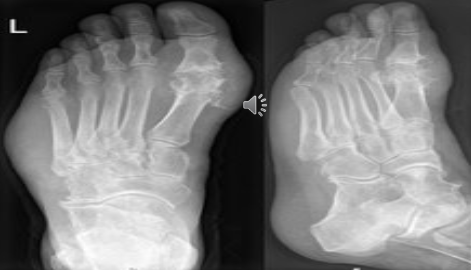
What pathology is shown?
gouty arthritis
At what week in embryonic development do synovial joints resemble adult joints?
8 weeks
Children under what age cannot take tetracycline?
8
What can tetracycline cause in young children?
grey smile
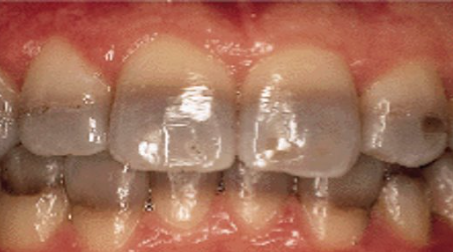
What drug caused this discoloration?
tetracycline
Osteopetrosis is known as “_____ ______”
stone bone
What causes osteopetrosis?
osteoclasts are nonfunctional but osteoblasts are active
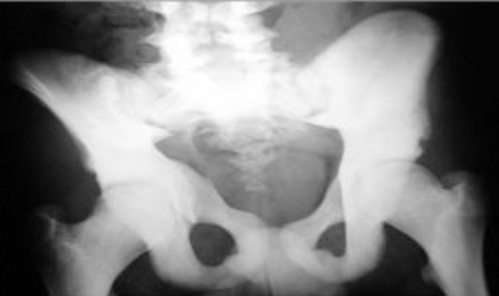
What is the pathology?
osteopetrosis
Osteopetrosis may cause what disorder?
scoliosis
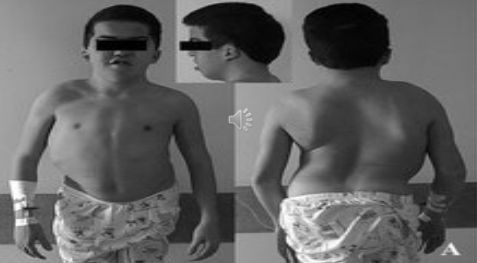
What is the pathology shown?
scoliosis
What is kyphosis?
upper middle back has accentuated curvature
What causes kyphosis in 1st world countries?
wear and tear; often working on computers and hunching
What causes kyphosis in 3rd world countries?
TB
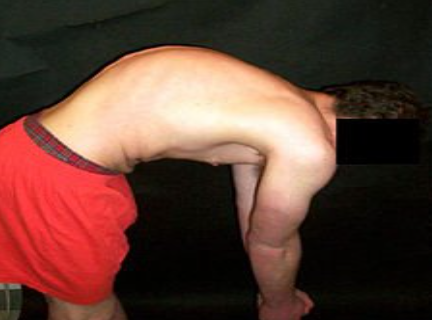
What back mis-alignment is this?
kyphosis
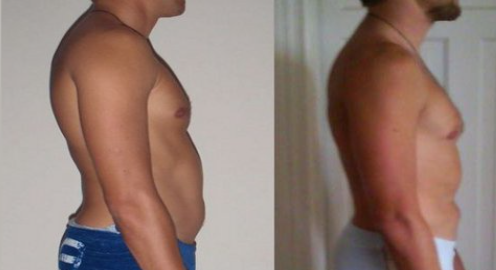
What back mis-alignment is this?
lordosis
What is another name for lordosis?
“sway back”
What causes lordosis?
pregnancy or accumulatation of visceral fat
What test is done to check for torsional scoliosis of the shoulders/thoracic region?
Adam’s test
How is Adam’s test performed?
a patient bends over 90 degrees to check for shoulder misalignment
What is the “Blais test”?
a test for scoliosis; when a patient walks away you check for lumbar scoliosis and when they walk toward you, you check for a thoracic tilt
What 3 conditions are caused my GH problems?
acromegaly
giantism
dwarfism
What is the cause of acromegaly?
pituitary gland produces excess growth hormone after epiphyseal plate closure at puberty
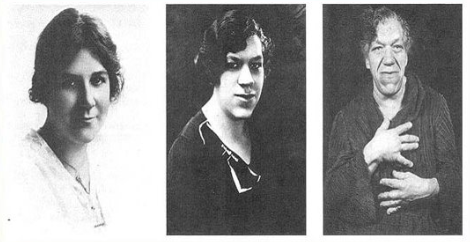
What condition is this?
acromegaly
What is the cause of giantism?
over production of human growth hormone prior to puberty
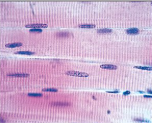
What muscle is this?
skeletal
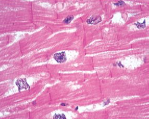
What muscle is this?
cardiac
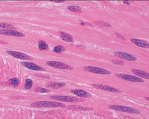
What muscle is this?
smooth
How does skeletal muscle form?
myoblasts fuse together
A muscle cell is also called a _________ _______.
muscle fiber
What is the covering that surrounds a muscle?
epimysium
What is the covering that surrounds fascicles?
perimysium
What is the covering that surrounds individual muscle cells?
endomysium
What is the name of the stem cells that replace skeletal muscle?
satellite cells
Sarcopenia
muscle weakness that occurs with age
What is the light band?
I band
What is the dark band?
A band
What is the unit from I band to I band?
sarcomere
Thin filaments are made of _____.
actin
Thick filaments are made of _____.
myosin
What is titin made of?
elastic fibers
What is found inside of muscle fibers?
myofibrils
The myosin binding site on G actin is covered by ________.
tropomyosin
What moves tropomyosin off of actin’s binding sites?
troponin
What is the first step of muscle contraction?
A thought in the brain results in an impulse traveling down a nerve to a muscle
What is the second step of muscle contraction?
At the neural motor endplate, the impulse causes calcium to enter the nerve
What is the third step of muscle contraction?
calcium results in exocytosis of ACH from the endplate into the synapse
What is the fourth step of muscle contraction?
ACH binds to the Na channels on the sarcolemma of the muscle
What is the fifth step of muscle contraction?
ACH binding to the Na channel receptor opens the channel and allows Na to diffuse into the muscle causing the depolarization of the electrical membrane potential
What is the sixth step of muscle contraction?
the membrane potential results in an action potential that travels along the sarcolemma until it reaches a T-tubule where is proceeds down
What is the seventh step of muscle contraction?
The impulse stimulates electrical gated sensors to open gates in the terminal cisternae of the sarcoplasmic reticulum to release calcium onto the sarcomere