Theory of Mind
 Call Kai
 Learn
Learn Practice Test
 Spaced Repetition
 Match
Match Flashcards
 Knowt Play
1/45

There's no tags or description
Looks like no tags are added yet.
Name | Mastery | Learn | Test | Matching | Spaced | Call with Kai |
|---|
No analytics yet
Send a link to your students to track their progress
46 Terms
What is a theory of mind?
Our ability to accurately explain other peoples' actions in terms of their beliefs, desires, goals, emotions etc (capacity, mentalising, mindreading)
Theory because
Unobservable states (beliefs, goals and desires)
Cause
Observable behaviour (predicted)
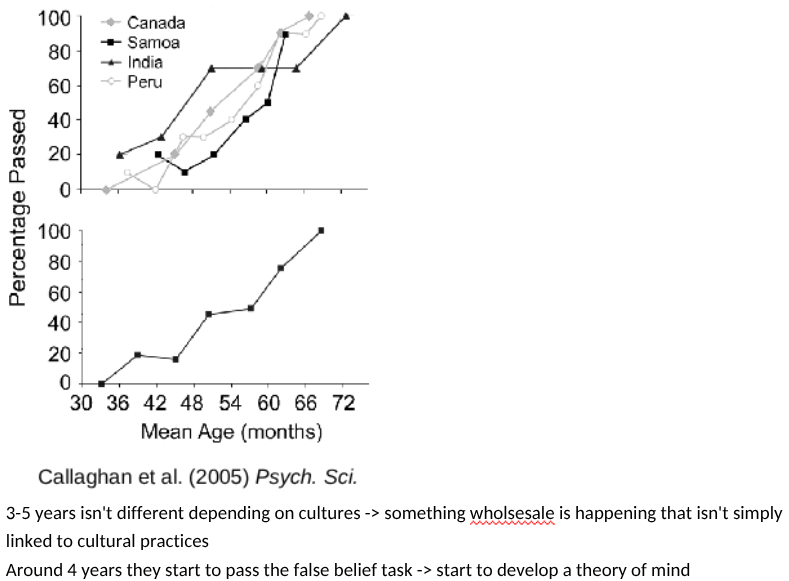
Around what age does a theory of mind develop?
4yo
What are the 2 perspectives on development?
Ontogeny → how does an ability develop in a child?
Phylogeny → how has an ability developed in humans
Issue for both cases: continuity vs change
What evidence is there of children being ‘mind blind’?
Gopnick + Astington (1989) → struggle to think about what was in the box in a way that was different from others
What must you do to use a theory of mind?
Believe the world is a certain way
Represent you believing that the world is a certain way
Represent that another person can believe the world is a different way
What are the elements needed to solve a task?
Knowledge that there is a true state of the world
Multiple representations of what that state might be → so that my beliefs + yours can differ
An ability to accurately bind those representations to different people
What is necessary when evaluating whether you have a theory of mind?
False beliefness
Give an example of a test of false beliefness?
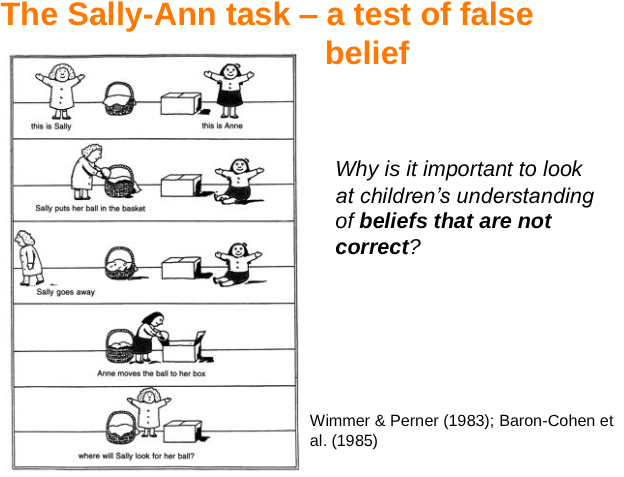
Sally-Ann task
Multiple reps of the world (1 right, 1 wong)
Bind each rep to 1 person
Key questions:
Where is the ball?
Where will Sally look for the ball?
What is hard about the Sally-Ann task?
Considerable demands on memory + behavioural control
Remember who is who
Remember who did what
Remember what is where
Remember who knew what
What is some evidence that processing demands constrain performance?
What are some explanations for the development of a theory of mind?
Is due to a change in ability to rep beliefs
From repping another person's desires (wants the ball → goes to where it is) to representing another person's beliefs (wants the ball → goes to where she believes it is)
There are other cognitive skills which are necessary in order to competently perform this task → additional task demands (e.g. on working memory + executive control) → too taxing
When you look at children's performance in false belief tasks, it is very strongly predicted by their performance in inhibition + executive function tasks in info processing
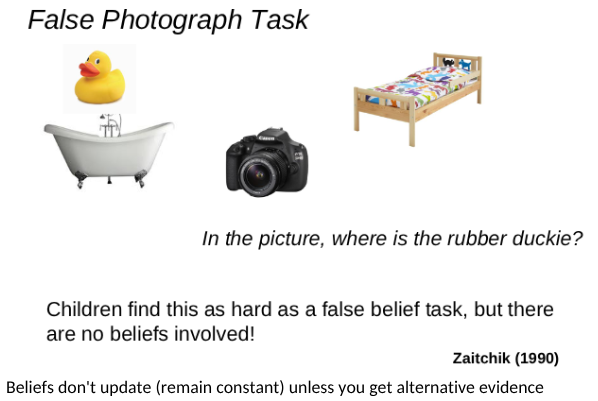
Children's competence at theory of mind may be stronger than indicated by their performance on tasks like Sally-Ann
What are the applications of understanding how children’s social cognition develops?
Help us to understand the building blocks of social behaviour
What are abilities aid development of a theory of mind?
Early perception of goals
Joint attention
What is joint attention?
Ability of 2 individuals to attend to the same thing in a way that is jointly done rather than just independently
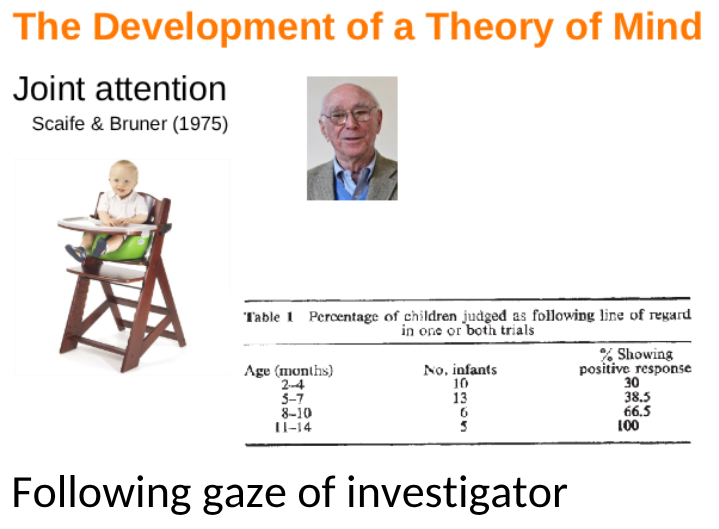
What did Warneken and Tomasello (2006) demonstrate?
Altruistic helping in pre-linguistic children (2yos)
What fact implies that false belie understanding depends upon earlier-developing, simpler social skills?
Robust evidence that children fail verbal false belief tasks until around 4 years BUT not asocial before this age
What is theory of mind a prerequisite to?
Natural language acquisition (Baldwin & Tomasello, 1998)
Strategic social interaction (Zhang, Hedden, & Chia, 2012)
Reflexive thought (Bogdan, 2000)
Moral judgment (Guglielmo, Monroe, & Malle, 2009)
According to Baird and Baldwin (2001), how does theory of mind relate to actions?
Capacity to interpret certain physical movements in terms of mental states → perceivers can parse this complex scene into intentional actions of reaching and giving → can interpret the actions as instances of offering + trading
What do Perner (1991) and Wellman (1990) argue about theory of mind?
It frames + interprets perceptions of human behaviour in a particular way → as perceptions of agents who can act intentionally + who have desires, beliefs, and other mental states that guide their actions
Why do humans need to understand minds?
To engage in the kinds of complex interactions that social communities require
Teaching another person new actions or rules by taking into account what the learner (doesn’t ) knows + how one might best make him understand
Learning the words of a language by monitoring what other people attend to + are trying to do when they use certain words.
Figuring out our social standing by trying to guess what others think/feel about us
Sharing experiences by telling a friend how much we liked a movie or by showing her something beautiful.
Collaborating on a task by signaling to one another that we share a goal + understand/trust the other’s intention to pursue this joint goal
How does Autism relate to theory of mind?
Missing an automatic processing of 'people info' → perceive others in a more analytical way BUT this is tiresome + slow
What mental processes underlie theory of mind?
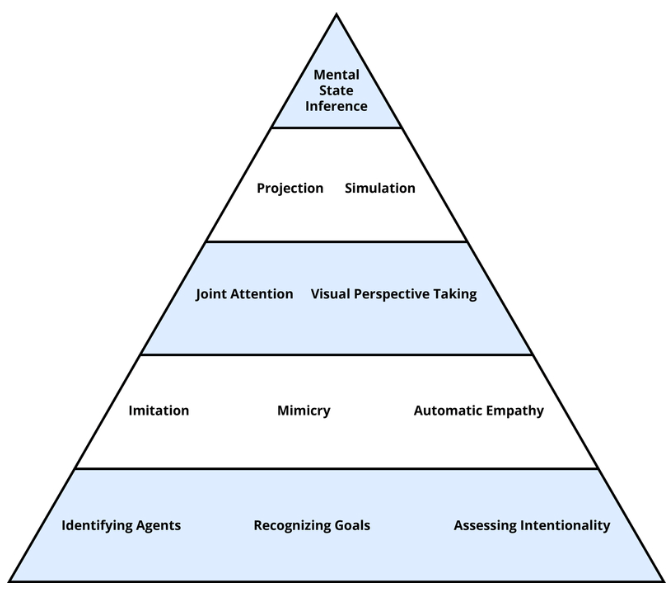
What are agents?
Allows humans to identify those moving objects in the world that can act on their own
Self-propelling
Have eyes
React systematically to the interaction partner's behaviour (e.g. following gaze of imitating, Johnson, 2000; Premack, 1990)
What does recognising goals build on?
Agents because agents are characteristically directed towards goal objects → seek out, track + physically contact said objects
Even before the end of their first year, infants recognize that humans reach toward an object they strive for even if that object changes location or if the path to the object contains obstacles (Gergely, Nádasdy, Csibra, & Bíró, 1995; Woodward, 1998)
See the systematic + predictable relationship between a particular agent pursuing a particular object across various circumstances
How do we learn to pick out intentional behaviours?
Through learning to recognise the many ways by which agents pursue goals
More sophisticated → can be nonintentional + goal-directed
Act intentionally → need the right kinds of beliefs about how to achieve the goal + skill
According to Meltzoff and Decety (2003), what are 2 other basic capacities that aid the understanding of mind from childhood?
Imitation + empathy
What is imitation?
Carefully observe others' behaviours + do as they do
E.g. mimicry + synchrony (mutual mimicry → largely unconscious)
Can happen even at very low levels (e.g. negative physiological arousal →Levenson & Ruef, 1992)
People who enjoy an interaction synchronise their behaviours more + increased synchrony (even manipulated in an experiment) makes people enjoy their interaction more (Chartrand & Bargh, 1999)
What may synchronising be caused by?
Brain mechanisms that tightly link perceptual info with motor info
In monkeys, highly specialized mirror neurons fire both when the monkey sees a certain action + when it performs that same action (Rizzolatti, Fogassi, & Gallese, 2001)
BUT more complex in humans (is selective → triggering primarily actions that are relevant to the perceiver’s current state or aim)
What does automatic empathy build on?
Imitation + synchrony
Sonnby-Borgström (2003) → if Bill is sad + expresses this emotion in his face/body + Elena watches/interacts with Bill, then she will subtly imitate his dejected behaviour + through well-practiced associations of certain behaviours and emotions, she will feel a little sad as well
What is critical when learning the meaning of objects (value and words referring to them)?
Joint engagement
What is visual perspective taking useful for?
Overcoming egocentric perspective → imaginatively adopt the other person’s spatial viewpoint and determine how the world looks from their perspective
Evidence that we mentally “rotate” toward the other’s spatial location, because the farther away the person sits (e.g., 60, 90, or 120 degrees away from you) the longer it takes to adopt the person’s perspective (Michelon & Zacks, 2006)
Briefly describe the process of imaging another person’s psychological position?
Go beyond mental rotation → effortful process involving simulation
People use their own current state (of knowledge, concern, perception) to grasp other people’s mental states
BUT get things wrong → must recognise egocentrism + actively take on others' perspectives (grasp their actual mental states, even if (or especially when) they are different from our own)
What is the process of simulation?
Using one's own mental states as a model for others' mental states (used to understand others' thoughts + feelings)
What is social projection?
Like-me assumption (Meltzoff) → others think, feel + want what we do
Absence of perspective taking, because we assume that the other’s perspective equals our own
BUT unhelpful when common ground is lacking
What is explicit mental state inference?
Ability to truly take another person’s perspective requires that we separate what we want/feel/know from what the other person is likely to want/feel/know
Capacity of integrating multiple lines of information into a mental-state inference develops steadily within the first few years of life (Wellman, Cross, & Watson, 2001)
False-belief test → have to infer this false belief against our own better knowledge
People are good at automatically relating to other people, using their own minds as a fitting model for others’ minds
BUT people need to recognise when to step out of their own perspective + truly represent the other person’s perspective (may harbour very different thoughts/feelings/intentions)
What does explicit mental state inference rely on?
Stored knowledge → general + agent-specific
Perceived facts on the concrete situation → what’s happening to the agent, the agent’s facial expressions + behaviours +what the person (didn’t) saw
How do people explain unintentional behaviour?
Merely identify cause
How do people explain intentional behaviour?
Use more sophisticated framework of interpretation
Follows directly from concept of intentionality + associated mental states they infer (Malle, 2004)
Performing intentional behaviours invole:
A desire for an outcome/goal
Beliefs about how a particular action leads to the outcome
An intention to perform that action
If the agent then actually performs the action with awareness + skill, people take it to be an intentional action (Malle & Knobe, 1997)
Make inverse inferences → what desire + beliefs the agent had that led them to act (reasons)
With extreme actions → retreat to causal history explanations (Malle, 1999) → e.g. they were mentally ill
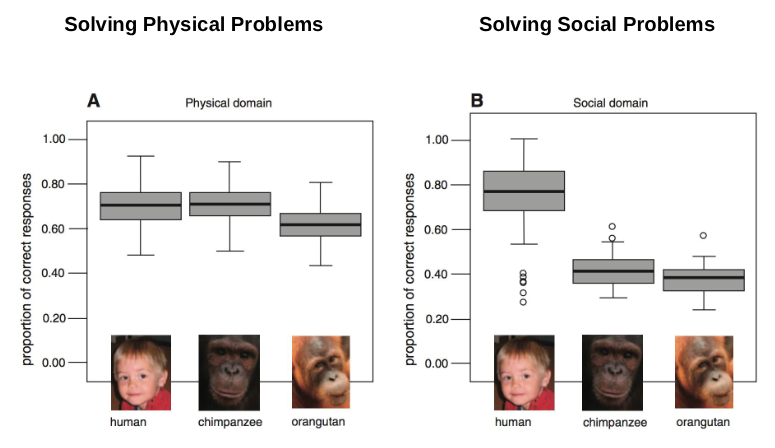
What is Michael Tomasello’s cultural intelligence hypothesis?
Human cognition is special because we have evolved specific skills to facilitate having successful social interactions
Socially smarter (e.g. due to enhanced, early-developing theory of mind) → culture
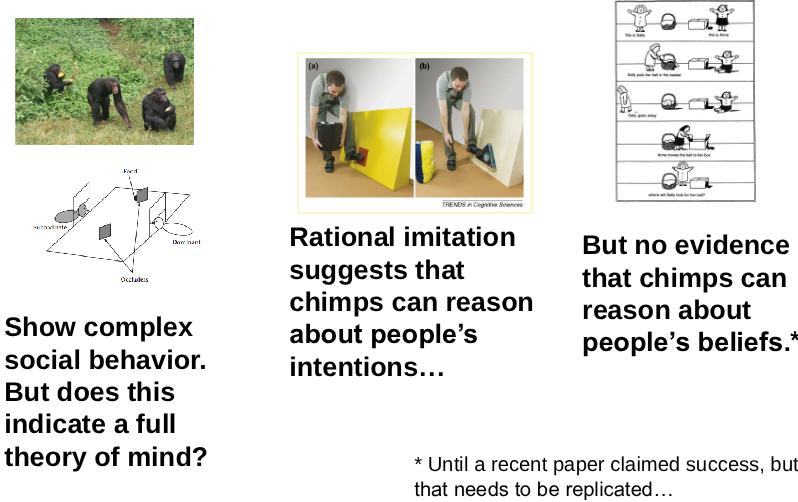
Physical + social problems matched with chimps + children
Early developing of specialised social skills support children in developing a range of human cultural tools
Social skills specific to humans
Warneken + Tomasello (2006) → chimps raised by humans develop human-like qualities (altruistic helping)
Culture in which we raise kids enable them to develop these skills
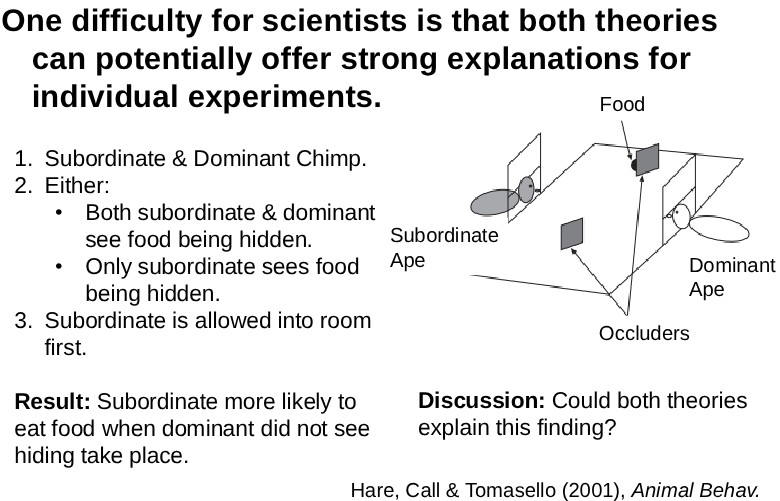
What are rich vs lean interpretations?
To what degree is social behaviour in non-human primates governed by:
Theories about the intentions + beliefs of other animals
OR
Simpler behavioural rules
E.g. goals + intentions (Call + Tomasello, 2008) BUT this model assumes chimps have mental states (not that they rep things like beliefs/desires) (Povinelli + Vonk, 2003)
What is a difficulty of rich vs lean interpretations?
Both theories can potentially offer strong explanations for individual experiments
How do children and chimps compare in solving physical and social problems?
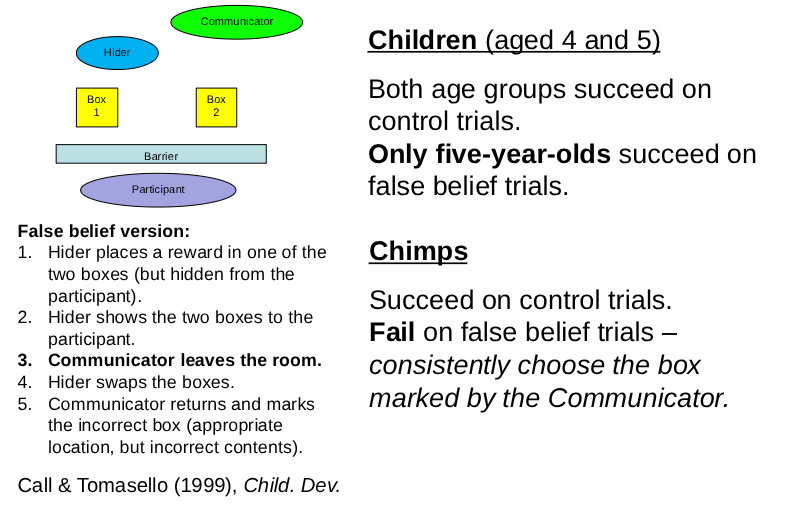
What was Call and Tomasello’s (1999) theory of mind test?
Control trials
Boxes are hidden from PPT
Hider places a reward in one of the boxes
Both boxes are shown to PPT
Communicator puts a marker on correct box
PPT chooses a box
False belief version
Boxes are hidden from PPT
Hider places a reward in one of the boxes
Both boxes are shown to PPT
Communicator leaves room
Hider swaps boxes in sight of PPT
Communicator returns + marks incorrect box (right location, wrong content)
PPT chooses a box
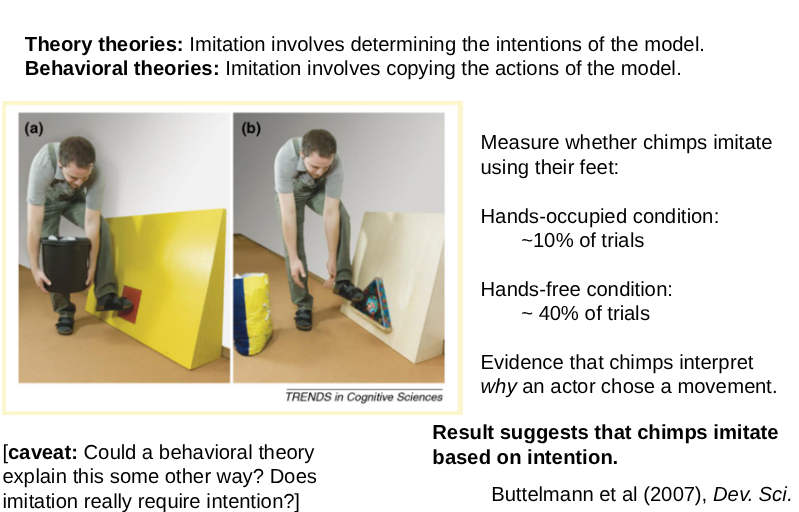
What are the 2 theories for imitation?
Theory theories → imitation involves determining the intentions of the model
Behavioural theories → imitation involves copying the actions of the model
What was Buttelmann’s (2007) research into imitation?
Chimps imitate based on intention
What are the 3 perspectives about the presence of theory of mind in chimps?