Week 11: Physical Changes Associated with Aging pt. 2
 Call Kai
 Learn
Learn Practice Test
 Spaced Repetition
 Match
Match Flashcards
 Knowt Play
1/12

There's no tags or description
Looks like no tags are added yet.
Name | Mastery | Learn | Test | Matching | Spaced | Call with Kai |
|---|
No analytics yet
Send a link to your students to track their progress
13 Terms
Menopause symptoms
Hot flashes, sweats, flushing, irritability, headaches, disturbed sleep
Dynamics of perimenopause
Ovarian reserve depletion rate increases dramatically - significantly reduces fecundity. (38) At 51, ovary reserve is depleted (<1000) this is the average of final menstrual period. Estradiol and progesterone drop sharply. FSH and LH increase dramatically due to loss of negative feedback.
Consequences of estrogen loss
Shrinkage of ovaries and uterus
Vaginal tissues become thinner, drier, and less elastic
Breast tissue becomes less dense and firm
Accelerated loss in bone density - estrogen inhibits osteoclasts.
Loss of estrogen’s ability to protect blood vessels by increasing level of HDL or good cholesterol → increased risk of atherosclerosis
Aging Nervous System
Normal declines in brain and cognitive function with age
- decrease in brain volume (hippocampus and pre-frontal cortex
- loss of myelin coating → less white matter
- little loss of neurons but brain can compensate
- decrease in synaptic connections/density
- decrease in hippocampal neurigenesis
- enlargement of ventricles, and subarachnoid space
- arteries and blood vessels to brain harden and shrink → blood flow to brain reduced
- decreases in neurotransmitter systems
lead to mild cognitive decline, should not affect normal activities
Alzheimer’s disease
Abnormal changes - dementia or alzheimer’s disease
Severe cell death and structural and biochemical abnormalities in brain leading to profound deterioration of mental and motor function
Prevalence of alzheimer’s
7% of Canadians aged 65 or higher diagnosed with dementia, 24.6% aged 85+
Alzheimer’s disease risk factors
Age
Genetics - familial early onset <10% of cases, genes involved in generation of harmful amyloid or breakdown of APP protein
late onset - APOE4 gene codes for protein involves in cholesterol transport
Most is sporadic (combo of genes, environment, and lifestyle)
Environmental & lifestyle - atherosclerosis, high LDL cholesterol, diabetes, obesity, smoking, head injuries
Infection and inflammation
Alzheimer’s disease protective factors
Education and higher cognitive reserve
Alzheimer’s pathology
Enlarged ventricles, shrinkage of cerebral cortex, shrinkage of hippocampus, shrinkage of entorhinal cortex
Neurofibrillary tangles and amyloid plaques.
Increased inflammation and activated microglia
Pathophysiology of alzheimers
Protein misfolding disease - abnormal aggregation of tau protein inside neurons → neurofibrillary tangles (involved in microtubule stabilization)
Fibrils of beta-amyloid protein → senile plaques outside neurons. Beta-amyloid fragments come from TM protein called amyloid precursor protein (APP) that is proteolyzed. APP normally functions in neuron growth, survival and repair
Inner ear aging
Age-related hearing loss
Usually due to loss of sensory receptors called hair cells. More loss in higher pitches, difficulties understanding speech. Vertigy or dizziness, and tinnitus
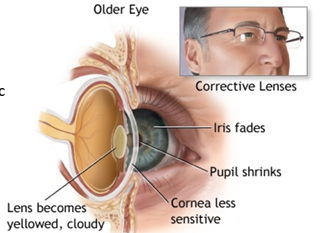
Eyes aging
Stiffening of lens, lens becomes denser, yellowing of lens, cell loss in retina and optic nerve
Results in presbyopia, need for brighter light, changes in colour perception
Disorders (secondary aging) - cataracts, macular degeneration, glaucoma
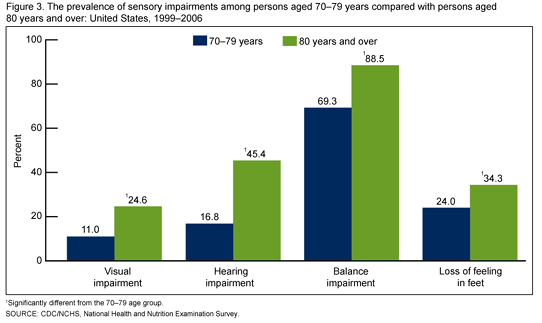
Prevalence of sensory impairments
Visual impairment (11% 70-79, 24.6% 80 over)
Hearing impairment (16.8% 70-79, 45.4% 80 over)
Balance impairment (69.3% 70-79, 88.5% 80 over)
Loss of feeling in feet (24% 70-79, 34.3% 80 over)