Thoracic & Lumbar Spinal Conditions
 Call Kai
 Learn
Learn Practice Test
 Spaced Repetition
 Match
Match Flashcards
 Knowt Play
1/20

Earn XP
Description and Tags
PTA 160
Name | Mastery | Learn | Test | Matching | Spaced | Call with Kai |
|---|
No analytics yet
Send a link to your students to track their progress
21 Terms
L1
L2
L3
L4
L5
L
S1`
S2
S3
S4
S5
Compression Fracture
Stable fracture → collapse of vertebral body
!!! Most oftenly in thoracic spine - anterior aspect !!!
Causes :
1. Osteoporosis (most common cause)
2. Trauma, fall, cancerRisk increases w/ age & postmenopausal women
Symptoms : Sharp pain in mid-to-low back that is relieved by lying down, ribs may become closer to pelvis, due to compression - increased thoracic kyphosis
Intervention : Core stab/proprioception/balance training, strengthen spinal extensors, EXTENSION BIAS
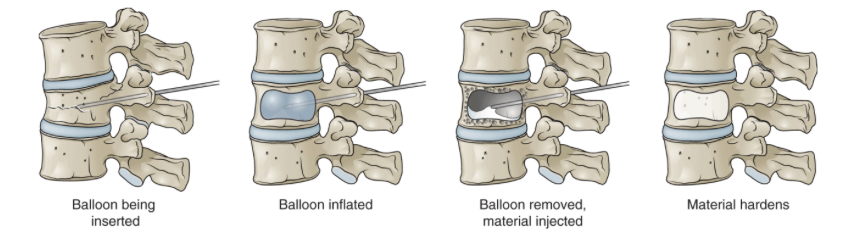
Surgery : Vertebral augmentation
Special Tests : Rib-pelvis distance & wall-occiput distance
Rib-pelvis distance
Position : Standing facing the wall with arms up (ARRESTED)
Test : Palpate the number of fingertips between the iliac crest & bottom rib
Positive : <2 fingertips between crest and bottom rib
For : Compression fracture
Wall-Occiput Distance
Position : Standing with scapulas & heels against the wall
Test : Measure in cm’s the distance between the occiputs & wall
Positive : >7 cm
For : Compression fracture
Vertebral Augmentation
For : Compression fractures
Vertebroplasty : Injecting bone cement into vertebral body & maintain vertebral body height
Kyphoplasty : Prior to injecting bone cement, a small inflatable balloon is placed into vertebral body & inflated (compacts bone & creates space for cement)
Pain relief usually within 24 hours
Hyperkyphosis
Abnormal increase in thoracic kyphotic curve
Normal curve ::
(children age 10) : 20 degrees
(women >65 years) : 45 degrees
(men >65 years) : 35 degrees
Causes : Compression fracture, DDD, cystic fibrosis, COPD, muscle weakness in back extensors/tightness in hip flexors
Scheuermann’s disease in adolescents can lead to this
Males 2 : Females 1
Symptoms : Pain & stiffness
Intervention :
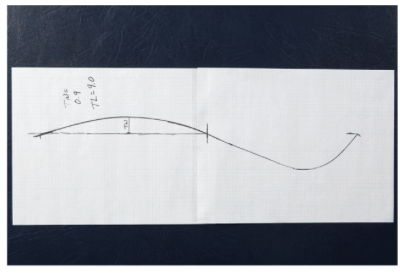
Special Tests : Rib-pelvis distance, wall-occiput distance, & flexicurve kyphosis index
Flexicurve Kyphosis Index
Patient stands in usual best posture, & examiner marks C7 & L5/S1
Patient holds chair & examiner molds flexicurveto the shape of patient’s thoracic & lumbar curves
Markings for C7 & L5/S1 are placed on the ruler, & then the ruler is placed on graph paper
The curve is traced & a kyphosis index is calculated
Over 13 indicates abnormal kyphosis
Scoliosis
Curvature of spine in the frontal spine causing an ‘S’ or ‘C’
Can be structural or nonstructural (Ex. Nonstructural - leg length discrepancy)
!!! NAMED BY WHICH SIDE IS THE CONVEXITY = Right bends to the right !!!
Causes : Most often idiopathic, but can also be from a neuromuscular disorder (cerebral palsy, muscular dystrophy, spina cord injury)
Symptoms : Mild is asymptomatic / Severe may be cardiopulmonary or neurologically compromised
Intervention : Bracing, stretching the concave side & strengthening the convex side
Surgical : Spinal fusion
Special Tests : Adams Forward Bend Test
Adams Forward Bend Test
Position : Standing in full thoracic flexion
Test : PTA takes two fingers on either side of spine and superiorly moves up spine, looking for an abnormal curvature
Positive : A curve within the horizontal plane
For : Scoliosis
Lumbar Strain/Sprain
3 GRADES:
Grade I : Microtearing
Grade II : Partial tear
Grade III : Complete tear
Causes : Trauma or stressful postures
Symptoms : Pain with stretch OR contraction of affected muscles
Specifically in sitting or standing from seated
Intervention : modalities, stretching/strengthening, core stab, avoid prolonged poor posture
Degenerative Disc Disease (DDD)
Disc space narrowing / Disc desiccation or fibrosis / small tears in the annulus fibrosis
Causes : Hereditary or aging (90% of people >65 years have in some degree)
Symptoms : Generalized lower back pain
Intervention : Coordination / core strengthening / endurance
Facet Joint DJD
Causes :
Symptoms :
Intervention :
Special Tests :