Test 4 econ
 Call Kai
 Learn
Learn Practice Test
 Spaced Repetition
 Match
Match Flashcards
 Knowt Play
1/58

There's no tags or description
Looks like no tags are added yet.
Name | Mastery | Learn | Test | Matching | Spaced | Call with Kai |
|---|
No analytics yet
Send a link to your students to track their progress
59 Terms
Monopolistic competition characteristics
non price competition
many/diff sized firms
differentiated products
firms are price makers
low barriers of entry
no profit in long run
firms are unefficent if unregulated
output at MC=MR, price at the output’s demand hence under produces and overcharges
excess capacity
difference between the firm’s profit-maximizing output (MR=MC) and output where total costs are minimized (ATC=MC)
monopolistic competition will only produce output if
MR= or greater than MC
too many firms enter market
existing firms will see their MR and D go down until D= ATC so no profit is made long run.
market has a loss…
firms leave the market which makes MR and D go up for existing firms until ATC= D
Oligopolies characteristics
few large firms
products are differentiated and have substitutes
non price comeptition
price makers
inefficent when unregulated
high barriers to entry
make MR=MC output but charge the demand’s price at that output
make profits in long run
how to oligopolies make profit with barriers
name brand, economies of scale, geographic control of inputs
mutual independency
a firm’s decisions effect profits and losses of their comepetitiors. Firms must watch eachother.
oligipolies colluding eachothers due to interdepency
a cartel
game theory
study of how oligopolies collude in competitive markets.
price leaderships
firms following another’s strageties by copying
domaint stragety
the descion that brings more profit regardless of other’s firm decisions
externalities
benefits or costs that fall on people who don’t buy or produce products. EX: smell of cigarettes in public spaces is a negative externality to non smokers
spill over
another word for negative externalities
externalities of consumption
spill over costs or benefits caused by consumers of a good
externalities in production
spill over costs or benefits caused by producer of a good
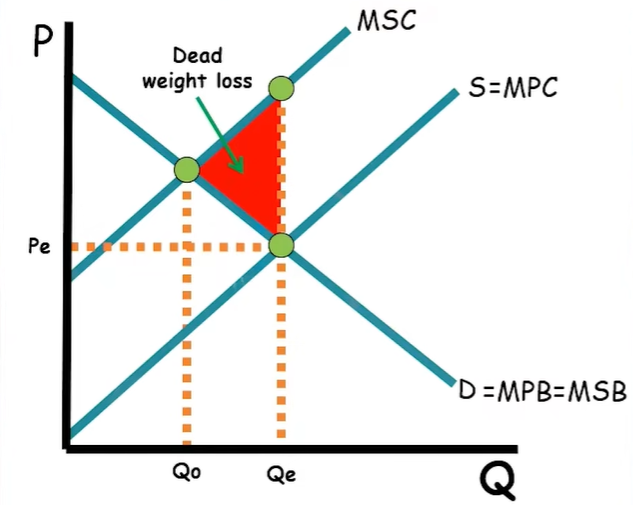
how to graph externalities
add (if positive) or subract externalities from supply curve because supply = marginal private cost IF it is a externality in production.
if it is an externality in consumption, add (if positive) or subtract externality from demand curve because demand= marginal private benefit
negative externality in production
negative exterality in consumption
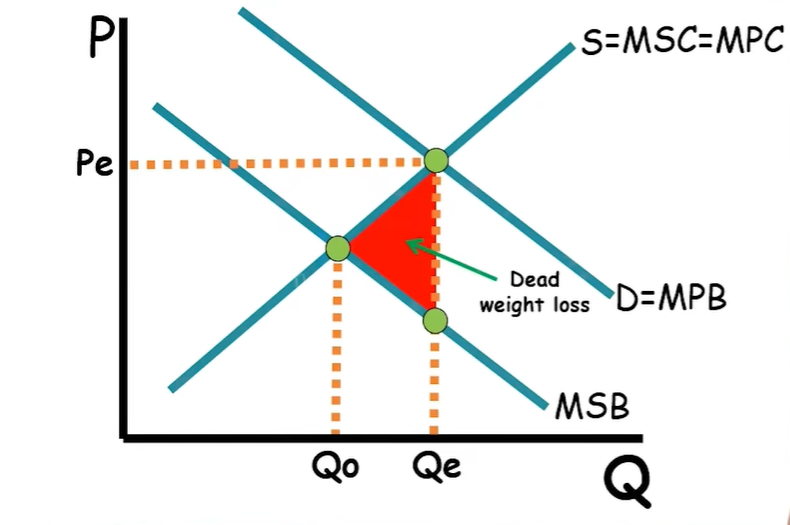
socially optimal point
when other curve = social MSB or MSC
free rider
people who benefit without paying, underprovision by private markets. This is caused by non exclusionary goods
public good
a non-exclusion and non-rivalry good.
non exclusion- you can’t exclude people who dont pay
nonrivalry- extra consumption doesn’t make it worse for anyone
monopolistic product differentiation?
advertising, geographic location, name branding, quality,
horizontal differntation vs vertical
horizontal involves taste preferences on which product is better, not quality while vertical is based on price, not quality.
hortzional ex: chocolate vs vanilla ice cream of same brand
vertical: tom and jerry ice cream vs great value
rank elasticities of perfect competition/monopoly/monopolistic
perfect elasticity: perfect competition
mid-elastic monopolistic
least elastic: monopoly
monopolistic profit in long run? Monopoly in long run?
Monopoly= Price = ATC at min ATC output level so zero profit, efficient
monopolistic= Price = ATC, not min ATC so its unefficent and makes zero profit
consumer surplus in monopolistic vs perfect competition
consumer surplus in perfect competition is higher because perfect competition is price takers. Consumer surplus is lower in monopolistic because prices are maximized
why is there excess capacity in monopolistic competition and not perfect?
Because monopolistic compeitions arent effeicent. They don’t produce at min ATCcompetitions
What are the three types of mergers?
Horizontal (same industry, same stage), vertical (different stages of production), conglomerate (unrelated industries).
Why might the government block a merger?
If it substantially lessens competition, creates monopoly power, or raises prices for consumer
What is tacit collusion?
firms coordinate their behavior without communication, often through price leadership or following observed actions.
What makes tacit collusion easier? or harder?
EASIER: Few firms, similar costs, stable demand, frequent interaction, and small gains from cheating.
HARDER:Many firms, different costs, fluctuating demand, secret price cuts, large potential gain from cheating.
In a cartel, what happens if one firm cheats by increasing output?
Market price falls, cartel profits decrease, cheating firm gains temporarily but industry profits suffer.
marginal social cost of pollution.
The additional cost imposed on society from one more unit of pollution (includes private cost + external cost).
Define marginal social benefit of pollution.
The additional benefit to the polluter (e.g., cost savings from not reducing pollution) from one more unit of pollution.
What happens to price and quantity when a negative externality is internalized?
Price increases, quantity decreases (moves toward social optimum).
What happens to price and quantity when a positive externality is internalized?
Price decreases (or subsidy reduces net price), quantity increases.
How would the government correct a positive externality?
Subsidies, vouchers, or direct provision (e.g., public education, vaccines).
What type of policy corrects a positive externality?
Subsidies or Pigouvian subsidies (negative tax).
Difference between Coase Theorem solution and Pigouvian tax?
Coase: private bargaining without government (requires low transaction costs, clear property rights). Pigouvian tax: government sets a tax equal to external cost.
What is a market for the right to pollute?
tradable permits system (cap‑and‑trade) where firms buy/sell allowances to emit a set total amount.
What happens if number of tradable permits decreases?
price of permits increases which result in eqilbirum pollution emitted quanity descreasing
what happens if number of tradable permits increase
price goes down and eqilbirum of pollution emitted quanity goes up
advantage and disadvantage of tradable pollution permits
advantages: firms with lowest reducing pollution (abatement) reduce the most, total cost minimized.
disadvantage: requires monitoring and enforcement.
relationship between property rights and common resources
people will overuse without property rights, which is called the problem of the commons. No one has an incentive to conserve because others will overuse if they don’t. They ignore the external cost of depletio
How does public good differ from common resources?
Public good is non rivalry which mean one more person using it doesn’t mean someone else can’t. Ex: fish is a common resource because it is rivalry. More people fishing means less people can in the future.
why do individuals not want to pay for public goods?
free rider problem, each person hopes others will pay, so private provision is too low.
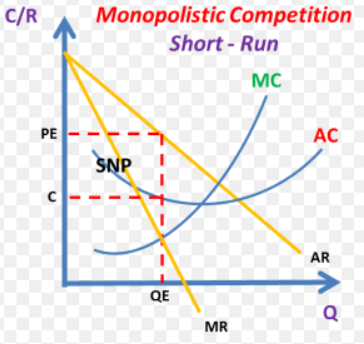
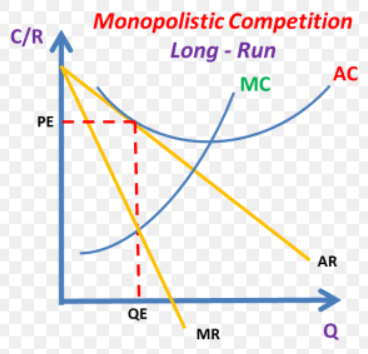
monopolistic competition makes a profit
ATC is less than demand price
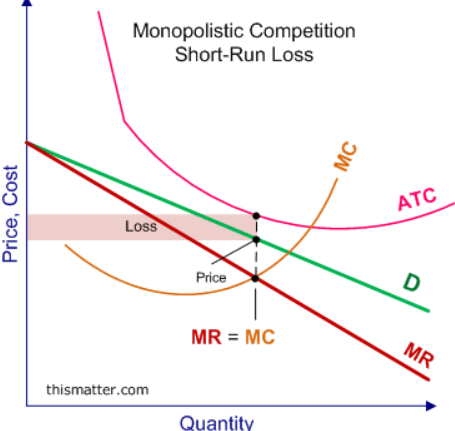
monopolistic competition making a lost
ATC is more than demand price
monopolistic comeptition in long run
demand price= ATC
How to calculate Herfindahl‑Hirschman Index (HHI)?
Sum of squared market shares (as whole numbers). Example: 30² + 30² + 40² = 900+900+1600=3400
What is Nash equilibrium?
each player’s response to the other player is best stredegy, no one wants to change
In a payoff matrix, how does collusion equilibrium differ from Nash equilibrium?
in collusion equilbirum, each choose the high profit unless someone cheats
Tiit‑for‑tat strategy in repeated game?
cooperate at first but do what the opponent did last round
In a repeated game, if both play tiit‑for‑tat, does cheating pay?
there is short run gain profit from cheating but in the long run, it isn’t beneficial b/c long run loss from retaliation > stable cooperation can occur
On MSB/MSC graph, what is pollution without government intervention?
where marginal social benefit is zero and marginal social cost is maxx
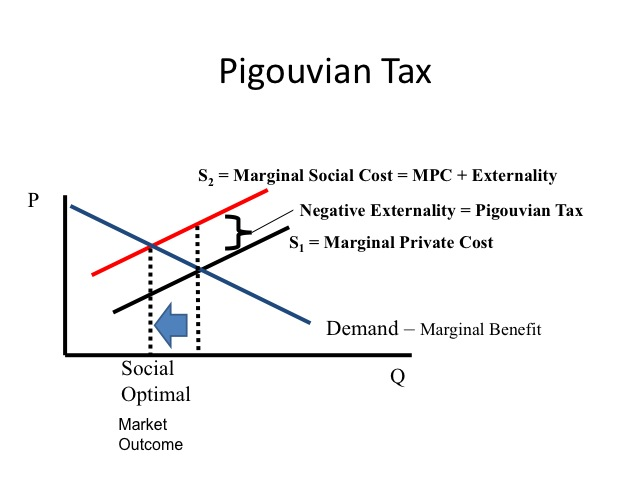
On MSB/MSC graph, what is optimal Pigouvian tax?
The vertical distance between MSC and MPC at the socially optimal quantity (tax = external cost).
Under emission standards with two firms (one lower abatement cost), which firm reduces more?
Both reduce the same in equal costs- inefficient, higher total cost
Under emission tax with two firms (one lower abatement cost), which firm reduces more?
lower abatement firm loses more, higher cost firms pay tax on remaining emissions. lower total cost