7. Structural Organisation in Animals
 Call Kai
 Learn
Learn Practice Test
 Spaced Repetition
 Match
Match Flashcards
 Knowt Play
1/189

Earn XP
Description and Tags
Only 5 flashcards in this deck are not about Frog. The entire deck is just Frog. NCERT removed everything from this chapter and now all it has is Frog. This is a flashcards deck about Frog. Good luck with Frog. Okay but in all seriousness, this deck contains all the NCERT sentences in this chapter, so it's suitable for revision for IAT, NEET, NEST, probably more. Question mode: Flashcards only. Answer mode: Answer with definition. Good luck with exams!
Name | Mastery | Learn | Test | Matching | Spaced | Call with Kai | Chat |
|---|
No analytics yet
Send a link to your students to track their progress
190 Terms
Is Hydra a unicellular or multicellular organism?
multicellular
What are the four types of tissues present in all complex animals?
Epithelial
Connective
Muscular
Neural
What is an example of an organ in humans that consists of all four types of tissues present in complex animals?
heart
What is the difference between morphology and anatomy of animals?
In case of animals, “morphology” refers to the external appearance of the organs or parts of the body. The word “anatomy” conventionally is used for the study of morphology of internal organs in the animals.
What is the most common species of frog found in India?
Rana tigrina
What is the class that frogs belong to?
Amphibia
What is the phylum that frogs belong to?
Chordata
What is the habitat of frogs?
They can live both on land and in fresh-water
Are frogs poikilotherms or homoiotherms?
poikilotherms
What does poikilothermous mean?
They do not have constant body temperature i.e., their body temperature varies with the temperature of the environment.
What is the ability of frogs changing colour called?
mimicry (camouflage) 😛
How do frogs camouflage themselves?
You might have also noticed changes in the colour of the frogs while they are in grasses and on dry land.
You might have also noticed changes in the colour of the frogs while they are in grasses and on dry land. Why do they do this?
To protect themselves from predators, as camouflage
What is mimicry (in frogs)?
They have the ability to change the colour to hide them from their enemies (camouflage). This protective coloration is called mimicry.
What is aestivation (in frogs)?
Summer sleep — frogs taking shelter in deep burrows to protect themselves from extreme heat
What is hibernation (in frogs)?
Winter sleep — frogs taking shelter in deep burrows to protect themselves from extreme cold
What is summer sleep in frogs called?
Aestivation
What is winter sleep in frogs called?
Hibernation
Comment on the texture of frog skins.
The skin is smooth and slippery due to the presence of mucus. The skin is always maintained in a moist condition.
Comment on the colour of frog skins.
The colour of dorsal side of body is generally olive green with dark irregular spots. On the ventral side the skin is uniformly pale yellow.
What can frogs do with their skin that humans cannot do with their skin?
The frog never drinks water but absorbs it through the skin.
What are the segments of the body of a frog?
head
trunk
Necks are _________ in frogs.
(present / absent)
absent
Tails are _________ in frogs.
(present / absent)
absent
Where can nostrils be found on frogs?
above the mouth
Comment on the shape of frogs’ eyes.
BULGED
Comment on the covering of frogs’ eyes.
Their eyes are covered by a nictitating membrane that moisturises their eyes and protects them while in water.
They have regular eyelids too but can’t close them. Only the nictating membrane can close over their entire eyes.
What external organs do frogs use for hearing?
external tympanum
Where is the tympanum present in frogs?
On either side of eyes
How many limbs do frogs have?
4
How many digits do hind legs in frogs have?
5
How many digits do forelimbs in frogs have?
4
Why are feet in frogs webbed?
to help in swimming
Why are hind limbs larger and more muscular than forelimbs in frogs?
Because they leap and swim and the hind limbs are used more in these activities
Do frogs exhibit sexual dimorphism?
yes
What are the two morphological differences between male and female frogs?
presence of sound-producing vocal sacs (frogs that croak a lot are male, females don’t usually make sounds)
copulatory pads on the first digit of forelimbs to hold the female in place when humping i mean mating
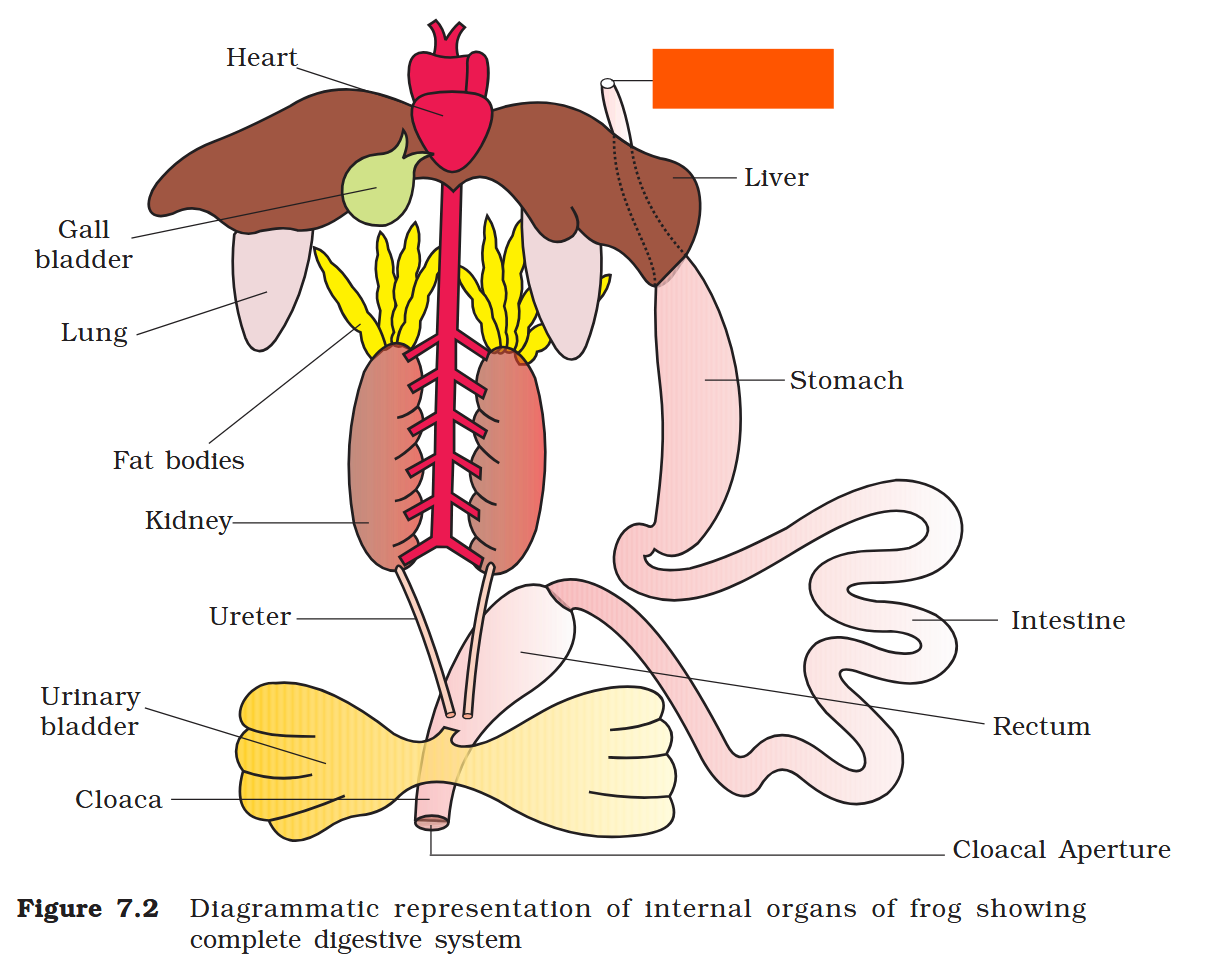
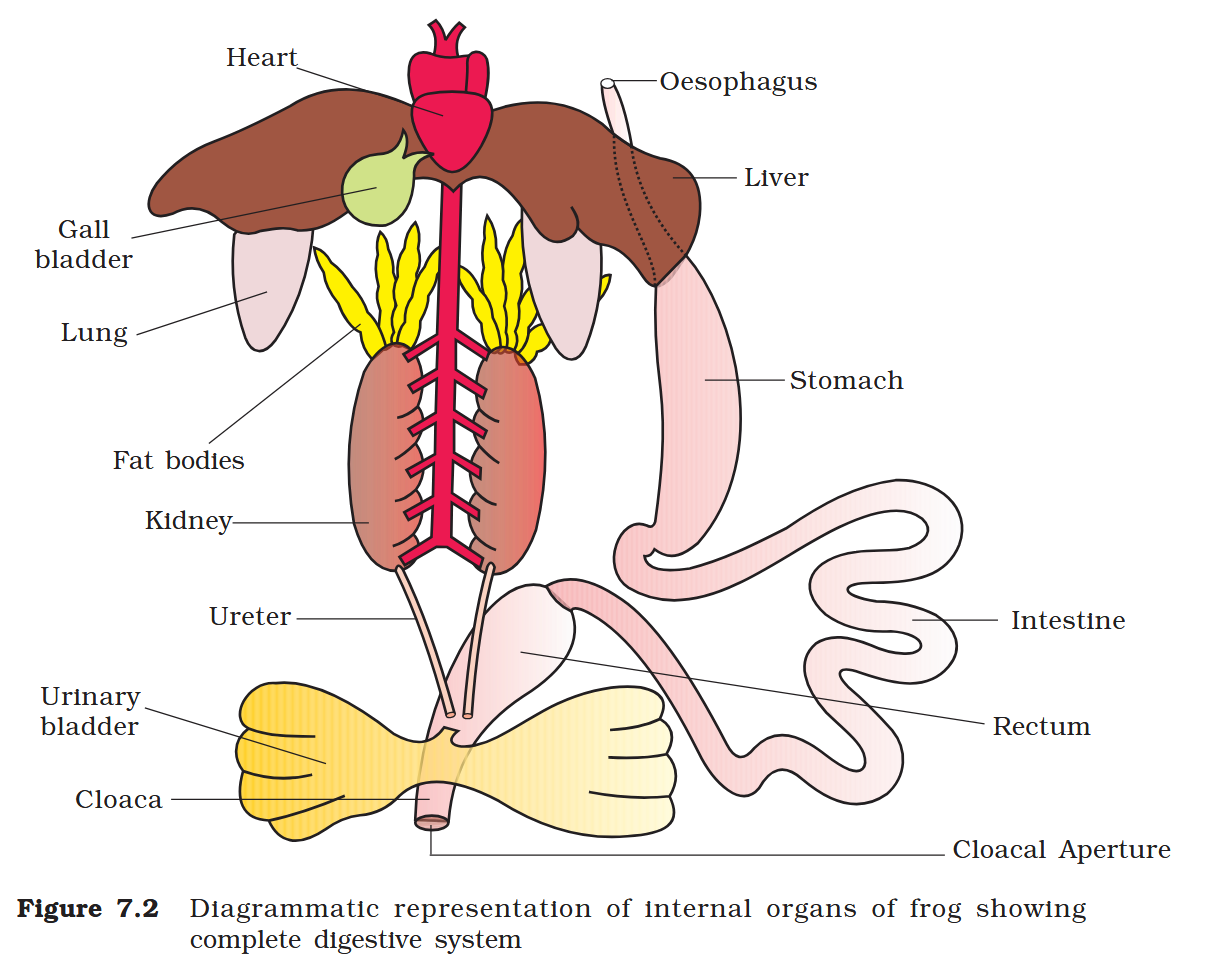
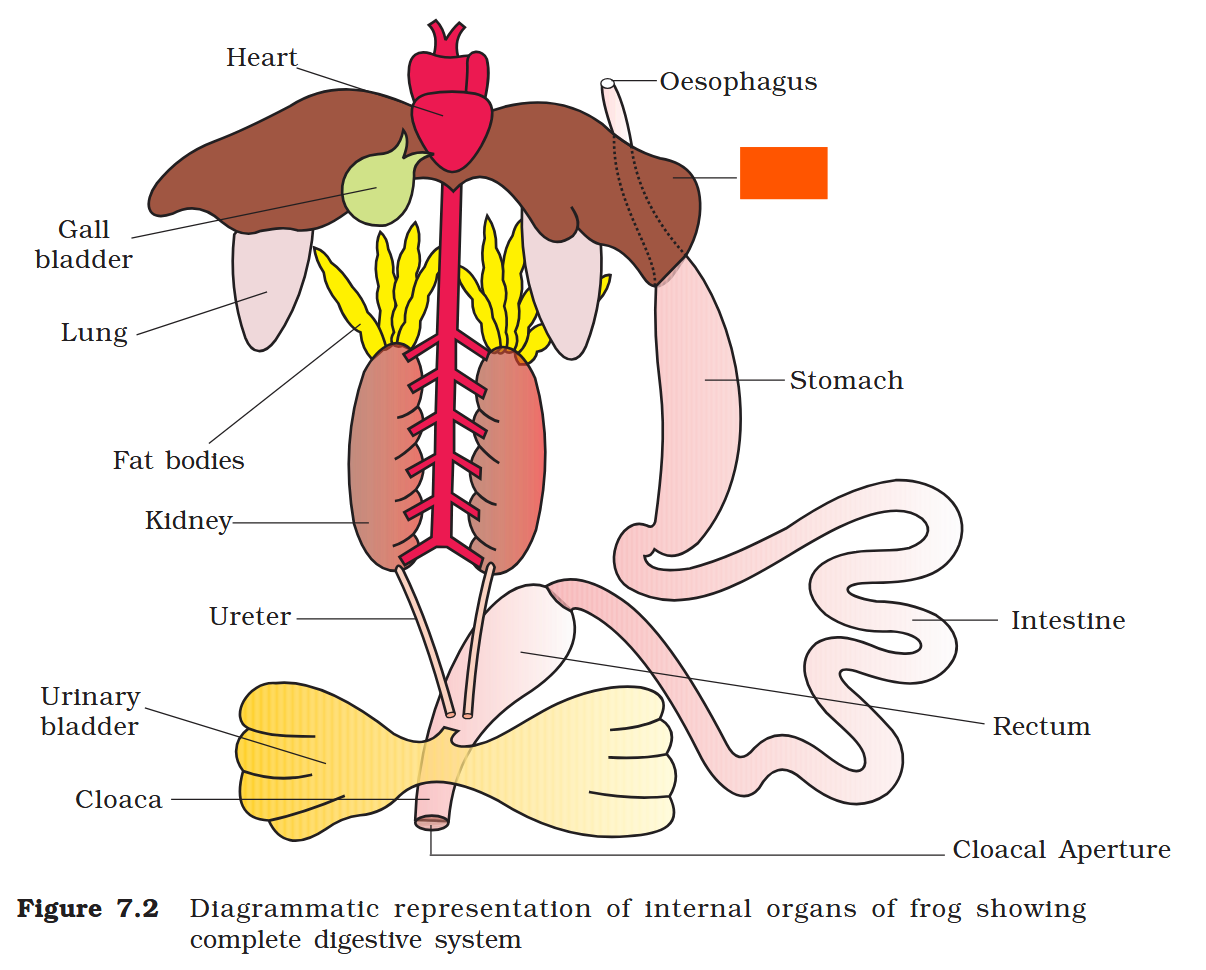
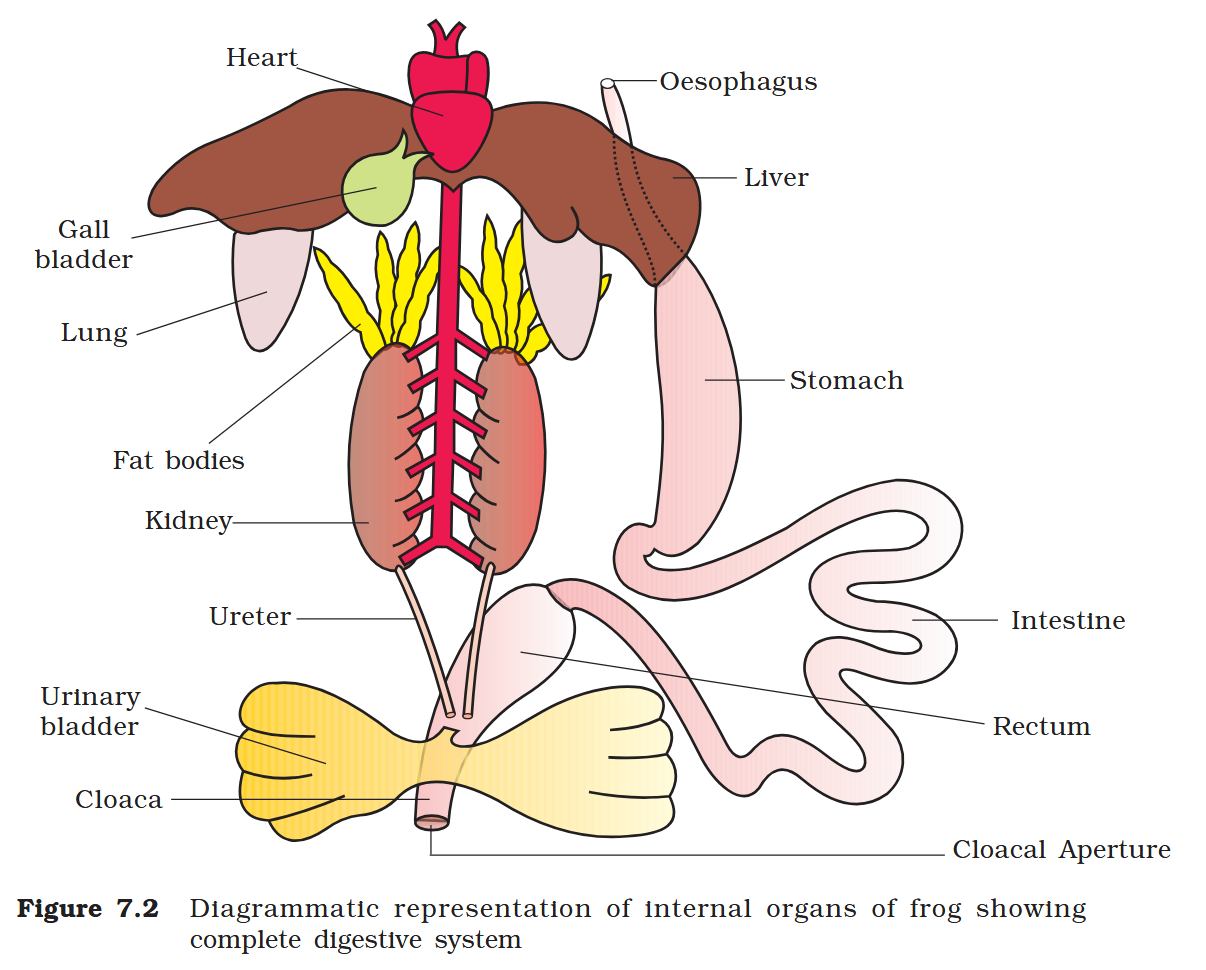
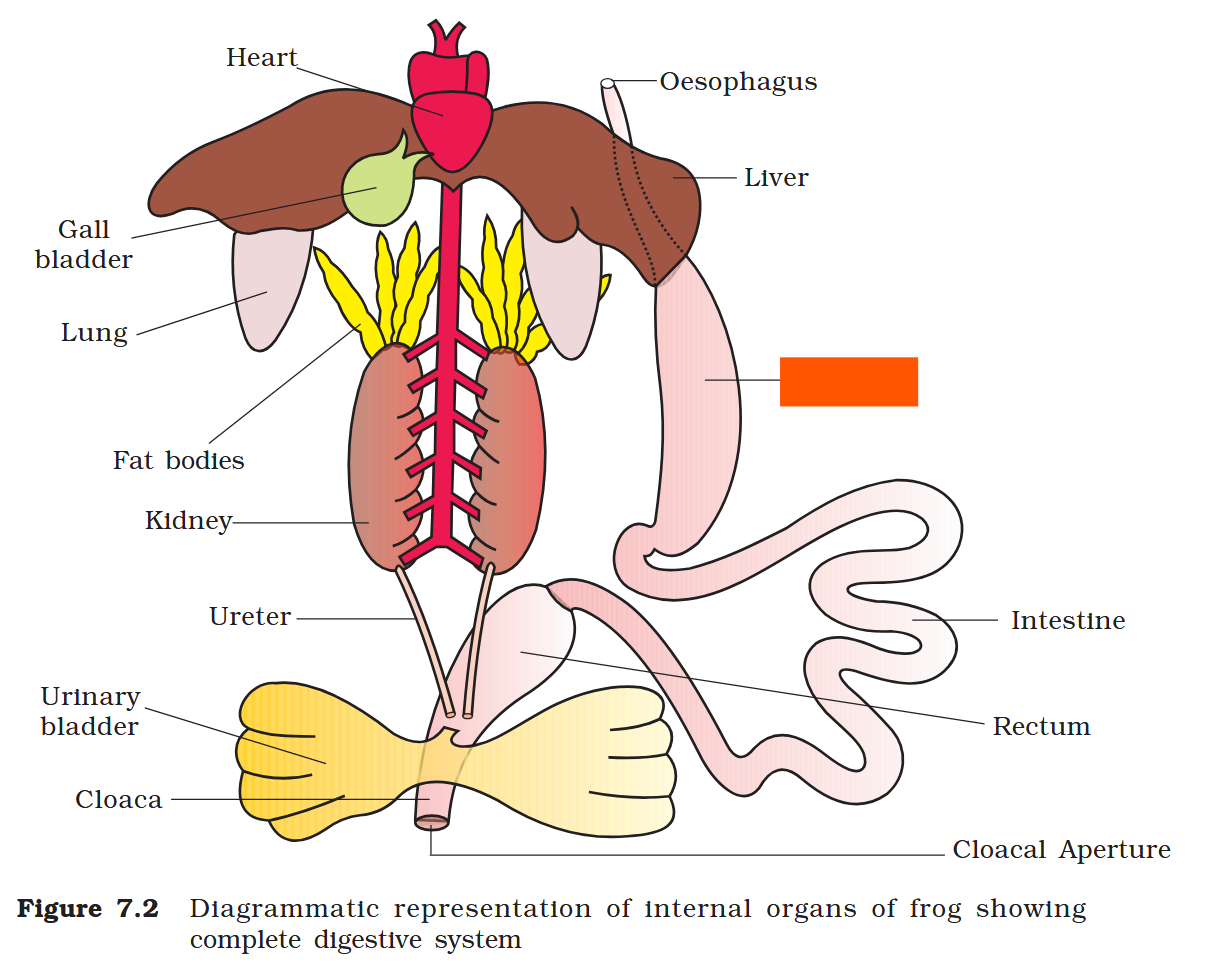
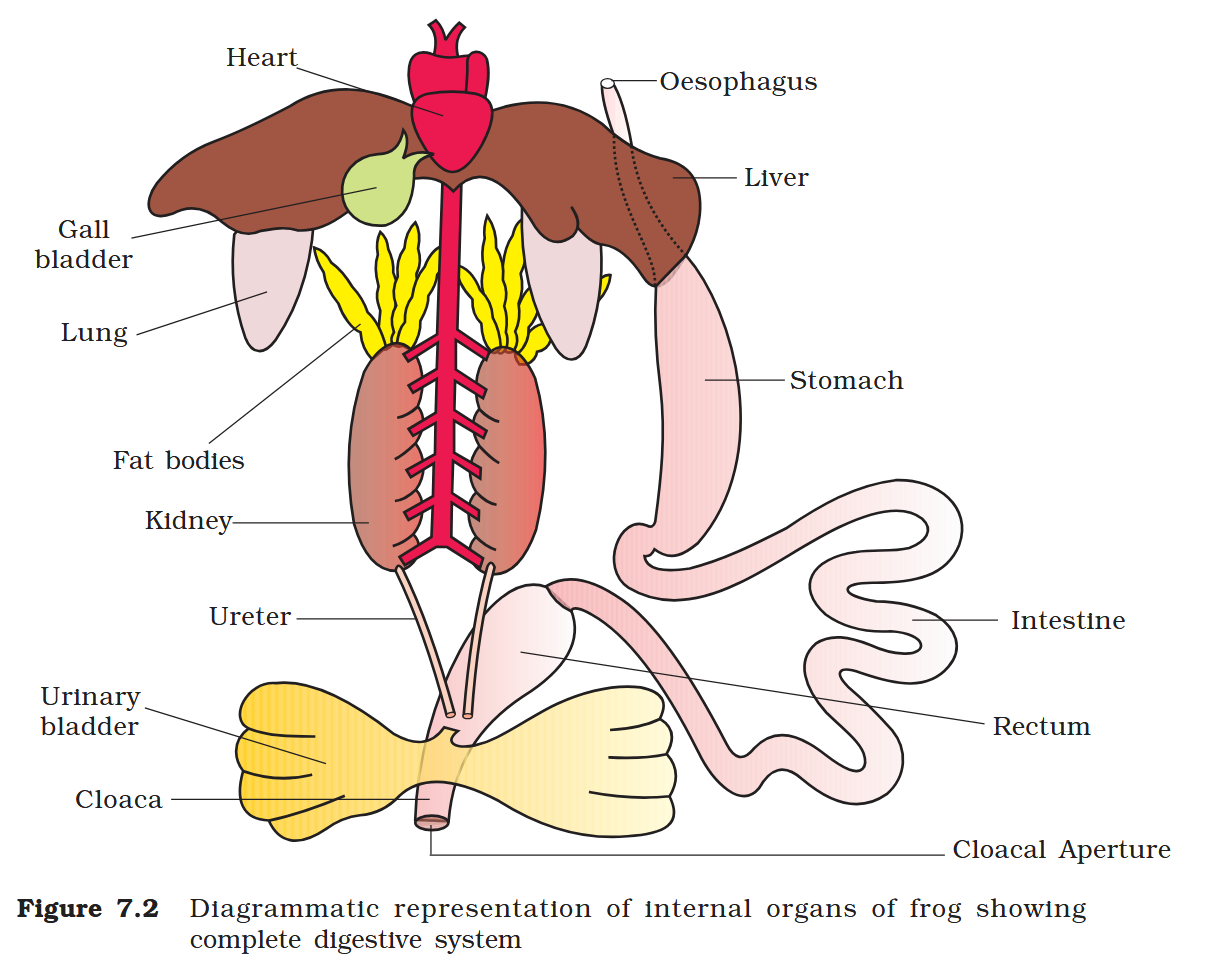
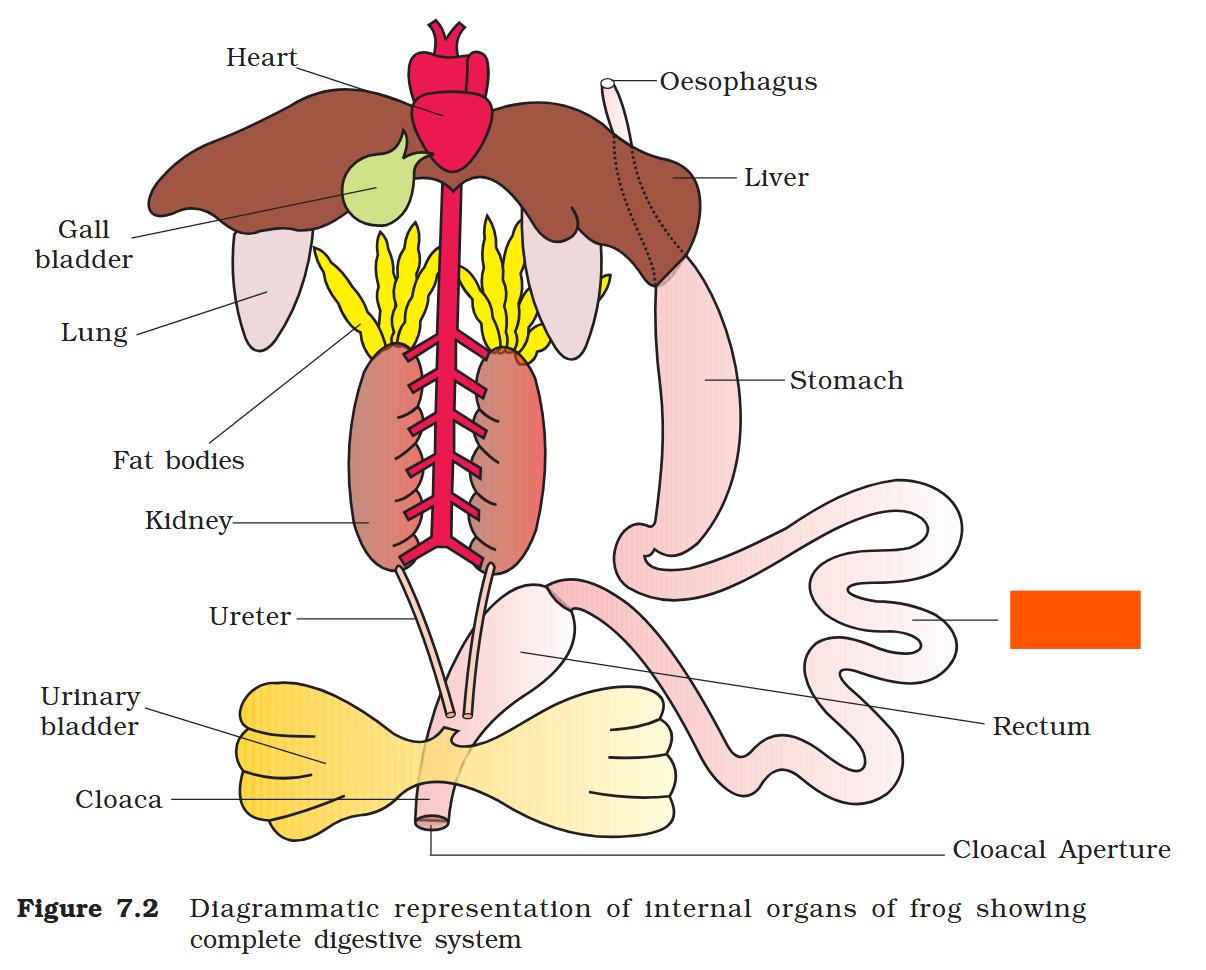
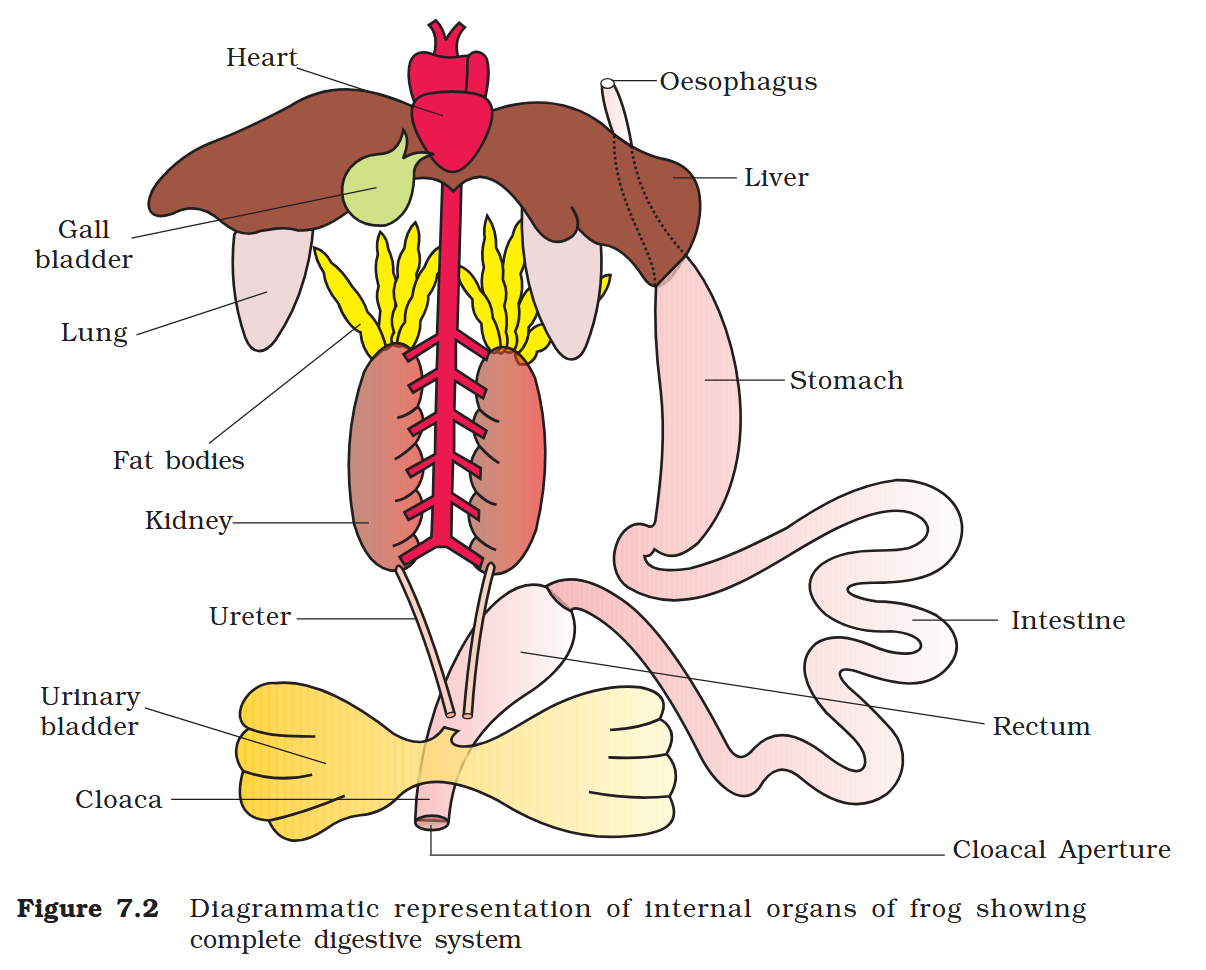
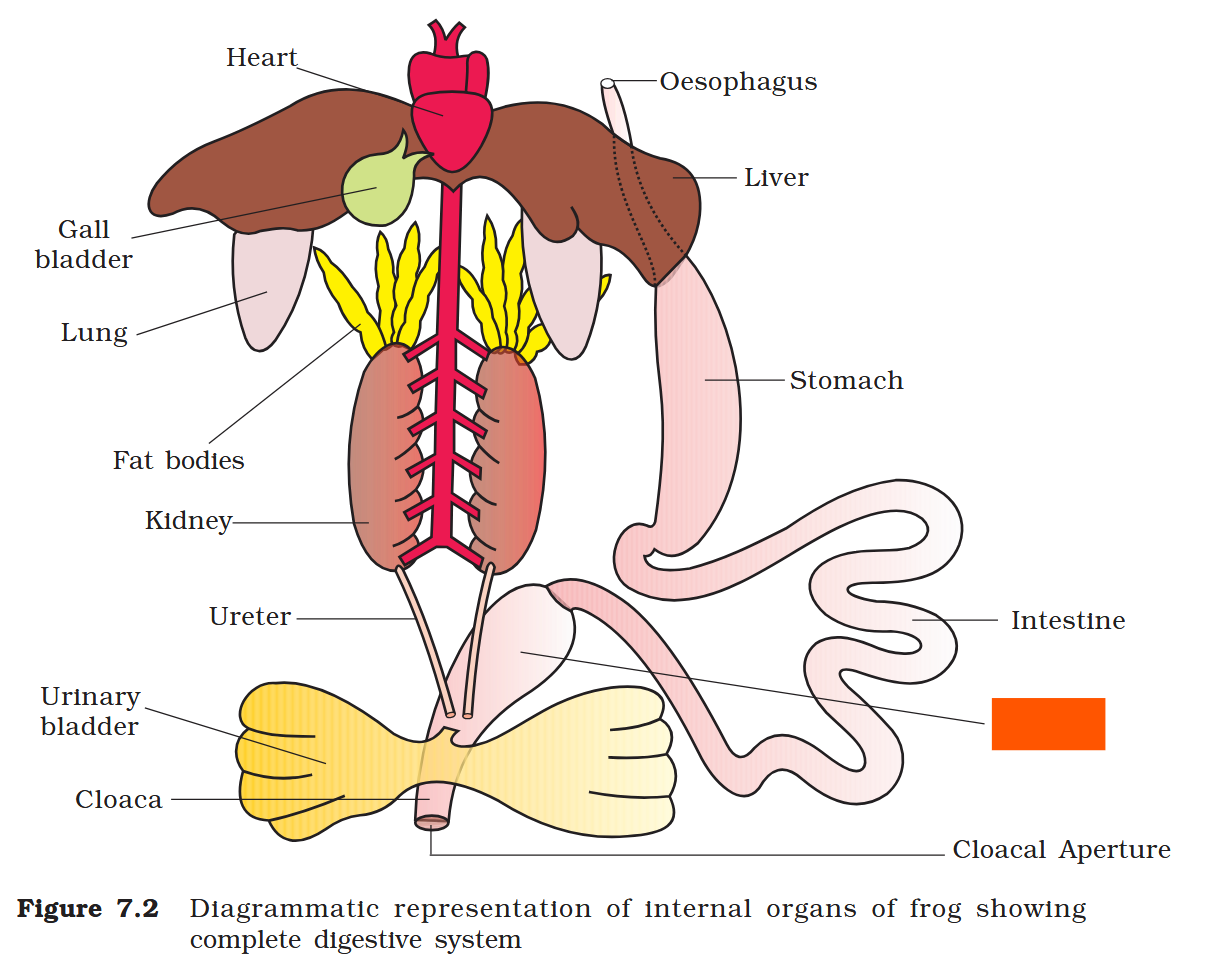
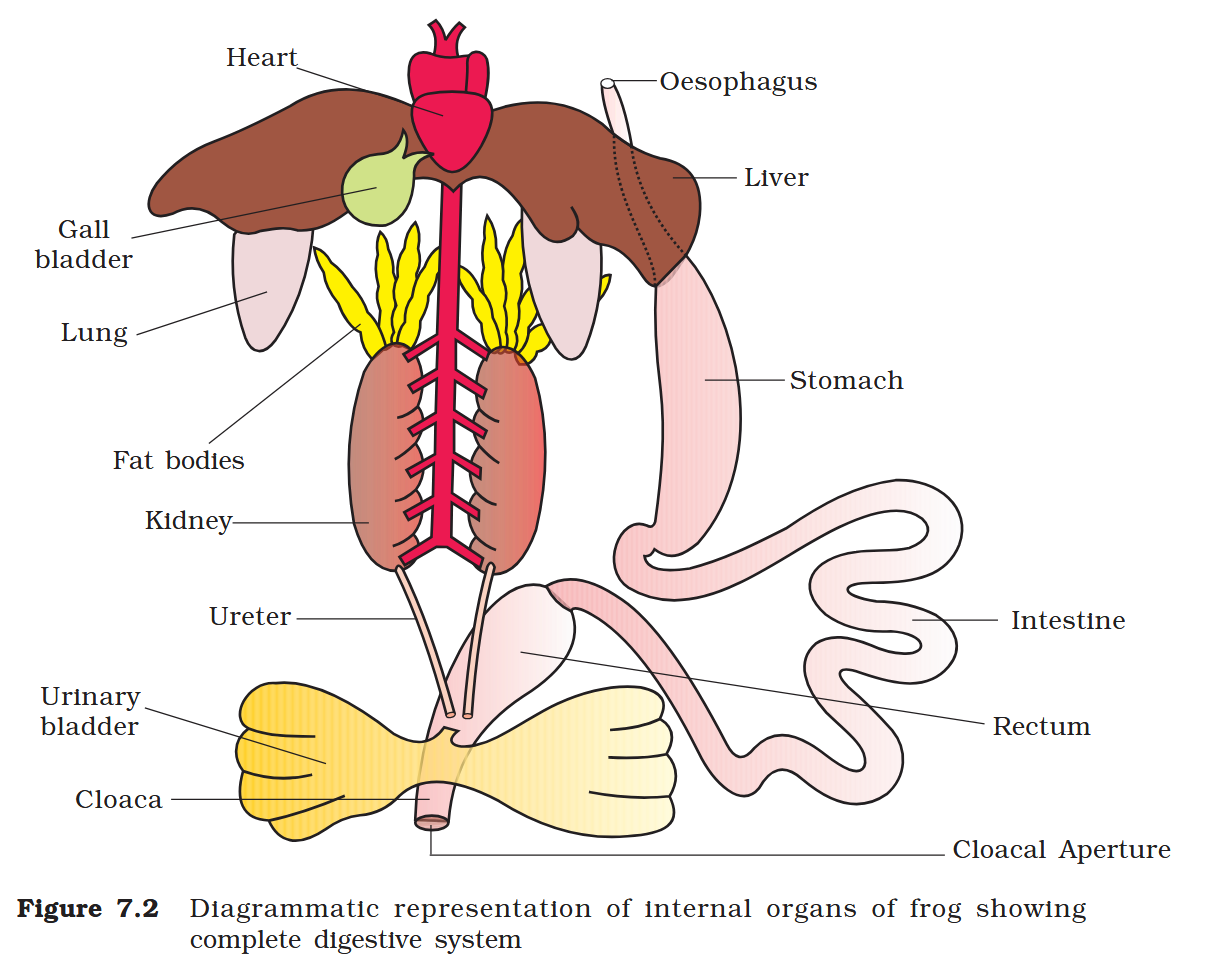
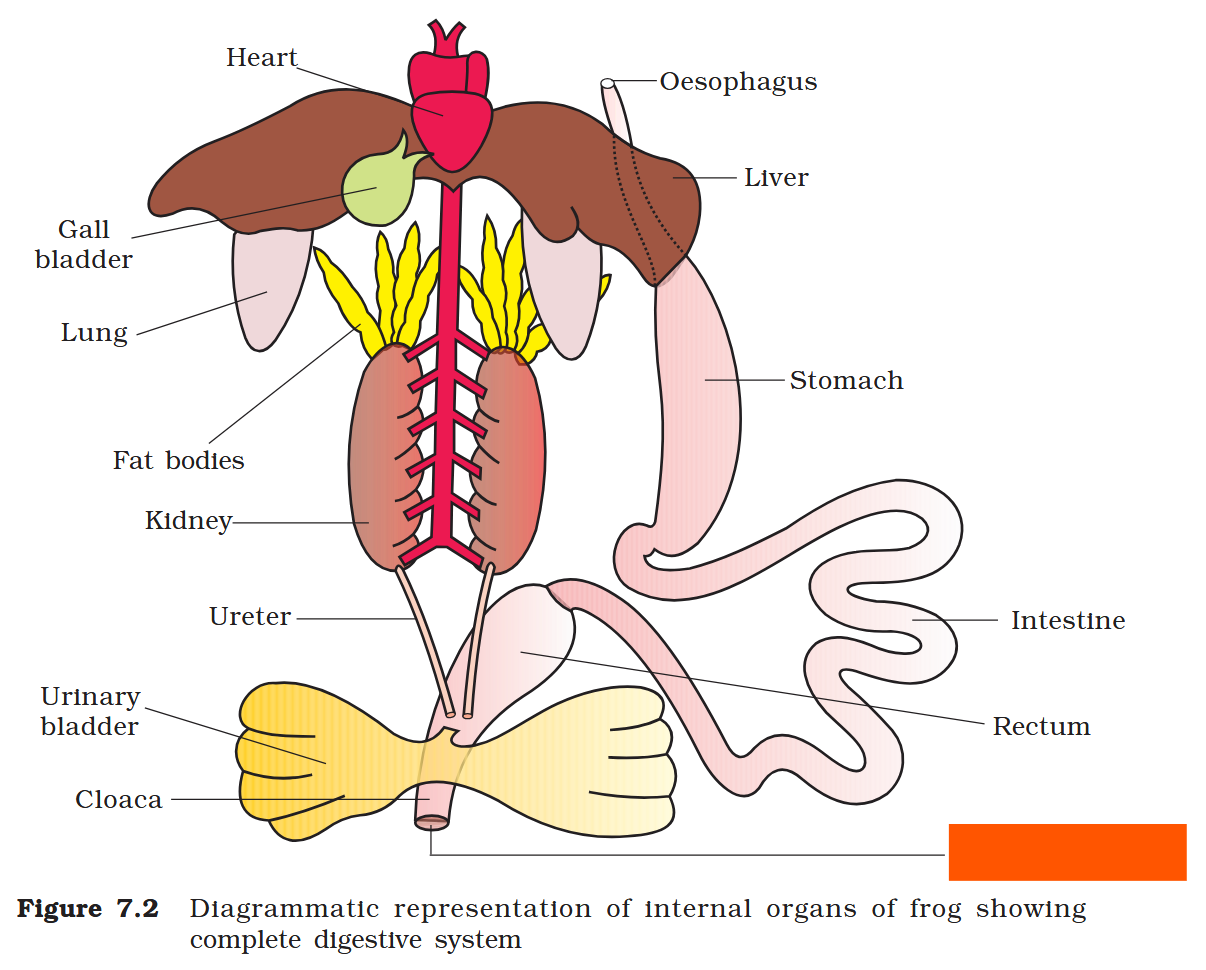
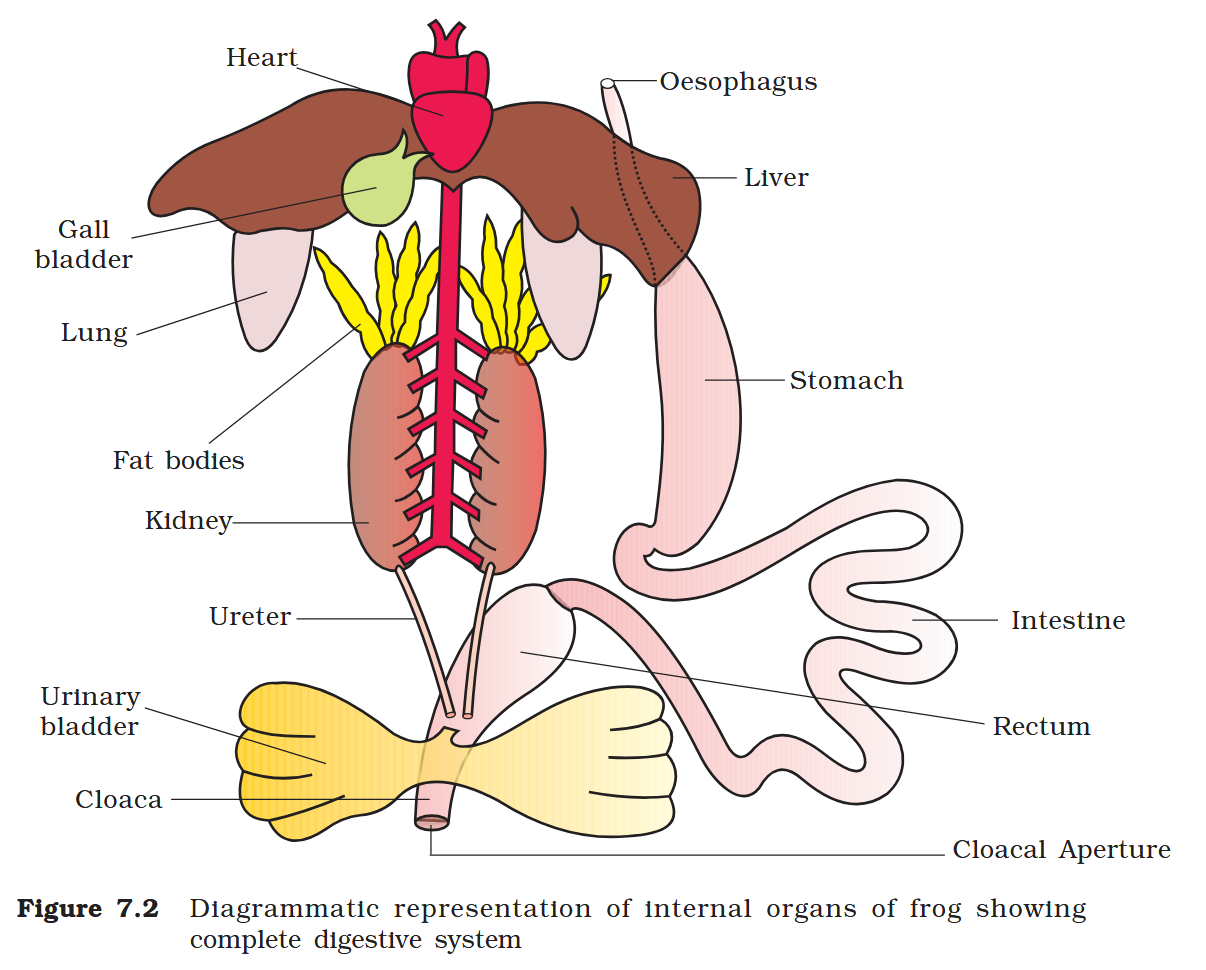
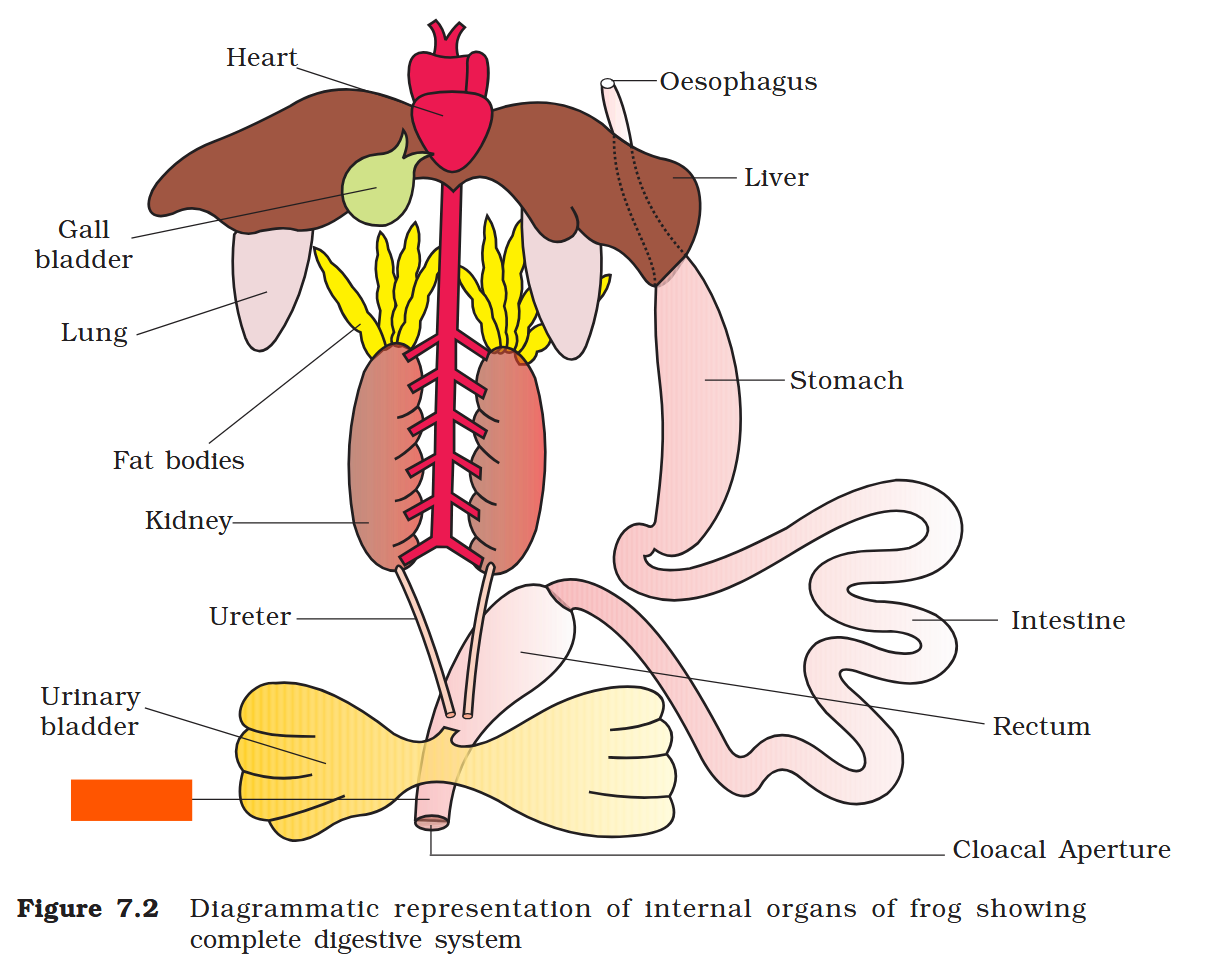
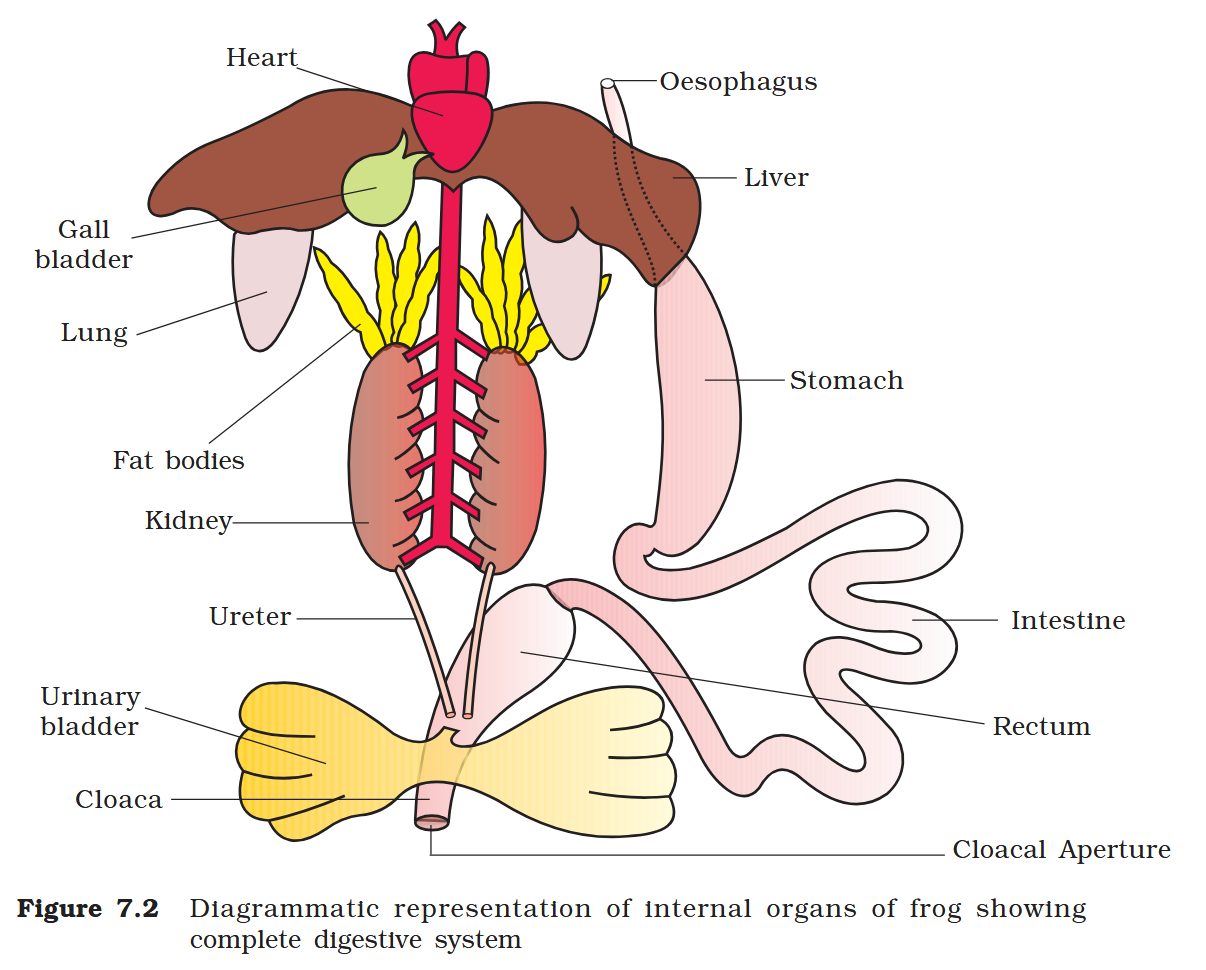
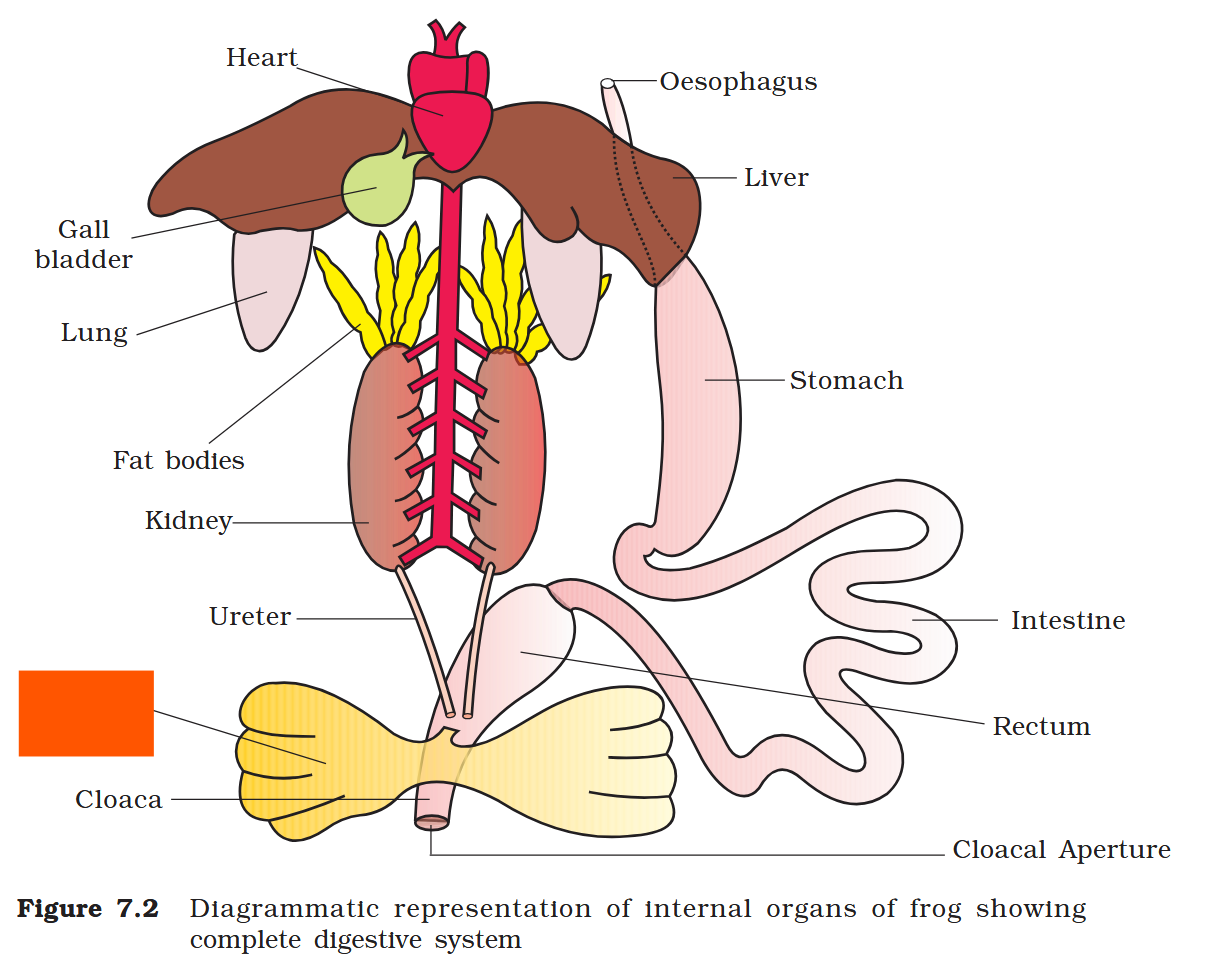
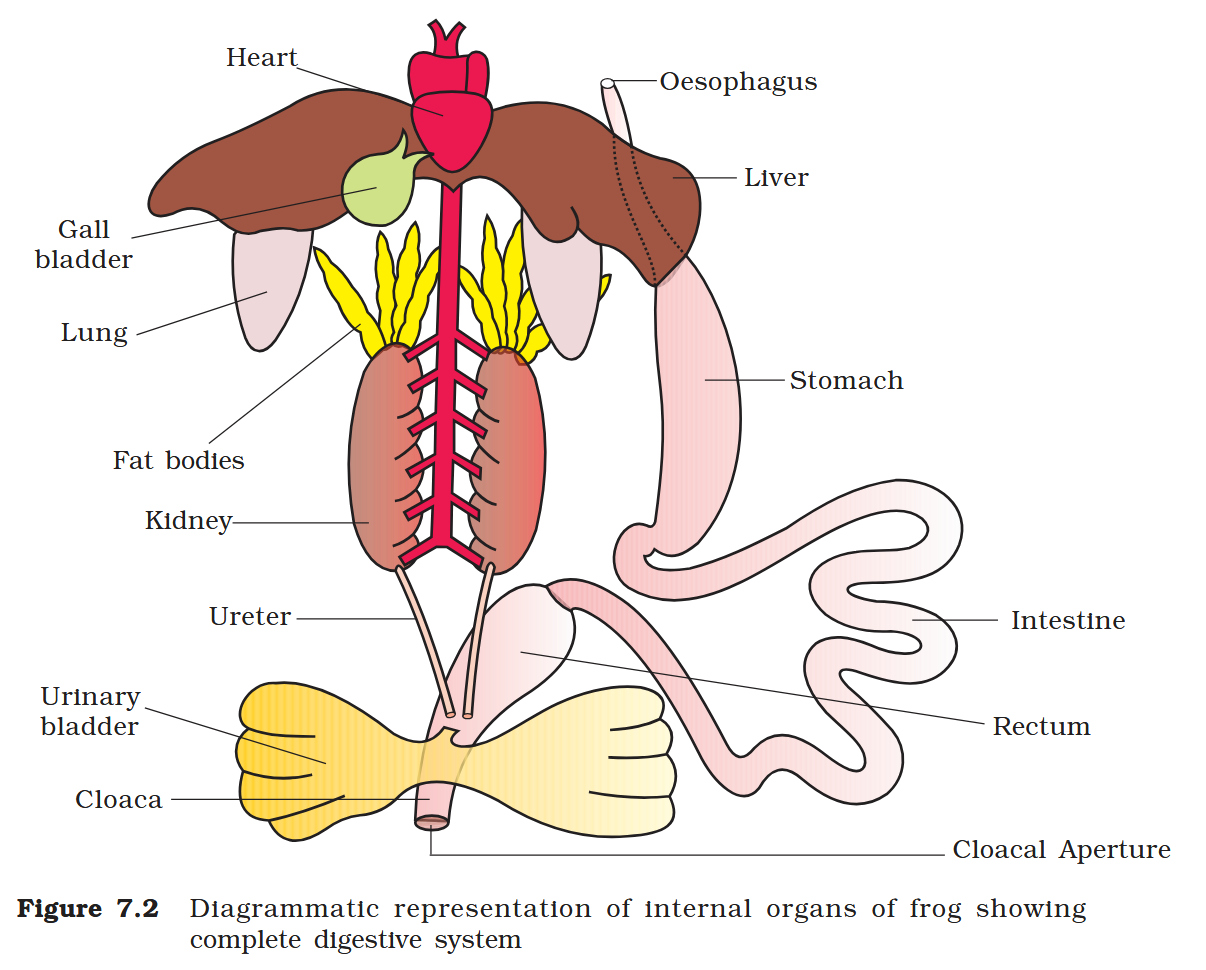
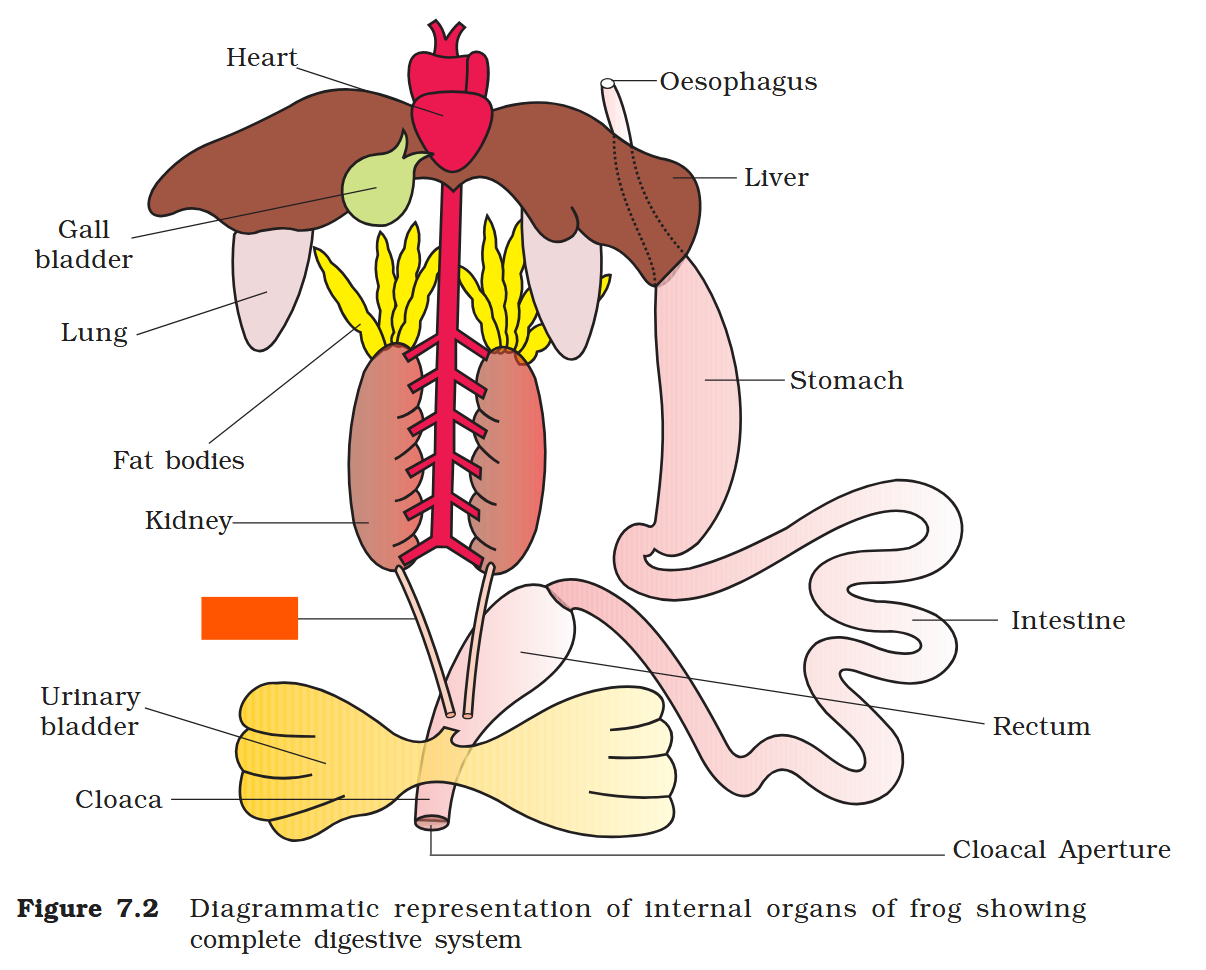
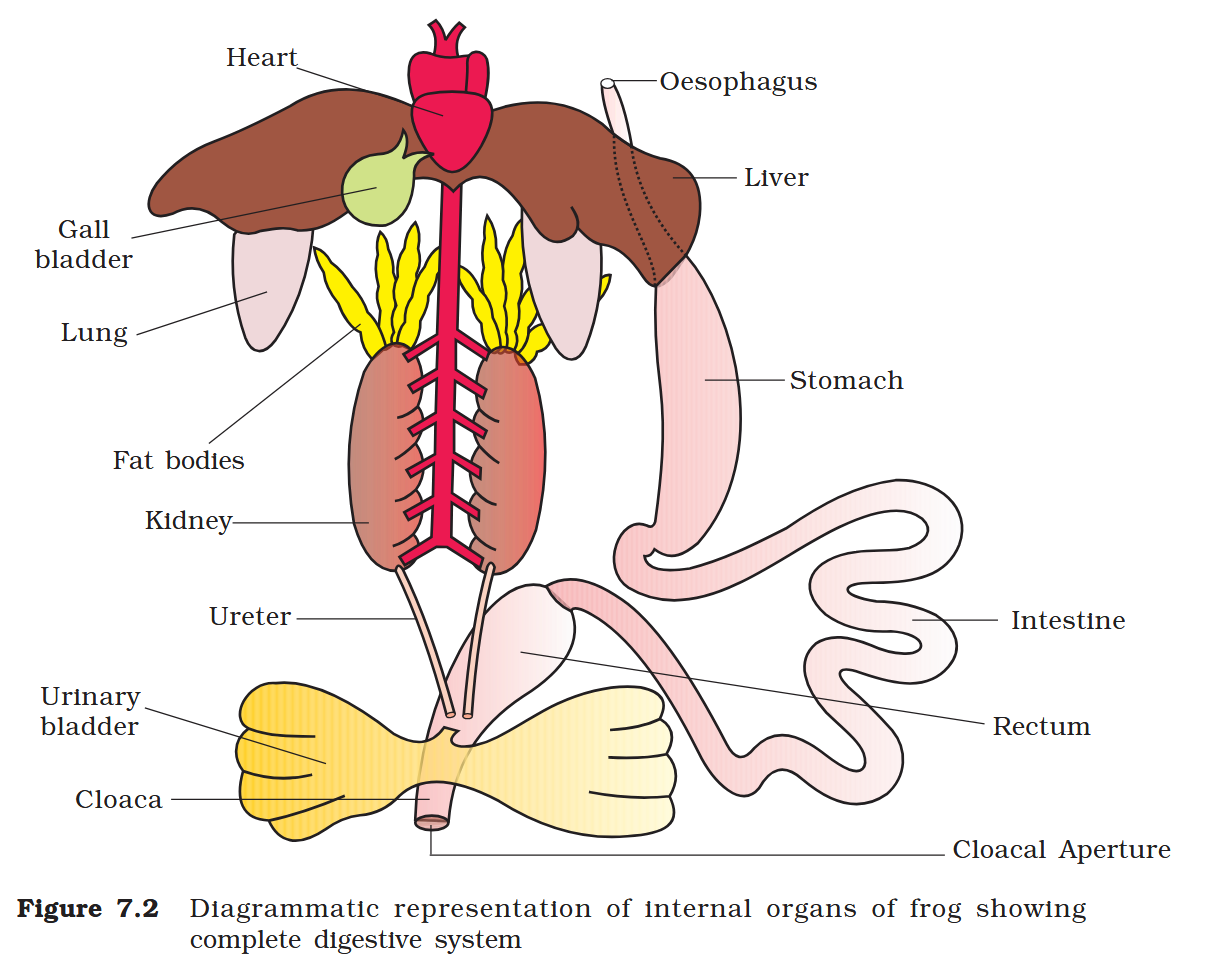
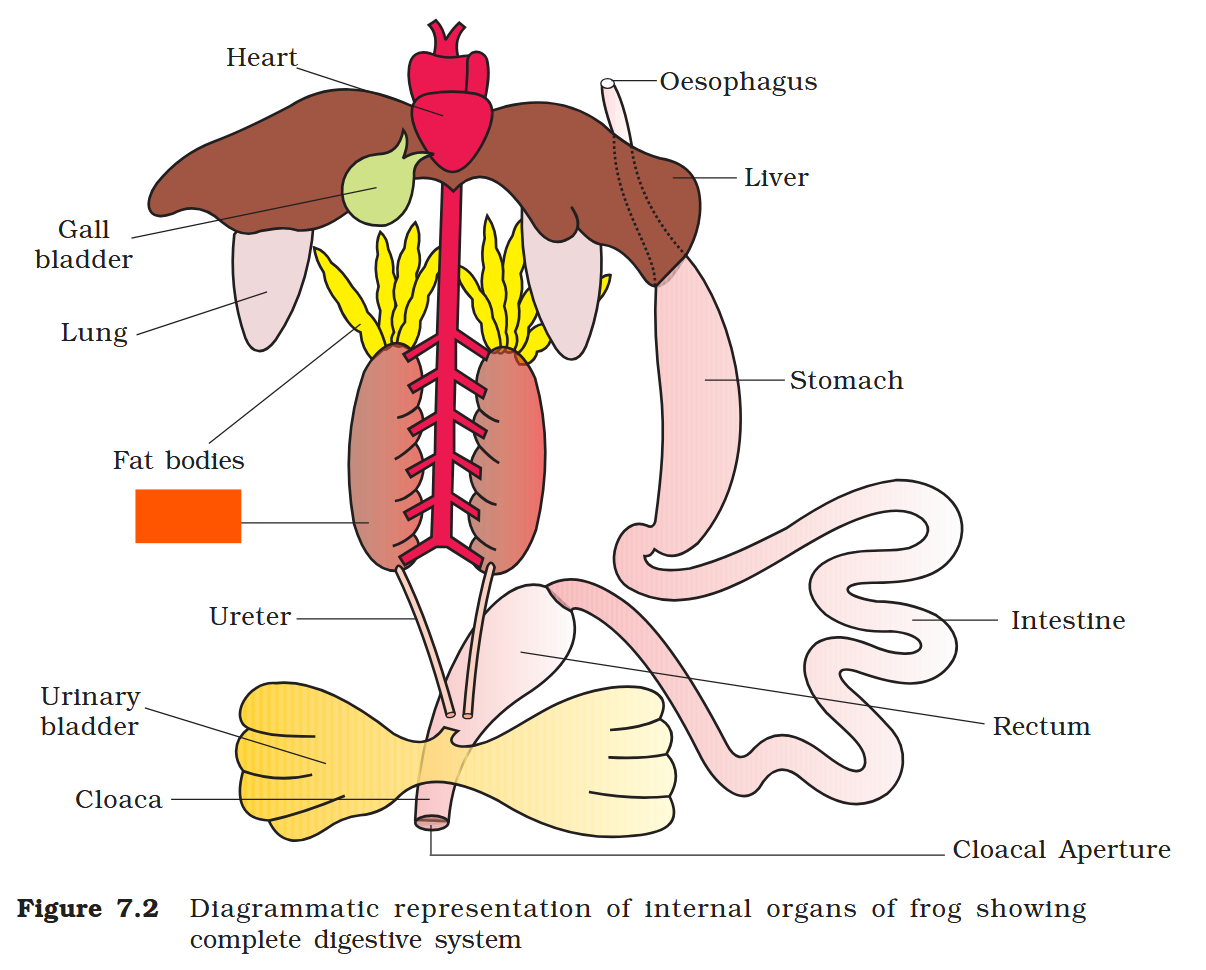
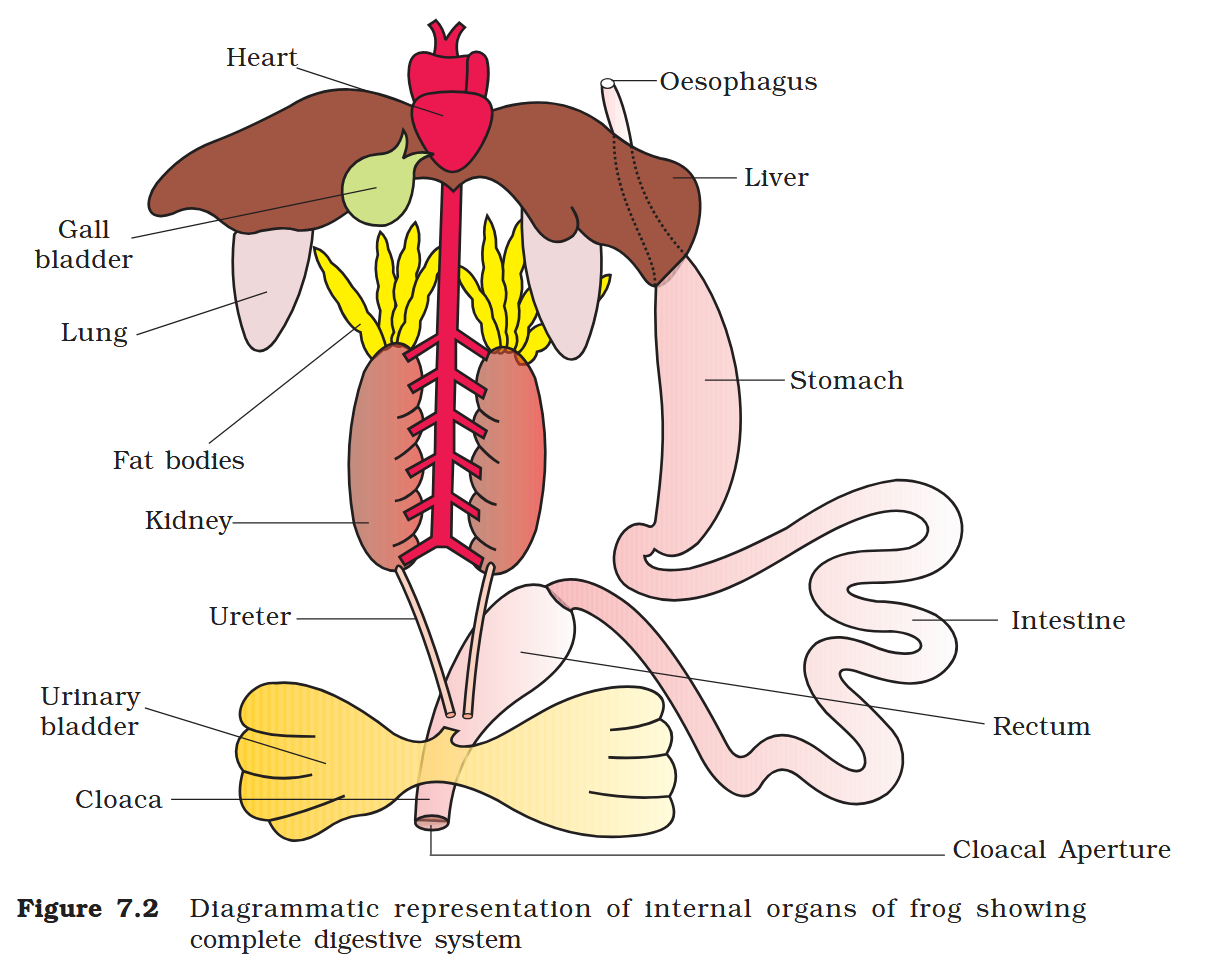
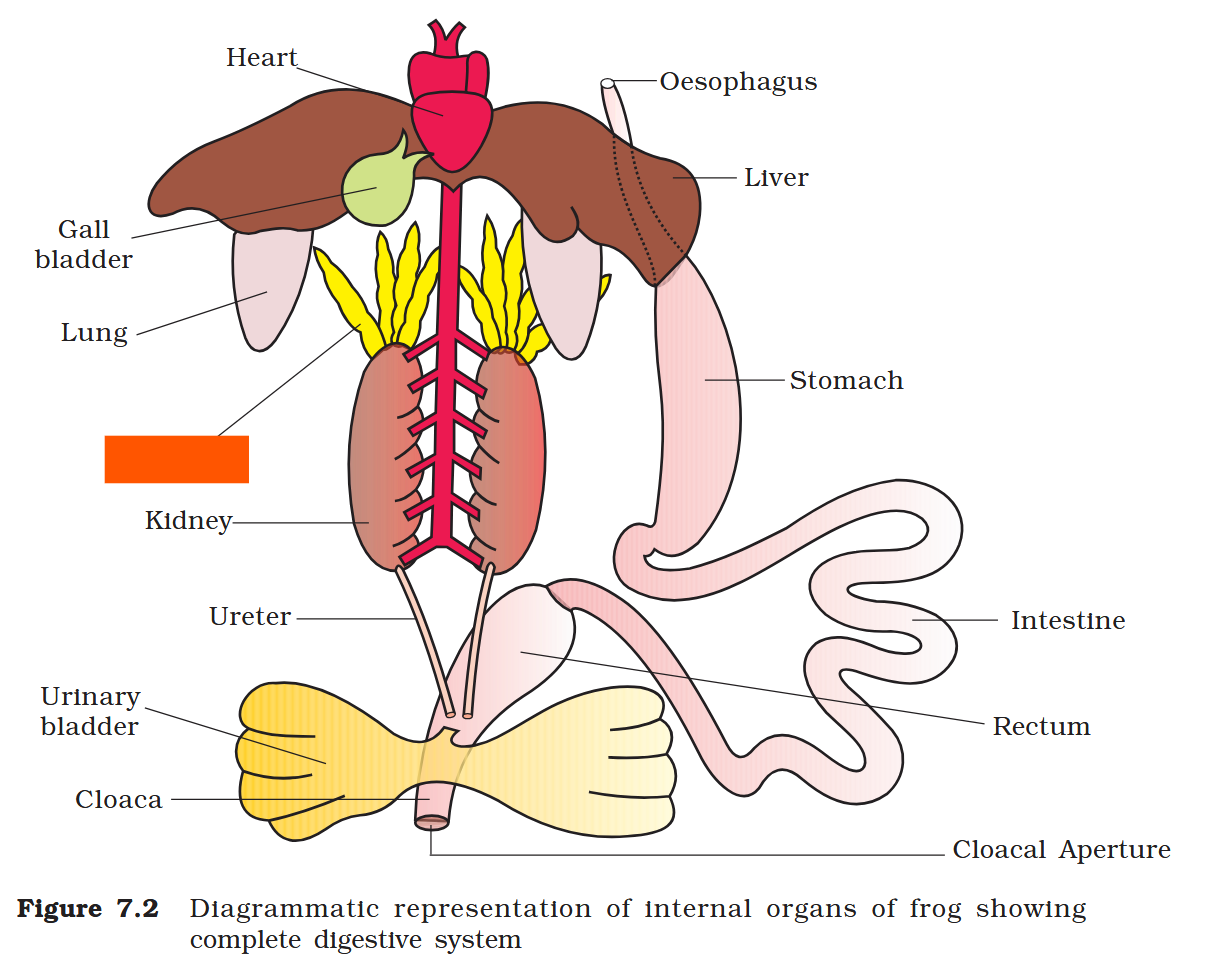
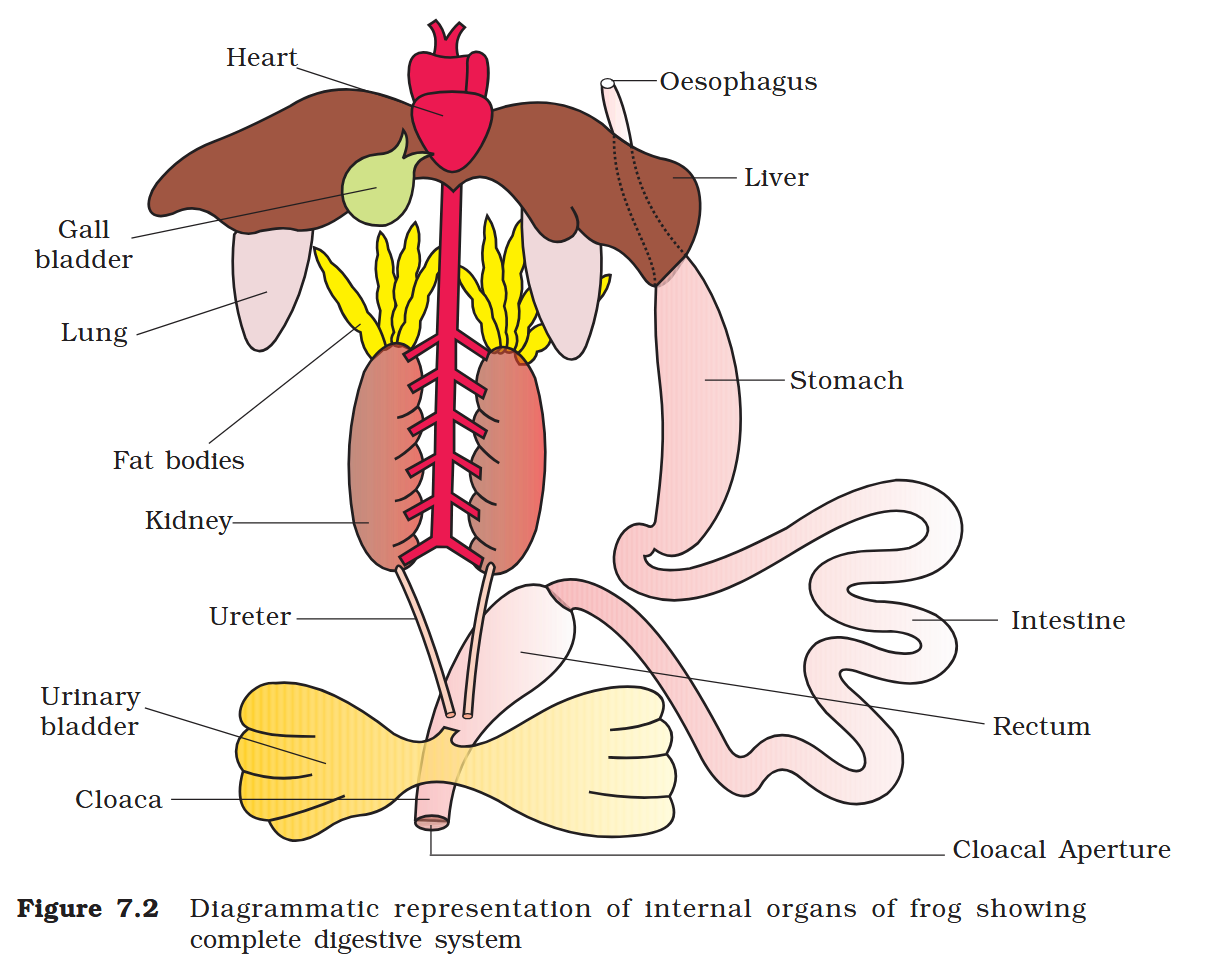
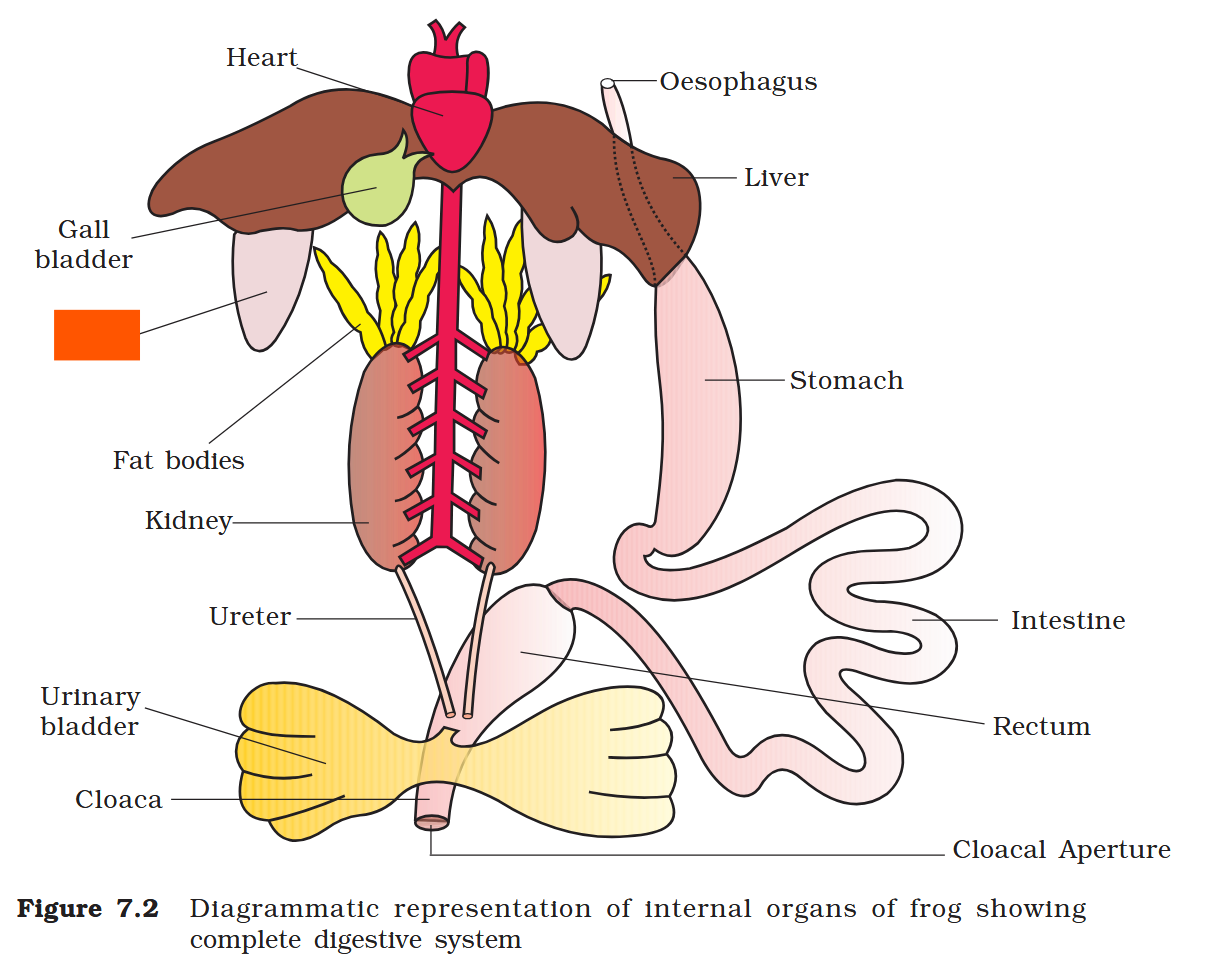
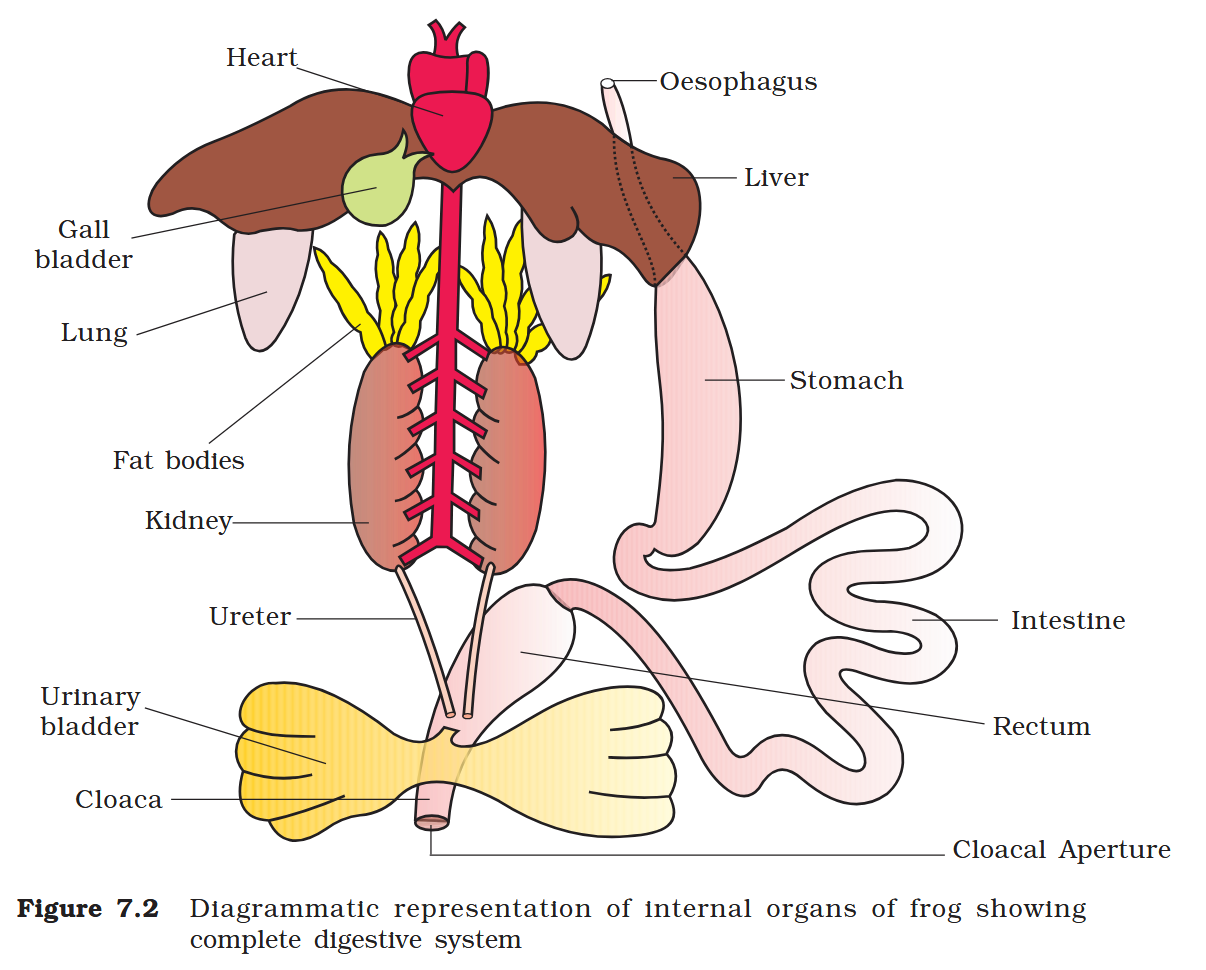
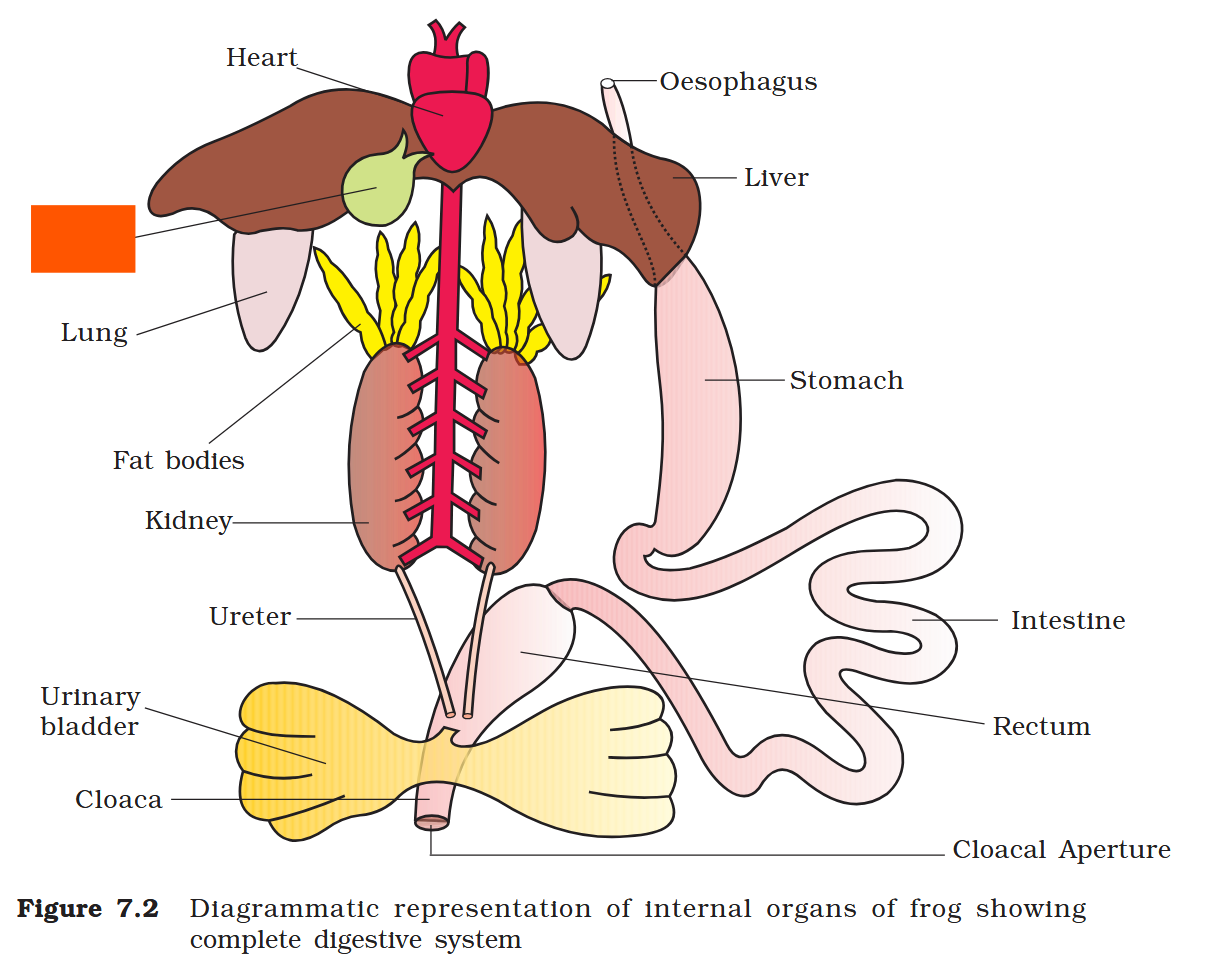
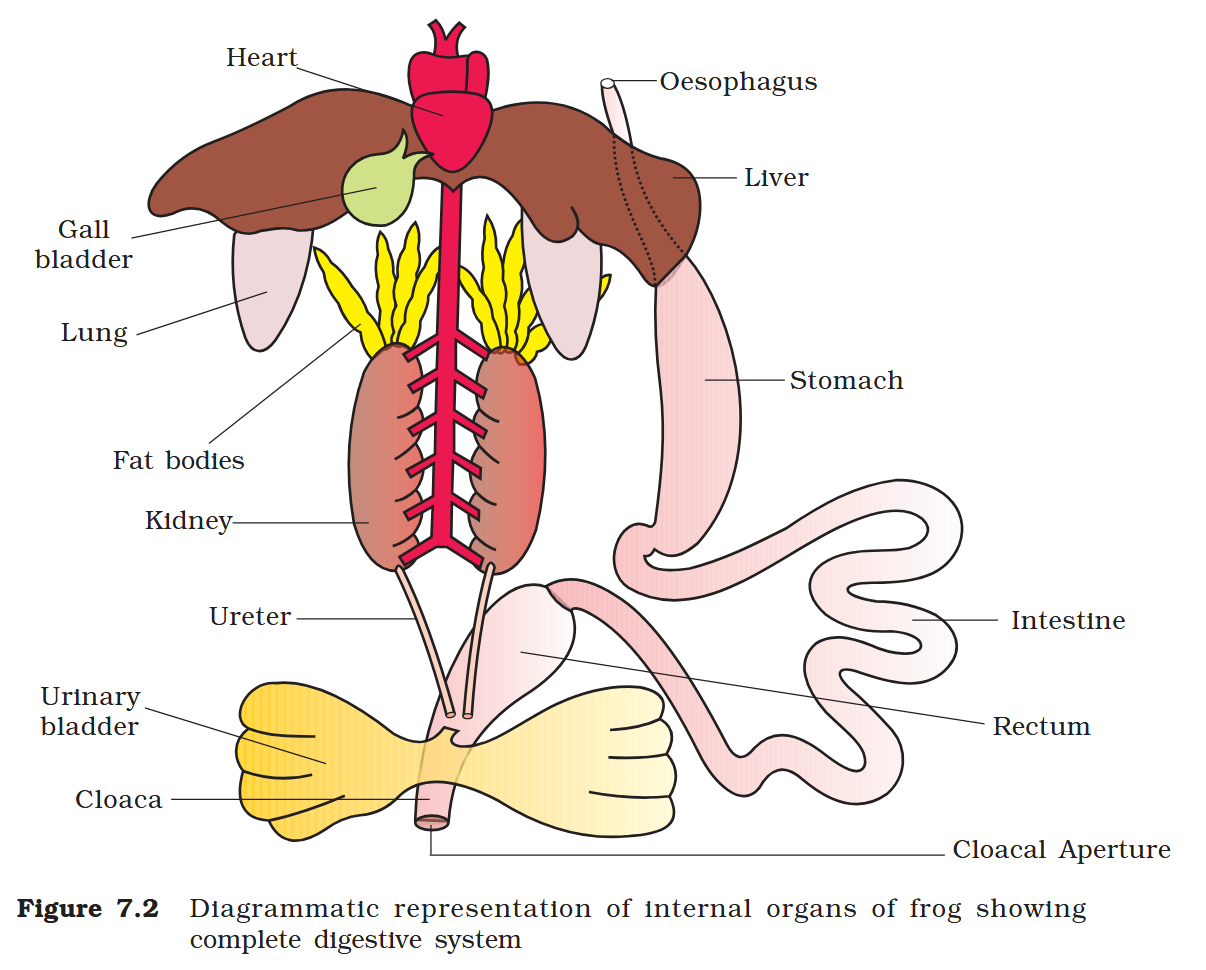
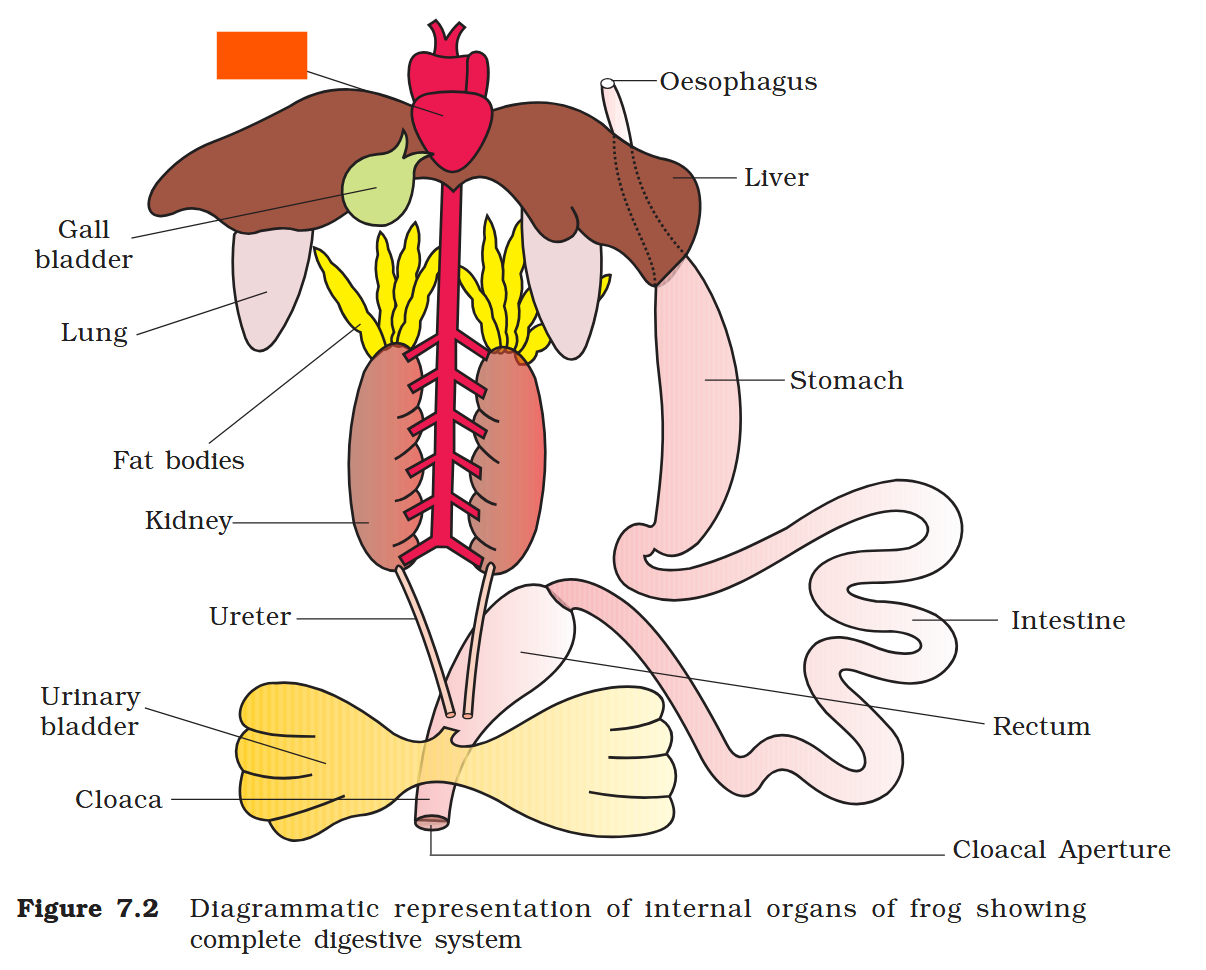
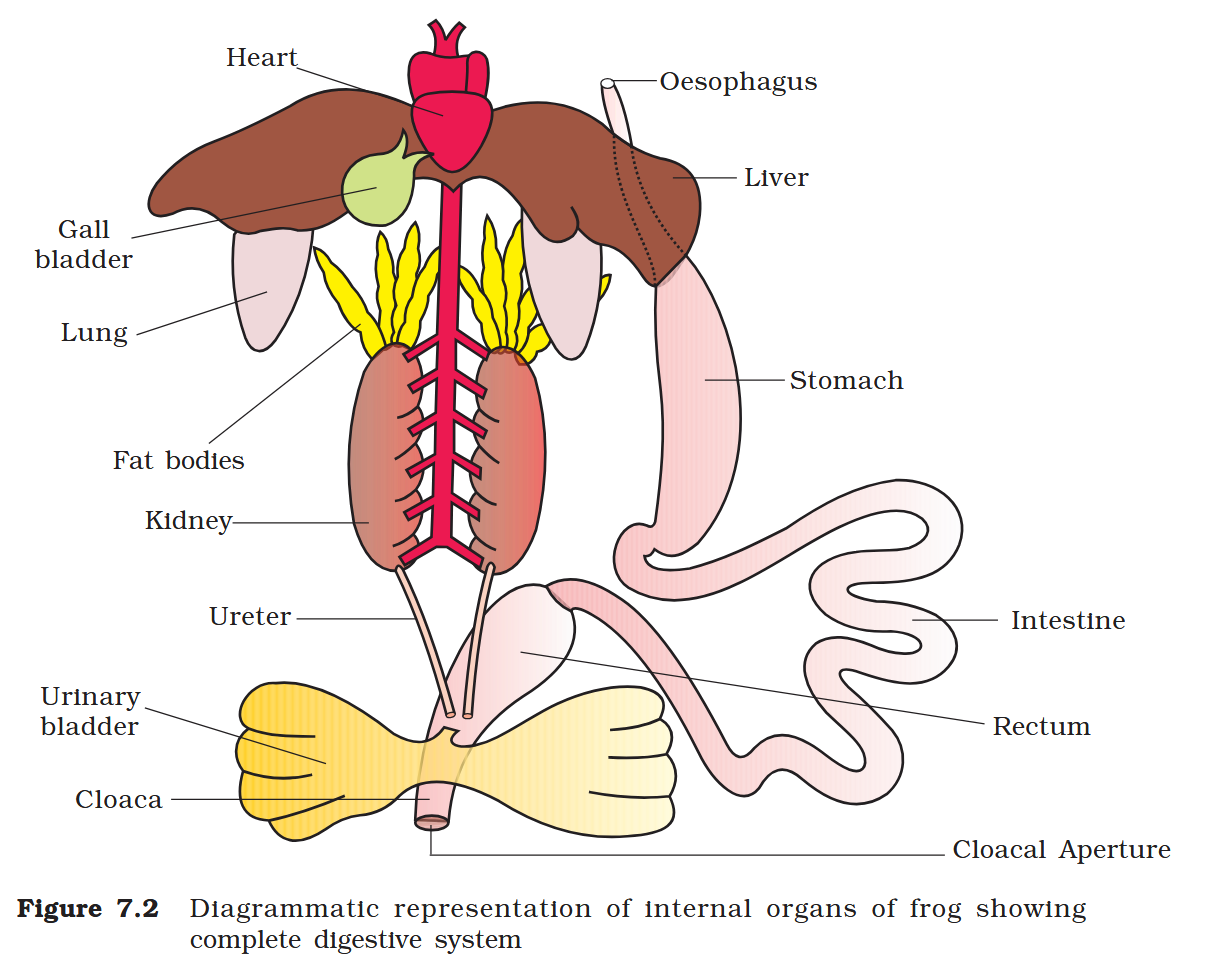
Why is the digestive system of frogs quite short?
The alimentary canal is short because frogs are carnivores and hence the length of intestine is reduced.
What are the two things that frogs’ digestive systems consist of?
alimentary canal
digestive glands
Arrange in order from the start of the alimentary canal in frogs:
pharynx, buccal cavity, mouth, oesophagus
mouth → buccal cavity → pharynx → oesophagus
What is an oesophagus?
Oesophagus is a short tube that opens into the stomach that carries food from the mouth to the stomach.
Arrange in order from the start of the alimentary canal in frogs:
rectum, intestine, cloaca, stomach, oesophagus
oesophagus → stomach → intestine → rectum → cloaca
Liver secretes bile that is stored where?
in gall bladder
What does pancreatic juice contain?
Digestive enzymes
What produces pancreatic juice?
Pancreas
How do frogs capture food?
Using their bilobed tongue.
Digestion of food in frogs takes place by the action of _____ and gastric juices secreted from the walls of the stomach.
(which chemical?)
HCl
In frogs, partially digested food called ________ is passed from stomach to the first part of the small intestine.
In frogs, partially digested food called chyme is passed from stomach to the first part of the small intestine.
What is the duodenum in frogs?
The first part of their small intestine
How do bile and pancreatic juices enter a frog’s alimentary canal?
From the gall bladder/liver and the pancreas, through a bile duct, into the duodenum
What does bile do, as part of a frog’s digestive system?
Bile emulsifies fat
What do pancreatic juices do, as part of a frog’s digestive system?
They digest carbohydrates and proteins.
Where does “final digestion” take place in frogs?
In the small intestine.
Final digestion in frogs takes place in the intestine. Digested food is absorbed by the numerous finger-like folds in the inner wall of intestine called _____ and __________.
Final digestion in frogs takes place in the intestine. Digested food is absorbed by the numerous finger-like folds in the inner wall of intestine called villi and microvilli.
What are villi and microvilli?
Digested food is absorbed by the numerous finger-like folds in the inner wall of intestine called villi and microvilli.
Final digestion in frogs takes place in the intestine. Digested food is absorbed by the numerous finger-like folds in the inner wall of intestine called villi and microvilli. What happens to the undigested food?
The undigested solid waste moves into the rectum and passes out through cloaca.
What three things pass out from a flog’s cloaca?
undigested waste
urine
gametes
Frogs respire on land and in the water by two different methods.
How do they respire in water?
In water, skin acts as aquatic respiratory organ (cutaneous respiration). Dissolved oxygen in the water is exchanged through the skin by diffusion.
Frogs respire on land and in the water by two different methods.
How do they respire on land?
On land, the buccal cavity, skin and lungs act as the respiratory organs.
What is respiration through lungs called?
pulmonary respiration
What is respiration through skin called?
cutaneous respiration
What are lungs in frogs?
The lungs are a pair of elongated, pink coloured sac-like structures present in the upper part of the trunk region (thorax), used for pulmonary respiration.
On land, which three organs act as respiratory organs in frogs?
buccal cavity
skin
lungs
How does air reach lungs in frogs?
Air enters through the nostrils into the buccal cavity and then to lungs.
How do frogs respire during aestivation or hibernation?
Cutaneous respiration. During aestivation and hibernation gaseous exchange takes place through skin.
The vascular system of frog is ______ type.
(open / closed)
The vascular system of frog is closed type.
What are the three parts that constitute a frog’s blood vascular system?
heart
blood vessels
blood
How many chambers does a frog heart have?
3
What are the chambers of a frog heart?
2 atria, 1 ventricle
The heart in frogs is covered in a membrane called?
pericardium
What is a pericardium?
The membrane covering a heart.
What are the two accessory chambers of a frog’s heart/
sinus venosus
conus arteriosus
What is the sinus venosus in frogs? What is its function?
a triangular structure that joins with the right atrium of the heart, which received blood through the vena cava and sends it into the atrium.
Sinus Venosus receives blood from _________________________ to pass it into the right atrium.
Sinus Venosus receives blood from major veins called vena cava to pass it into the right atrium.
The ventricle in a frog heart opens into a sac-like ___________________ on the ventral side of the heart.
The ventricle in a frog heart opens into a sac-like conus arteriosus on the ventral side of the heart.
The sinus venosus in frogs is present on the _________ side.
(dorsal / ventral)
dorsal
The conus arteriosus in frogs is present on the ________ side.
(dorsal / ventral)
ventral
The blood from the heart is carried to all parts of the body by the __________ (________ system).
The blood from the heart is carried to all parts of the body by the arteries (arterial system).
What is the venous system in frogs?
The veins collect blood from different parts of body to the heart and form the venous system.
What is the arterial system in frogs?
The blood from the heart is carried to all parts of the body by the arteries (arterial system).
Special venous connection between _______ and _________ as well as the kidney and lower parts of the body are present in frogs.
Special venous connection between liver and intestine as well as the kidney and lower parts of the body are present in frogs.
Special venous connection between liver and intestine as well as the _______ and ____________________ are present in frogs.
Special venous connection between liver and intestine as well as the kidney and lower parts of the body are present in frogs.
What are the two special venous connections present in frogs?
between liver and intestine
between kidney and lower body parts
What is the special venous connection in frogs between the liver and intestine called?
hepatic portal system.
What is the special venous connection in frogs between the kidney and the lower body parts called?
renal portal system.
What are the three types of blood cells found in frogs?
RBCs
WBCs
Platelets
RBC’s are _____________ and contain red coloured pigment namely haemoglobin.
(nucleated. unnucleated)
nucleated