Impact of social and environmental determinants on inequities
 Call Kai
 Learn
Learn Practice Test
 Spaced Repetition
 Match
Match Flashcards
 Knowt Play
1/39

There's no tags or description
Looks like no tags are added yet.
Name | Mastery | Learn | Test | Matching | Spaced | Call with Kai | Chat |
|---|
No analytics yet
Send a link to your students to track their progress
40 Terms
What are the determinants of health?
The range of personal, social, economic, and environmental factors that influence health status are known as determinants of health.
What are the types of determinants?
Social
Socioeconomic
Biomedical
Environmental
What are social determinants of health?
The social determinants of health are the conditions in which people are born, grow, live, work and age and are shaped by the distribution of money, power and resources.
What are the social determinants of health?
Social gradient
Stress
Early life
Social exclusion
Work
Unemployment
Social support
Addiction
Food
Transport
Culture
What is the social gradient?
The social gradient refers to the consistent relationship between an individual's socioeconomic status (SES) and health outcomes.
• The higher a person’s socioeconomic position, the healthier they tend to be.
• In all countries, income levels, health, and illness follow a social gradient: the lower the socioeconomic position, the worse the health outcomes.
What are examples of social gradient?
• Income Level: Individuals with higher incomes often have better access to healthcare services, nutritious food, and safe housing, resulting in an improved health status.
• Education: Higher educational attainment can lead to better job opportunities and health literacy, contributing to healthier lifestyles.
What is stress
psychological response to challenging events.
Stress can be perceived differently.
• One highly stressful event for one person can be perceived as relatively low stress by another.
• Mindset, outlook, personality, beliefs, values, attitudes, and mental and physical health are some factors that influence your perception of stress.
What are examples of stress
Financial
Job loss
Divorce
Illness
Death of a loved one
Unemployment
Legal issues
Moving house
What are positive impacts of short term stress?
• Reaching deadlines
• Increasing productivity
• Enhances sporting performance in the optimal zone
• Enhances focus
What are negative impacts of long term stress?
• Decreases immunity
• Increases risk of mental and physical health issues
• Depression
• Anxiety
• Adrenal fatigue
• Nutrient deficiencies
• Increases risk of addiction and poor lifestyle choices around physical activity and diet Weight gain/loss
What is early life
Refers to the developmental period from conception through early childhood, encompassing prenatal development and the first few years after birth.
Experiences and exposures during this phase have profound and lasting effects on an individual's health status, influencing the risk of developing chronic diseases and affecting overall well-being throughout their life.
What are positive impacts in early life?
• Prenatal Care: Good maternal nutrition and healthcare contribute to better health status in newborns.
• Childhood Environment: Secure, stimulating environments promote positive cognitive and emotional development, improving lifelong health status.
What are negative impacts in early life?
• Addiction: Exposure to smoking increases the risk of low-birthweight babies.
• Nutrition: Poor maternal diets and/or poor toddler diets can increase the risk of diabetes and obesity in children both in childhood and as an adult.
What is social exclusion?
• Groups within society that are more likely to experience social exclusion experience poorer mental, social and emotional health outcomes.
• Groups at higher risk of exclusion: • Culturally and Linguistically Diverse (CALD)
• Migrants and refugees
• People living with a disability
• LGBTIQA+ • Aboriginal & Torres Strait Islanders (ATSI)
What is work?
Refers to the type of job an individual has.
What is the impact of work
• Work, or the type of job someone has, can be thought of in many ways.
• Work can be physically demanding, dangerous or require mostly sedentary time.
• Work can be stressful and intense, or casual and potentially lacking in stimulation.
• Work can be casual/temporary or permanent.
• Work colleagues can provide social support and enjoyment in the workplace, but they could also be a form of stress.
What are examples of work inequities?
• Work enables social interaction and can provide individuals with increased social support networks.
• High or prolonged stress in the workplace can have adverse impacts on health. Dangerous work can also increase the risk of injury.
• Work can also have ongoing psychological impacts if it is unenjoyable, excessive in its demands, or if people feel limited in their autonomy.
What is unemployment?
Refers to the state of being without paid work while actively seeking employment.
What are the impacts of unemployment on health?
• It could increase the risk of mental health issues due to the stress and uncertainty of the situation.
• Social connections may be lacking among the unemployed population, which can strain family and social relationships.
• Due to financial constraints, individuals may have reduced access to healthcare, which can lead to decreased early disease detection and prevention.
• Individuals may be more likely to use unhealthy coping behaviours like smoking, vaping and alcohol/drugs, which are harmful to health in the short and long term.
What is social support?
The network of people you surround yourself with and turn to for support.
What are the impacts of social support?
• People with a larger or highly supportive network will have lower levels of illness and disease and higher life expectancy, partly because of their ability to seek help and support from this network.
• Individuals with fewer support networks experience poorer health outcomes, particularly mental health.
What is addiction?
Addiction is the fact or condition of being addicted to a particular substance or activity.
Some examples may be:
• illicit drugs
• vaping/smoking
• sexual activity
• alcohol
• fast food
• risk-taking behaviour
Impacts of addiction?
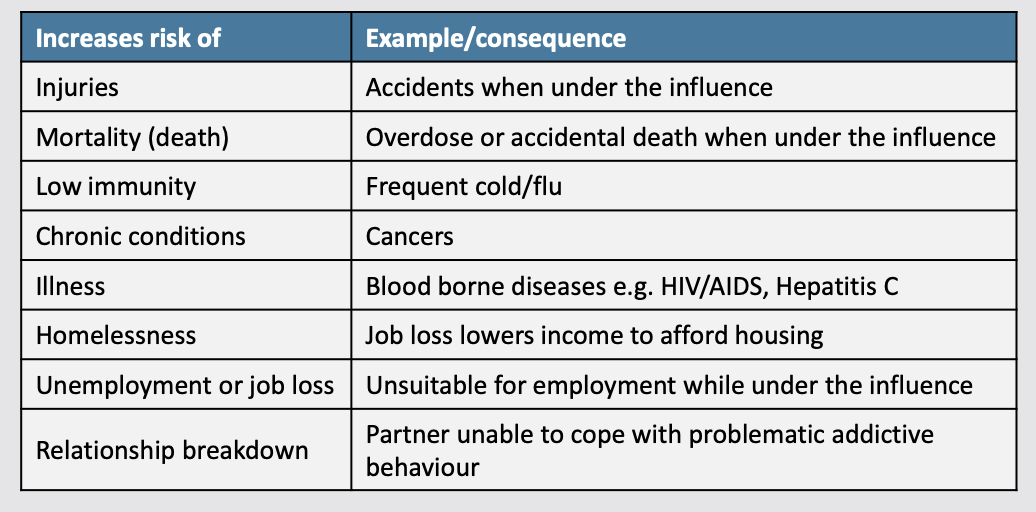
What are som determinants that increase the likelihood of addiction occuring?
Stress, unemployment, work, employment & social exclusion → More likely to use addiction as a coping mechanism
Geographical location → Rural and remote populations have a higher likelihood of addiction.
Education → Lower education levels increase the risk of addiction
Early life → Exposure to addiction in utero
Income → Lack of income can increase stress and addictive coping mechanisms
Housing /neighbourhood → Low socioeconomic areas have higher levels of addiction, crime and violence.
What is food?
Food refers to the type of food an individual has access to and consumes.
Income and education are strongly linked to an individual's food choices, which in turn influence short- and long-term health outcomes.
What are impacts of food?
• Poor diets and inadequate nutrition increase the risk of developing diseases and illnesses such as those below:
• Cancer • Type 2 diabetes
• Stroke
• Obesity
• Arthritis
• Gout
• Decreased stress resilience
• Decreased immunity
• Poorer mental health
• Dementia/Alzheimers
• Skin issues such as eczema
• Inflammatory immune responses, such as fibromyalgia
• Fatigue
What is transport?
A system or means of conveying people or goods from place to place.
• This could include road networks, infrastructure, public transport systems, personal transportation options, and availability.
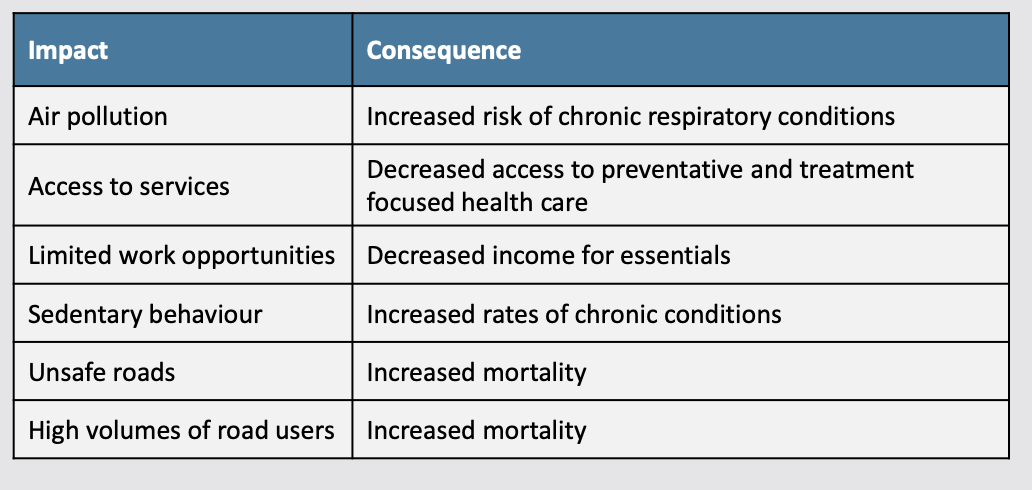
• Low socioeconomic countries have higher road user mortality rates than higher socioeconomic countries due to lower standards and provision of infrastructure, inadequate road user laws, and higher volumes of road users, often using unsafe transportation methods.
What are impacts of transport?
What is culture?
Culture refers to the shared beliefs, values, customs, traditions, and social behaviours of a particular group or society.
• An individual's culture shapes their values, beliefs and attitudes, which directly relate to their health behaviours and influence their health status.
Culture affects how people
perceive illness
seek treatent
maintain wellbeing
How does culture impact health?
Belief in traditional gender practices of only seeing female healthcare workers
Lack of availability of female healthcare workers
Long waiting times for treatent or prevention of health conditions
Increased risk of morbidity and mortality fro undiagnosed or untreated conditions
Culture affects how people
perceive illness
seek treatent
maintain wellbeing
1. access to healthcare (health literacy and acceptability)
2. diet (culturally specific food or way of eating)
3. social support (cultural community norms and hierarchy)
4. communication (languages spoken and read)
5. cultural barriers (language, beliefs, gender roles)
6. education (health literacy for prevention)
How can culture provide barriers?
• Culture can provide many barriers regarding accessing timely, culturally appropriate prevention and treatment, which negatively influences health status.
• It can also provide great value to health status with a strong sense of community support for each other.
• Strong social networks are a protective factor for mental health.
What are the environmental determinants of health?
Geographical Location
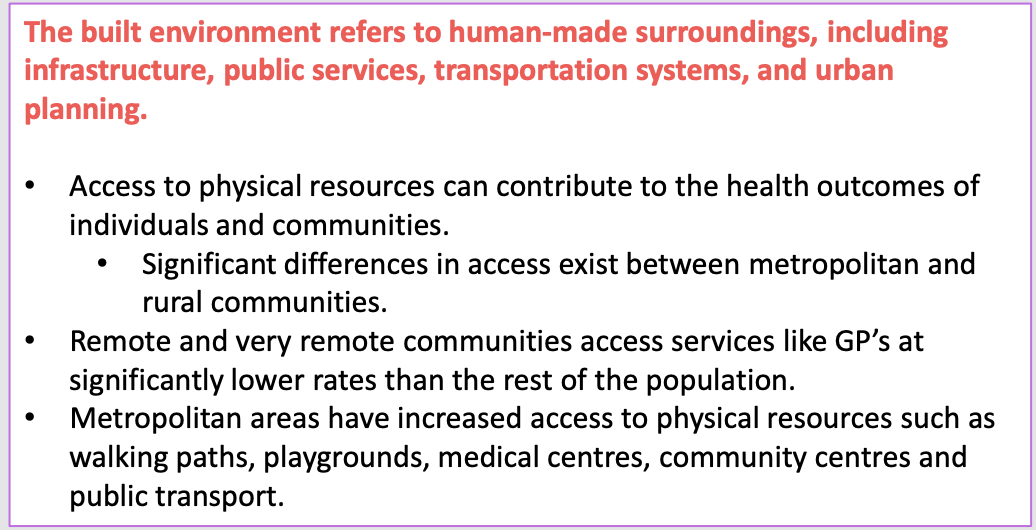
Features of the natural and built environment (Natural and Built)
What are environmental determinants
Environmental determinants include the physical, chemical and biological factors external to the individual, as well as all the other factors impacting behaviours in order to prevent diseases and create healthy environments.
What is Geographical Location
Where people live geographically
How can geographical location influence health?
• healthcare
• educational opportunities
• nutritious food
• clean water
• environmental conditions
• job types and opportunities
• Social support networks
What are the direct correlations between where an individual lives and their health outcomes
• People in rural and remote areas often travel long distances for work, socialising, or medical help.
• Poor road conditions, wildlife, speed, and fatigue increase the risk of road accidents.
• Isolation is more common, leading to loneliness and limited support during medical emergencies.
• Agricultural workers may also face long-term health risks from exposure to hazardous chemicals.
How can featureds of the built and natural environment impact health?

What is the natural environment?
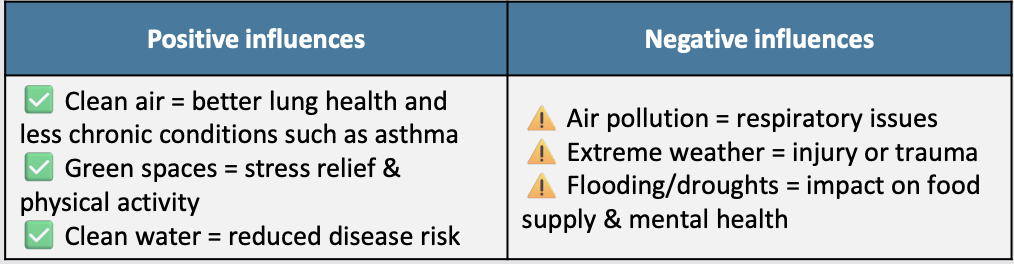
includes all physical, biological, and ecological elements of the world, such as air, water, climate, and ecosystems. • These elements are not manmade—they occur naturally and surround us every day.
What are positive and negative impacts of the natural environment
What are features of the built envronment?