biochem test part 3
 Call Kai
 Learn
Learn Practice Test
 Spaced Repetition
 Match
Match Flashcards
 Knowt Play
1/18

There's no tags or description
Looks like no tags are added yet.
Name | Mastery | Learn | Test | Matching | Spaced | Call with Kai |
|---|
No analytics yet
Send a link to your students to track their progress
19 Terms
pyruvate dehydrogenase complex
Under aerobic conditions, pyruvate is transported from the cytoplasm into mitochondria and converted to acetyl-CoA by the _____, allowing entry into the TCA cycle. (Pyruvate + CoA-SH + NAD⁺ → acetyl-CoA + NADH + CO₂ + H⁺)
lactate dehydrogenase
Under anaerobic conditions, pyruvate is reduced to lactate by _____ in the cytoplasm, regenerating NAD⁺ for glycolysis.
acetyl-CoA
Once pyruvate becomes _____, that carbon is basically committed to oxidative metabolism rather than being easily sent back to glucose.
PDH regulation
It says PDH kinase is stimulated by ATP/acetyl-CoA/NADH, while PDH phosphatase reactivates it and is promoted by Ca²⁺, ADP, pyruvate, and CoA.
CO₂
The purpose of the Krebs cycle is to oxidize acetyl-CoA to 2 molecules of ______
NADH
One acetyl-CoA gives one turn of the cycle, and that for each turn the products are: 2 CO₂, 3 _____, 1 FADH₂, and 1 GTP/ATP
mitochondrial matrix
TCA is in the _____ and ETC is in the inner mitochondrial membrane
FADH₂
One glucose gives 2 turns of the cycle, and that for each turn the products are: 4 CO₂, 6 NADH, 2 _____, and 2 GTP/ATP
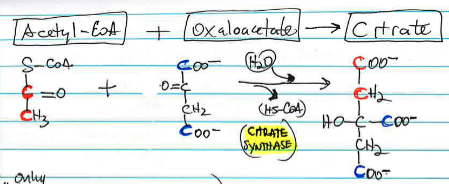
citrate synthase (Step 1)
Acetyl-CoA condenses with oxaloacetate to form citrate, catalyzed by _____. A 2-carbon acetyl group joins with 4-carbon oxaloacetate. It is essentially irreversible.
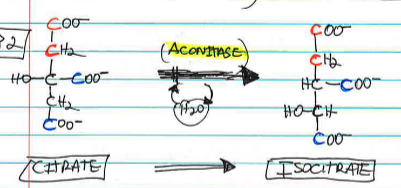
aconitase (Step 2)
citrate is isomerized to isocitrate by _____ in two parts: dehydration to cis-aconitate and rehydration to isocitrate. The molecule is reorganized into isocitrate.
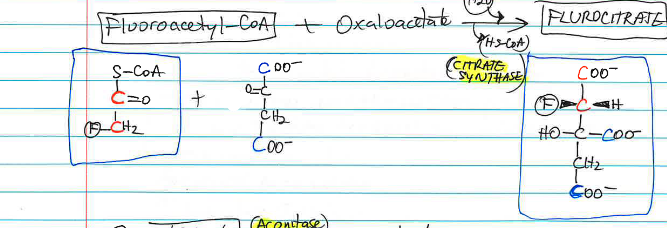
fluoroacetate (Step 2)
Is converted metabolically into fluoroacetyl-CoA, then combines with oxaloacetate to form fluorocitrate, which inhibits aconitase.
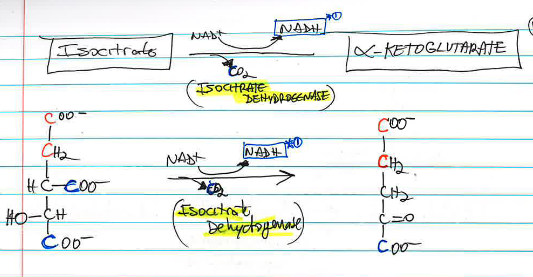
isocitrate dehydrogenase (Step 3)
Isocitrate is catalyzed by _____ and converts 6-carbon isocitrate to 5-carbon α-ketoglutarate, releasing CO₂ and producing NADH. NADH production. Is highly regulated by ATP concentration.
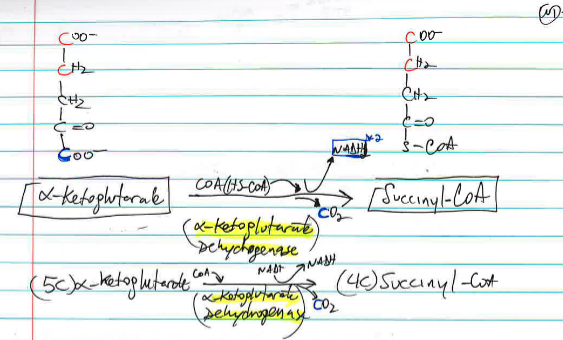
α-ketoglutarate dehydrogenase (Step 4)
α-ketoglutarate → succinyl-CoA is catalyzed by _____, converting 5-carbon α-ketoglutarate to 4-carbon succinyl-CoA, releasing a second CO₂ and producing NADH.
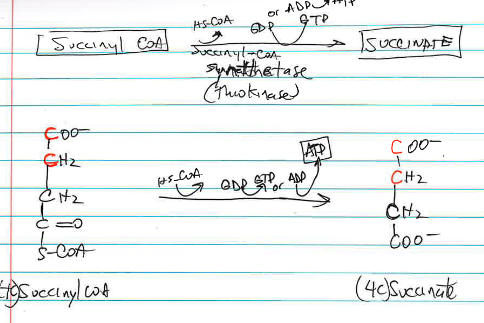
succinyl-CoA synthetase (Step 5)
succinyl-CoA → succinate is catalyzed by _____, converting succinyl-CoA to succinate. This is the only TCA step producing a high-energy phosphate equivalent (GTP or ATP)
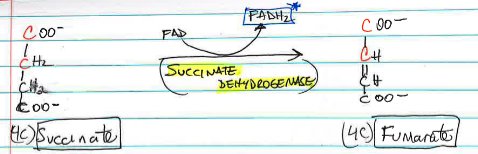
succinate dehydrogenase (Step 6)
succinate → fumarate is catalyzed by _____, oxidizing succinate to fumarate and producing FADH₂. (FADH₂ electrons enter the ETC at Complex II)
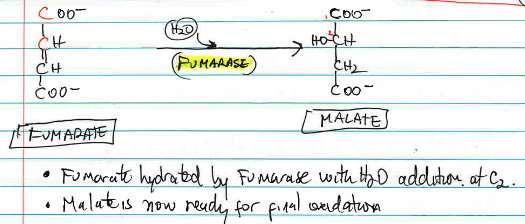
fumarase (Step 7)
fumarate → malate is catalyzed by _____, hydrating fumarate by adding water to form malate.
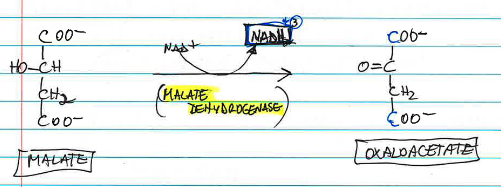
malate dehydrogenase (Step 8)
malate → oxaloacetate is catalyzed by _____, oxidizing malate to oxaloacetate and producing the third NADH of the cycle.
oxygen
The TCA cycle does not use _____directly, but still depends on _____. Because the cycle needs: NAD⁺ and FAD. But the cycle keeps reducing them to:
NADH and FADH₂. Those reduced carriers must be reoxidized by the ETC.
thiamine
If deficient in _____, pyruvate cannot be efficiently converted into acetyl-CoA, causing lactate production due to excess pyruvate