Visual guidance of action
 Call Kai
 Learn
Learn Practice Test
 Spaced Repetition
 Match
Match Flashcards
 Knowt Play
1/27

There's no tags or description
Looks like no tags are added yet.
Name | Mastery | Learn | Test | Matching | Spaced | Call with Kai |
|---|
No analytics yet
Send a link to your students to track their progress
28 Terms
How does perception start
starts with static pattern of light intensity on the retina
The outcome of perception is the formation of an
internal representation of objects in the environment
Our actions towards objects in the real world are informed by
internal representations
Explain the work of J.J. Gibson (1966, 1979)
stimulation by light in itself does not lead to perception
e.g. eyes covered with halves of table tennis balls
light energy is affected by the medium that it traverses
e.g. water, glass, air
different surfaces reflect light in different ways depending on their textures, opacity, slant, etc.
e.g. light reflected by polished or textured surfaces
Describe the Visual cliff (Gibson & Walk, 1960) study
goal: perception of depth from texture
6-14 month old infants and variety of animal species
the experiment used a glass-covered table with a checkerboard pattern, creating a "shallow" and a "deep" side to test if depth perception is innate
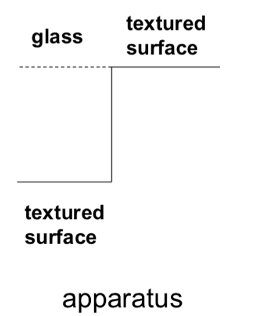
What was found from the Visual cliff (Gibson & Walk, 1960) study
demonstrated that infants (6–14 months) possess depth perception, as most refused to crawl over an apparent drop-off
What is optic array
it represents the arrangement of light at a specific point of observation, structured by surfaces in the surrounding environment. It is not just retinal images, but the light available to an observer from all directions
What is optic flow
the constant, changing pattern of visual information on the retina caused by relative motion between an observer and their environment, which allows the brain to perceive self-motion, speed, and direction
What is structural invariants
patterns of relationships that remain constant despite changes in the retinal image
e.g. a possible invariant specifying size constancy ratio of an object’s height to the distance between its base and the horizon
What are the four transformational invariants
flow - locomotion (moving)
non flow - stasis (lack of change or movement)
outflow - approach
centre of outflow - direction
shift of the centre change of direction
inflow - retreat from
What is the role of the perceiver in direct perception
pick-up information in optic array and optic flow
no need to process the retinal image and internal representations
Is perception direct or indirect
direct
What two things provide all the information needed for perception
optic array and optic flow
What is Gibson’s theory of Affordances
proposes that organisms perceive their environment not just in terms of shapes and spatial properties, but in terms of action possibilities - what the environment "affords" them
bridge the gap between perception and action
e.g. a mail-box affords positing letters
Describe the methods of Micro-affordances (Ellis & Tucker, 2000)
participants required to make a power or precision grip in response to a high or low pitch tone
if an object present in the background (irrelevant to the task) affords a grip compatible with the response, then response is faster and more accurate
What is the purpose of the Micro-affordances (Ellis & Tucker, 2000) study
to describe how seeing objects automatically activates specific motor components - like grip type or wrist rotation - associated with interacting with them
What are the four key findings of Micro-affordances (Ellis & Tucker, 2000)
action potentiation: the study showed that viewing objects automatically activates motor components (like gripping or rotating)
compatibility effects: participants were faster to respond (e.g., press a button) when the required action matched the affordance of the object (e.g., handle orientation matching the hand)
micro-level analysis: unlike Gibson's general affordances, these focus on specific, small-scale, neural-based "micro-affordances" (e.g., a power vs. precision grip)
experimental evidence: two experiments showed that holding or rotating a tool is influenced by the visual input of its functional part (e.g., a handle), causing a "compatibility effect"
What do the findings of the Micro-affordances (Ellis & Tucker, 2000) study show
these findings suggest the brain constantly maps visual, graspable objects into potential motor actions
What do the neo-gibsonians argue
that perception and action are directly coupled and continuous, with the environment providing all necessary information for behaviour
What does exteroceptive mean
information from the environment
e.g. spatial relationship between landmarks to guide navigation
What does proprioceptive mean
information from the body
e.g. maintain balance with eyes closed
What does exproproceptive (Lee, 1977) mean
position of the body relative to the environment
e.g. obstacle avoidance
What was the method of the Swinging room (Lee & Aronson, 1974)
suspended bottomless box
wallpaper provides texture
movements of the room produce optic flow
expanding optic flow
subject sways backwards
creates an expanding visual pattern, simulating that the subject is falling forward
contracting optic flow
subject sways forward
creates a contracting visual pattern, simulating that the subject is falling backward
visual information overrides proprioceptive information
How did toddlers (13-16 months) react in the swinging room
show the same behavioural pattern
visual information overrides proprioceptive information early in development
The swinging room (Lee & Aronson, 1974) experiment showed that
vision dominates over other senses in maintaining posture and balance.
when the surrounding walls moved, creating "optic flow," participants (including toddlers) swayed or fell to compensate, even though their feet remained on a stationary floor
What does time-to-contact mean
to an observer's ability to estimate the remaining time before a moving object reaches a specific point or hits them
it is a crucial aspect of visual perception and motor control, allowing humans to initiate necessary actions, such as catching a ball, breaking in traffic, or avoiding a collision
What are the behaviours that might be regulated by using time to contact
long jumping (Lee et al., 1982)
catching a bus
jumping over puddles
avoiding obstacles
fishing gannets (Lee and Reddish, 1981)
Describe the study of Time to contact in fishing gannets (Lee and Reddish, 1981)
dive from height of 30m
reach speed of 24m/sec
wings streamlined just before reaching the water
predictions based on corrected tau values
predictions based on height, velocity, and acceleration
observation of bird’s behaviour
predictions based on tau fit the data