MATH 2565 - Lecture 9: Randomness & Probability Models & Probability Rules
 Call Kai
 Learn
Learn Practice Test
 Spaced Repetition
 Match
Match Flashcards
 Knowt Play
1/37

Earn XP
Description and Tags
Randomness & Probability Models & Probability Rules (Chapter 4.1, 4.2, 4.5)
Name | Mastery | Learn | Test | Matching | Spaced | Call with Kai |
|---|
No analytics yet
Send a link to your students to track their progress
38 Terms
Anything about which the outcome is uncertain is called:
Experiment (or Trial/Random Phenomenon)
One single result of an experiment, or a sample point in the sample space is called:
Outcome
The entire set of possible outcomes is called the:
Sample Space (S)
Any subset of the sample space/a collection of any one or more of the outcomes is called an:
Event
What makes two trials independent?
When the outcome of one does not influence the other
What is a valid example of independence?
Rolling Dice
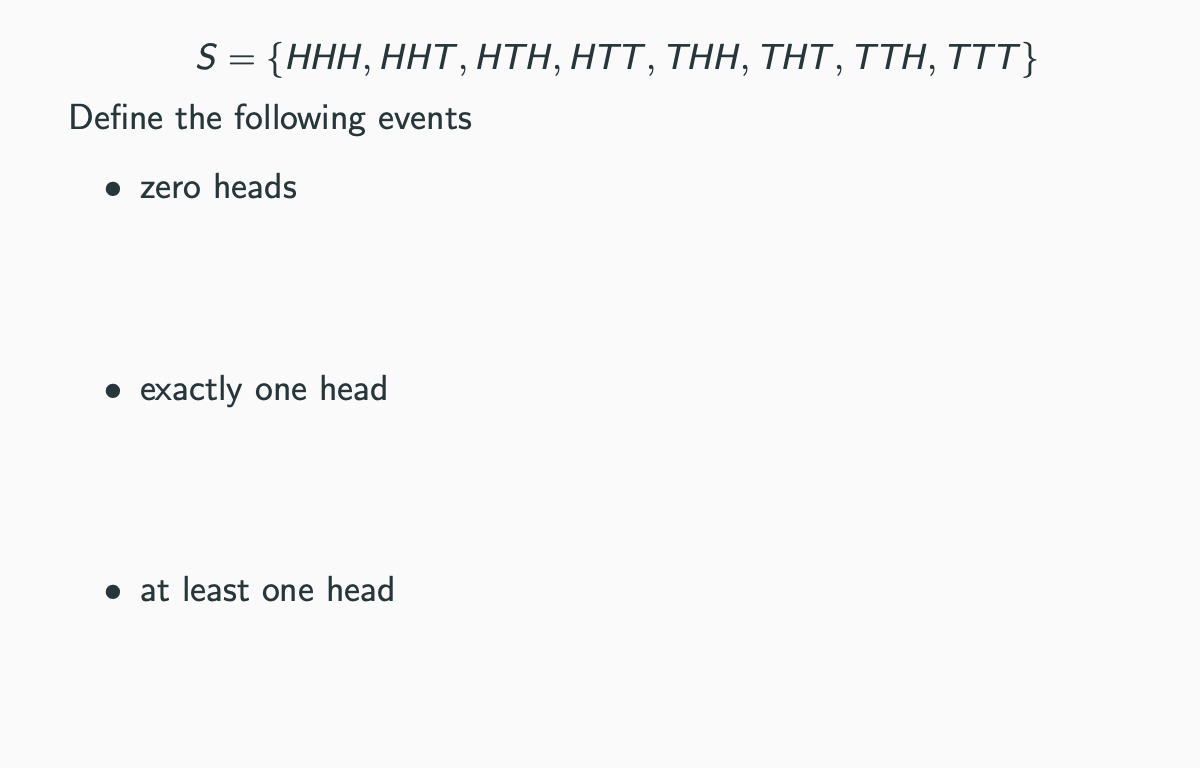
Describe the following events
zero heads = {TTT}
exactly one head = {HTT, THT, TTH}
at least one head = {HHH, HHT, HTH, HTT, THH, THT, TTH}
What are the two fundamental probability rules?
The probability of an event occurring always has a value between 0 and 1, inclusive: 0 ≤ P(A) ≤ 1
The probabilities of all outcomes must always add up to 1: P(S) = 1
When all outcomes in the sample space are equally likely, what is the equation:
P(A) = Total number of outcomes in A ÷ Total Number of outcomes in S
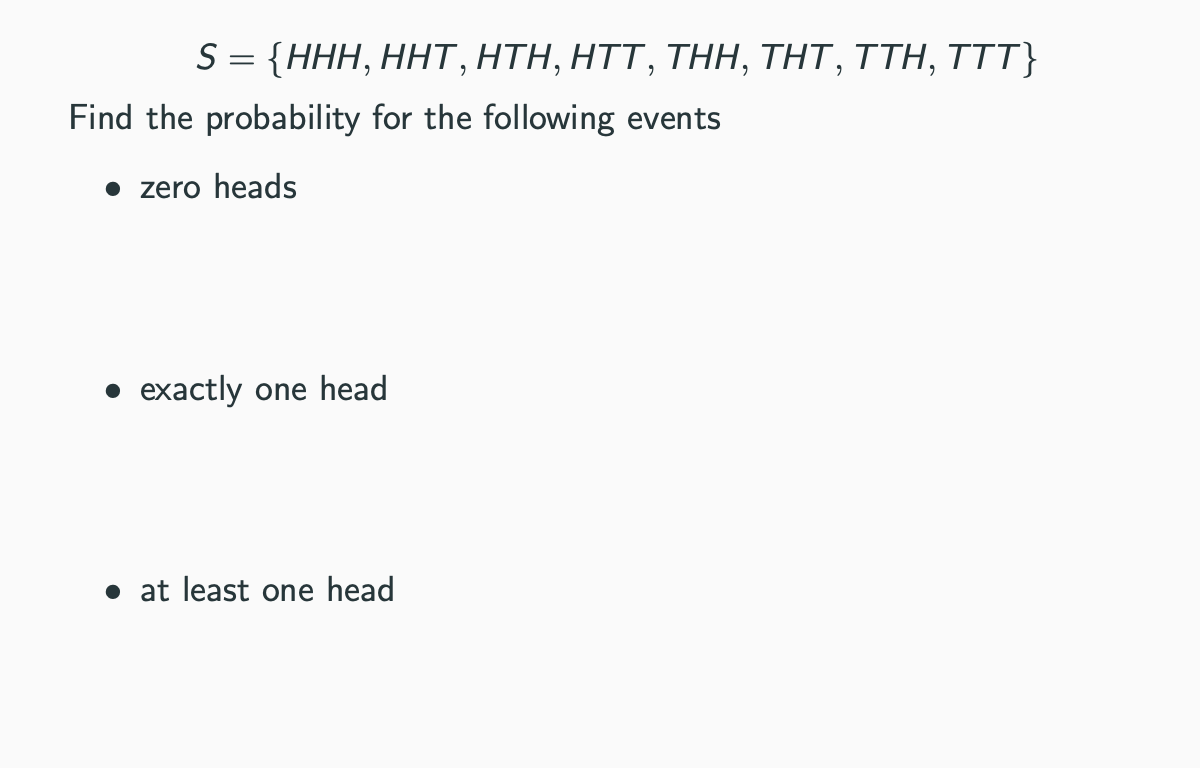
List the probabilities of the following events in order
1/8, 3/8, 7/8
Sample without replacement example: An urn contains 10 red chips, 6 black chips, and 4 blue chips. You randomly select two chips without replacement. You win the game if both chips selected are the same colour. What is the probability you win the game? (3 decimal places)
0.347
What is the complement of an event?
The complement of an event is the event consisting of all outcomes not in that event (i.e., the event does not occur)
What is the complement rule, and the equation?
The probability that an event does not occur, is equal to one minus the probability that it will occur: P(Ac ) = 1 - P(A)
What is the probability that at least one 6 will appear after tossing three fair 6-sided dice? (hint: P(A) = 1 - P(Ac )
P(A) = 1 - (5³ / 6³)
What is the probability that at least one 6 will appear after tossing k fair 6-sided dice?
P(A) = 1 - (5k / 6k)
The probability of the intersection of events A and B is called the
Joint Probability
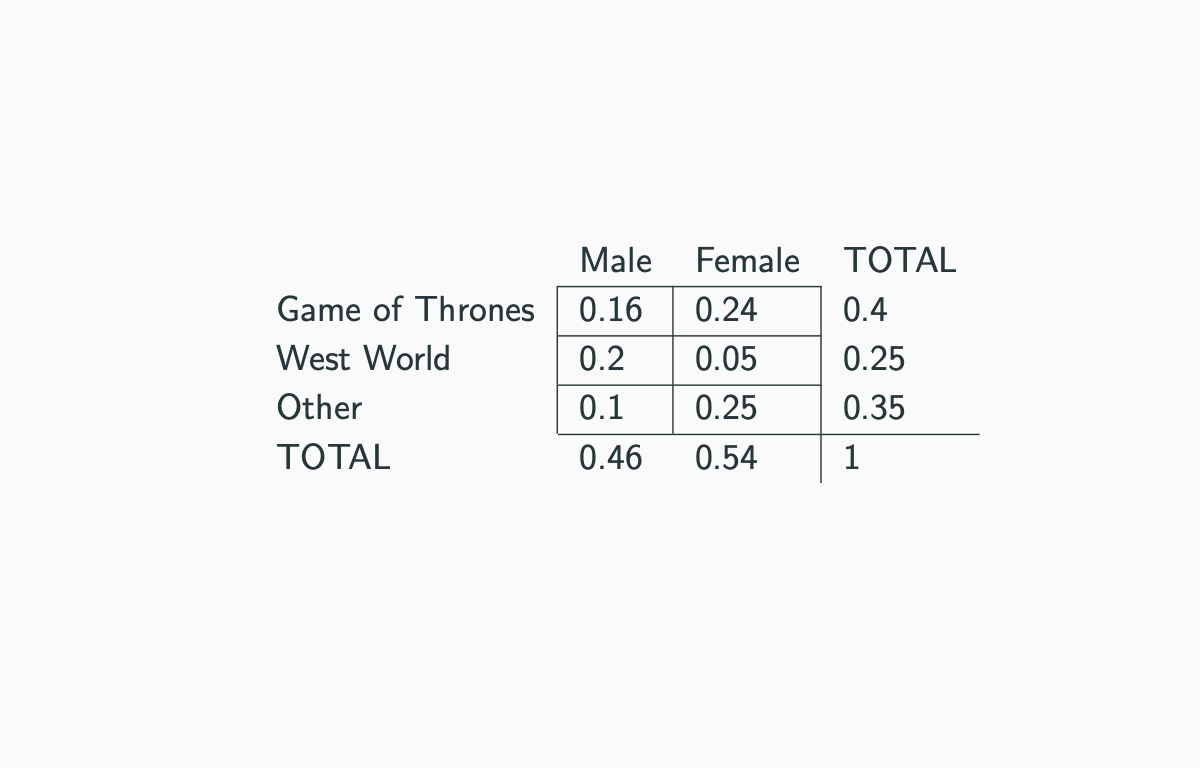
What is the probability of an HBO subscriber being male AND preferring West World?
0.2
In the example of flipping a coin three times, let event B = exactly one head, and C = at least one head, define the event B∩C
B or {HTT, THT, TTH}
Two events are said to be ______ if their intersection is “empty”; they cannot occur at the same time
Disjoint or Mutually Exclusive - A∩B = ∅
Are the two events: D – an HBO subscriber being male and E – an HBO subscriber preferring West World mutually exclusive?
No
The ______ of events A and B is the event that occurs when either A or B or both occur - Notation: A⋃B
Union
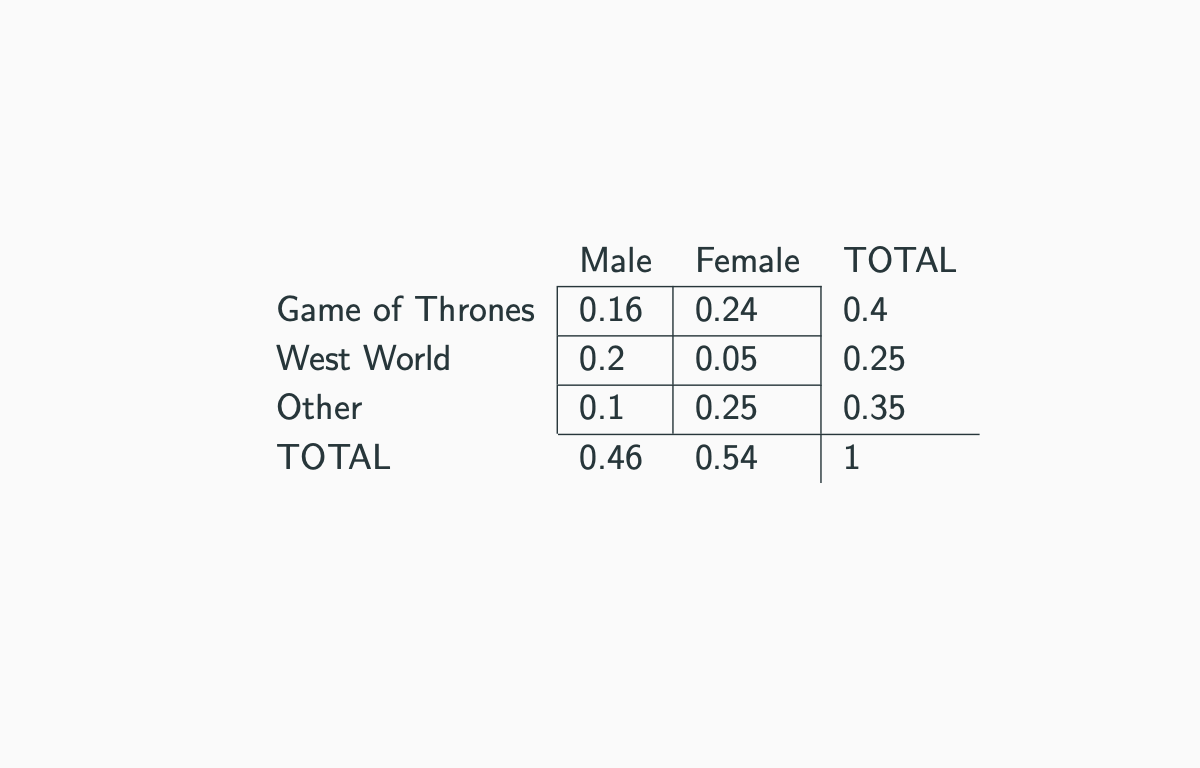
What is the probability of an HBO subscriber being male OR preferring West World?
0.51
In the example of flipping a coin three times, let
• A – zero heads
• B – exactly one head
• C – at least one head
Define the events A∪B, A∪C and B∪C
{TTT, HTT, THT, TTH}, S, C
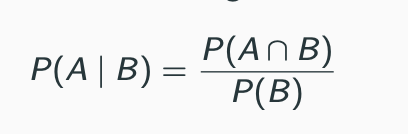
What does this equation represent?
Conditional Probability (Joint prob. over Marginal prob.)
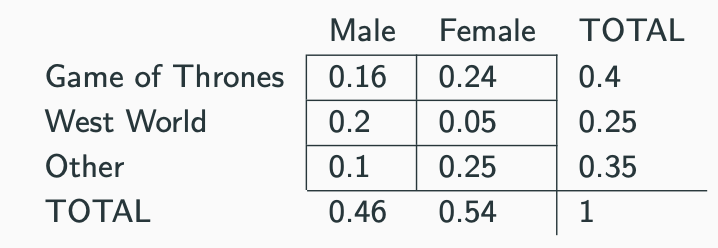
Given that a subscriber’s favorite show is West World. What is the probability that they are male?
What is the probability that a female HBO subscriber likes the Game of Thrones the most?
0.45, 0.44
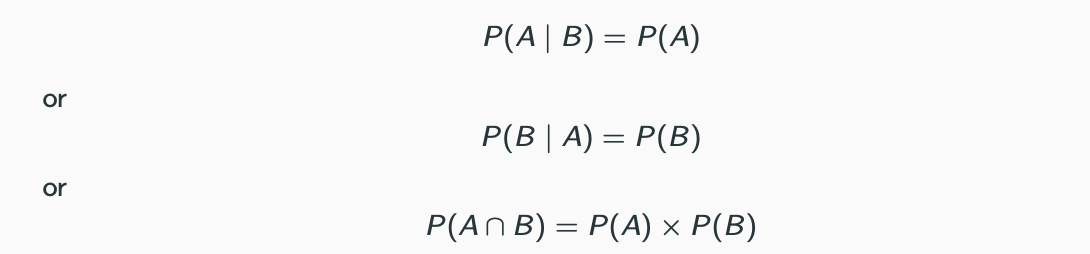
These events are
Independent
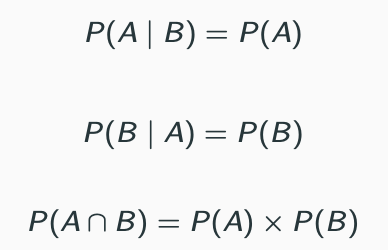
Are the two events A:“an HBO subscriber likes the West World the most” and B: “an HBO subscriber is a male” independent?
No
Are disjoint (mutually exclusive) events independent?
No, disjoint events are always dependent, but dependent events may or may not be disjoint
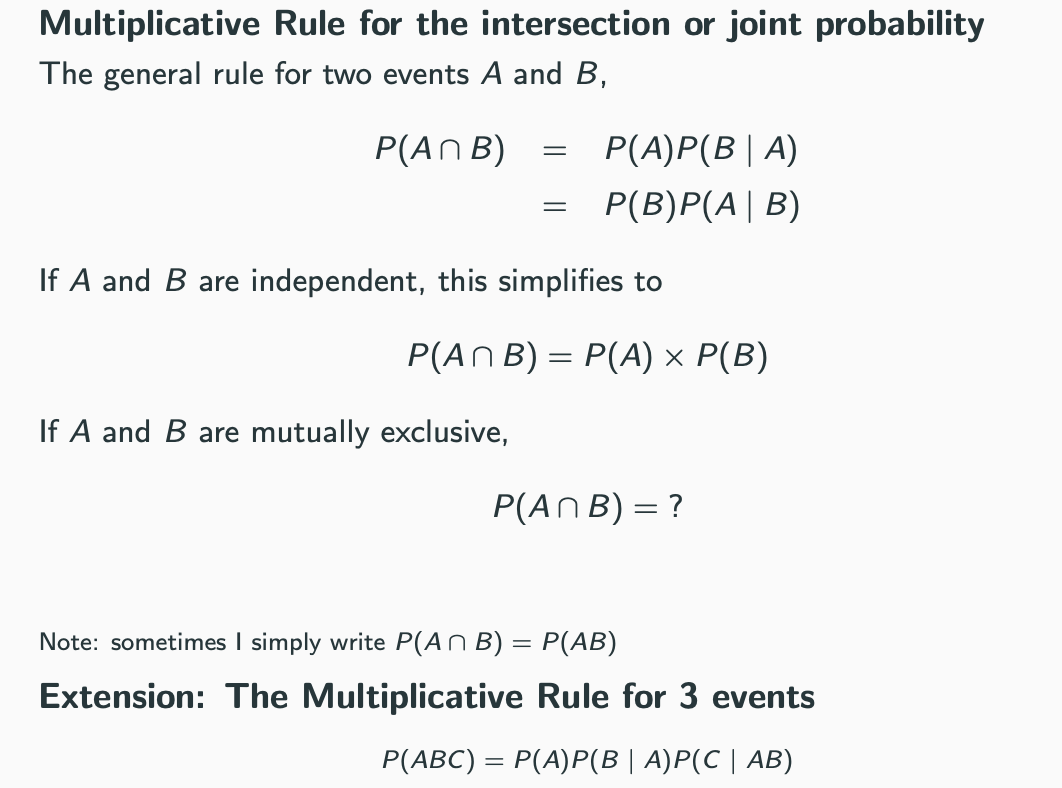
What is the probability to get the outcome {HTTH} with a biased coin which has a 0.1 chance to toss a head?
0.1 × 0.9 × 0.9 × 0.1 = 0.0081
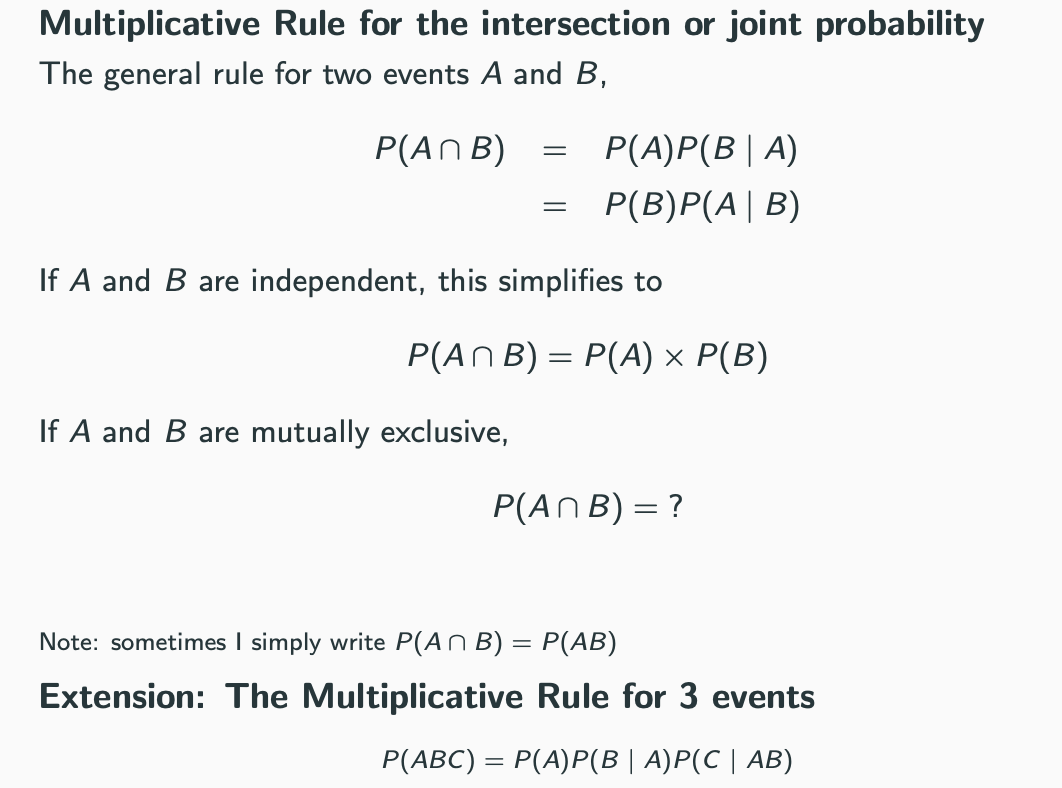
A Canadian is randomly selected. Find the probability they are male, 65 or older, and living in Ontario if
• 50% of Canadians are male
• 39% of Canadians live in Ontario
• 18% of Canadians living in Ontario are 65 or older
• 45% of Canadians living in Ontario who are 65 or older are male
0.39 × 0.18 × 0.45 = 0.0316
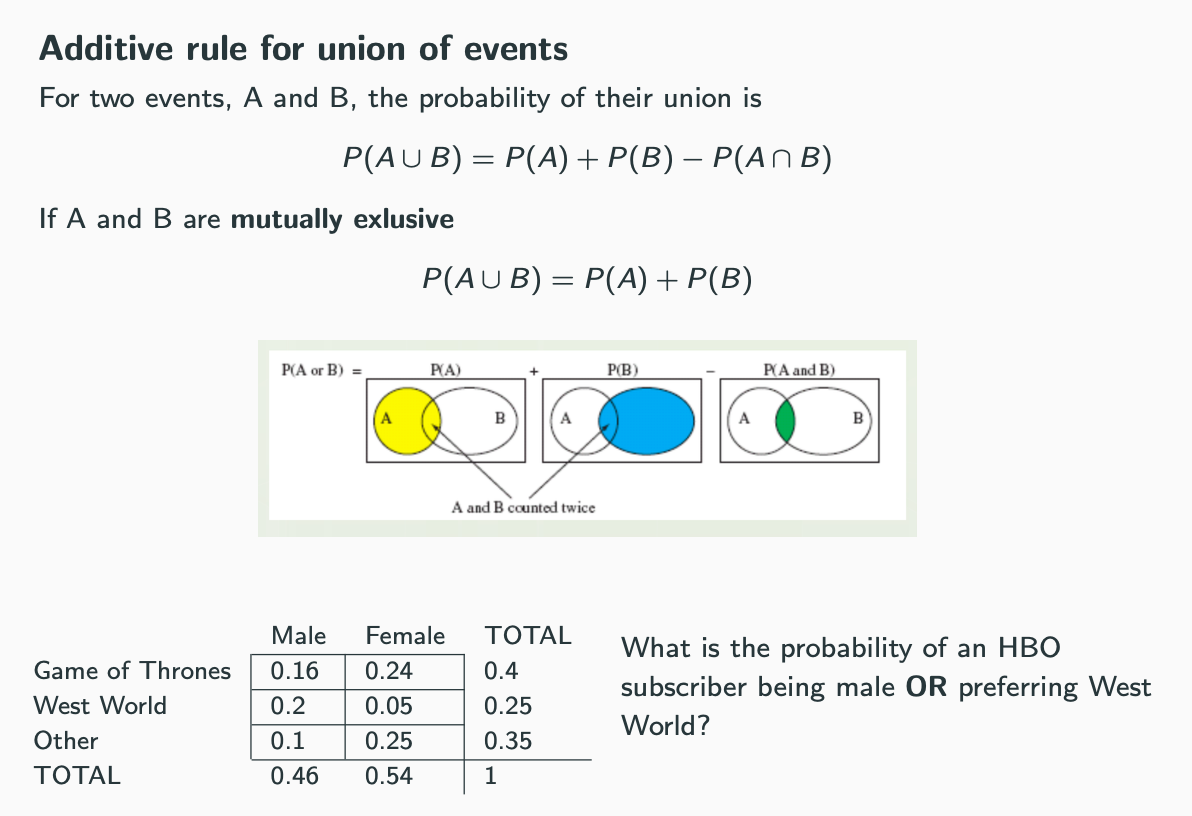
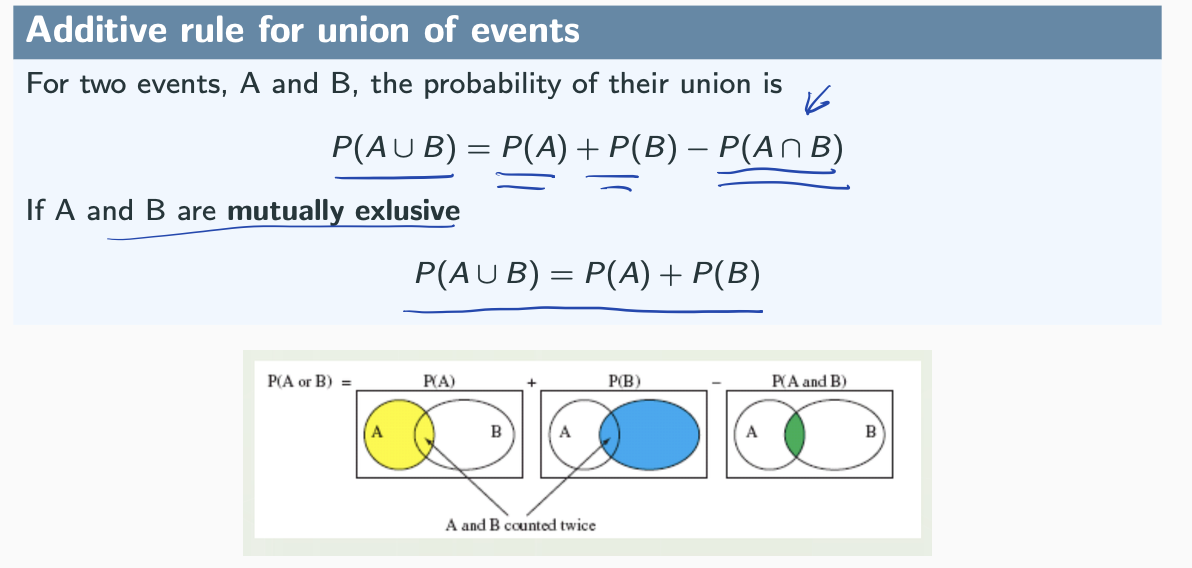
What is the probability of an HBO subscriber being male OR preferring West World?
0.46 + 0.25 - 0.2 = 0.51
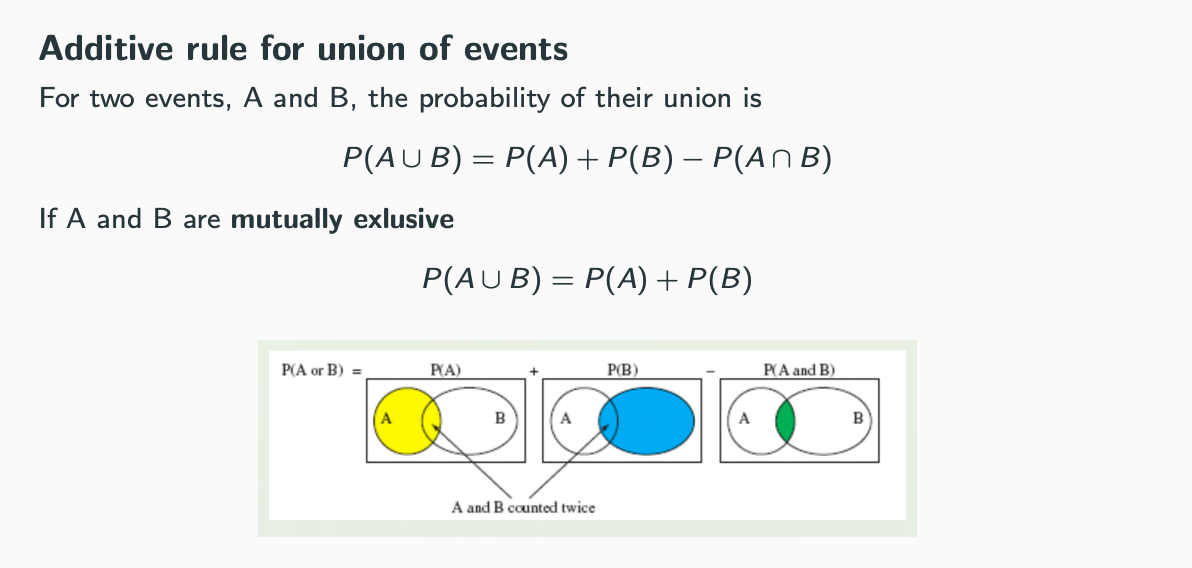
Suppose there is 40% chance of colder weather, 10% chance of rain and colder weather, 80% chance of rain or colder weather. Find the chance of rain.
P(R) = 0.4
Find the chance that a randomly selected day does not rain and does not have colder weather.
0.2
Suppose that A and B are two independent events with P(A) = 0.2 and P(B) = 0.4, what is
P(A∪B)
P(A∩B)
P(A∪B) = P(A) + P(B) - P(A∩B) = 0.2 + 0.4 - 0.08 = 0.52
P(A∩B) = P(A) x P(B) = 0.2 × 0.4 = 0.08
Suppose that A and B are two disjoint (mutually exclusive) events with P(A) = 0.2 and P(B) = 0.4, what is P(A∪B), P(A∩B)
P(A∪B) = P(A) + P(B) = 0.2 + 0.4 = 0.6
P(A∩B) = 0
Three machines make parts at a factory. Suppose we know the following about the manufacturing process:
• Machine 1 makes 60% of the parts
• Machine 2 makes 30% of the parts
• Machine 3 makes 10% of the parts
• Of the parts Machine 1 makes, 7% are defective
• Of the parts Machine 2 makes, 15% are defective
• Of the parts Machine 3 makes, 30% are defective
A part is randomly selected, What is the probability it is defective? (Hint: use a tree diagram or a probability tree)
0.117