Angela's Choice of Working Hours when paying Rent
 Call Kai
 Learn
Learn Practice Test
 Spaced Repetition
 Match
Match Flashcards
 Knowt Play
1/3

Earn XP
Description and Tags
Name | Mastery | Learn | Test | Matching | Spaced | Call with Kai |
|---|
No analytics yet
Send a link to your students to track their progress
4 Terms
When one has a production function that looks like:
c = g(t), where g’(t) < 0 and g’’(t) < 0
And a quasi-linear utility function that looks like:
U(t,c) = v(t) + c, where v’(t) < 0 and v’’(t) > 0
-What is the FOC?
𝑣′(𝑡)+𝑔′(𝑡)=0
When one has a production function that looks like:
c = g(t), where g’(t) < 0 and g’’(t) < 0
And a quasi-linear utility function that looks like:
U(t,c) = v(t) + c, where v’(t) < 0 and v’’(t) > 0
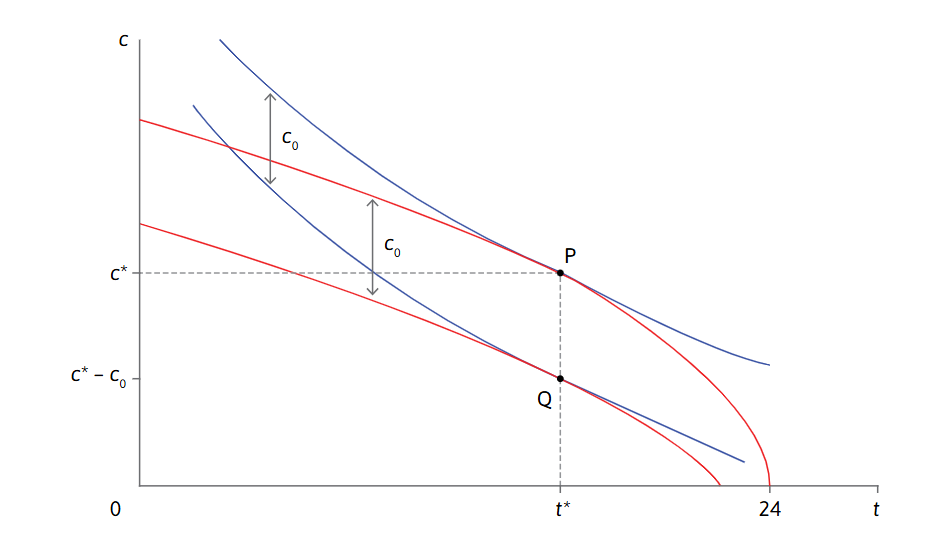
How does this problem if Angela needs to pay rent, c0?
-Her constrained optimisation problem will change in order to choose t and c to max v(t) + c, subject to constraint c = g(t) - c0
-But her FOC says the exact same. Thus, it means that she will produce the same amount of grain, but just consume less. Simply because the rate at which she can transform free time into consumption for herself does not change.
-And her lower consumption does not concern itself with MRS, because of quasi-linear preferences. Her MRS is only v’(t) - nothing to do with grain consumption
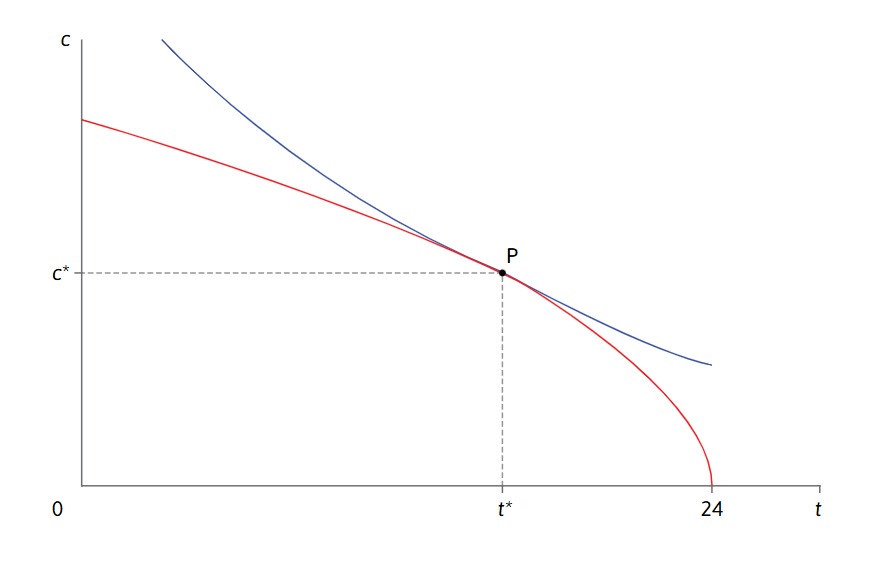
So given that Angela needs to pay rent, how does this change this graph, which assumes Angela didn’t?
-See how the MRS does not change
What is the point of using Quasi-Linear preferences here?
-The main point is to ensure the size of the pie and the division of the pie remains separated issues.