PHYSICS UNIT 3 TOPIC 1 - Gravity and Motion
 Call Kai
 Learn
 Practice Test
 Spaced Repetition
 Match
 Flashcards
 Knowt Play
1/110

111 Terms
What is meant by resolving a vector into two perpendicular components?
Resolving a vector means breaking it into two perpendicular vectors, usually horizontal (x) and vertical (y) components, that together produce the original vector.
How is the horizontal component of a vector calculated?
Vx=Vcosθ
where:
V = vector magnitude
θ = angle from the horizontal
How is the vertical component of a vector calculated?
Vy=Vsinθ
where:
V = vector magnitude
θ = angle from the horizontal
Why are vectors resolved into perpendicular components?
Resolving vectors makes calculations easier because horizontal and vertical components can be analysed independently.
Why is vector resolution useful when analysing forces?
Forces acting at angles can be split into horizontal and vertical components, allowing Newton's laws to be applied separately in each direction.
How do you know whether to use sine or cosine when resolving a vector?
Use:
Cosine for the component adjacent to the angle.
Sine for the component opposite the angle.
What is the first step when solving a vector problem?
Resolve each vector into perpendicular components:
Vx = Vcosθ
Vy = Vsinθ
After resolving vectors into components, what should be done?
Add or subtract the horizontal components and vertical components separately:
Rx = ∑Vx
Ry = ∑Vy
How is the magnitude of the resultant vector calculated?

How is the direction of the resultant vector calculated?

When are vector components added?
Components are added when vectors act in the same direction.
When are vector components subtracted?
Components are subtracted when vectors act in opposite directions.
Why is it incorrect to directly add the magnitudes of vectors acting at different angles?
Because vectors have both magnitude and direction. Their components must be combined before calculating the resultant vector.
What does it mean to say that the horizontal and vertical components of velocity are independent?
Changes in the horizontal component of velocity do not affect the vertical component, and changes in the vertical component do not affect the horizontal component.
How are the horizontal and vertical components of velocity treated in projectile motion?
The horizontal and vertical motions are analysed separately because they are independent of each other.
What happens to the horizontal component of velocity in projectile motion (ignoring air resistance)?
The horizontal component of velocity remains constant because there is no horizontal acceleration.
vx = constant
What happens to the vertical component of velocity in projectile motion?
The vertical component changes due to the acceleration caused by gravity.
ay = −9.8 m/s²
What happens to the horizontal and vertical components of velocity at the highest point of a projectile's motion?
At the highest point:
Horizontal velocity is still present.
Vertical velocity is zero momentarily.
Does a projectile slow down horizontally as it rises?
No. Ignoring air resistance, the horizontal velocity remains constant throughout the motion.
What equation is used to calculate vertical velocity in projectile motion?
where:
vy = final vertical velocity
uy = initial vertical velocity
g = acceleration due to gravity
t = time

What equation is used to calculate vertical displacement in projectile motion?
where:
sy = vertical displacement
uy = initial vertical velocity
g = acceleration due to gravity
t = time

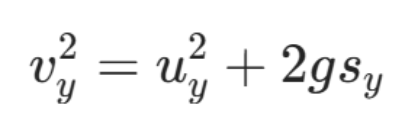
What equation relates vertical velocity and displacement without time?
This equation is useful when time is not given.
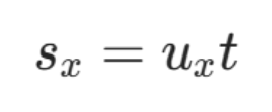
What equation is used to calculate horizontal displacement?
where:
sx = horizontal displacement
ux = horizontal velocity
t = time
Why does horizontal velocity remain constant in projectile motion?
Air resistance is neglected, so there is no horizontal force and therefore no horizontal acceleration.
What quantity links the horizontal and vertical motion of a projectile?
Time (t).
Solve the vertical motion first to find t, then use that time in the horizontal motion equation.
How does the launch angle affect the horizontal distance travelled by a projectile?
The horizontal distance (range) depends on the launch angle. As the angle increases from 0° to 45°, the range increases. As the angle increases above 45°, the range decreases.
At what launch angle is the horizontal distance travelled by a projectile maximised?
For a projectile launched and landing at the same height (with no air resistance), the maximum horizontal distance occurs at: 45°
What is special about complementary launch angles in projectile motion?
Complementary angles (angles that add to 90°) produce the same horizontal range.
Examples:
30° and 60°
20° and 70°
How does the horizontal distance travelled at 30° compare with that at 60°?
They are approximately equal because 30°∘ and 60° are complementary angles.
Why do very small launch angles produce a short horizontal distance?
The projectile has little vertical velocity, so it spends less time in the air.
Why do very large launch angles produce a short horizontal distance?
The projectile spends a long time in the air but has a small horizontal velocity.
What equation is used to calculate the force due to gravity (weight)?
where:
Fg = weight (N)
m = mass (kg)
g = gravitational field strength (9.8 N/kg)

What is weight?
Weight is the force acting on an object due to gravity.
What is the difference between mass and weight?
Mass:
Amount of matter in an object
Measured in Kg
Constant
Weight:
Force due to gravity
Measured in Newtons
Depends on gravitational field strength
What are the units of mass, weight and gravitational field strength?
Mass - Kg
Weight - N
Gravitational field strength — N/Kg
What is the normal force?
The normal force is the support force exerted by a surface on an object in contact with it. It acts perpendicular (normal) to the surface.
In what direction does the normal force act?
The normal force always acts at 90° to the surface.
What is the normal force acting on an object resting on a horizontal surface?
If the object is stationary on a flat surface:
FN = mg
The normal force is equal in magnitude and opposite in direction to the object's weight.
Why does a normal force act on an object?
The surface prevents the object from passing through it by exerting an upward support force called the normal force.
What forces act on a book resting on a table?
Weight (Fg) acting downward.
Normal force (FN) acting upward.
If the book is at rest:
FN = Fg
How does the normal force change on an inclined plane?
The normal force becomes smaller than the object's weight because only the component of weight perpendicular to the surface contributes to the normal force.
FN = mgcosθ
Is the normal force always equal to an object's weight?
No. It is only equal to the weight when an object is on a horizontal surface with no other vertical forces acting.
How is the normal force represented on a free-body diagram?
As an arrow acting perpendicular to the contact surface and away from the surface.
What forces may act on an object on an inclined plane?
An object on an inclined plane may experience:
Force due to gravity (weight)
Normal force
Frictional force
Tension
Applied force
These forces can be represented using a free-body diagram.
How is the force due to gravity shown on a free-body diagram for an inclined plane?
The weight (Fg = mg) always acts vertically downward toward the centre of the Earth, regardless of the angle of the slope.
How is the normal force shown on a free-body diagram for an inclined plane?
The normal force (FN) acts perpendicular to the surface of the inclined plane and away from the surface.
How is the frictional force shown on a free-body diagram?
Friction acts parallel to the surface and opposes the direction of motion or attempted motion.
How is tension shown on a free-body diagram for an object on an inclined plane?
Tension acts parallel to the rope or cable and pulls away from the object.
How is an applied force shown on a free-body diagram?
An applied force acts in the direction in which the object is pushed or pulled.
Why is the weight force often resolved into components on an inclined plane?
Because one component acts parallel to the slope and the other acts perpendicular to the slope, making force analysis easier.

In what direction does friction act if an object tends to slide down a slope?
Friction acts up the slope, opposing the motion.
How can the net force acting on an object on an inclined plane be determined?
Resolve all forces into components parallel and perpendicular to the slope, then add the components as vectors to find the resultant (net) force.
Why is the normal force usually not included when calculating the net force along an inclined plane?
The normal force acts perpendicular to the slope and is balanced by the perpendicular component of weight, so it does not affect motion along the slope.
What is uniform circular motion?
Uniform circular motion is the motion of an object travelling in a circular path at a constant speed.
Why is an object in uniform circular motion accelerating even though its speed is constant?
Although the speed remains constant, the direction of the velocity is continuously changing. A change in velocity means the object is accelerating.
What type of acceleration occurs in uniform circular motion?
Centripetal acceleration, which acts towards the centre of the circular path.
In what direction does the acceleration act in uniform circular motion?
The acceleration always acts towards the centre of the circle.
What force is required to maintain uniform circular motion?
A centripetal force is required, acting towards the centre of the circular path.
Give examples of uniform circular motion.
A satellite orbiting Earth.
A car travelling around a roundabout at constant speed.
A ball being swung in a circle on a string.
In what direction does the velocity of an object in uniform circular motion act?
The velocity is always tangent to the circular path.
Does an object in uniform circular motion have zero acceleration because its speed is constant?
No. The object is accelerating because its velocity is changing direction, even though its speed remains constant.
What is average speed?
Average speed is the total distance travelled divided by the total time taken.
Average Speed = Total Distance / Total Time
What is the period of an object in circular motion?
The period (T) is the time taken for an object to complete one full revolution or cycle.
What are the SI units of average speed and period?
Average speed → m/s
Period → s
What does the period tell us about an object moving in a circle?
It tells us how long the object takes to complete one full circle.
How can average speed be determined for an object moving in a circle?
Divide the circumference travelled by the period:
v = 2πr / T
v = speed
r = radius
T = period
Is average speed the same as instantaneous speed?
No. Average speed is calculated over a whole journey, whereas instantaneous speed is the speed at a particular moment.
What equation is used to calculate centripetal acceleration?
where:
ac = centripetal acceleration (m/s²)
v = speed (m/s)
r = radius (m)

In what direction does centripetal acceleration act?
Centripetal acceleration always acts towards the centre of the circular path.
What is centripetal acceleration?
Centripetal acceleration is the acceleration of an object moving in a circular path. It is directed towards the centre of the circle and causes the object's velocity to continuously change direction.
What is centripetal force?
Centripetal force is the net force acting towards the centre of a circular path that causes an object to undergo circular motion.
In what direction does centripetal acceleration act?
Centripetal acceleration always acts towards the centre of the circular path
In what direction does centripetal force act?
Centripetal force always acts towards the centre of the circular path.
Why does an object moving in a circle experience centripetal acceleration even if its speed is constant?
The object's velocity is continuously changing direction. Any change in velocity is an acceleration.
What is the relationship between centripetal force and centripetal acceleration?
Centripetal force causes the centripetal acceleration that keeps the object moving in a circular path.
Fc = mac
What can provide the centripetal force in circular motion?
Different forces can act as the centripetal force, including:
Tension
Friction
Gravity
Normal force
What equation is used to calculate the centripetal force acting on an object in uniform circular motion?
where:
Fc = centripetal force (N)
m = mass (kg)
v = speed (m/s)
r = radius (m)

In what direction does the centripetal force act?
The centripetal force always acts towards the centre of the circular path.
What is the Law of Universal Gravitation?
The Law of Universal Gravitation states that every object in the universe attracts every other object with a gravitational force that depends on their masses and the distance between them.
Who developed the Law of Universal Gravitation?
Sir Isaac Newton proposed the Law of Universal Gravitation.
How does mass affect gravitational force?
The gravitational force increases as the masses of the objects increase.
Fg ∝ m1m2
How does distance affect gravitational force?
The gravitational force decreases as the distance between the objects increases.
Fg ∝ 1 / r2
Which objects experience gravitational attraction?
Any two objects with mass experience gravitational attraction.
What equation is used to calculate the gravitational force between two masses?
where:
F = gravitational force (N)
G = universal gravitational constant
M = mass of object 1 (kg)
m = mass of object 2 (kg)
r = distance between the centres of the masses (m)

What is the value of the universal gravitational constant?

How does increasing one of the masses affect the gravitational force?
Gravitational force is directly proportional to both masses.
F ∝ Mm
If one mass doubles, the force doubles.
What happens to the gravitational force if the distance between two masses doubles?
F = 1/4
The force becomes one-quarter as large.
What happens to the gravitational force if the distance between two masses triples?
F = 1/9
The force becomes one-ninth as large.
What is a gravitational field?
A gravitational field is a region of space around a mass where another mass experiences a gravitational force.
Why does a mass create a gravitational field?
Every object with mass produces a gravitational field that exerts an attractive force on other masses placed within the field.
What is Earth's gravitational field?
Earth's gravitational field is the region around Earth where objects experience a gravitational force directed towards Earth's centre.
In what direction does a gravitational field act?
A gravitational field always points towards the mass creating the field.
How are gravitational fields represented using field lines?
Field lines point towards the mass, and the closer the lines are together, the stronger the gravitational field.
How does gravitational field strength change with distance from a mass?
Gravitational field strength decreases as the distance from the mass increases.
What happens when an object is placed in a gravitational field?
The object experiences a gravitational force directed towards the source of the field.
How is weight related to a gravitational field?
Weight is the gravitational force experienced by an object within a gravitational field.
Fg = mg
What is the difference between gravitational force and gravitational field?
gravitational field is the region where gravity acts, while gravitational force is the force experienced by a mass placed within that field.
What is the gravitational field strength near Earth's surface?
g = 9.8 m/s²
What is Kepler's First Law of Planetary Motion?
Planets move in elliptical orbits with the Sun located at one focus of the ellipse.
What is Kepler's Second Law of Planetary Motion?
A line joining a planet and the Sun sweeps out equal areas in equal time intervals.