Chapter 13 & 14 chemistry test
 Call Kai
 Learn
Learn Practice Test
 Spaced Repetition
 Match
Match Flashcards
 Knowt Play
1/38

There's no tags or description
Looks like no tags are added yet.
Name | Mastery | Learn | Test | Matching | Spaced | Call with Kai |
|---|
No analytics yet
Send a link to your students to track their progress
39 Terms
What is the definition of molality?
moles of solute per kg of solvent
Solution
homogeneous mixture of two or more
substances in a single phase
solutes
the substance that dissolves in a solution
solvents
the substance that does the dissolving
Henry law meaning
Sg = Kh Pg
Sg = solubility of gas (usually mol/L)
– Pg = partial pressure of the gas over the solution
– kH = Henry’s Law constant
Calculate the concentration of CO2 in a Mountain Dew drink that is
bottled with a partial pressure of CO2 of 4.0 atm over the liquid at 25 C (
Henry’s law constant at this temp is 3.1 × 10⁻² mol/L atm)
0.12 mol/L or 0.12 M
What is the concentration of O2 in a
freshwater stream in equilibruim with air at
25 oC and at a pressure of 1.0 atm?
Express answer in moles of O2/liter of
seawater.
The pressure of O2 is 0.21 atm in air and the
Henry’s law constant is 1.3 x 10 -3mol/liter . atm
2.7 x 10⁻⁴ mol/liter
When the temperature is increased, the
solubilities of most gases _____, and the
solubilities of most solids _____.
A increase; increase
B increase; decrease
C decrease; increase
D decrease; decrease
C
Raoult law
Xsolvent=moles of solvent/moles of solvent + moles of solute
Psolvent = Xsolvent Pºsolvent
Psolvent is the vapor pressure of the solvent over the
solution
Pºsolvent is the vapor pressure of the pure solvent
Xsolvent is the mole fraction of the solvent
(raoult law problem)Urea, (NH2)2CO, which is widely used in fertilizers
and plastics, is quite soluble in water. If you dissolve
9.00 g of urea in 10.0 grams of water, what is the
vapor pressure of the solution at 24 °C?
Vapor pressure of water at 24oC = 22.4 mm Hg
Molar mass of urea = 60.06g = 1 mole
Molar mass of water = 18.02g = 1 mole
17.6 mm Hg
Freezing point formula
m=moles of solute/kg of solvent
Tf=KfM
T + Tsolvent= T solution
Freezing point problem answer is 80.32 C
Eugenol, a compound found in nutmeg and cloves, has the
formula C10H12O2. What is the boiling point of a solution
containing 0.144 g of this compound dissolved in 10.0 g of
benzene?
Molar mass of Eugenol = 164.2g/mole
molal boiling point elevation constant for benzene = 2.53oC/m
The boiling point of pure benzene = 80.10oC
ΔTbp = Kbpm
What is the freezing point of a solution made by adding
1840 grams of ethylene glycol, HOCH2CH2OH, to 5500
grams of water.
molar mass of ethylene glycol = 62.07g/mole
molal freezing point depression constant for water = -1.86oC/m
freezing point of pure water is 0.0oC.
ΔTfp = Kfpm
T = Tsolution -Tsolvent
-10 ºC
Polyvinyl alcohol is a water soluble polymer with an average
molar mass of 28,000. You dissolve 1.844 g of this polymer in
water to give 150. mL of solution. What is the osmotic
pressure, measured at 27 °C ( 300 K)?
PV = nRT
R = 0.08206L .atm.mole-1.K-1
0.0108 atm
In which aqueous solution is the boiling
point greater?
• 0.30 molal NaCl
• 0.20 molal AlCl3
0.20 molal AlCl3
The units of "reaction rate" are
mol L-1 s-1.
Appropriate units for a first-order rate constant are
1/s.
Appropriate units for a second-order rate constant are
1/M·s.
Appropriate units for a third-order rate constant are
1/M2·s
The reaction A + 2B → products has been found to have the rate law, rate = k[A]
[B]2. While holding the concentration of A constant, the concentration of B is
increased from x to 3x. Predict by what factor the rate of reaction increases.
3²=9
The reaction A + 2B → products has the rate law, rate = k[A][B]3. If the
concentration of B is doubled while that of A is unchanged, by what factor will the
rate of reaction increase?
2³=8
For the chemical reaction A → B + C, a plot of [A]t versus time is found to give a
straight line with a negative slope. What is the order of reaction with respect to A?
zeroth
For the chemical reaction A → B + C, a plot of 1/[A]t versus time is found to give a
straight line with a positive slope. What is the order of reaction with respect to A?
Second
For the chemical reaction A → B + C, a plot of ln[A]t versus time is found to give a
straight line with a negative slope. What is the order of reaction with respect to A?
First
For a first order reaction, the half-life is equal to
A. t1/2 = 0.693/k.
B. t1/2 = k/0.693.
C. t1/2 = 1/k[A]o.
D. t1/2 = k.
E. t1/2 = [A]o/2k.
A. t1/2 = 0.693/k.
0th order
[A] t = −𝑘𝑡 + [𝐴] 0
1st order
ln [𝐴] 𝑡 = −kt + ln [𝐴] 0
2nd order
1/[A]t=Kt + 1/[A]o
The reaction 2A B is first order in A with a rate constant of 2.8 x 10⁻² s-1 at 800C.
How long will it take for A to decrease from 0.88 M to 0.14 M ?
ln[A]t = -kt + ln[A]0
66 s
A first order reaction has a rate constant of
1.35x10⁻⁴s-1 at 25 oC.
How long will it take for the concentration to
decrease from 0.45M to 0.32M.
ln[A]t = -kt + ln[A]0
2500s
Is second order in A. What is the concentration of A after 60
seconds if the rate constant is 0.50 M-1s-1 and the initial A
concentration is 0.15M.
2nd order 1
1/[A]t=kt + 1/[A]o
0.027m
osmosis pressure formula
p=nrt/v
Rate formula
Rate 1/Rate2= K[A]^x [B]^y
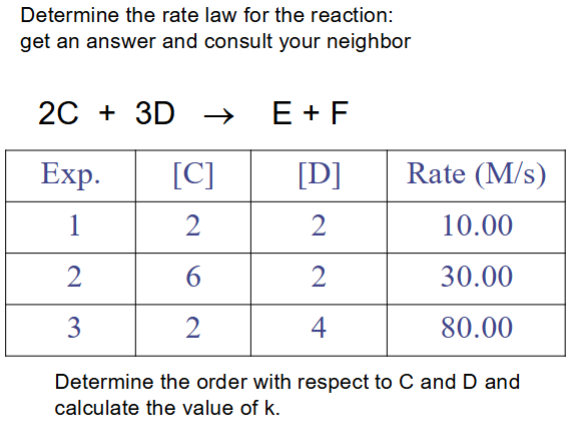
c/x=1 d/y=3 k=0.625s^-1 m-3