EXAM 4 CELL BIO
 Call Kai
 Learn
Learn Practice Test
 Spaced Repetition
 Match
Match Flashcards
 Knowt Play
1/8

There's no tags or description
Looks like no tags are added yet.
Name | Mastery | Learn | Test | Matching | Spaced | Call with Kai |
|---|
No analytics yet
Send a link to your students to track their progress
9 Terms
Chp 16
Signaling Cascade
Types of signals:
signals and responses
whys is signaling complex?
response time
signal to effector on the cell and then a response.
a) endocrine ( long distance, into the bloodstream)
b) paracrine (local, close by, same tissue or organ)
c) synaptic (neurons, electrical, action potential)
d) contact dependant ( 2 touching cells)
one signaling moelucla can induce different responses, ex: acetylcholine, these signal means different things to different cells.
signaling is complex because cells need certina amount of signals to stay alive ( hey man, ILY stay alive), if not they go into apoptosis.
two types of response time: a) slow becasue you make the proteins you are going to be using and the b) fast becasue you are using already made proteins.
ex: VIAGRA examples: prolong a signal = prolong its effect.
signal cascade parts
feedback
3 classes of cell surface receptors
parts to the signal cascade:
a) relay = signal from one to another.
b) amplify = turn on many
c) integrate = many signals turn 1 thing on.
d) distribute = what do we turn on.
phosphorylate = on or off, but GDP = always OFF, GTP = always ON.
positive feedback ( +, more, keep going), negative feedback ( -, less, stop)
the changes in pathways can affect the other pathways and lead to changes, ex: homeostasis.
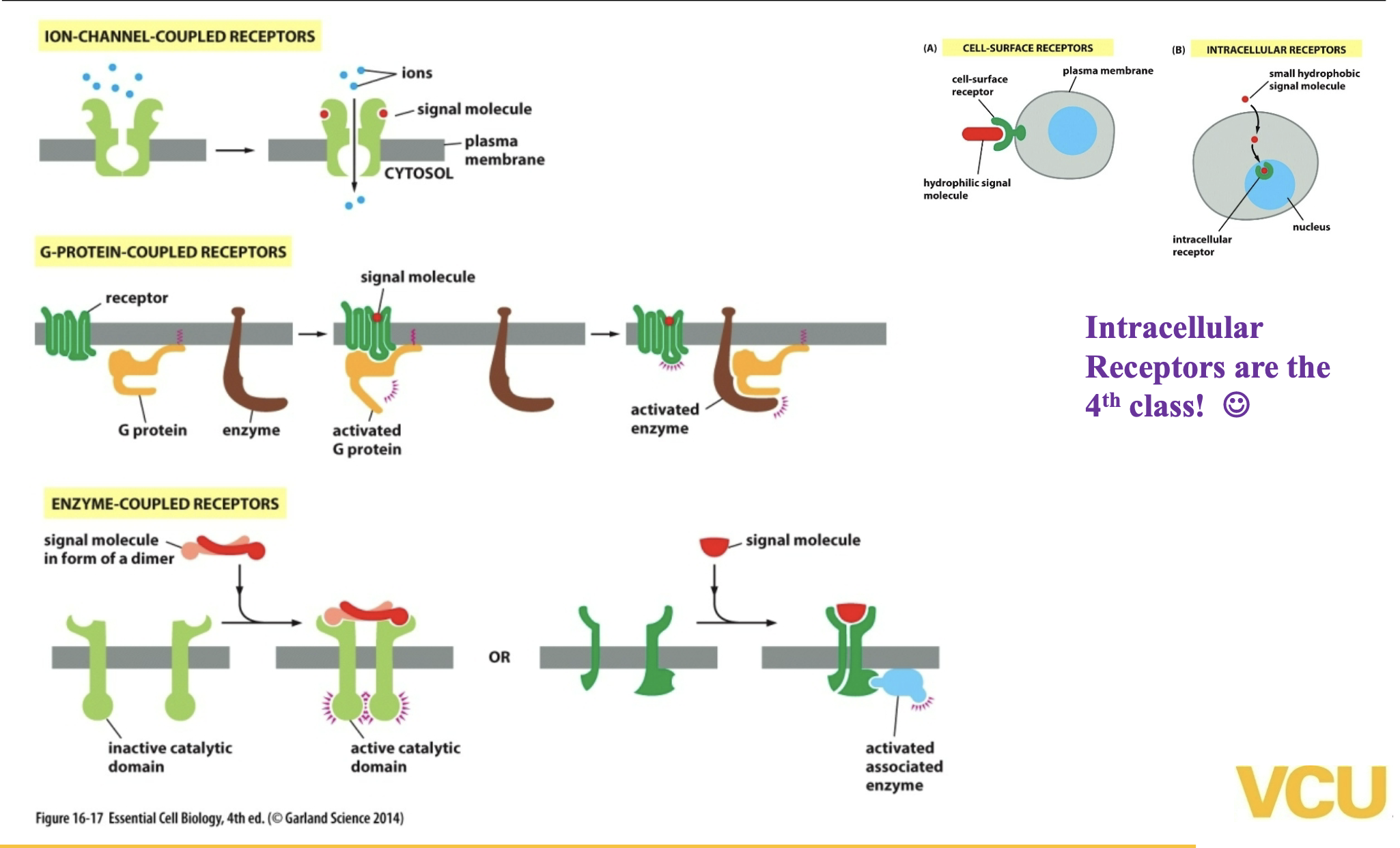
you have ion channels, g proteins, enzyme coupled and cell surface or intracellular = these are wehre the signal cascade begin at, they are the ears of the cell.
many singals cna interact with mote than 1 receptor.
Ion channel
G- protein. ( part 1)
Ion channel, example = ligand gated channel, needs ligand to change shape conformation.
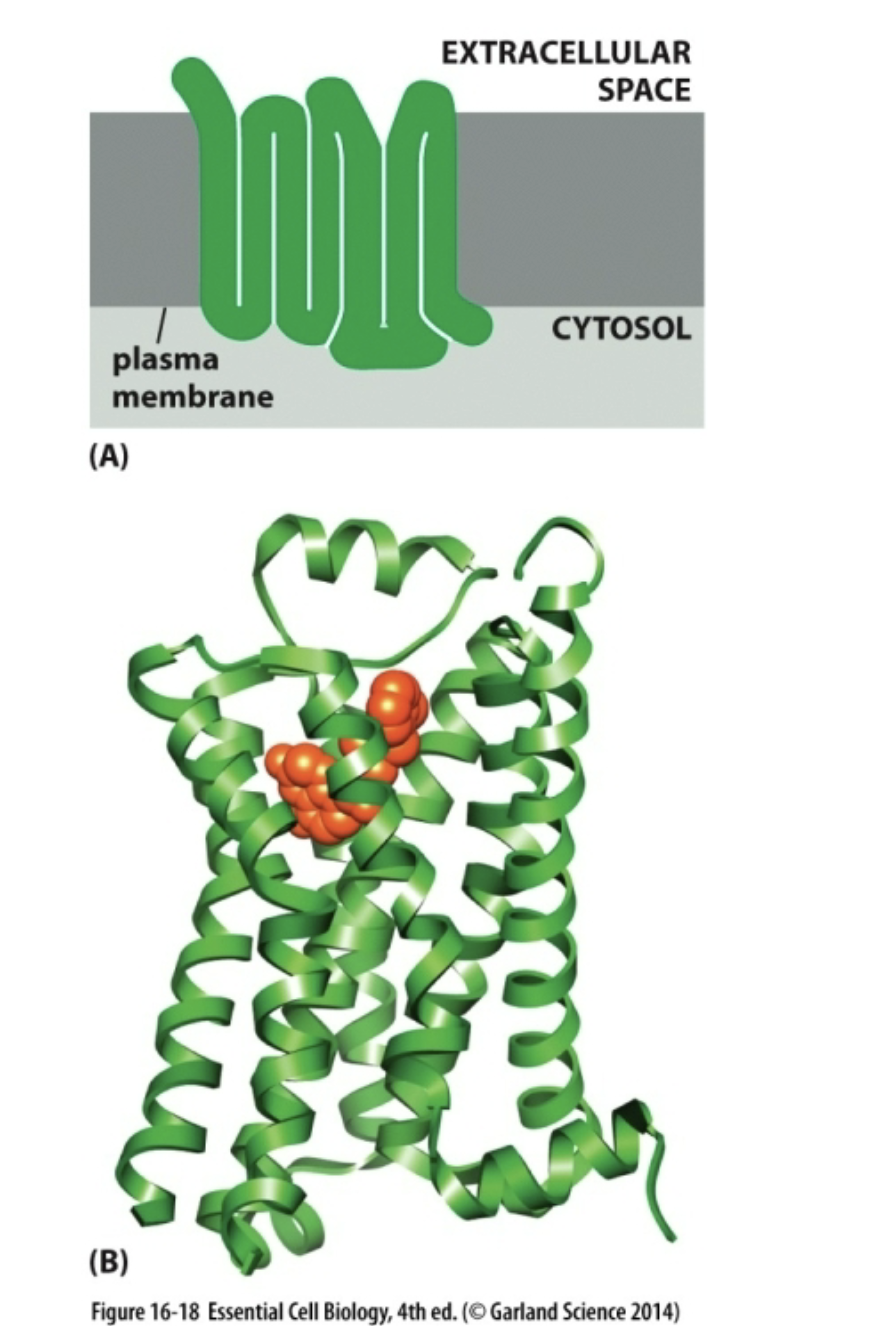
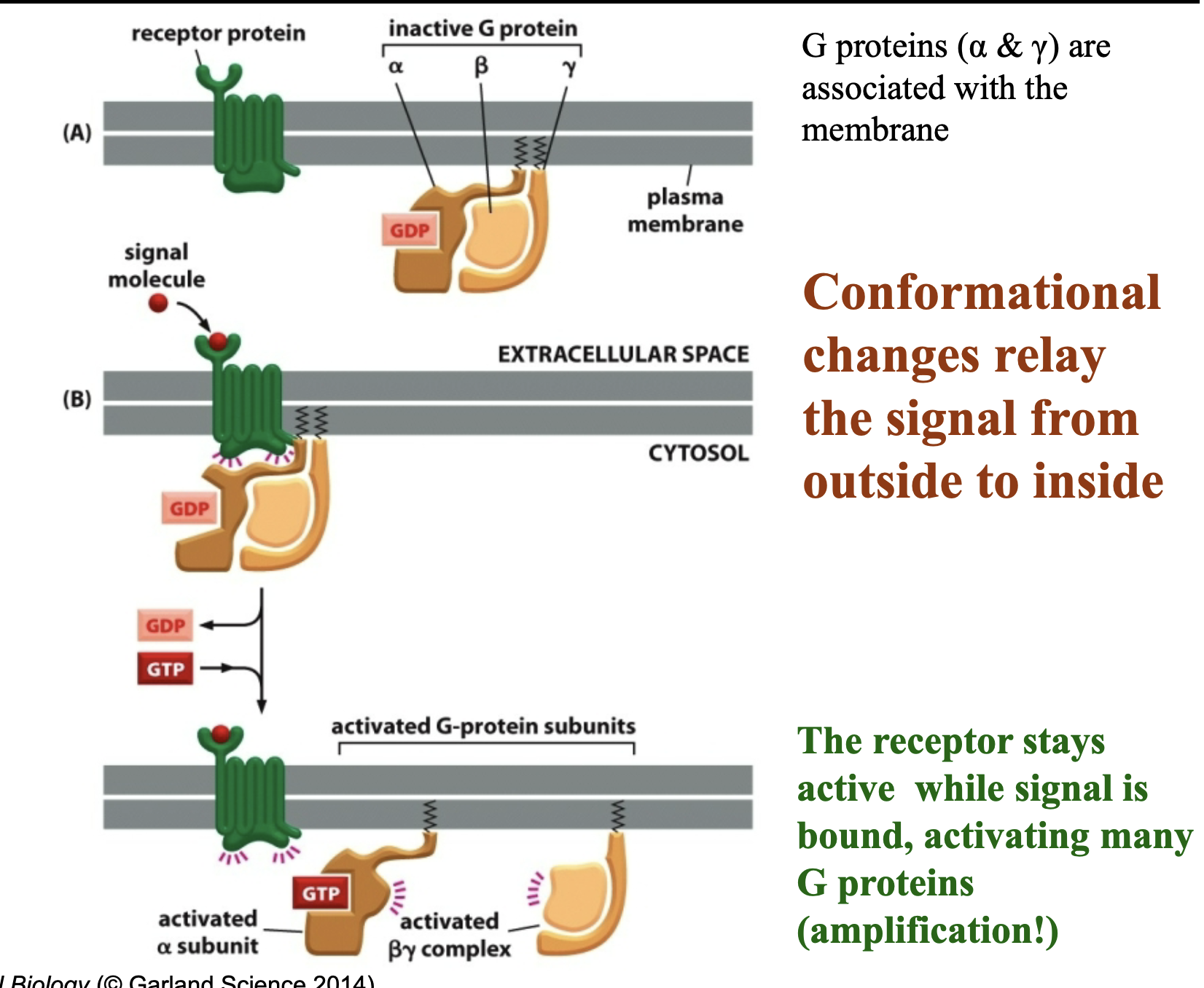
G- protein receptor is where most drugs work!!! ( you also have organ receptors than have been discovered but dont know yet what they do), the G-protein receptor is a 7 pass transmembrane proteins, and its a trimeric protein = meaning its conformed of 3 parts = a,B,y, which are lipid linked into the membrane.
when a and GTP are separate from By, the G protein is ON.
and when you have GDP and all 3 subunits united the G protein is OFF.
- way it works = signal molecule comes and binds into the GPCReceptor, like a lock and key, which turns G protein on, then G protien releases GDP, separates from By and takes on GTP.
1 signal molecule can activate many g-proteins = amplify effect.
G protein hydrolizes itself by turning GTP to GDP and turning itself off. this works by having the target protein attaching to a which then hydrolizes and turns GTP => GDP which turns the g protein off and gets the 3 subunits back together. ( slide in the next flashcard)
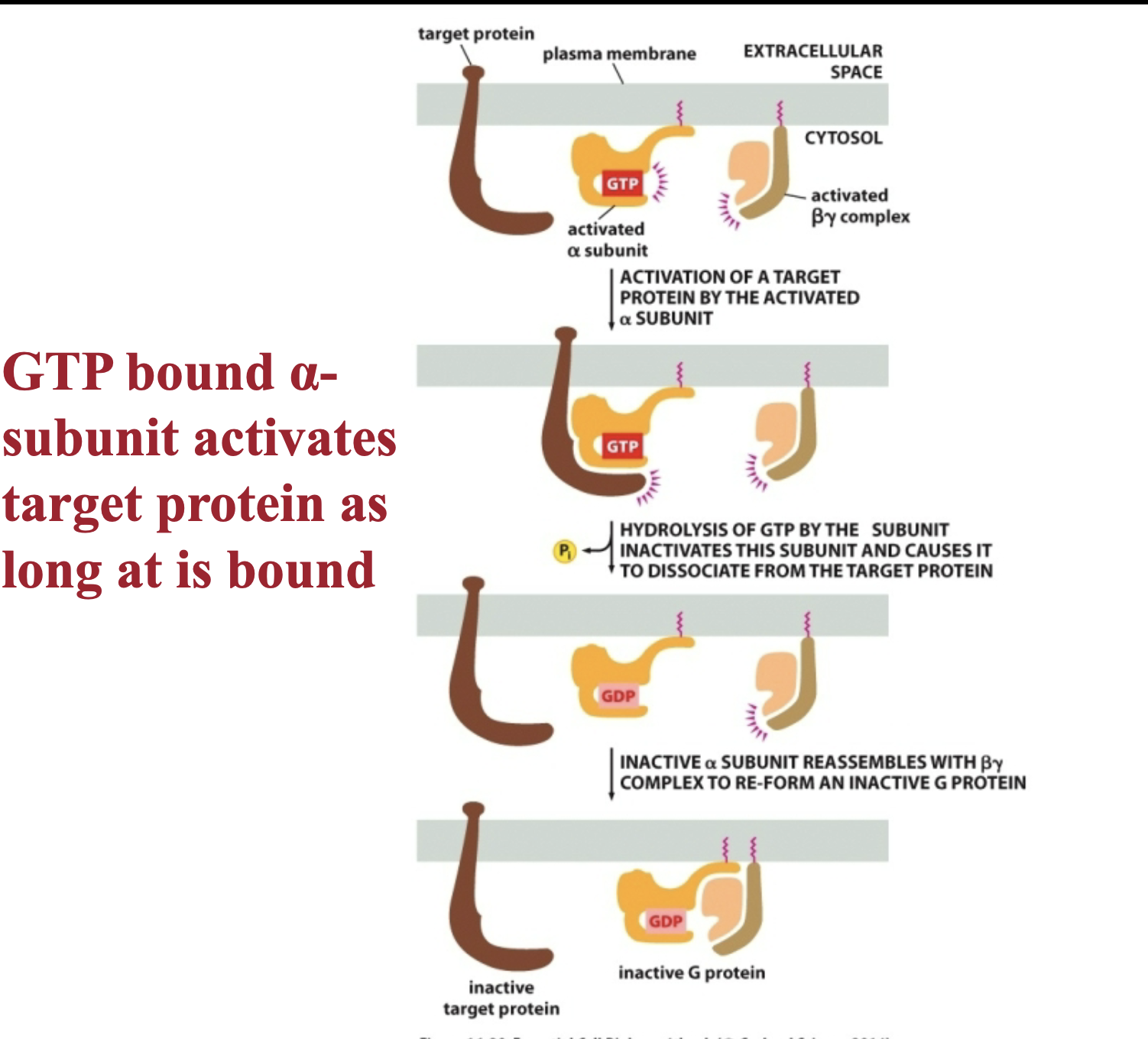
Slide 22 mechanism/ G- protein part 2)
types of G - protein
motions of how the signal works, start with the signal coming to the GPCR which turns G protein one by releasing GDP and obtaining GTP, then these sensors/ receptors can become over time drug tolerant ( menaing if you give the drug too much it looses its effect), this is DUE to B- arresting, which binds to the inside of teh cell receptor and makes the receptor not work as well ( Desinsizatation). After the desinzitized receptors gets eating into a vesicle inside the cell, where its no longer working = called internalization, this could lead to drug tolerance [ when a cell cannot work w/out the drug and it needs to function normally]. After internilization the receptor could be put back into the membrane to could be degraded.
a ) Gi = inhibitory, and the pertussin toxin is the one that indicates this, blocks Gi, generates uncontrolled cough.
b) Gs= stimulatory, and the cholera toxins is the one that indicates this by blocking Gs, you can poop yourself to death.
c) different ligands act on the same receptor and canccause diff subtypes of G proteins.
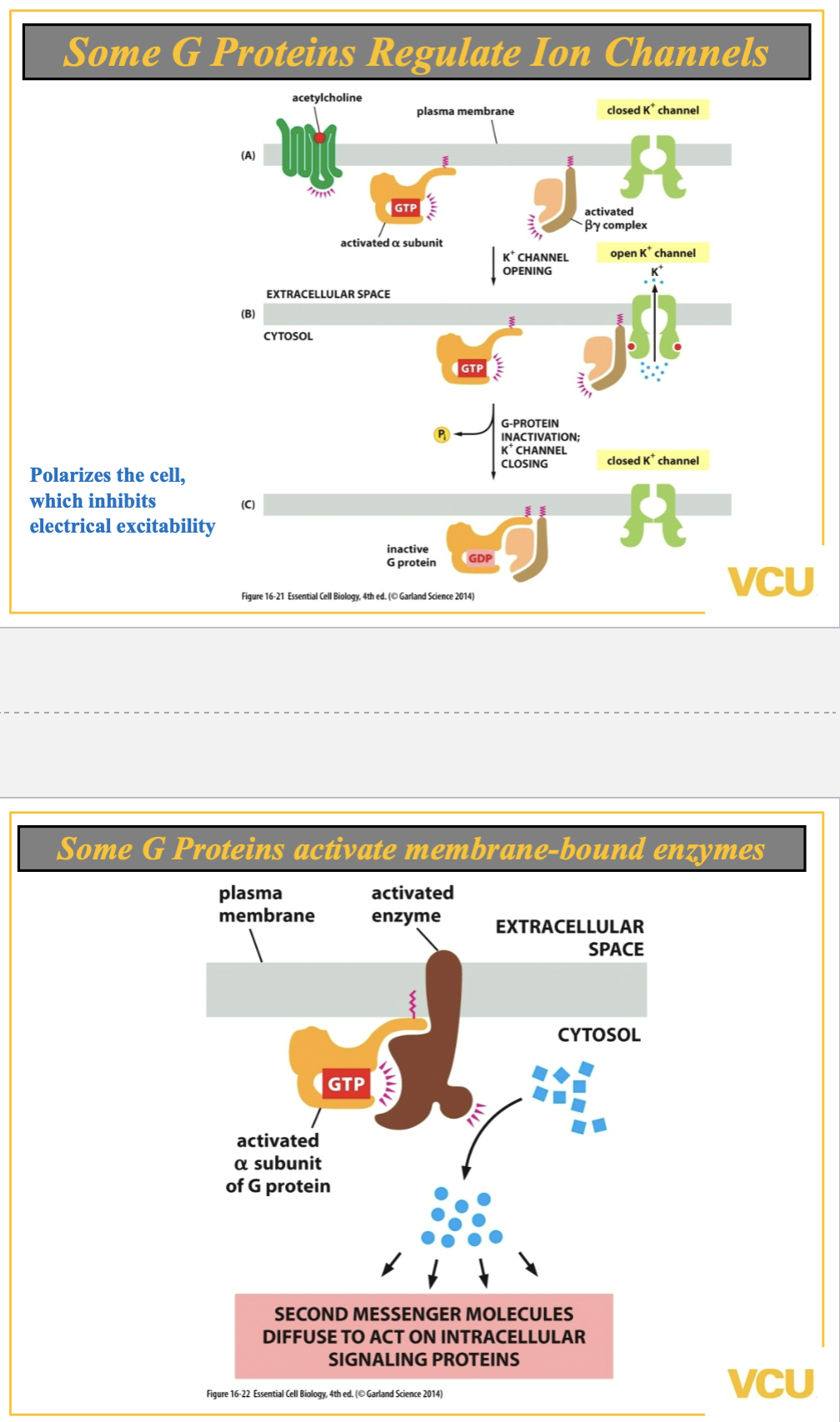
d) G protein can turn on ion channels and membrane bound enzymes.
![<ol><li><p>motions of how the signal works, start with the signal coming to the GPCR which turns G protein one by releasing GDP and obtaining GTP, then these sensors/ receptors can become over time drug tolerant ( menaing if you give the drug too much it looses its effect), this is DUE to B- arresting, which binds to the inside of teh cell receptor and makes the receptor not work as well ( Desinsizatation). After the desinzitized receptors gets eating into a vesicle inside the cell, where its no longer working = called internalization, this could lead to drug tolerance [ when a cell cannot work w/out the drug and it needs to function normally]. After internilization the receptor could be put back into the membrane to could be degraded. </p></li><li><p>a ) Gi = inhibitory, and the pertussin toxin is the one that indicates this, blocks Gi, generates uncontrolled cough. </p></li></ol><p>b) Gs= stimulatory, and the cholera toxins is the one that indicates this by blocking Gs, you can poop yourself to death. </p><p>c) different ligands act on the same receptor and canccause diff subtypes of G proteins. </p><p>d) G protein can turn on ion channels and membrane bound enzymes. </p><p></p>](https://assets.knowt.com/user-attachments/8ca92d94-aba7-4e4b-92d9-3a924a06dc01.png)
cAMP pathway
c-PLC pathway
cAMP is produced by adenylyl cyclase (takes ATP and cyclases it to cAMP), located in membrane, this + G protein produce cAMP ( cAMP is not attached to the membrane, its a second messanger activated by adenylyl cyclase.
cAMP has many responses fast one where the end product is a metabolic kinase, which uses whats is already made ( ie. get like adrenaline) or a slow one where you get a transcription factor and you make the protein you are gonna use.
fast cascade: GPCR → G protein → adenyl → cAMP→ PKA→ metabolic kinase → effect needed.
slow cascade: GPCR → G protein → adenyl → cAMP→ PKA→ transcription factor → effect.
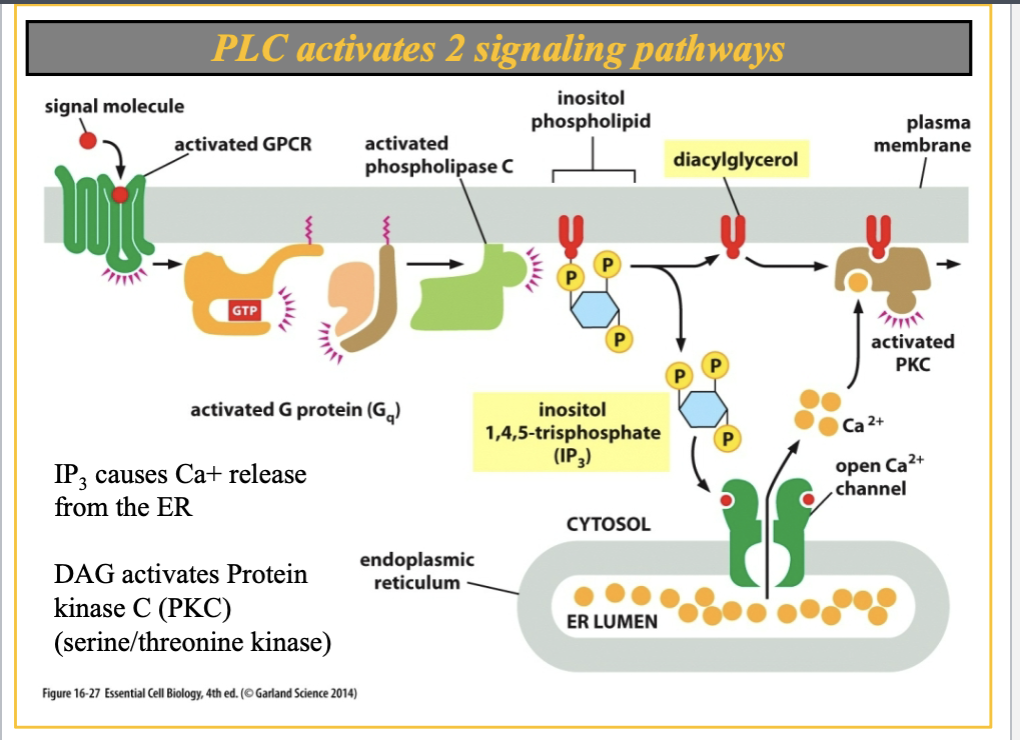
Phospholipase (c-PLC) = membrane bound, produces inositiol triphosphate [IP3] + DAG.
PLC activates 2 pathways, one where IP3 activates Ca+2 to release from ER( this can start new life, like embryonic development) and DAG which activates Kinase C ( PKC).
then Ca+2 binds to calmoudin and creates a shape change.
PLC→ IP3 → Ca+2 → calmoudin. ( calmoudin can grab onto othe things)
![<ol><li><p>cAMP is produced by adenylyl cyclase (takes ATP and cyclases it to cAMP), located in membrane, this + G protein produce cAMP ( cAMP is not attached to the membrane, its a second messanger activated by adenylyl cyclase. </p></li></ol><ul><li><p>cAMP has many responses fast one where the end product is a metabolic kinase, which uses whats is already made ( ie. get like adrenaline) or a slow one where you get a transcription factor and you make the protein you are gonna use. </p></li><li><p>fast cascade: GPCR → G protein → adenyl → cAMP→ PKA→ metabolic kinase → effect needed. </p></li><li><p>slow cascade: GPCR → G protein → adenyl → cAMP→ PKA→ transcription factor → effect. </p></li></ul><ol start="2"><li><p>Phospholipase (c-PLC) = membrane bound, produces inositiol triphosphate [IP3] + DAG. </p></li></ol><ul><li><p>PLC activates 2 pathways, one where IP3 activates Ca+2 to release from ER( this can start new life, like embryonic development) and DAG which activates Kinase C ( PKC).</p></li><li><p>then Ca+2 binds to calmoudin and creates a shape change. </p></li><li><p>PLC→ IP3 → Ca+2 → calmoudin. ( calmoudin can grab onto othe things) </p></li></ul><p></p>](https://assets.knowt.com/user-attachments/c0888ad0-3b76-4026-af58-c4e4c3b48b11.png)
vision
receptor tyrosine kinase
vision starts with a protein cascade, its fast and adaotable.
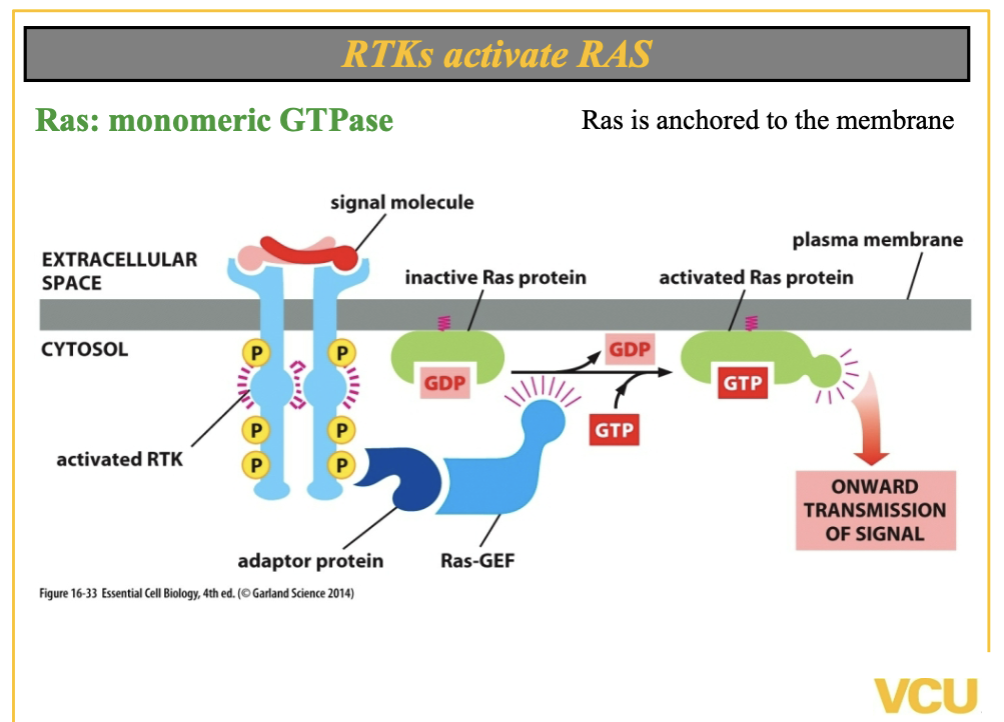
receptor - Tyrosine kinase ( RTK) receives signal, gets P added on, and its an enzyme. Gets signal and auto P on tyrosine which changes it shape and allows for other molecules to dock on it. = spaceshift.
RAS releases GDP = get GTP on.
pathways: RTK→ RAS→ MAPKKK→ MAPKK→ MAPK→ protein (fast) or gene ( slow) → response. (3,2,1)
Chp 18