Test 1 Psych 20
 Call Kai
 Learn
Learn Practice Test
 Spaced Repetition
 Match
Match Flashcards
 Knowt Play
1/190

There's no tags or description
Looks like no tags are added yet.
Name | Mastery | Learn | Test | Matching | Spaced | Call with Kai |
|---|
No analytics yet
Send a link to your students to track their progress
191 Terms
Prototype theory
We have one (abstracted average) prototype of a category
Prototype
One idealized average of all members of a category you have percieved
Exemplar theory
Representation corresponds to an actual category member
The best specific examples of a category you have actually percievd
Basic-level categories
The first term used to describe an object (ex: chair)
Superordinate category
Even more general term than first term (ex: seat)
Subordinate category
More specific term than first term (ex: office chair)
Group attribution error
When you apply the qualities (or perceived qualities) of a group to an individual
Leads to stereotyping and prejudice
Mental Representation
Some sort of internal model (or knowledge) that is linked to an external stimulus or information
2 possibilities: analog representation or propositional representation
Analog Representation
Mental representation in the form of sensory; perceptual experience
Ex: visual image, taste
Propositional Representation
Mental representation in the form of symbols; abstract assertions that maintain the relationship of referent
Ex: semantic language
Computer metaphor
Supported by the idea that, when shown an ambiguous image, people have a harder time switching between the two representations in their head after only seeing one interpretation, but they can see it switch when they actually look at the image again
Navigate the island
Participants look at and remember a simple map with a few landmarks —> participants push a button when a zipping dot would reach one landmark to another
Favors analog representation: the further the two locations, the longer participants took to push the button
Mental rotation
Visual images of cube shapes that have been rotated differently —> how long does it take for participants to answer whether or not the shape is the same or different than the original
Favors analog representation: the larger the angle of rotation, the longer the response time
Increased activation in the visual cortex alongside increased rotation
Visualization
Imagination to simulate a task
Mental vs physical trombone practice: group that only mentally practiced saw improvement, but group that mentally and physically practiced saw most improvement
Mental muscle building: mental training groups improved strength over control (stimulating muscle growth) but less than actual movement groups
Aphantasia
Lack of willed vivid imagery
Difficult to study; self-reported using VVIQ
Vividness of Visual Imagery Questionnaire (VVIQ)
Standard test for aphantasia or extent of vivid imagery in general
Hyperphantasia
Extremely vivid mental imagery
Binocular rivalry task
Alternative method to study vividness of imagery;
Prime patients to visualize one interpretation of a binocular rivalry stimulus —> those with aphantasia do not show priming effect of imagery
Inner speech
Speaking to yourself; single words, ideas, etc that pop up
Inner monologue
Specifically the narration of own life; more grammatical and continuous
Associated with default mode network in brain
VISQ-R
VISQ-R
Questionnaire on inner monologue/speech
No difference in cognitive ability between those with high/low scores
Frisson Response
“Aesthetic chills”
Skin tingling, goosebumps, shivers in response to musical aesthetics
Physical fear response yet we feel comfortable after
Mozart effect
Study that claimed that listening to Mozart before a test of spatial reasoning improved scores —> found later that same effect happened with other types of music and even other stimuli
Default Mode Network (DMN)
High activity in people with frequent/persistent inner speech/monologue
Associated with tasks involving introspection, basically the “ego”
Mind wandering, introspection, prospective thinking
Reduction in DMN activity and connectivity associated with “living in the moment”, meditation, exercise
Internal Representation Questionnaire (IRQ)
Revised version of the VVIQ and VISQ into a single more comprehensive questionnaire
4 categories: visual, verbal, manipulation (spatial cog), orthographic (visualize written words)
Compressions (sound)
Areas of high density and pressure where particles are pushed together
Rarefactions (sound)
Areas of low density and pressure where particles are pulled apart
Sine wave (“pure tones'“)
Simplest sound wave, only has one frequency (the fundamental)
Frequency
Measured in Hz. Doubling —> octave up
Related to perceived pitch
Amplitude
Measured in dB
Related to the perceived loudness (intensity)
Harmonics
Higher multiples of a fundamental frequency —> gives sound “timbre” (unique qualities that distinguishes a voice from an instrument for ex)
Changes sound without changing its pitch
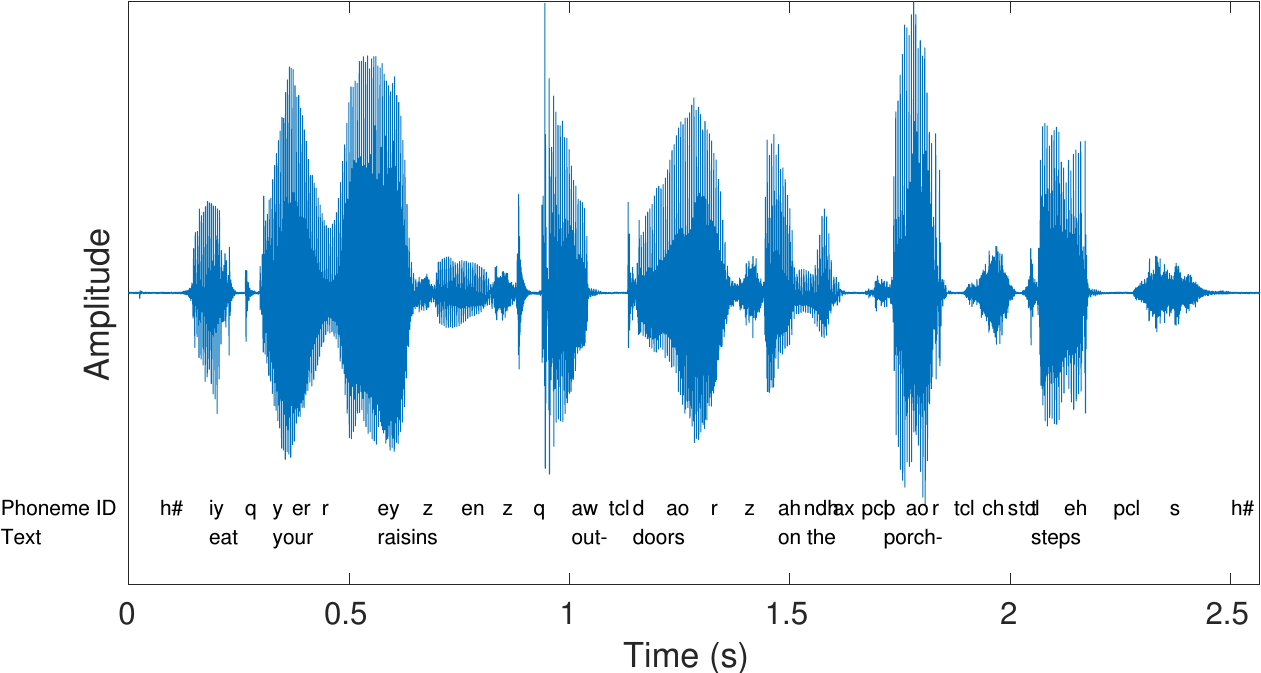
Waveform
Intensity over time
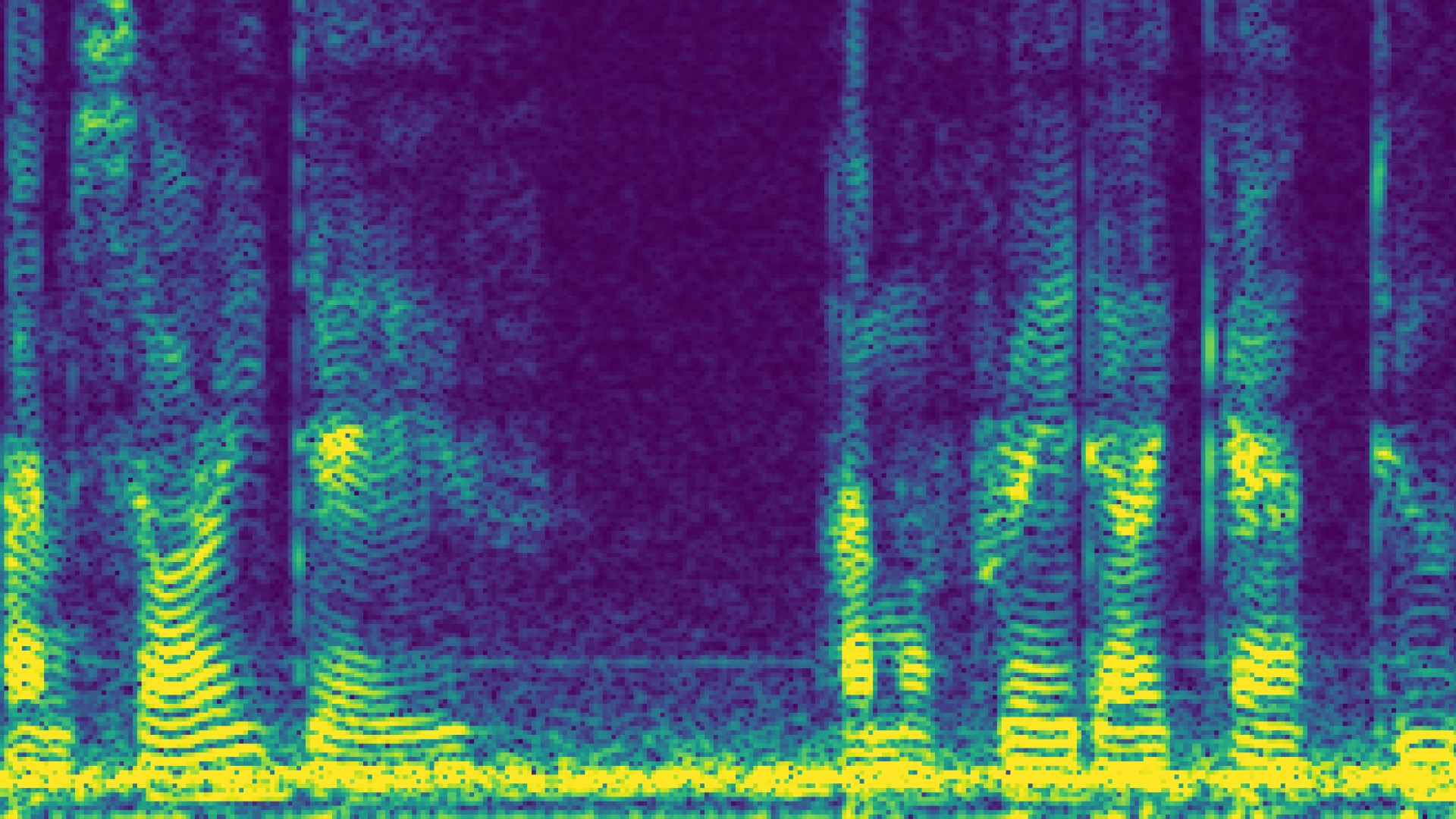
Spectrogram
Frequency and intensity over time
Pure tones = one frequency, one line
Complex tones = multiple frequencies at once, many lines
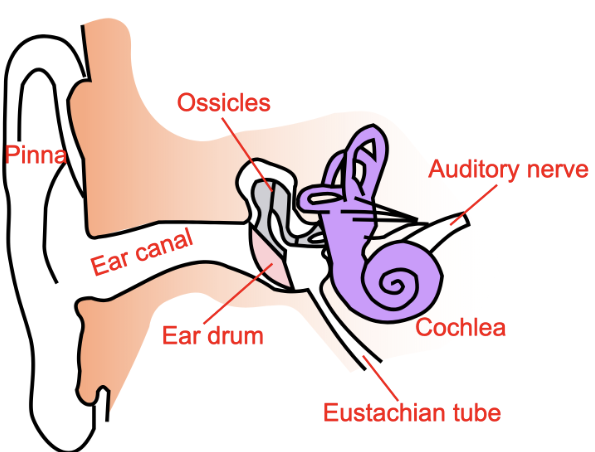
External auditory canal
Basilar membrane
Located within the cochlea; forms bulges due to sound —> pushes hair cells up
Hair cells
Specialized neurons
Auditory equivalent of photoreceptors (but they detect mechanical energy (pressures on the hair) instead of light)
How do hair cells work
Converts mechanical sound vibrations into electrical signals for the brain. Sound causes fluid in the cochlea to vibrate, bending hair-like stereocilia atop these cells, which opens ion channels, depolarizes the cell, and releases neurotransmitters to the auditory nerve
Too loud sounds → break tips of hair sounds → permanent damage because hair cells cannot repair themselves
Cochlea (“acoustic prism”)
Physical structure mirrors spectrogram
High frequencies stimulate hair cells near base, low frequencies stimulate hair cells near apex
Transmits electrical impulses to auditory complex
Cochlear implant
Artificially produces electrical impulses
Can stimulate much less variations of sound —> much lower sound quality
Conductive hearing loss
Vibrations inhibited due to ear wax buildup, infection, otosclerosis (degeneration of ossicles)
Hearing loss due to physical obstructions to ear
Sensorineuron hearing loss
Caused by damage to the inner ear’s hair cells or nerve pathway to the brain
Metabolic - can be caused by certain drugs (ototoxicity)
Sensory - caused by exposure to loud noises over long periods of time
Auditory cortex
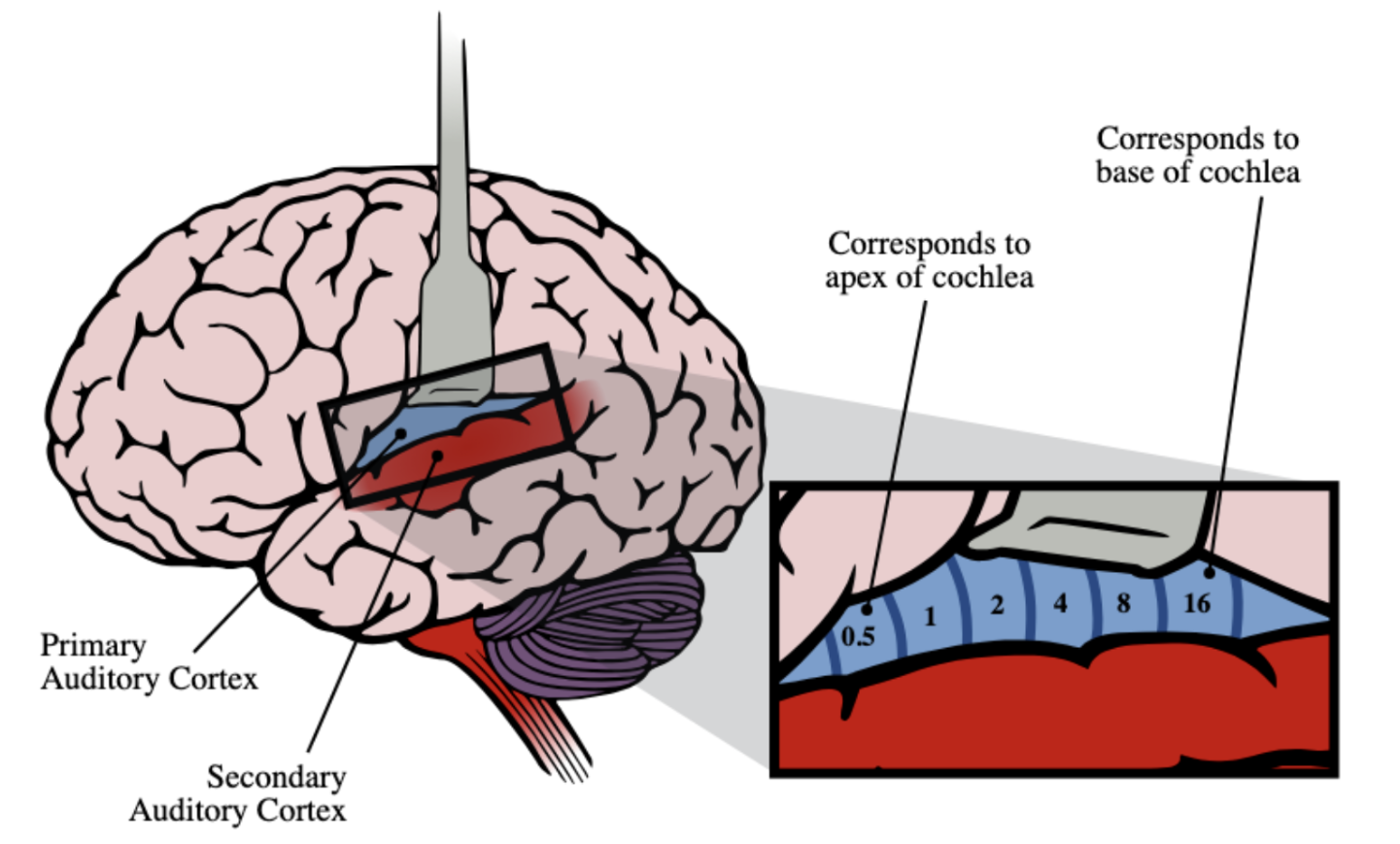
Primary auditory cortex (A1) in the temporal lobe
After A1, splits into dorsal (where) and ventral (when) stream, like vision!
Tonotopic organization
Tonotopic organization
Different neurons react differently to different pitches, organized spatially
Binaural cues
Sound localization technique using auditory signals from both ears
ITD & ILD
Interaural Time Different (ITD)
Sound reaching opposite ear from source takes longer
Interaural Level Difference (ILD)
Sound reaching opposite ear from source is quieter
Monaural cues
Sound localization technique using auditory signals from one single ear
Pinna folds
Pinna folds
Shape of ear; used for sound localization as their shape filters incoming sound waves differently depending on their source
Cone of confusion
Region where you can’t discriminate the location of a sound
ITD and ILD are ambiguous
Best way to resolve = moving the head around
Localizing distance (sound)
The best for sound is 1 meter
Inverse square law —> we underestimate long distances
We are good at telling of things are approaching or receding
Reverberations
Sound bounces off surfaces
Sound localizing technique; if someone is far in a room, much of the sound will be bouncing off the surface. If someone is close, much of the sound will be direct
Auditory Stream Segmentation
We need to segment one “stream” (one source) of sound from others in an environment where they’re all mixed together
Use auditory grouping principles
Auditory Grouping Principles
Proximity (in time) - sounds occurring close together in time are likely to be perceived as one stream
Size and pitch - bigger things (ex: animal vocal tracts) vibrate slower —> lower pitch
Timbre
Continuity
Cocktail effect
Ability to focus attention on one speaker alone
Acoustic startle response
Very rapid motor response to a loud unexpected noise
Amusia
Inability to perceive / reproduce tone
“tone deafness”
Music agnosia
Inability to hear music holistically
Can be selective to music; cannot recognize familiar songs
Motion adaptation effect
Stationary objects appear to move in the opposite direction after prolonged viewing of a moving stimulus
Apparent motion
Stationary objects, displayed in quick succession or viewed from a moving reference frame, are perceived as moving
Motion pareidolia
Our brain can perceive coherent motion if instructed to / told random shifts make a certain motion
Works with random dots if you prime or direct people to see it
Motion parallax
As we move side to side, objects that are closer to us move faster and objects that are further from us move slower
Helps with depth perception
Temporal resolution (speed of sight)
Ability of the visual system to separate events over time
Flicker fusion
Visible persistence
Flicker fusion
Light that is flashing super fast just looks solid —> can’t separate so they “fuse” together
Speed of sight = ~30 ms
Happens because neural communication isn’t instantaneous
Visible persistence
The brain continues to perceive an image after the physical stimulus has disappeared
Causes motion blur in humans —> used in film by cameras and animation
Global superiority effect
Largest grouping (global) is preferred over smaller grouping
Property of an object
Gestalt grouping principles
Systems for organizing a messy world into discrete systems of objects
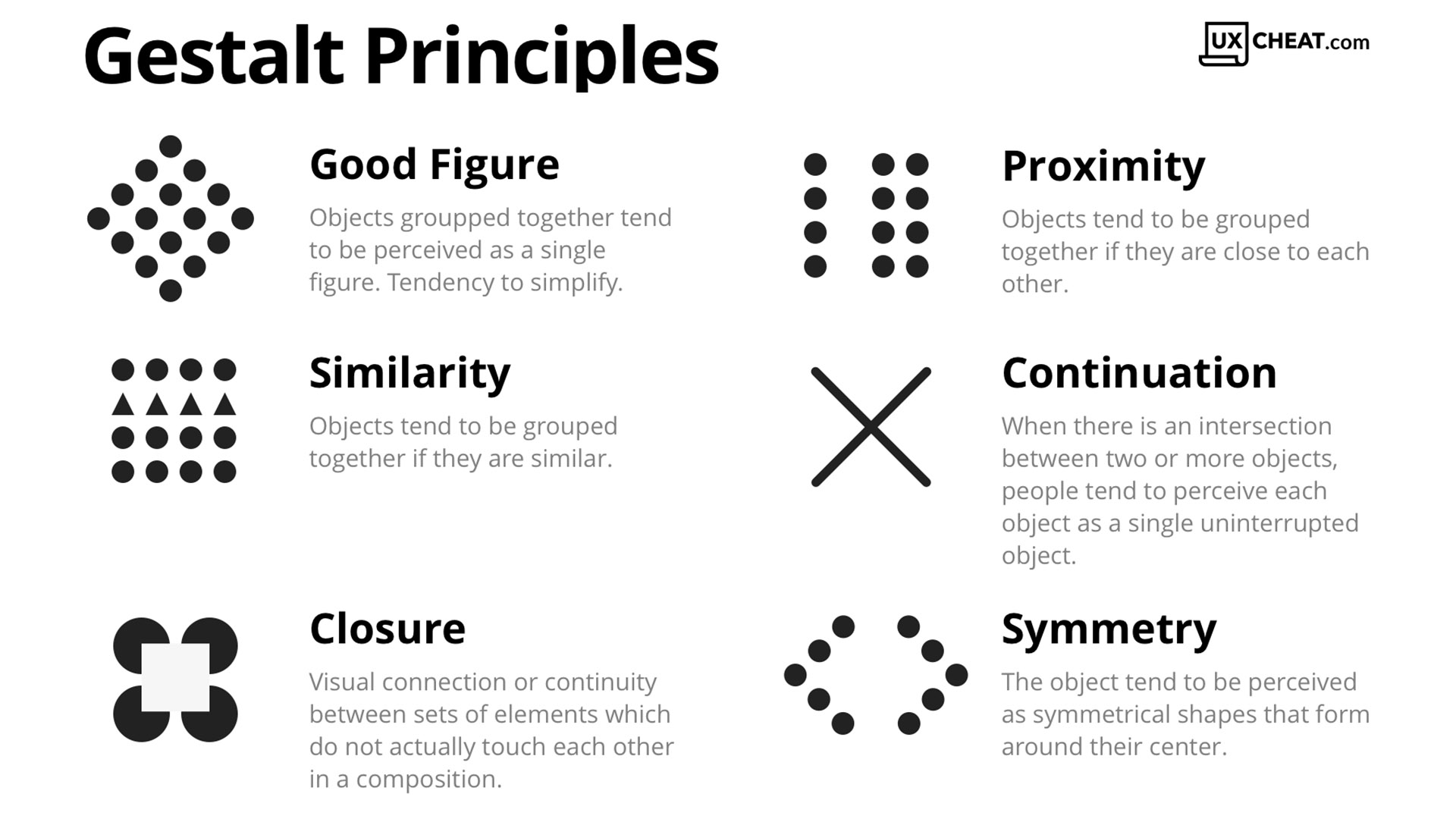
Subjective edge
A visual phenomenon where the brain perceives a clear edge, border, or shape even though no physical contrast, color, or luminance change exists at that location
Continuation & Closure
Object properties
A singular level of hierarchical structure
Stable grouping of visual info (Gestalt)
Figure as opposed to ground
Shading
Canonical viewpoint
Most representative / “obvious” viewpoint
Accidental viewpoint
Rare angle of an object —> harder to identify
Two theories of Object Recognition
Distributed and Local
Distributed object recognition
Recognition by components; segments an object into geometrical components (geons)
Advantage: can be modeled computationally
Could better recognize entry-level categories (ex: bird, dog)
Local object recognition
Recognition by views; different views of the same object are stored in LTM (exemplars)
Disadvantage: computationally expensive because it uses much more storage
Could better recognize specific instances of object type (ex: my dog)
Object agnosia
Difficulty or inability to engage in object recognition; 2 forms
Apperceptive agnosia
Cannot identify objects based on vision because they only pay attention to fragments
Can draw from memory but cannot reproduce new things
Associative agnosia
Can see and even reproduce objects, but can’t recognize them as what they are (name, use, meaning)
Problem with perception and memory (forming associations)
Visual indeterminacy
Damage to inferior temporal lobe
Visual indeterminacy
Before object recognition occurs, object is “indeterminant”
Optic ataxia
Inability to guide hand or eye movements using visual info, despite having normal vision and motor strength
Can identify objects, but difficulty acting on them
Damage to posterior parietal lobe
Pareidolia
Seeing patterns (objects or faces) in things that are not such (houses, cars, clouds, etc)
Prosopagnosia
Difficulty recognizing faces specifically
Fusiform Face Area (FFA)
Damage to this area located in the right temporal lobe —> prosopagnosia
Active when people recognize/discriminating specific types of things (cars, words)
Greebles
Highly homogenous artificial stimuli used to study object classification similar to facial recognition
FFA is active in “experts” that can distinguish them
Thatcher effect
Inverted faces are less subject to holistic (global) processing
Flash face distortion effect
A visual illusion where rapidly alternating faces, viewed in the periphery, appear grotesquely deformed or caricatured
Light
Comprised of photons, particles, and waves
Wavelength
Determines the color of light
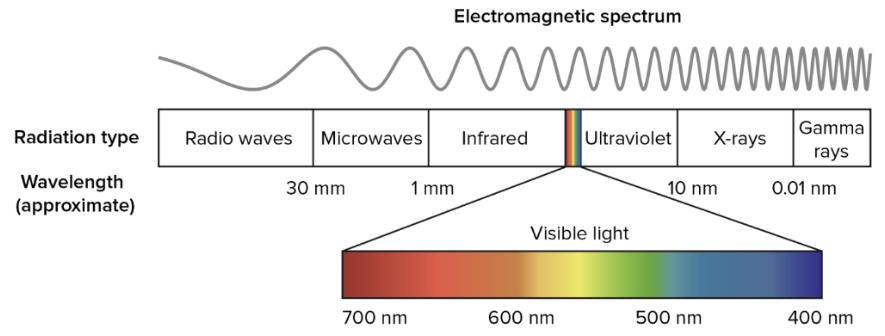
Amplitude
Determines the brightness of light
Fovea
Focus; exactly what you’re currently looking at
Sharpest, most detailed, color-sensitive
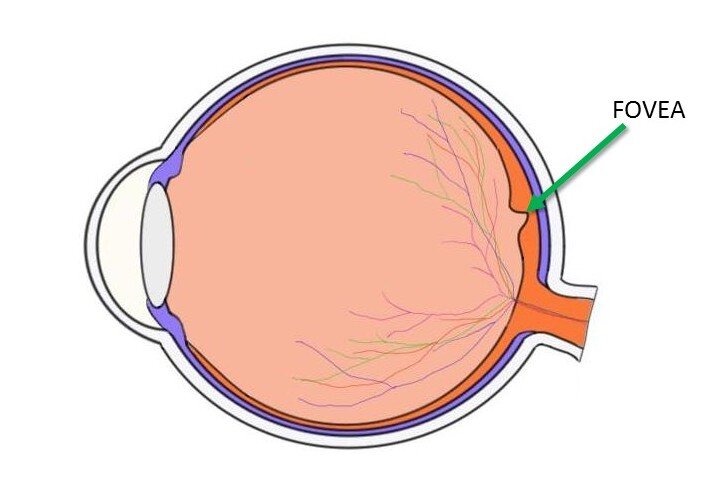
Retina
Converts light into electrical signals, enabling vision
At the back of the eye
Optic nerve
Bundle of nerve fibers that transmit visual data form the retina to occipital lobe
Rods
Low light vision (scotopic); night vision
Sensitive to fast motion
Low resolution; poor edge detection (high convergence)
Concentrated at the peripheries of the eye
~120 million per eye
Cones
Requires bright light (photopic)
3 types: short, medium, long —> corresponds to the wavelength of light they’re most sensitive to (not physical length)
Allows us to perceive color
High resolution, good edge detection (low convergence)
Concentrated in the fovea
~6 million per eye
Neural convergence
Each cone provides a much larger relative input to visual cortex than rods, even though rods outnumber them
90% of the brain’s input originates from cones
Optic disk
“Blind spot” where the optic nerve leaves the retina
Optic chiasm
X-shaped structure where info from the optic nerve splits into either hemisphere
Lateral Geniculate Nucleus (LGN)
Structure in thalamus that routes information from the optic chiasm to the primary visual cortex
Primary visual cortex & area V1 (primary visual area)
Cortical area for processing information
At the back of the occipital lobe
Retinotopic organization
The precise, ordered mapping of the visual field from the retina onto the brain’s visual areas, specifically V1
Adjaent neurons respond to adjacent areas of the visual scene
Cortical magnification
Much more neurons are used to process information from the fovea rather than the periphery
2 Streams of information that flow from V1
Dorsal pathway & Ventral pathway
Dorsal pathway
Visual processing stream connecting the Occipital to Parietal lobe
Spatial location and action (“where”)