Microbiology final practice
 Call Kai
 Learn
Learn Practice Test
 Spaced Repetition
 Match
Match Flashcards
 Knowt Play
1/1039

There's no tags or description
Looks like no tags are added yet.
Name | Mastery | Learn | Test | Matching | Spaced | Call with Kai |
|---|
No analytics yet
Send a link to your students to track their progress
1040 Terms
Which of the following is directly involved in the initiation of dental caries?
A) sucrose
B) lysozyme
C) lactic acid
D) crevicular fluid
E) dentin
C
.·:*¨ ✘♚✘ ¨*:·..·:*¨ ✘♚✘ ¨*:·.
Lactic acid is very strong, and can cause dental caries which are dangerous
dental caries: tooth decay or cavities.
⚙ How they form (simple steps):
Food sugars + oral bacteria form plaque
Bacteria metabolize sugar → produce acid
Acid demineralizes enamel (breaks down calcium)
Over time → a hole (cavity) forms in the tooth
Clostridium difficile-associated diarrhea is usually preceded by
A) eating contaminated food.
B) a blood transfusion.
C) extended use of antibiotics.
D) improper food storage.
E) travel to an underdeveloped country.
C
.·:*¨ ✘♚✘ ¨*:·..·:*¨ ✘♚✘ ¨*:·.
C diff.
Antibiotics kill normal gut flora
Normal microbiota (which normally keep C. diff in check) is disrupted
C. difficile overgrows
Produces toxins → watery diarrhea and colitis
Mnemonic:
CD = Comes after Drugs
Which of the following statements about salmonellosis is FALSE?
A) It is a bacterial infection.
B) Severity of disease depends on number of organisms ingested.
C) A healthy carrier state exists.
D) The mortality rate is high.
E) It is often associated with poultry products.
D
Disease-causing exotoxins are produced by all of the following organisms EXCEPT
A) Clostridium perfringens.
B) Vibrio cholerae.
C) Shigella dysenteriae.
D) Staphylococcus aureus.
E) Clostridium botulinum.
C
Which one of the following diseases of the gastrointestinal system is transmitted by the respiratory route?
A) staphylococcal enterotoxicosis
B) mumps
C) Vibrio gastroenteritis
D) bacillary dysentery
E) traveler's diarrhea
B
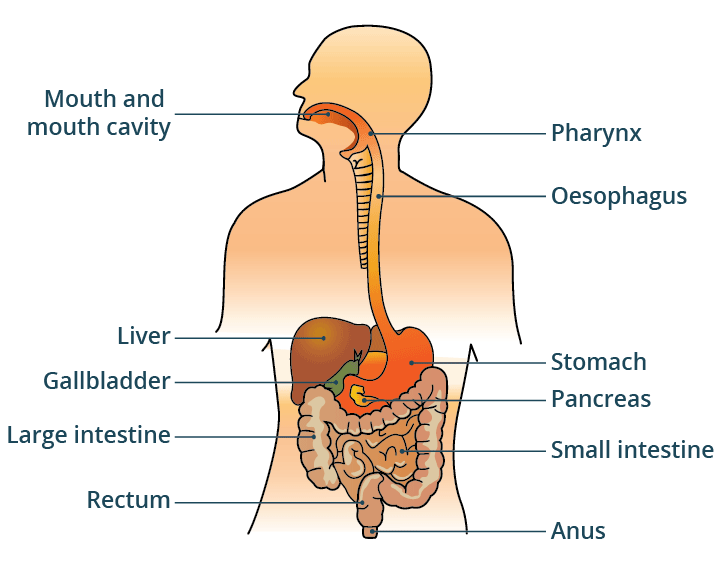
The digestive tract is essentially one long tube. The order of the structures, beginning
with the mouth, is
A) pharynx, esophagus, stomach, small intestine, large intestine.
B) esophagus, pharynx, stomach, small intestine, large intestine.
C) pharynx, esophagus, stomach, large intestine, small intestine.
D) esophagus, stomach, pharynx, small intestine, large intestine.
E) pharynx, stomach, esophagus, small intestine, large intestine.
A
Which of the following helminthic diseases is a common infestation found in the southeastern United States?
A) Enterobius vermicularis
B) Ascaris lumbricoides
C) Taenia saginata
D) Trichuris trichiura
E) Echinococcus granulosus
B
Poultry products are a likely source of infection by
A) Helicobacter pylori.
B) Salmonella enterica.
C) Vibrio cholerae.
D) Shigella spp.
E) Clostridium perfringens.
B
All of the following infections can result from drinking contaminated water EXCEPT
A) Cyclospora infection.
B) giardiasis.
C) trichinellosis.
D) cholera.
E) cryptosporidiosis.
C
.·:*¨ ✘♚✘ ¨*:·..·:*¨ ✘♚✘ ¨*:·.
Trichinellosis is acquired by eating undercooked pork or wild game, not drinking contaminated water.
The parasite forms cysts in muscle after ingestion of infected meat.
Which of the following organisms is shed in the feces of humans and animals, including beavers, and can contaminate water?
A) Giardia lamblia
B) Escherichia coli
C) Taenia spp.
D) Vibrio parahaemolyticus
E) Entamoeba histolytica
A
.·:*¨ ✘♚✘ ¨*:·..·:*¨ ✘♚✘ ¨*:·.
beavers mess with lumbar and lamblia sounds like lumbar
In humans, beef tapeworm infestations are acquired by ingesting
A) the eggs of Taenia saginata.
B) segments of Taenia solium tapeworms.
C) water contaminated with Diphyllobothrium latum eggs.
D) cysticerci of Taenia saginata in undercooked meat.
E) cysticerci of Taenia solium in undercooked meat.
D
Which of the following statements about staphylococcal food poisoning is FALSE?
A) It is caused by ingesting an enterotoxin.
B) It can be prevented by adequate refrigeration of food.
C) It can be prevented by heating foods to 50°C for 15 minutes.
D) It is treated by replacing water and electrolytes.
E) It is characterized by rapid onset and short duration of symptoms.
C
.·:*¨ ✘♚✘ ¨*:·..·:*¨ ✘♚✘ ¨*:·.
toxins cannot be destroyed even if heated
The most common cause of traveler's diarrhea is
A) Shigella spp.
B) Salmonella enterica.
C) Giardia lamblia.
D) Escherichia coli.
E) Campylobacter jejuni.
D
.·:*¨ ✘♚✘ ¨*:·..·:*¨ ✘♚✘ ¨*:·.
when in doubt click E. Coli
Acute gastroenteritis that occurs after an incubation period of two to three days,
persists for about a week, and commonly affects children is probably caused by
A) Giardia.
B) rotavirus.
C) Salmonella.
D) Staphylococcus aureus.
E) Trichinella.
B
Which of the following is mismatched?
A) Echinococcus granulosus – most benign of human tapeworm infections
B) Taenia solium – cysticerosis
C) trichinellosis – humans eat larva of parasite in undercooked meat
D) pinworm infestation – humans ingest parasite's eggs
E) hookworm infestation – heavy infections may cause pica
A
Thorough cooking of food will prevent all of the following EXCEPT
A) trichinellosis.
B) beef tapeworm.
C) staphylococcal food poisoning.
D) salmonellosis.
E) shigellosis.
C
.·:*¨ ✘♚✘ ¨*:·..·:*¨ ✘♚✘ ¨*:·.
heat will not kill food poisoning!
Most of the normal microbiota of the digestive system are found in the
A) mouth.
B) stomach.
C) stomach and small intestine.
D) small intestine and large intestine.
E) accessory structures.
D
Gums bleeding while brushing one's teeth is most commonly associated with
A) halitosis.
B) cavities.
C) gingivitis.
D) periodontitis.
E) trench mouth.
C
Typhoid fever differs from salmonellosis in that in typhoid fever
A) the microorganisms multiply within macrophages.
B) the organism is only spread in the feces of humans.
C) the incubation period is much shorter.
D) the organism first invades the intestinal mucosa.
E) infection occurs due to ingestion of endospores.
B
Which of the following organisms is likely to be transmitted via contaminated
shrimp?
A) Trichinella spiralis
B) Vibrio parahaemolyticus
C) Giardia lamblia
D) Clostridium perfringens
E) Staphylococcus aureus
B
.·:*¨ ✘♚✘ ¨*:·..·:*¨ ✘♚✘ ¨*:·.
when shrimp “rides the wave” it looks like they are VIRBRating
Which of the following organisms is likely to be transmitted via undercooked pork and horse?
A) Salmonella enterica
B) Staphylococcus aureus
C) Trichinella spiralis
D) Entamoeba histolytica
E) Shigella spp.
C
.·:*¨ ✘♚✘ ¨*:·..·:*¨ ✘♚✘ ¨*:·.
A) Salmonella enterica ❌ → poultry, eggs, contaminated food (not muscle cyst meat transmission)
B) Staphylococcus aureus ❌ → food poisoning from toxin in improperly handled foods
D) Entamoeba histolytica ❌ → fecal-oral (contaminated water/food), not meat
E) Shigella spp. ❌ → fecal-oral spread, person-to-person or contaminated food/water
A vaccine to provide active immunity to HBV is prepared from
A) viruses grown in tissue culture.
B) genetically modified yeast.
C) pooled gamma globulin.
D) viruses grown in embryonated eggs.
E) viral particles in patients.
B
Aflatoxin is a(n) associated with ingestion of contaminated .
A) mycotoxin; peanuts
B) mycotoxin; rye or other cereal grains
C) enterotoxin; peanuts
D) enterotoxin; rye or other cereal grains
E) endotoxin; peanuts
A
Which of the following causes inflammation of the liver?
A) Salmonella enterica
B) Shigella spp.
C) hepatitis A virus
D) Vibrio cholerae
E) Escherichia coli
C
"Rice water stools" are characteristic of
A) salmonellosis.
B) cholera.
C) bacillary dysentery.
D) amebic dysentery.
E) tapeworm infestation.
B
Epidemics related to bacterial infection of the digestive system are typically caused by
A) biological vectors.
B) contaminated food and water.
C) unpasteurized milk.
D) the respiratory route.
E) exposure to contaminated soil.
B
Many bacterial infections of the lower digestive tract are treated with
A) antitoxin.
B) penicillin.
C) water and electrolytes.
D) quinacrine.
E) thorough cooking.
C
Dental plaque is an example of
A) a pellicle.
B) a biofilm.
C) gingivitis.
D) dentin.
E) tooth enamel.
B
Which of the following is mismatched?
A) ergot – gangrene
B) Salmonella endotoxin – lyses red blood cells
C) Vibrio enterotoxin – secretion of Cl-, K+, and H2O
D) aflatoxin – liver cancer
E) shiga toxin – tissue destruction
B
Bacterial intoxications differ from bacterial infections of the digestive system in that
intoxications
A) are transmitted via contaminated water.
B) are more severe.
C) have shorter incubation times.
D) are treated with antibiotics.
E) are accompanied by high fever.
C
The most common mode of HAV transmission is
A) contamination of food during preparation.
B) respiratory route.
C) blood transfusion.
D) contaminated hypodermic needles.
E) airborne.
A
Which of the following correctly lists the stages of tooth decay?
A) plaque accumulation, destruction of enamel, advancement of decay through enamel,
decay in dentin, decay in tooth pulp
B) decay in dentin, plaque accumulation, destruction of enamel, advancement of decay
through enamel, decay in tooth pulp
C) plaque accumulation, destruction of enamel, decay in tooth pulp, advancement of
decay through enamel, decay in dentin
D) destruction of enamel, advancement of decay through enamel, plaque accumulation,
decay in dentin, decay in tooth pulp
E) destruction of enamel, plaque accumulation, advancement of decay through enamel,
decay in dentin, decay in tooth pulp
A
A 38-year-old man had onset of fever, chills, nausea, and myalgia while vacationing on the Gulf of Mexico. On April 29, he had eaten raw oysters and gone wading in the warm coastal waters. On May 2, he was admitted to a hospital because of a fever of 39°C and two circular necrotic lesions on the left leg. He had a history of alcoholic liver disease. He was transferred to the ICU; therapy with antibiotics was initiated. On May 4, he died. Which of the following is the most likely cause?
A) Bacillus cereus
B) Cyclospora cayetanensis
C) Salmonella Typhi
D) Vibrio vulnificus
E) hepatitis C virus
D
Which of the following is included in GALT?
A) thymus
B) Peyer's patches
C) tonsils
D) liver
E) salivary glands
B
.·:*¨ ✘♚✘ ¨*:·..·:*¨ ✘♚✘ ¨*:·.
Gut-Associated Lymphoid Tissue
Peyer’s = Primary Gut immune spot
Microscopic examination of a patient's fecal culture shows spiral bacteria. The bacteria probably belong to the genus
A) Campylobacter jejuni.
B) Escherichia coli.
C) Salmonella Typhi.
D) Shigella spp.
E) Vibrio cholerae.
A
“Campy = Curvy bacteria”
Campylobacter = curved/spiral in stool
Which of the following pertains to typhoid fever?
A) It is typically acquired via ingestion of contaminated eggs.
B) Enterotoxin spreads via the blood.
C) It is caused by several different species of Salmonella.
D) Causative microorganism multiplies in patient phagocytes.
E) It is also called bacillary dysentery.
D
All of the following are gram-negative rods that cause gastroenteritis EXCEPT
A) Clostridium perfringens.
B) Escherichia coli.
C) Salmonella Typhi.
D) Shigella spp.
E) Yersinia enterocolitica.
A
. . • ☆ . ° .• °:. *₊ ° . ☆. . • ☆ . ° .• °:. *₊ ° . ☆
Clostridium perfringens food poisoning is the EXCEPT because it is:
Gram-positive rod
anaerobic
associated with food poisoning (especially improperly reheated meat)
Helicobacter pylori can grow in the stomach because it
A) hides in macrophages.
B) makes a capsule.
C) possesses an enzyme that neutralizes HCl.
D) makes HCl.
E) invades epithelial cells.
C
All of the following are eukaryotic organisms that cause diarrheal disease EXCEPT
A) Cryptosporidium.
B) Cyclospora.
C) Entamoeba.
D) Giardia.
E) Campylobacter.
E
. . • ☆ . ° .• °:. *₊ ° . ☆. . • ☆ . ° .• °:. *₊ ° . ☆
Campylobacteriosis is the EXCEPT because it is:
a bacterium (prokaryote)
All of the following pertain to pinworm infections EXCEPT
A) transmission is typically by contact with fomites or inhalation of eggs.
B) diagnosis is by detecting eggs on transparent tape pressed to the perianal area.
C) all family members living with the patient must also be treated.
D) it is most commonly transmitted by cysts in water.
E) it is a helminth disease.
D
. . • ☆ . ° .• °:. *₊ ° . ☆. . • ☆ . ° .• °:. *₊ ° . ☆
Pinworm spreads by:
ingestion of embryonated eggs
contaminated hands, bedding, clothing, surfaces (fomites)
possible inhalation of eggs that are later swallowed
👉 It does NOT involve cysts in water (that’s typical of protozoa like Giardia).
What is a Dane particle?
A) the chlorine-resistant virus that causes HAV
B) the infectious virion that causes HBV
C) the spherical particles found in serum of patients with HBV
D) the filamentous particles that cause HAV
E) another name for an HBV surface antigen
B
42) Which of the following is mismatched?
A) beef – E. coli O157:H7
B) custard and cream pies – Staphylococcus aureus
C) eggs – Trichinella spiralis
D) chicken – Campylobacter jejuni
E) oysters – Vibrio parahaemolyticus
C
Following a county fair, 160 persons complained of gastrointestinal symptoms. Symptoms included diarrhea (84 percent), abdominal cramps (96 percent), nausea (84 percent), vomiting (82 percent), body aches (50 percent), fever (60 percent; median body temperature = 38.3°C); median duration of illness 6 days (range 10 hr to 13 days).
In Situation 25.1, fecal samples should be cultured for all of the following EXCEPT
A) Salmonella enterica.
B) Shigella spp.
C) Campylobacter jejuni.
D) enteropathogenic Escherichia coli.
E) Giardia lamblia.
E
Following a county fair, 160 persons complained of gastrointestinal symptoms. Symptoms included diarrhea (84 percent), abdominal cramps (96 percent), nausea (84 percent), vomiting (82 percent), body aches (50 percent), fever (60 percent; median body temperature = 38.3°C); median duration of illness 6 days (range 10 hr to 13 days).
In Situation 25.1, fecal samples were found to be negative when cultured. The next step in diagnosing the cause of illness would be
A) to begin antibiotic therapy.
B) blood cultures.
C) microscopic examination of feces for oocysts.
D) microscopic examination of feces for viruses.
E) muscle biopsy.
C
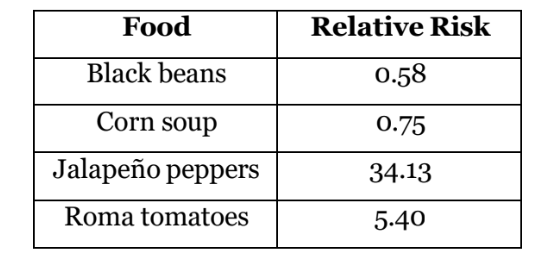
The relative risks shown in Table 25.1 were calculated for foods suspected of transmitting Salmonella. Which food is the most likely source of infection?
A) black beans
B) corn soup
C) jalapeño peppers
D) roma tomatoes
E) The answer cannot be determined based on the information provided.
C
Which structure or component of the small intestine is important to antimicrobial
defense?
A) salivary glands
B) stomach acid
C) Paneth cells
D) gall bladder
E) crevicular fluid
C
. . • ☆ . ° .• °:. *₊ ° . ☆
Paneth cells are located in the crypts of the small intestine and are an important part of innate immunity. These help kill bacteria and protect the intestinal lining.
A rushed homemaker prepared a stew from a large cut of beef but the family only consumed a small portion for dinner. The still-hot large pot was placed in the refrigerator overnight. The next day the stew was warmed for lunch. By the evening the entire family was suffering from varying degrees of diarrhea, abdominal cramping and nausea. You most likely suspect the culprit of this event is
A) Salmonella.
B) H. pylori.
C) Shigella.
D) C. perfringes.
E) B. cereus.
D
Which is true of the Mumps virus?
A) It is transmitted by the fecal-oral route.
B) It typically begins with symptoms of gastroenteritis.
C) The portal of entry is the respiratory route.
D) A component vaccine is part of the MMR.
E) Male sterility occurs in 40% of infections.
C
Which is NOT true of HBV?
A) 1/3 of the world population shows serological evidence of past infection.
B) 5% of acute HBV infections progress to chronic infection.
C) Filamentous particles are not infectious.
D) Acute HBV infection may be subclinical.
E) Individuals infected as adults are the most likely to become carriers of the virus.
E
. . • ☆ . ° .• °:. *₊ ° . ☆
Hepatitis B is much more likely to become chronic when infection occurs in infants and young children, not adults.
A young child received a red-eared slider turtle as a birthday gift. Within a week the child was suffering from a severe gastroenteritis that required a visit to urgent care. What is the child likely suffering from?
A) salmonellosis
B) Campylobacter infection
C) shigellosis
D) hepatitis A infection
E) cholera
A
TRUE OR FALSE
Campylobacter gastroenteritis is the leading cause of foodborne illness in the United States.
TRUE
TRUE OR FALSE
Clostridium perfringens typically causes a self-limiting gastroenteritis.
TRUE
TRUE OR FALSE
Bacterial infections, but not intoxications, can cause diarrhea.
FALSE
TRUE OR FALSE
An outbreak of viral gastroenteritis occurs in a pediatrics ward. Rotavirus is the most likely causative agent.
TRUE
true or false
Aflatoxin poisoning is associated with liver cancer.
true
true or false
Approximately 30 percent of the body's immune system is located in the intestinal tract.
false
TRUE OR FALSE
Humans infected with Enterobius vermicularis may have hydatid cysts within their lungs or other organs.
TRUE
TRUE OR FALSE
Gastroenteritis due to ingestion of food contaminated with Staphylococcus aureus is due to intoxication by enterotoxins.
TRUE
TRUE OR FALSE
EHEC is a major cause of diarrhea in developing countries and may result in the death of small children.
FALSE
TRUE OR FALSE
H. pylori is able to survive the acidic environment of the stomach as a result of adaptations that allow it to increase the pH of the immediate environment.
TRUE
1) The most frequently used portal of entry for pathogens is the
A) mucous membranes of the respiratory tract.
B) mucous membranes of the gastrointestinal tract.
C) skin.
D) parenteral route.
E) All of these portals are used equally.
A
The ability of some microbes, such as Trypanosoma or Giardia to alter their surface molecules and evade destruction by the host's antibodies is called
A) antigenic variation.
B) lysogenic conversion.
C) virulence.
D) cytopathic effect.
E) cytocidal effect.
A
Most pathogens that gain access through the skin
A) can penetrate intact skin.
B) just infect the skin itself.
C) enter through hair follicles and sweat ducts.
D) must adhere first while their invasive factors allow them to penetrate.
E) must be injected.
C
The ID50 is
A) a measure of pathogenicity.
B) the dose that will cause an infection in 50 percent of the test population.
C) the dose that will kill some of the test population.
D) the dose that will cause an infection in some of the test population.
E) the dose that will kill 50 percent of the test population.
B
All of the following contribute to a pathogen's invasiveness EXCEPT
A) toxins.
B) capsules.
C) cell wall components.
D) hyaluronidase.
E) coagulases.
A
Which of the following statements is FALSE?
A) Leukocidins destroy neutrophils.
B) Hemolysins lyse red blood cells.
C) Hyaluronidase breaks down substances between cells.
D) Kinase destroys fibrin clots.
E) Coagulase destroys blood clots.
E
Which of the following statements about exotoxins is generally FALSE?
A) They are more potent than endotoxins.
B) They are composed of proteins.
C) They are resistant to heat.
D) They have specific methods of action.
E) They are produced by gram-positive bacteria.
C
Endotoxins are
A) associated with gram-positive bacteria.
B) molecules that bind nerve cells.
C) part of the gram-negative cell wall.
D) excreted from the cell.
E) A-B toxins.
C
Which of the following is NOT a membrane-disrupting toxin?
A) A-B toxin
B) hemolysin
C) leukocidin
D) streptolysin O
E) streptolysin S
A
Cytopathic effects are changes in host cells due to
A) viral infections.
B) protozoan infections.
C) fungal infections.
D) bacterial infections.
E) helminthic infections.
A
Which disease-associated fungi or fungal characteristics are mismatched?
A) ergot - sclerotia
B) trichothecenes - inhibit protein synthesis
C) Cryptococcus neoformans - capsules
D) Claviceps purpura - aflatoxin
E) Amantia - neurotoxin
D
All of the following are methods of avoiding host antibodies EXCEPT
A) antigenic changes.
B) IgA proteases.
C) invasins.
D) membrane-disrupting toxins.
E) inducing endocytosis.
D
Siderophores are bacterial proteins that compete with the host's
A) antibodies.
B) red blood cells.
C) iron-transport proteins.
D) white blood cells.
E) receptors.
C
The fimbriae of Neisseria gonorrhea and enteropathogenic E. coli are examples of
A) adhesins.
B) ligands.
C) receptors.
D) adhesins and ligands.
E) adhesins, ligands, and receptors.
D
All of the following are examples of entry via the parenteral route EXCEPT
A) injection.
B) bite.
C) surgery.
D) hair follicle.
E) skin cut.
D
Superantigens produce intense immune responses by stimulating lymphocytes to
produce
A) endotoxins.
B) exotoxins.
C) cytokines.
D) leukocidins.
E) interferons.
C
Botulism is caused by ingestion of a proteinaceous exotoxin; therefore, it can easily be prevented by
A) boiling food prior to consumption.
B) administering antibiotics to patients.
C) not eating canned food.
D) preventing fecal contamination of food.
E) filtering food
A
All of the following organisms produce exotoxins EXCEPT
A) Salmonella typhi.
B) Clostridium botulinum.
C) Corynebacterium diphtheriae.
D) Clostridium tetani.
E) Staphylococcus aureus.
A
Which of the following cytopathic effects is cytocidal?
A) inclusion bodies
B) giant cells
C) antigenic changes
D) transformation
E) release of enzymes from lysosomes
E
All of the following are used by bacteria to attach to host cells EXCEPT
A) M protein.
B) ligands.
C) fimbriae.
D) capsules.
E) A-B toxins.
E
Symptoms of protozoan and helminthic diseases are due to
A) tissue damage due to growth of the parasite on the tissues.
B) waste products excreted by the parasite.
C) products released from damaged tissues.
D) tissue damage due to growth of the parasite on the tissues and waste products excreted by the parasite.
E) tissue damage due to growth of the parasite on the tissues, waste products excreted by the parasite, and products released from damaged tissues.
E
Which of the following statements about staphylococcal enterotoxin is FALSE?
A) It causes vomiting.
B) It causes diarrhea.
C) It is an exotoxin.
D) It is produced by Staphylococcus aureus growing in the host's intestines.
E) It is a superantigen.
D
Which of the following contributes to the virulence of a pathogen?
A) numbers of microorganisms that gain access to a host
B) evasion of host defenses
C) toxin production
D) numbers of microorganisms that gain access to a host and evasion of host defenses
E) numbers of microorganisms that gain access to a host, evasion of host defenses, and
toxin production
E
Lysogenic bacteriophages contribute to bacterial virulence because bacteriophages
A) give new gene sequences to the host bacteria.
B) produce toxins.
C) carry plasmids.
D) kill the bacteria, causing release of endotoxins.
E) kill human cells.
A
. . • ☆ . ° .• °:. *₊ ° . ☆. . • ☆ . ° .• °:. *₊ ° . ☆
lysogenic bacteriophage integrates its DNA into the bacterial genome (forming a prophage). While integrated, it can insert new genes into the bacterium through a process called lysogenic conversion.
“Lysogenic = Lies low, Leaves genes”
Twenty-five people developed symptoms of nausea, vomiting, and diarrhea three to six hours after attending a church picnic where they ate a ham and green bean casserole with cream sauce. The most likely cause of this case of food intoxication is
A) botulinum toxin.
B) aflatoxin.
C) staphylococcal enterotoxin.
D) erythrogenic toxin.
E) cholera toxin.
C
Which of the following statements about M protein is FALSE?
A) It is found on Streptococcus pyogenes.
B) It is found on fimbriae.
C) It is heat- and acid-resistant.
D) It is readily digested by phagocytes.
E) It is a protein.
D
. . • ☆ . ° .• °:. *₊ ° . ☆. . • ☆ . ° .• °:. *₊ ° . ☆
M protein is a major virulence factor of Streptococcus pyogenes. Its main job is to help the bacteria avoid phagocytosis by neutrophils and macrophages.
"M = Makes microbes Miss macrophages"
Symptoms of intense inflammation and shock occur in some gram-positive bacterial
infections due to
A) A-B toxins.
B) lipid A.
C) membrane-disrupting toxins.
D) superantigens.
E) erythrogenic toxin.
D
Which of the following is an example of direct damage due to bacterial infection?
A) the uncontrolled muscle contractions in Clostridium tetani infection
B) the invasion and lysis of intestinal cells by E. coli
C) the hemolysis of red blood cells in a staphylococcal infection
D) the fever, nausea, and low blood pressure in a Salmonella infection
E) the excessive secretion of fluids in a Vibrio cholera infection
B
Polio is transmitted by ingestion of water contaminated with feces containing polio virus. What portal of entry does polio virus use?
A) skin only
B) parenteral only
C) mucous membranes only
D) skin and parenteral
E) skin, parenteral, and mucous membranes
C
All of the following bacteria release endotoxin EXCEPT
A) Clostridium botulinum.
B) Salmonella Typhi.
C) Neisseria meningitidis.
D) Proteus vulgaris.
E) Haemophilus influenzae.
A
Cholera toxin polypeptide A binds to surface gangliosides on target cells. If the gangliosides were removed,
A) polypeptide A would bind to target cells.
B) polypeptide A would enter the cells.
C) polypeptide B would not be able to enter the cells.
D) Vibrio would not produce cholera toxin.
E) Vibrio would bind to target cells.
C
Bacteria such as E. coli and Salmonella produce invasins that bind host cells, thus causing the cells to
A) release TNF.
B) produce iron-binding proteins.
C) engulf the bacteria.
D) destroy the bacteria.
E) release cytokines.
C
.·:*¨ ✘♚✘ ¨*:·..·:*¨ ✘♚✘ ¨*:·.
Which of the following mechanisms is used by gram-negative bacteria to cross the blood-brain barrier?
A) producing fimbriae
B) inducing endocytosis
C) producing toxins
D) inducing TNF
E) antigenic variation
D
Injectable drugs are tested for endotoxins by
A) the Limulus amoebocyte lysate test.
B) counting the viable bacteria.
C) filtering out the cells.
D) looking for turbidity.
E) culturing bacteria.
A
Endotoxins in sterile injectable drugs could cause
A) infection.
B) septic shock symptoms.
C) giant cell formation.
D) nerve damage.
E) no damage, because they are sterile.
B
Gram-negative septic shock results from the following events. What is the second step?
A) Body temperature is reset in the hypothalamus.
B) Fever occurs.
C) IL-1 is released.
D) LPS is released from gram-negative bacteria.
E) Phagocytes ingest gram-negative bacteria.
D
Antibiotics can lead to septic shock if used to treat
A) viral infections.
B) gram-negative bacterial infections.
C) gram-positive bacterial infections.
D) protozoan infections.
E) helminth infestations.
B
Which of the following is NOT a cytopathic effect of viruses?
A) cell death
B) host cells fusing to form multinucleated syncytia
C) inclusion bodies forming in the cytoplasm or nucleus
D) increased cell growth
E) toxin production
E
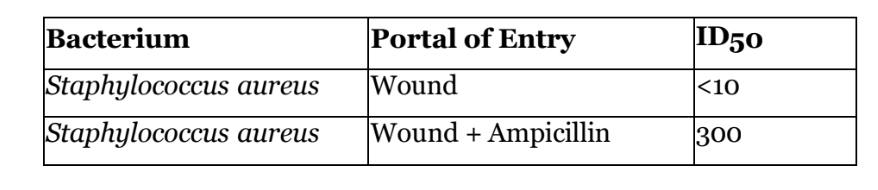
Table 15.1 shows the ID50 for Staphylococcus aureus in wounds with and without the administration of ampicillin before surgery. Based on the data, the administration of ampicillin before surgery
A) decreases the risk of staphylococcal infection.
B) increases the risk of staphylococcal infection.
C) has no effect on risk of infection.
D) replaces tetracycline.
E) The answer cannot be determined based on the information provided.
A