Trypanosomes - life cycles
 Call Kai
 Learn
Learn Practice Test
 Spaced Repetition
 Match
Match Flashcards
 Knowt Play
1/8

There's no tags or description
Looks like no tags are added yet.
Name | Mastery | Learn | Test | Matching | Spaced | Call with Kai |
|---|
No analytics yet
Send a link to your students to track their progress
9 Terms
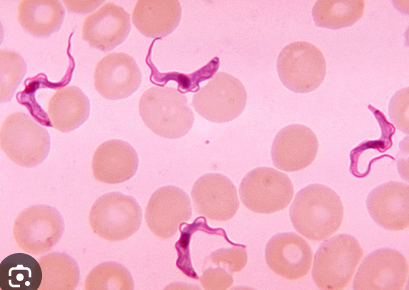
African Trypanosomes
Tsetse fly (DH) injects metacyclic trypomastigotes into human (IH)
Bloodstream trypomastigotes
Trypomastigotes binary fission
Tsetse feeds and ingests trypomastigotes from human
Bloodstream trypomastigotes in the midgut of fly replicate through binary fission
Trypomastigotes leave midgut and transform to epimastigotes
Epimastigotes replicated in salivary gland and then transform back to trypomastigotes.
Anterior station
Trypomastigotes
Kinetoplast near the posterior end.
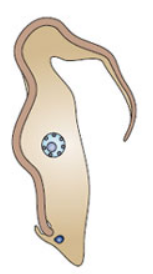
Epimastigotes
Kinetoplast in the middle.
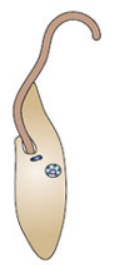
Amastigotes
Kinetoplast but no extending flagella.
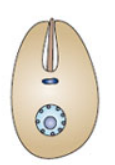
Promastigote
Kinetoplast near the anterior end.
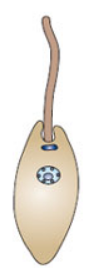
Anterior station
Transmission via bite (oral). Eg. African trypanosomes transmitted by tsetse proboscis.
Posterior station
Transmission via fecal route (poop). Eg. American trypanosomes where the bug poos out the trypomastigotes.
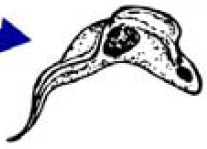
American trypanosomes - Trypanosoma cruzi: life cycle.
Bug injects trypomastigotes from bloodmeal.
Trypomastigotes transform into amastigotes in the cells
Amastigotes multiply by binary fission
Amastigote transform into trypomastigotes and burst out of the bloodstream
Bug takes blood meal and ingests trypomastigotes
Epimastigotes in midgut
Multiply in midgut
Metacyclic trypomastigotes in hindgut (posterior station)
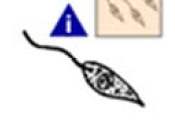
Leishmania life cycle
Sandfly takes blood meal (injects promastigote into the skin)
Promastigotes in the macrophages or other mononuclear phagocytotic cells.
Promastigotes transform to amastigotes
Amastigotes multiply in cells and infect others
Sandfly takes blood meal (ingests macrophages with amastigotes)
Ingestion of parasitized cell
Amastigotes transform to promastigote stage in the gut
Divide and migrate to proboscis.
Anterior station.