Music and Mind Psychology Exam 3
 Call Kai
 Learn
Learn Practice Test
 Spaced Repetition
 Match
Match Flashcards
 Knowt Play
1/34

There's no tags or description
Looks like no tags are added yet.
Name | Mastery | Learn | Test | Matching | Spaced | Call with Kai |
|---|
No analytics yet
Send a link to your students to track their progress
35 Terms
modularity of music and brain structure
the idea that there are specific regions of the brain that are responsible for certain things, like rhythm, meter, spectrum, contour
distributed mechanism of music and brain structure
the concept that music processing involves a network of interconnected brain areas rather than isolated regions
Broca’s aphasia vs Wernicke’s aphasia
Broca: deficit in speech production, telegraphic speech, but comprehension is retained
Wernicke’s: comprehension deficits, but speech production is fluent but nonsensical
Temporal lobectomy
Procedure removing part of the temporal lobe, often used to treat epilepsy/seizures. Those with right temporal lobectomy showed greater deficits on the standardized test of musical ability, suggesting that the right hemisphere has a specialization for music
How does the auditory pathway work ?
Each cerebral hemisphere receives input from each ear, but each ear projects more strongly to the opposite hemisphere.
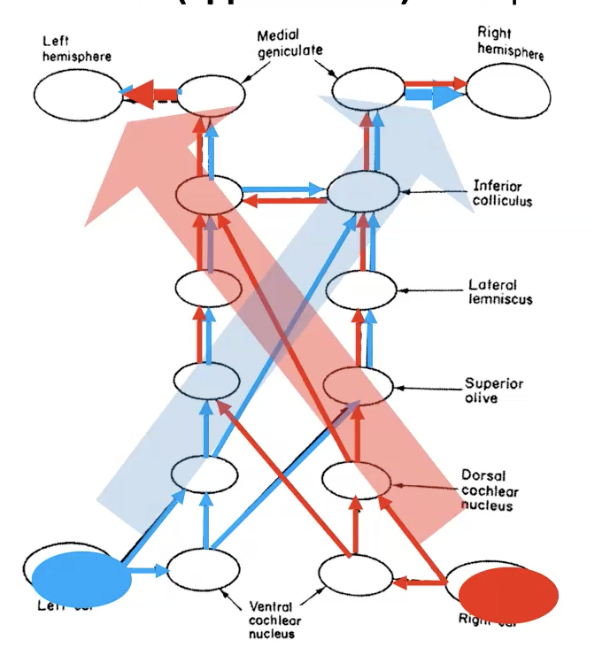
ex: language is a left brain thing, but music is on the right
dichotic listening experiment
There was a significant ear advantage when scientists asked participants “have you listened to this melody before?”. There was in fact a preference to the right ear for music recognition, but a significant advantage to the left ear for humming.
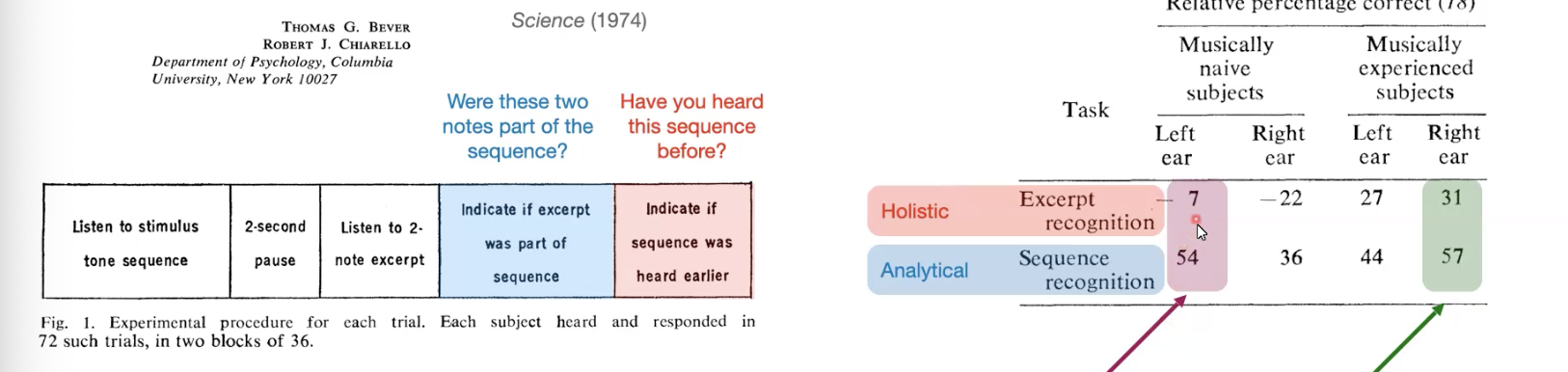
Explain cerebral dominance in musicians and nonmusicians
Musicians and Nonmusicians were given two tasks: (1) to listen to a melody and then 2 more notes and decide if those notes were part of the sequence or not and (2) have you heard this sequence before
Musically untrained listeners showed a left ear(right brain) advantage whereas Musically trained listeners show a right ear (left brain) advantage, especially in a task that requires analytically processing.
You may have heart that language is a left brain thing, but music is on the right. Where do these claims come from? How strong is the evidence?
The studies show that there are very small but statistically significant effects. While trends do support these claims, the evidence does not support categorical all-or-nothing differences
Structural neuroimaging vs functional neuroimaging
structural - the particular shape, size, of structures in the brain (MRI)
functional - the activity or responses of brain or regions of the brain related to particular process, task, ability, state. The brain in action (fMRI, PET, EEG, MEG)
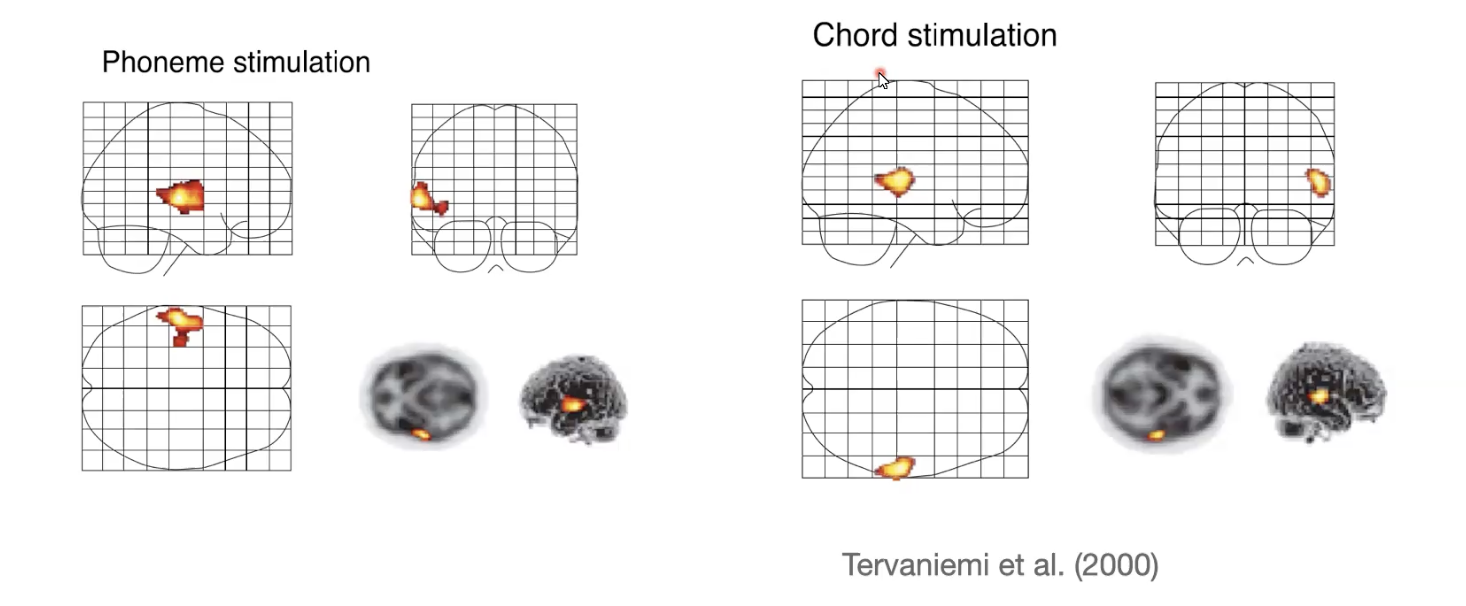
Localizing musical processing with PET experiment
Whereas the processing of phonemes (speech) is localized in the left hemisphere, the processing of chords is localized in the right hemisphere. This study shows different regions of activity of language and a musical task - shows some lateralization of function
What is congenital amusia
A lifelong deficit in melody perception and cannot be explained by hearing loss, brain damage, intellectual deficiencies, or lack of musical exposure
How can you assess amusia?
Six subtests:
Scale/Ker: in or out of key
Contour: step up or down in melody
Melodic interval: size of steps
Rhythm: timing ot notes
Meter: grouping of notes
Memory
Beat deafness example
Subject Mathieu was asked to tap to the beat of a metronome and to music. He can move in sync to a simple metronome, but can’t find the beat in the context of real music. This showed selective musical deficits related to entrainment to rhythms
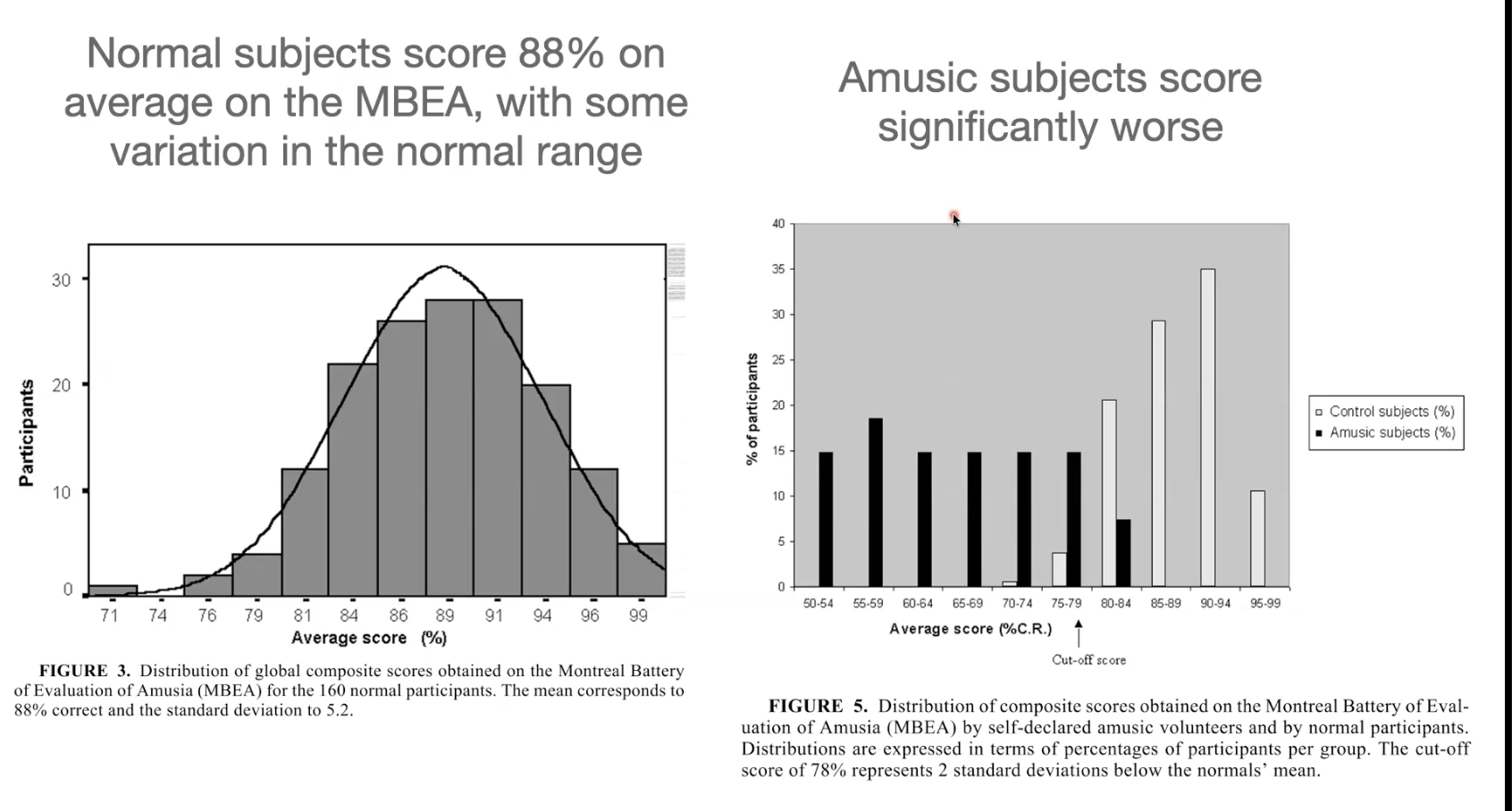
Amusics perform very differently on the MBEA, why?
Amusia is related to differences in brain structure. Figures show a structural study. People with amusia have increased cortical thickness in IFG relative to control group. Cortical thickness is negatively correlated with amusia test scores. People with lower scores have thicker cortex, and vice versa.
There is also some difference in activity - Amusics can hear properly (no auditory deficit), but there are particular parts of the brain that show decreased activity.
Do amusics show deficits with speech
Largely no - amusics performed similar to controls, but only for speech. This suggests domain specific deficits.
“He speaks french?” vs “He speaks French”. There was no difference in comprehension, but as soon as the words disappear and the tone remains, the comprehension disappears as well.
However, there was a study that argued it was more of a general deficit because amusic subjects struggled with tone discrimination in tonal languages like mandarin
Is there a genetic component to amusia?
Yes! 39% of first-degree relatives have the same cognitive disorder, whereas only 3% have it in the control families.
Monozygotic (identical) twins are more similar than dizygotic twins
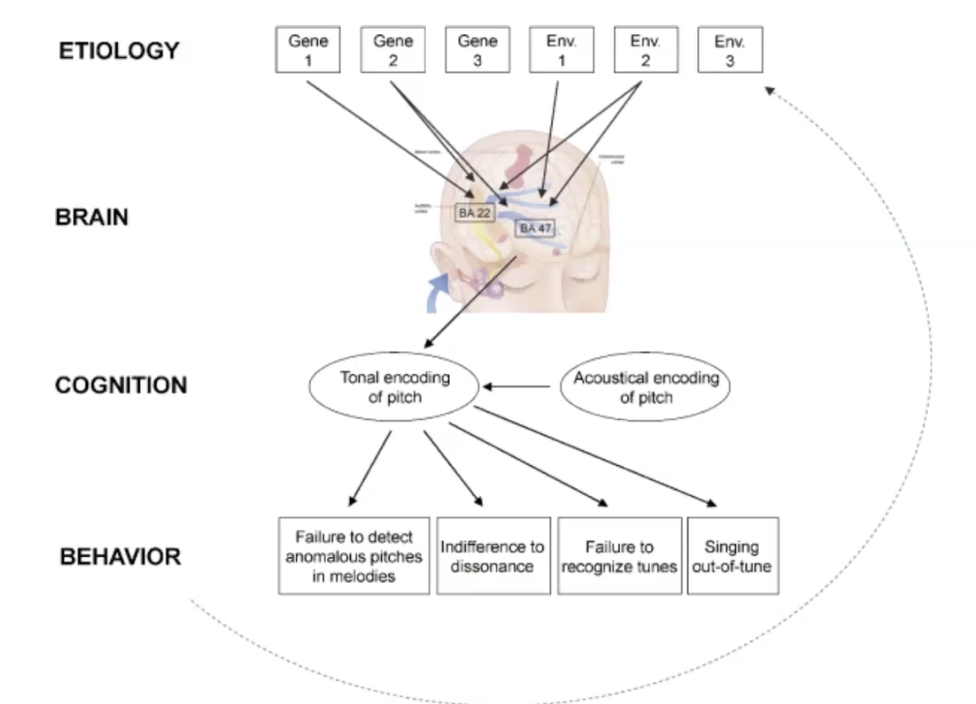
How does nature / nurture combine in amusia?
Genes and environment affect brain structure
Brain structure affects cognitive abilities
Cognitive abilities affect behavior
Behavior affects environment
Explain the model / feedback loop
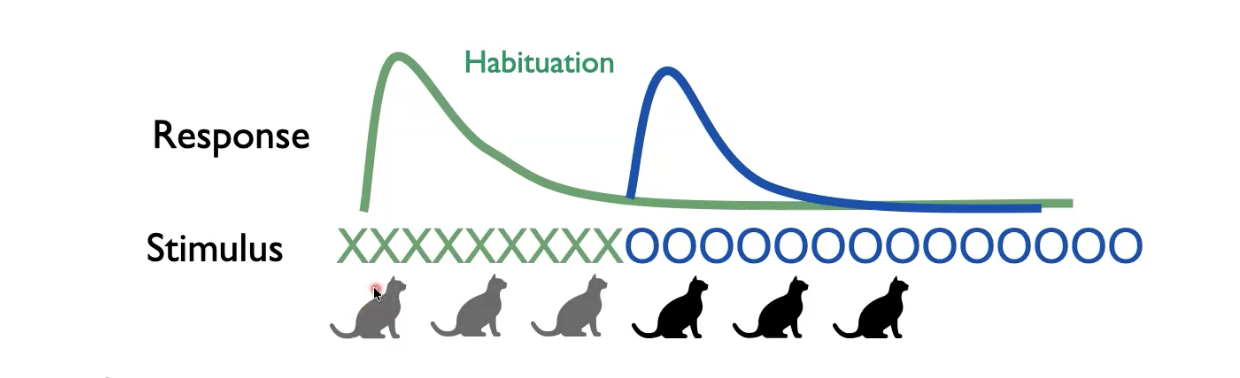
Explain the Habituation Paradigm
Subject shows an initial response to a stimulus but over the course of repetition the response is weakened (habituates). The stimulus is then changed slightly, and if the change is detected the response is increased.
This is how we test if babies can tell the difference between two stimuli
explain the Cat in the Hat study
Expectant mothers were recorded reading three books, and continued to read book daily for the last 6 ½ weeks of pregnancy. In HAS (sucking) paradigm, newborns preferred to hear recording of the story that was read prenatally.
What are the ways to measure infant perception?
HAS - High Amplitude Suction is when a baby sucks on a tube which will turn on a stimulus. They learn they can control their environment. Infants would suck harder in order to see visual stimulus.
Head-turn preference - a light flashes on one side orienting the infant, as long as that infant is looking, an auditory stimulus is presented and continues to play as long as the infant is looking. The looking time for each stimulus is preferred
Prerequisites to understanding music
be able to hear
be able to discriminate btwn different frequencies
be able to perceive patterns across different frequencies (melodies)
be able to distinguish between consonant and dissonance combinations of tones
be able to perceive temporal structure in patterns (rhythm and meter)
What do EEG and ERP measure in babies?
EEG - electroencephalography, general class of recording brainwaves, continuous measures (like sleep)
ERP - event-related potentials, is a time locked activity tied to an event or process
Can babies hear the differences between frequencies?
infants are able to discriminate frequency before birth, but don’t reach adult levels until 8-10 yrs old. By 2 months of age frequency discrimination is sufficient for the perception of musical structure.
8 to 11 month infants were tested on their ability to detect different kinds of melodic changes. Changes in which the contour was preserved were the most difficult to detect, suggesting that infants are primarily sensitive to contour
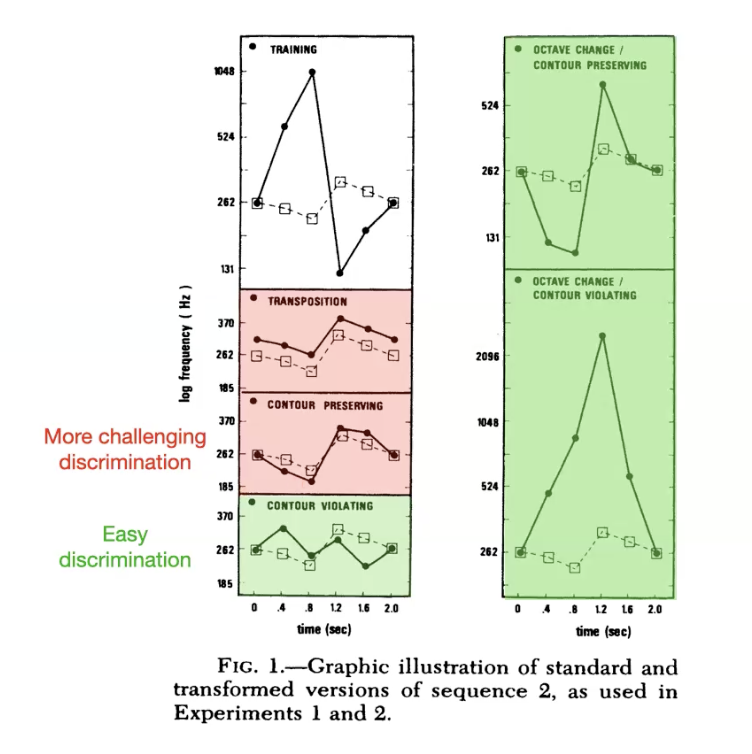
Why are babies so sensitive to contour?
contour is a large part of a baby’s auditory experience. Infant directed speech is characterized by exaggerate contour
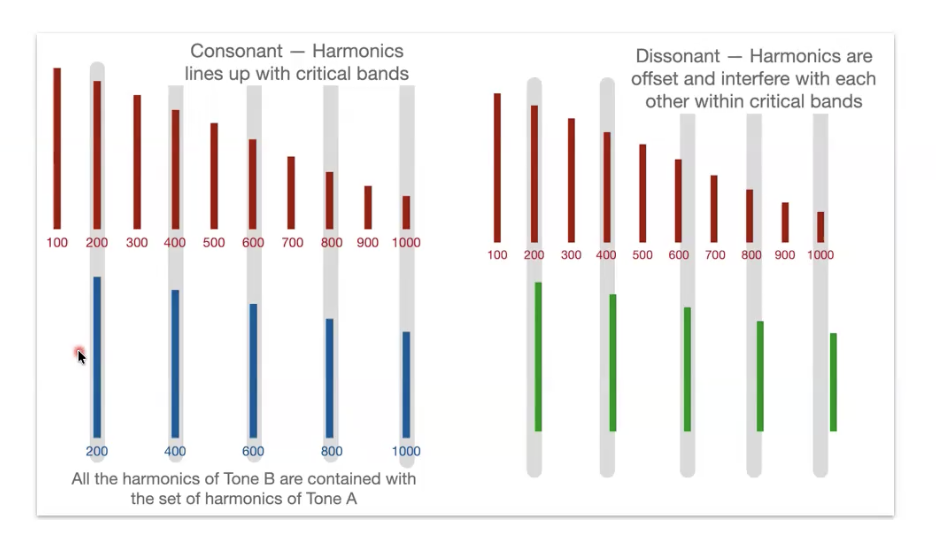
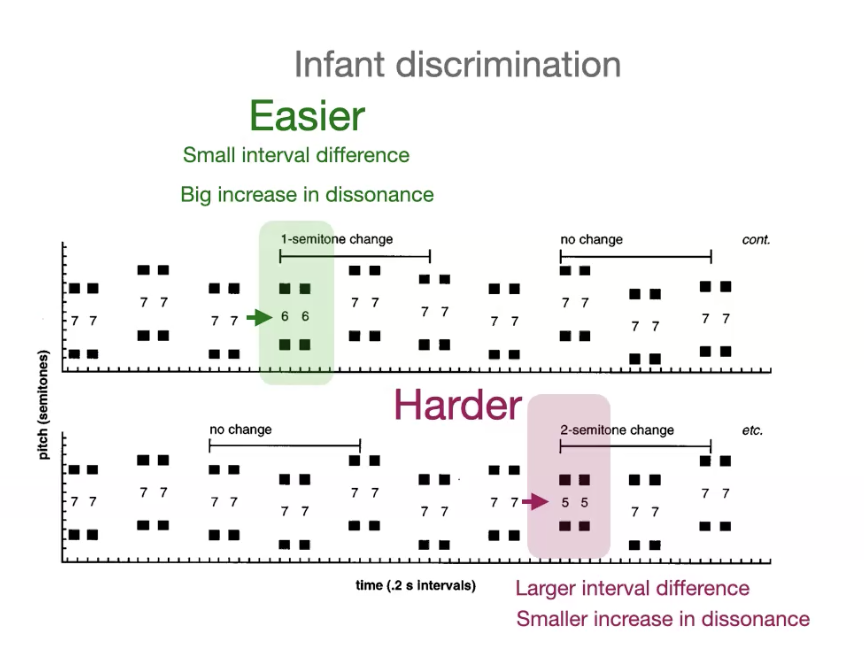
Do infants perceive consonance and dissonance? Do simple integer ratios matter to infants?
changes with bigger changes in dissonance were easier to detect suggesting that the perception of consonant / dissonant is already developed in infancy. Infants perceive dissonance similarly to adults.
Infants will look longer for music that is consonant during head-turn preference procedure
Simple integer ratios do matter. Infants can better detect a mistuning of consonant intervals than a dissonant interval. They can also better detect mistuning on consonant intervals than a dissonant interval.
How does movement to the beat physically develop?
Infants 5-24 mo engage in more rhythmic movement in response to music rather than speech, meaning they are predisposed to move rhythmically and also enjoy it.
Infants prefer an auditory rhythm that matches the way they felt themselves bounced. Vestibular sensation interacts with auditory encoding of rhythm.
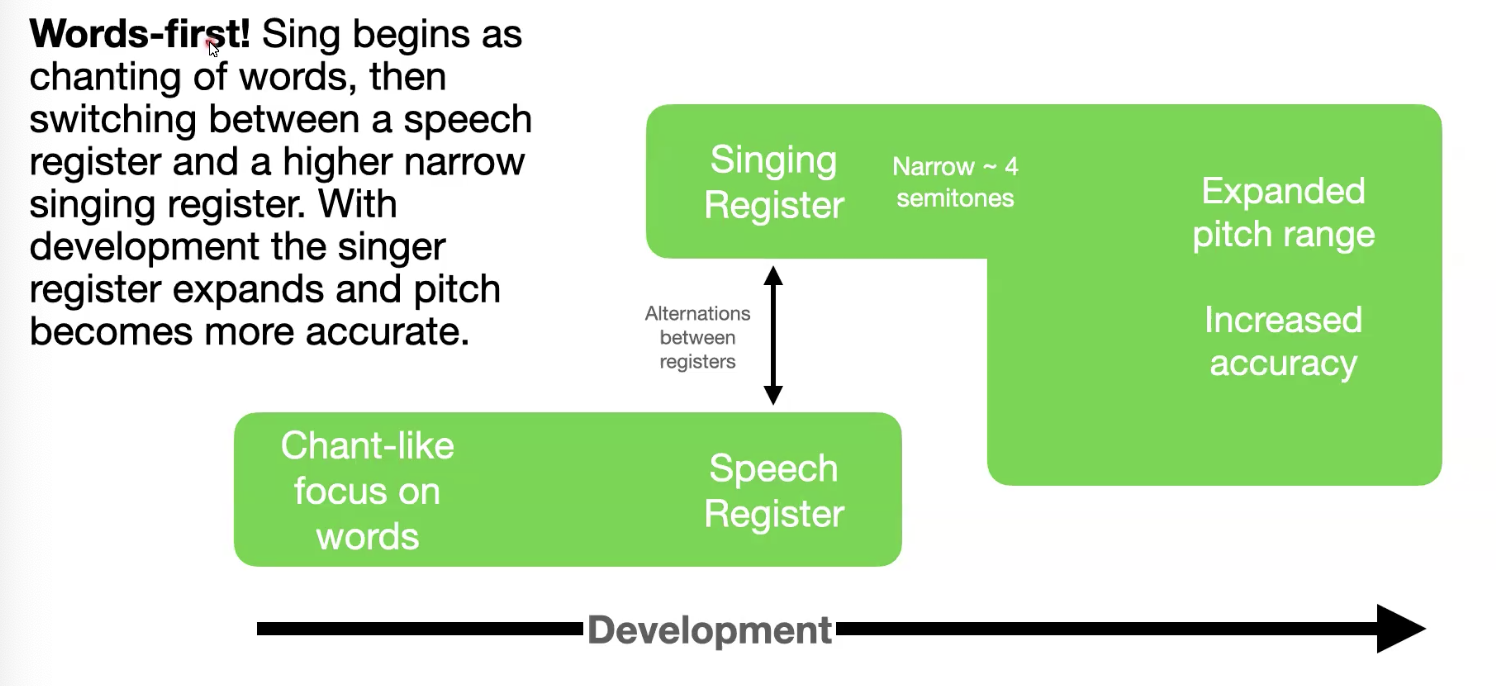
What is the Words first theory of children producing music? What is the counter argument?
singing begins as the chanting of words, switches between singing/speech register, to an expanded pitch range with increased accuracy
A study of north american adults showed that they can accurately identify icelandic toddlers rendition of familiar melodies (“Twinkle”), which challenges the words-first account of singing development.
What are the development trends of body movement to music?
cephalocaudal - head to foot (head moves before the feet)
proximodistal - near to far (trunk moves before the limbs
What is meant by talent vs deliberate practice?
Talent - genetic inheritance, abilities are evident early in development, early abilities predict who will excel, a small minority are considered “talented”, domain specific
Deliberate practice - highly structured practice with the explicit goal of improving performance, using tasks designed to address weakness and errors - not simply repetition or playing
Does deliberate practice really affect performance?
Deliberate practice matters for music, sports, and chess, but not as much as many people believe. A meta analysis was done over 88 studies, and it was found that 21% of deliberate practice accounts for the variability in expertise. the remaining percent is likely genetics and talent.
In looking at twin studies, genes account for 26% of variability in music accomplishment. Practice is heritable, but only a small portion of genetic influence on musical accomplishment is related to practice. Genes also influence practice behavior which affect musical ability.
Identical twins are better at music than fraternal twins
shared environment matters
How is the brain structured through experience?
“Neural Darwinism” - We have an overproduction of neurons and synapeses (more than we ultimately need), so there is a competitor process (survival of the fittest) to select the good neurons from the bad.
Caveat: gene mutation appears to be random, but neural growth is at least partly guided by other factors
Neuroplasticity
How the brain changes with development / experience. The following processes occur with experience.
Synaptogenesis - creation of new connections between neurons
Neuronal cell death - continues into adulthood for cortical connections, less useful neurons die while useful ones thrive
Synaptic pruning - useful connections are strengthened, less useful ones are pruned
Myelination - creation fatty sheath around axons which allow action potentials to travel more quickly and efficiently
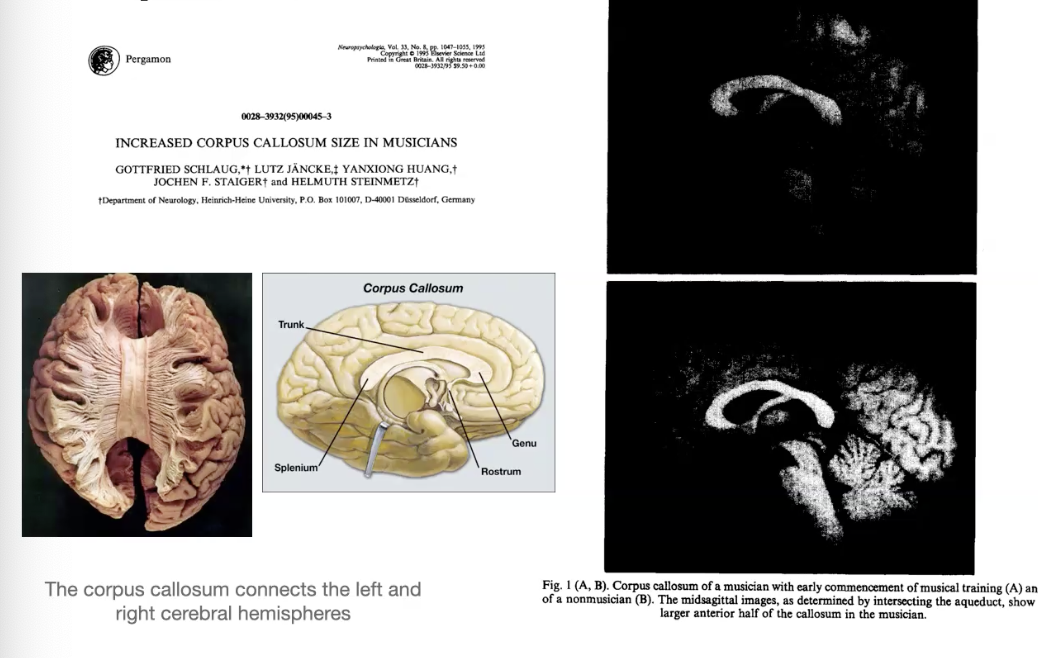
Structural differences in musician’s brains
More communication between cerebral hemispheres
Musicians had larger anterior corpus callosum than nonmusicians
Larger in musicians who started training before 7 years of age than in those who started later
Somatotopic map
Somatosensory cortex contains neurons that receive sensory input from different parts of the body
Cortex is organized as a map of body area
increased cortical representation (more neurons) for areas for which we have greater sensitivity
Homunculus - ugly “little man” based on wilder penfield’s cortical stimulation, which exaggerates body parts based on how much of the cortex is dedicated to a certain body part
explain Functional differences in musician’s brain responses
Musicians show enhanced responses to piano, but not sine tones. Tonotopic maps represent pitch/frequency in auditory cortex. These maps are larger in musicians than non musicians. There is also a stronger response in musicians that begin training early.