WGU C211 - Global Economics for Managers, Brian Final
 Call Kai
 Learn
Learn Practice Test
 Spaced Repetition
 Match
Match Flashcards
 Knowt Play
1/290

There's no tags or description
Looks like no tags are added yet.
Name | Mastery | Learn | Test | Matching | Spaced | Call with Kai |
|---|
No analytics yet
Send a link to your students to track their progress
291 Terms
3 views on globalization
Globalization is when you do business internationally
New, Evolutionary, and Pendulum
"New" view on globalization
A force sweeping through the world in recent times.
Which view claims that the phenomenon of globalization was initially driven by the desire of Western economies to exploit their power through multinational enterprises?
"Evolutionary" view on globalization
A long-run historical evolution since the dawn of human history
"Pendulum" view on globalization
One that swings from one extreme to another from time to time.
Most popular
Foreign Direct Investment (FDI)
Foreign direct investments (FDI) are investments made by one company into another company that is located in another country.
3 Different political views on FDI
Radical - radical view is hostile to FDI
Free market - free market view calls for minimum or unrestricted government restriction in FDI. Leads to a win-win situation for both home and host countries.
Pragmatic nationalism - most countries practice pragmatic nationalism, weighing the benefits and costs of FDI and only using it when benefits outweigh the costs.
What are the benefits to a country receiving Foreign Direct Investment?
Capital Inflow
Technology Spillover
Advanced Management Know-How
Job creation
What costs exist in a country when they receive Foreign Direct Investment?
1. Loss of Sovereignty (power),
2. Adverse effects on competition (drives domestic firms out of business)
3. Capital outflow
How do resources and capabilities influence the competitive dynamics of a business?
A firm's resources and capabilities must create value compared to its competition.
A firms resources need to bring:
Value, company resources must create value, patents are an example.
Rarity, the rarer, and more desired the more of an advantage it has.
Imitability, how easy is it to imitate your competition?
Organization, some companies are better at answering challenges from competitors.
Classical theories of international trade*
The major theories of international trade that were advanced before the 20th century, they consist of:
1. Mercantilism,
2. Absolute advantage
3. Comparative advantage
Classic Theory says things don't change, they are static.
How does resource similarity impact competitive dynamics?
Firms with a high degree of similarity are likely to make similar competitive decisions.
(Starbuck's instant coffee & McDonald's iced coffee, if one increases the price because of a coffee shortage the other will likely also)
What are modern trade theories of international trade?
Modern theories account for changes in patterns over time whereas classical theories are static.
Modern theories include
(1) Product life cycles,
(2) Strategic trade
(3) National competitive advantage or "Diamond"
What is the classical theory view of international trade regarding change?
Static, not changing
What is absolute advantage?
The economic advantage one nation enjoys that is superior to other nations, which nation is best at producing a particular good?
Trade can be a win/win
Absolute advantage is achieved when one producer is able to produce a competitive product using fewer resources, or the same resources in less time.
For example, Smith argued that because of better soil, water, and weather, Portugal enjoyed an absolute advantage over England in the production of grapes and wines. And England enjoyed an absolute advantage over Portugal as England produced more wool. If they trade, they would both benefit. international trade is not a zero-sum game as suggested by mercantilism. It is a win-win game. there are net gains from trade based on absolute advantage.
Comparative advantage
The ability of an individual or group to carry out a particular economic activity (such as making a specific product) more efficiently than another activity.
Comparative advantage is an economy's ability to produce a particular good or service at a lower opportunity cost than its trading partners.
Hypothetically, say that Michael Jordan could paint his house in eight hours. In those same eight hours, though, he could also take part in the filming of a television commercial which would earn him $50,000. By contrast, Jordan's neighbor Joe could paint the house in 10 hours. In that same period of time, he could work at a fast-food restaurant and earn $100.
In this example, Joe has a comparative advantage, even though Michael Jordan could paint the house faster and better. The best trade would be for Michael Jordan to film a television commercial and pay Joe to paint his house. So long as Michael Jordan makes the expected $50,000 and Joe earns more than $100, the trade is a winner. Owing to their diversity of skills, Michael Jordan and Joe would likely find this to be the best arrangement for their mutual benefit.
What is mercantilism?
It is the first recorded theory.
A theory that suggests that the wealth of the world (gold/sliver) is fixed and that a nation that exports more and imports less will be richer.
Mercantilism trade theory states that viewed international trade as a zero-sum game. A nation becomes richer by exporting more than it imports.
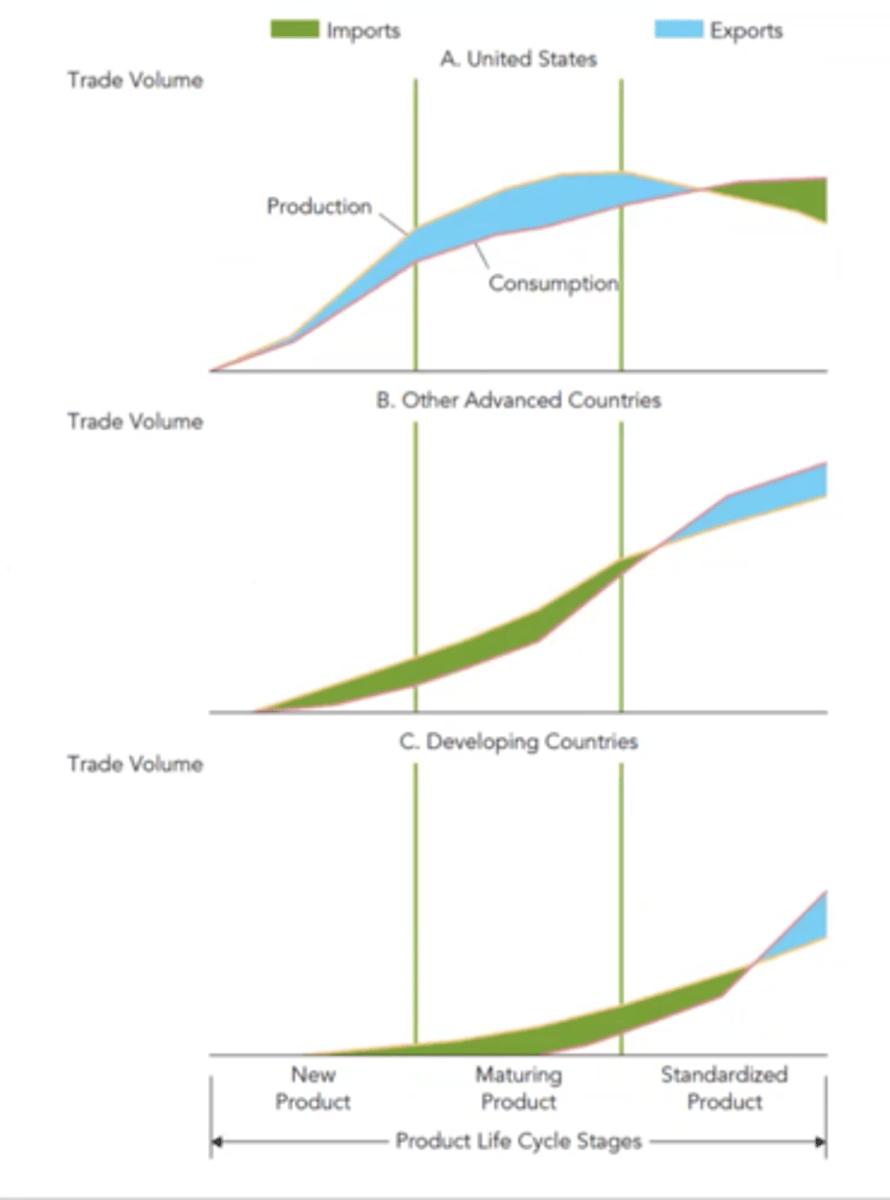
Features of the product life cycle?
The first dynamic theory.
New: production of a new product (such as a TV) that commands a price premium will concentrate in the United States, which exports to other developed nations.
Maturing Stage: demand and ability to produce growth in other developed nations (such as Australia and Italy), so it is now worthwhile to produce there.
Standardized: (or commoditized). Thus, much production will now move to low-cost developing nations, which export to developed nations. In other words, the comparative advantage may change over time
What is strategic trade theory?
Strategic intervention by governments in certain industries can enhance their odds for international success.
When a government helps an infant industry until it is large enough to compete on its own.
They do NOT believe that unrestricted free trade is in the best interest of all countries.
What are these industries? They tend to be highly capital-intensive, high entry-barrier industries in which domestic firms may have little chance without government assistance.
How are supply and demand related to the exchange rate of a country?
A country's currency is determined by its supply and demand.
Strong demand leads to price hikes; oversupply results in price drops.
Which theory came first mercantilism or modern-day protectionism?
Mercantilism, both state that governments should protect domestic industries from imports
If a company seeks to limit foreign exchange rate fluctuation in the forward direction (they are exporting the product), what is the most effective way to do this?
Currency hedging
What is an international transaction risk?
The exchange rate risk associated with the time delay between entering into a contract and settling it.
The potential for loss associated with fluctuations in the foreign exchange market.
What is hedging?
A transaction, such as forward transactions, that protects traders and investors from exposure to the fluctuations of the spot rate.
What is strategic hedging?
When you spread out your business activities in different currency zones to offset any currency losses that could occur if you were only in one spot (currency diversification)
What are first mover advantages?
Benefits that come to companies that enter the market first.
Proprietary, technological leadership, pre-emption of scarce resources, establishment of entry barriers to late entrants, avoidance of clash with dominant firms at home, relationships with key stakeholders, (such as governments.)
What are late mover advantages?
Benefits that come to companies that enter the market later.
Opportunity to free ride on first-mover investments, Resolution of technological and market uncertainty, First mover's difficulty to adapt to market changes.)
Consider the model of foreign market entries. How is scale-of-entry related/relevant?
Scale of entry is the amount of resources committed to entering a foreign market, should the scale of entry be large or small?
What is a non-equity mode?
Reflects relatively smaller commitments to enter overseas markets.
Determines the firm's MNE (Multinational Enterprise) status.
What is an equity mode?
Mode of entry that indicates a relatively larger, harder-to-reverse commitment into a foreign business.
Determines a firm's MNE status.
How do institutions reduce uncertainty?
They establish "rules of the game" that economic players play by.
What is a regulatory pillar?
The power of governments (laws, regs, rules)
What is a normative pillar?
The mechanism through which norms (unwritten rules of society) influence individual and firm behavior.
They are emotional.
What is a cognitive pillar?
The internalized, taken-for-granted values of beliefs between right/wrong.
Your conscience! What is right and wrong?
For example, what triggered whistleblowers to report Enron's wrongdoing was their belief in what's right and wrong. Essentially, whistleblowers choose to follow their internalized personal beliefs on what is right by overcoming the norm that encourages silence
What is a formal institution?
One that has laws, regulations, and rules
Their primary supportive pillar, the regulatory pillar, is the coercive power of governments.
Examples: Businesses, congress, and churches.
What is an informal institution?
An institution that is defined by norms, cultures, and ethics.
Many societies, for example, have informal institutions regarding courtship and marriage. When and how is it ok to date and marry. No real law but there is an unwritten rule.
What core views lie at the root of the institution-based view on global business and what propositions are the foundation of this view?
It suggests that the success and failure of firms are enabled and constrained by institutions.
(1) Managers and firms rationally pursue their interests and make choices within legal constraints (bounded rationality)
(2) When formal constraints are unclear or fail, informal constraints play a larger role.
The institution based view of global business is grounded upon what?*
The success or failure of your business is enabled or constrained by institutions.
How is global business affected by democracy?
An individual's right to freedom of expression and organization. For example, starting up a firm is an act of economic expression!
How is global business affected by totalitarianism?
Totalitarianism (also known as a dictatorship), which is defined as a political system in which one person or party exercises absolute political control over the population.
These countries often experience wars, riots, protests, chaos, and breakdowns, which result in higher political risk.
Democracy
Citizens elect representatives to govern the country on their behalf.
Totalitarianism
One person exercises absolute political control over the population.
What is civil law?
A law that uses statutes and laws to make legal judgments.
England and much of the world follow this, not the US though.
What is common law?
A legal tradition that comes from previous judicial decisions.
Common law has more flexibility than civil law because judges have to resolve specific disputes based on their interpretation of the law, and such interpretation may give new meaning to the law, which will shape future cases.
The US is Common Law.
Common law is more confrontational, because plaintiffs and defendants, through their lawyers, must argue and help judges to favorably interpret the law largely based on precedents.
Examples are: Nuisance or defamation.
What is theocratic law?
A legal system based on religious teachings.
Examples include Jewish law and Islamic law. Although Jewish law is followed by some elements of the Israeli population, it is not formally embraced by the Israeli government. Islamic law is the only surviving example of a theocratic legal system that is formally practiced by some governments, such as those in Iran and Saudi Arabia
How do civil, common, and theocratic laws compare?
Common law has more flexibility than civil because judges have to resolve issues based on their interpretation of the law.
Civil law has less flexibility because judges only have the power to apply the law.
Theocratic laws follow religious teachings only.
What is a property right?
The legal right to use a resource and to receive income and benefits from it.
A fundamental economic function that legal systems protect.
What is an intellectual property right?
Rights associated with the ownership.
They primarily include rights associated with patents, copyrights, and trademarks.
What is a market based economy*
An economy that is characterized by the "invisible hand" of market forces
Government has a hands-off approach. (laissez-faire)
Specifically, all factors of production should be privately owned. The government should only perform functions that the private sector cannot perform (such as providing roads and defense)
No country has FULLY embraced this principle
There are more market-based economies than command-based economies. TEST QUESTION
What is a command based economy?
One that is defined by a government taking control over all factors of production. It is government-owned or state-owned, and all supply, demand, and pricing are planned by the government.
During the heydays of communism, the former Soviet Union and China approached such an ideal.
What is a mixed economy?
One that has elements of both a market economy and a command economy.
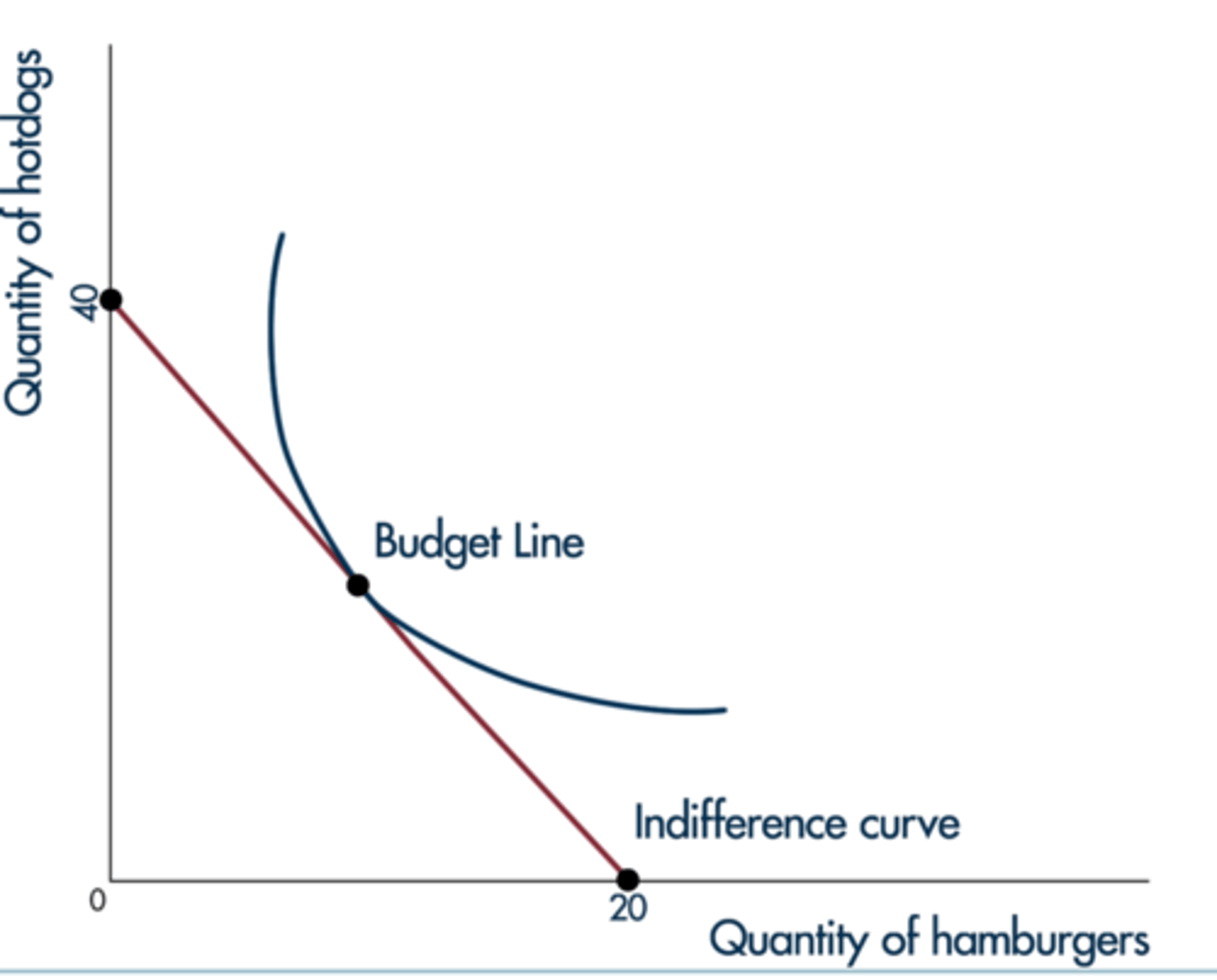
What is an indifference curve?
A curve that shows all the combinations of goods that will make you equally happy.
An indifference curve shows a combination of choices that give a consumer equal satisfaction making the consumer indifferent.
What are four properties of an indifference curve?
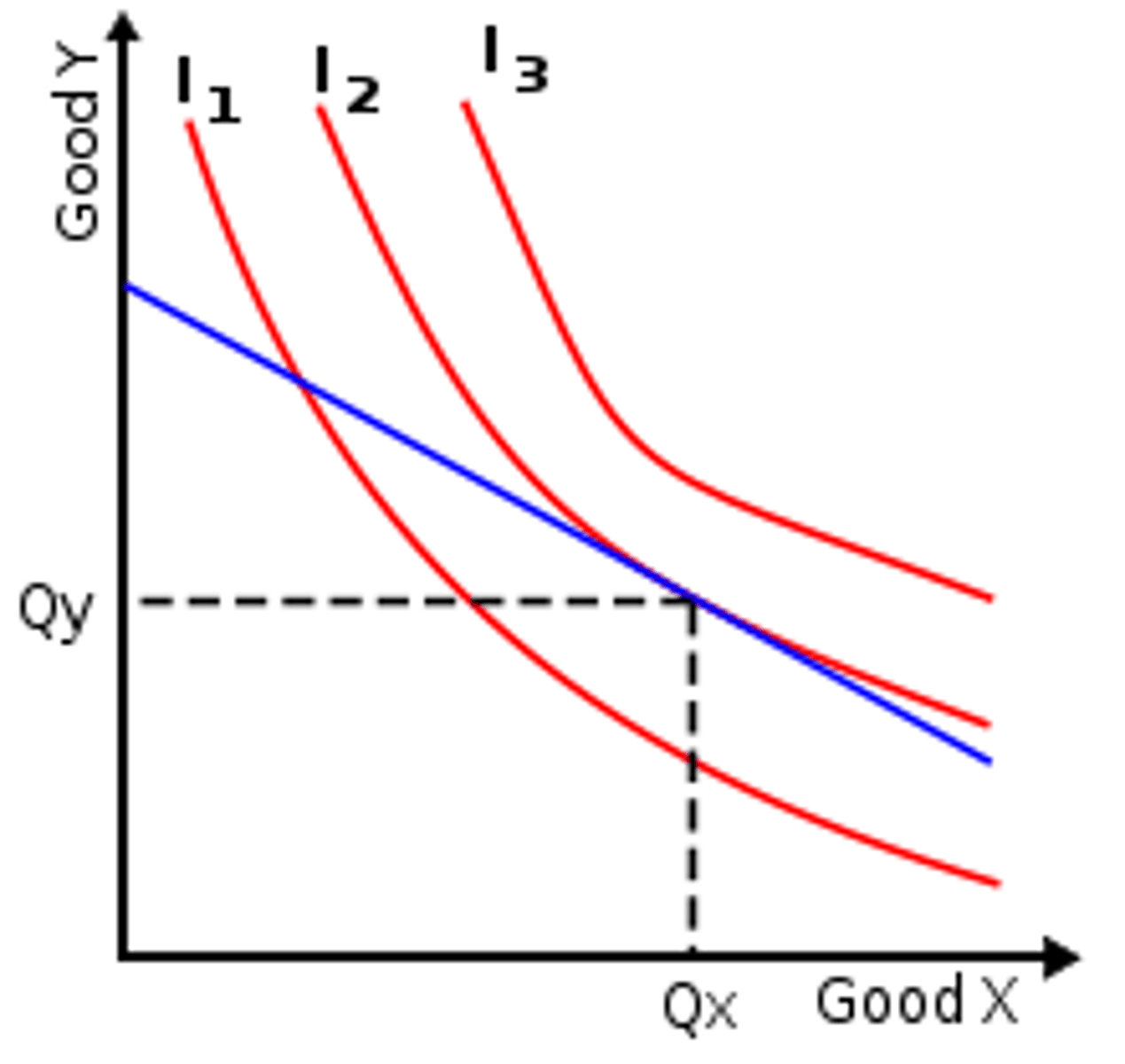
(1) Higher indifference curves are preferred to lower ones. People usually prefer to consume more goods rather than less.
(2) Indifference curves are downward sloping. The slope of an indifference curve reflects the rate at which the consumer is willing to substitute one good for the other.
(3) Indifference curves do not cross.
(4) Indifference curves are bowed inward. The slope of an indifference curve is the marginal rate of substitution—the rate at which the consumer is willing to trade off one good for the other.
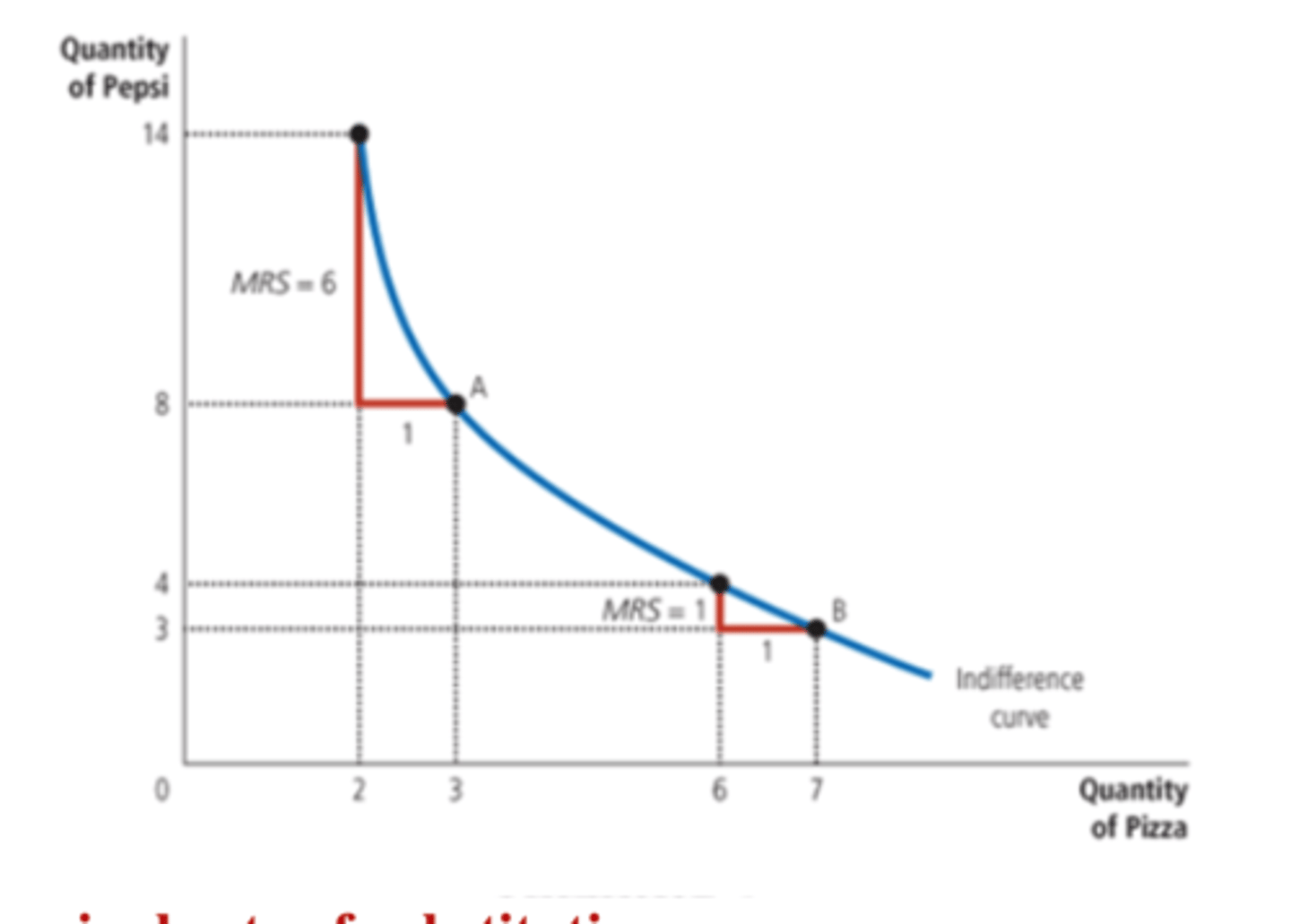
What is the marginal rate of substitution?*
The slope at any point on an indifference curve at which the consumer is willing to substitute one good for the other as both options will make them equally happy.
The rate at which the consumer is willing to trade off one good for the other (i.e. how much Pepsi the consumer requires to be compensated for a one-unit reduction in pizza consumption)
Budget constraint
The maximum amount of income the consumer can spend.
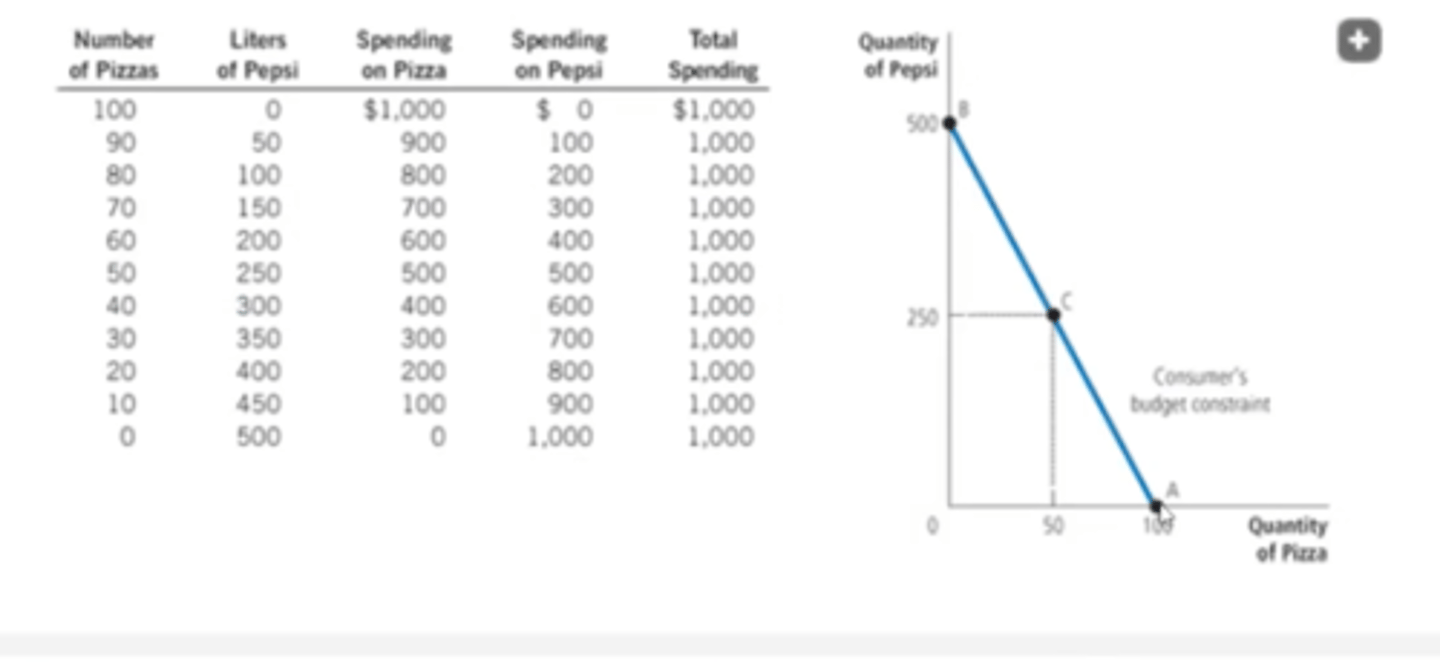
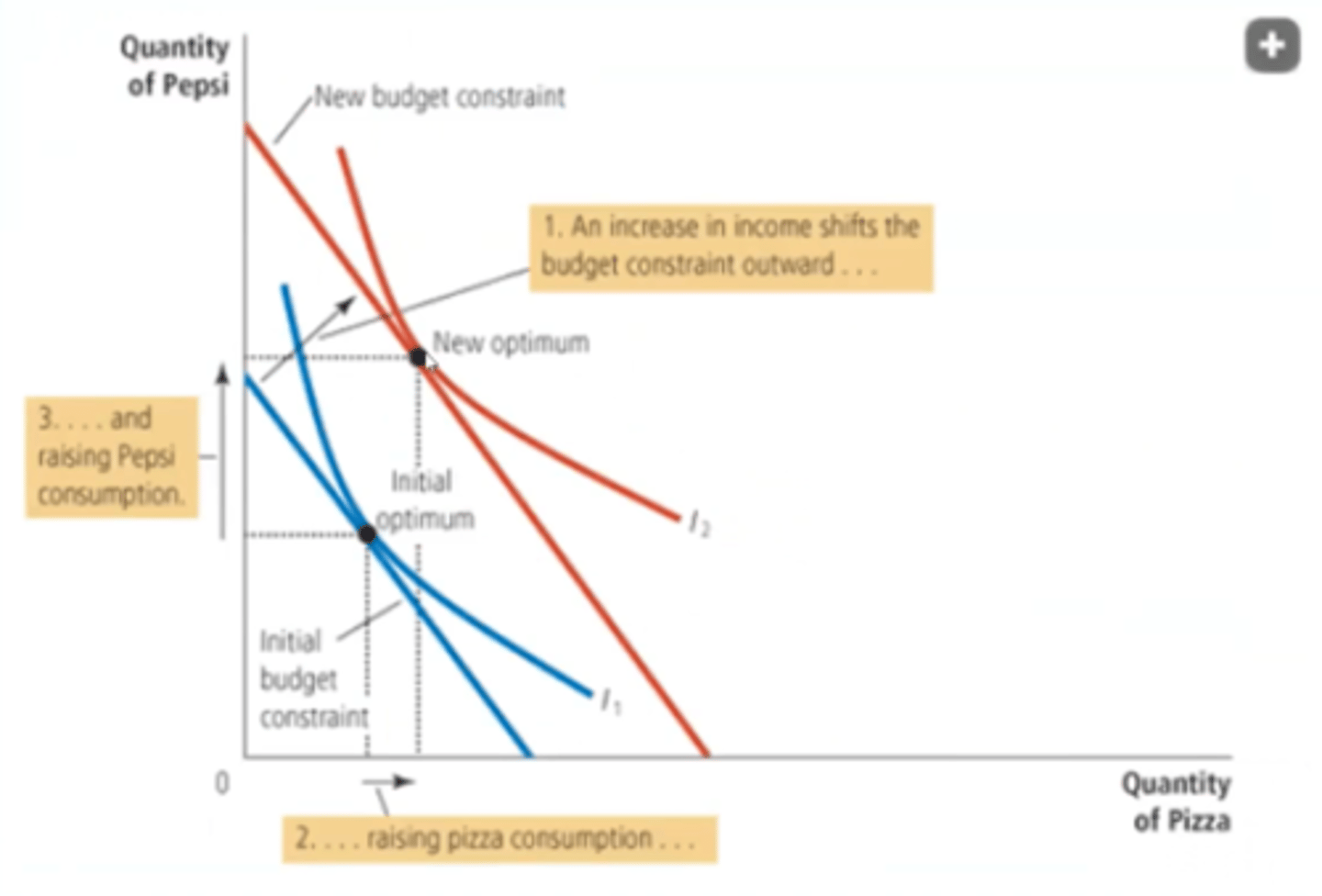
How might a budget constraint be impacted by an increase in income?
When the consumer's income rises, the budget constraint shifts outward.
If both goods are normal goods, the consumer responds to the increase in income by buying more of both of them. Then the consumer buys more pizza and Pepsi.
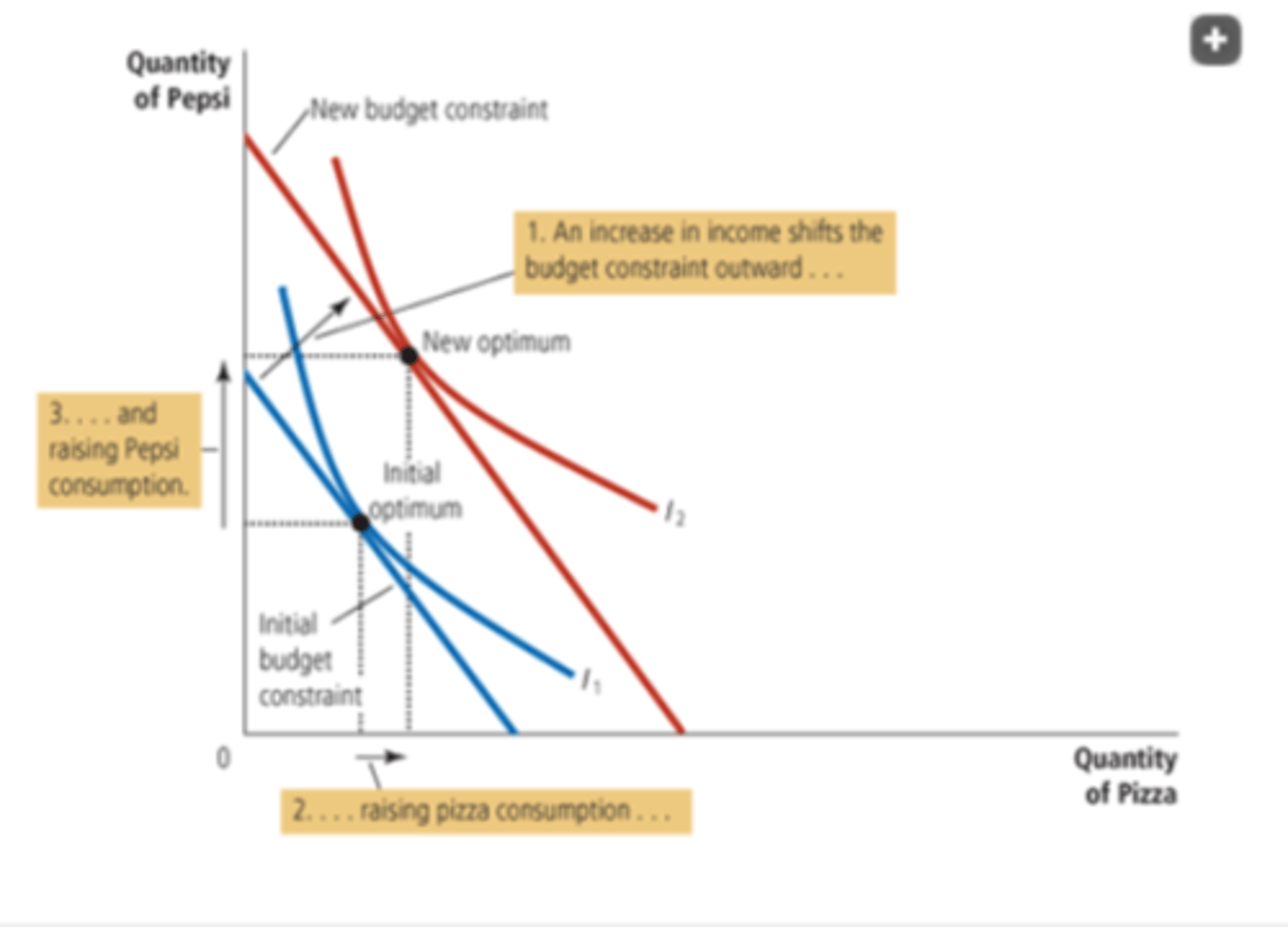
What two graphical elements are needed to determine a consumer's optimal point of consumption
Indifference curve and budget constraint.
The point at which this indifference curve and the budget constraint touch is called the optimum.
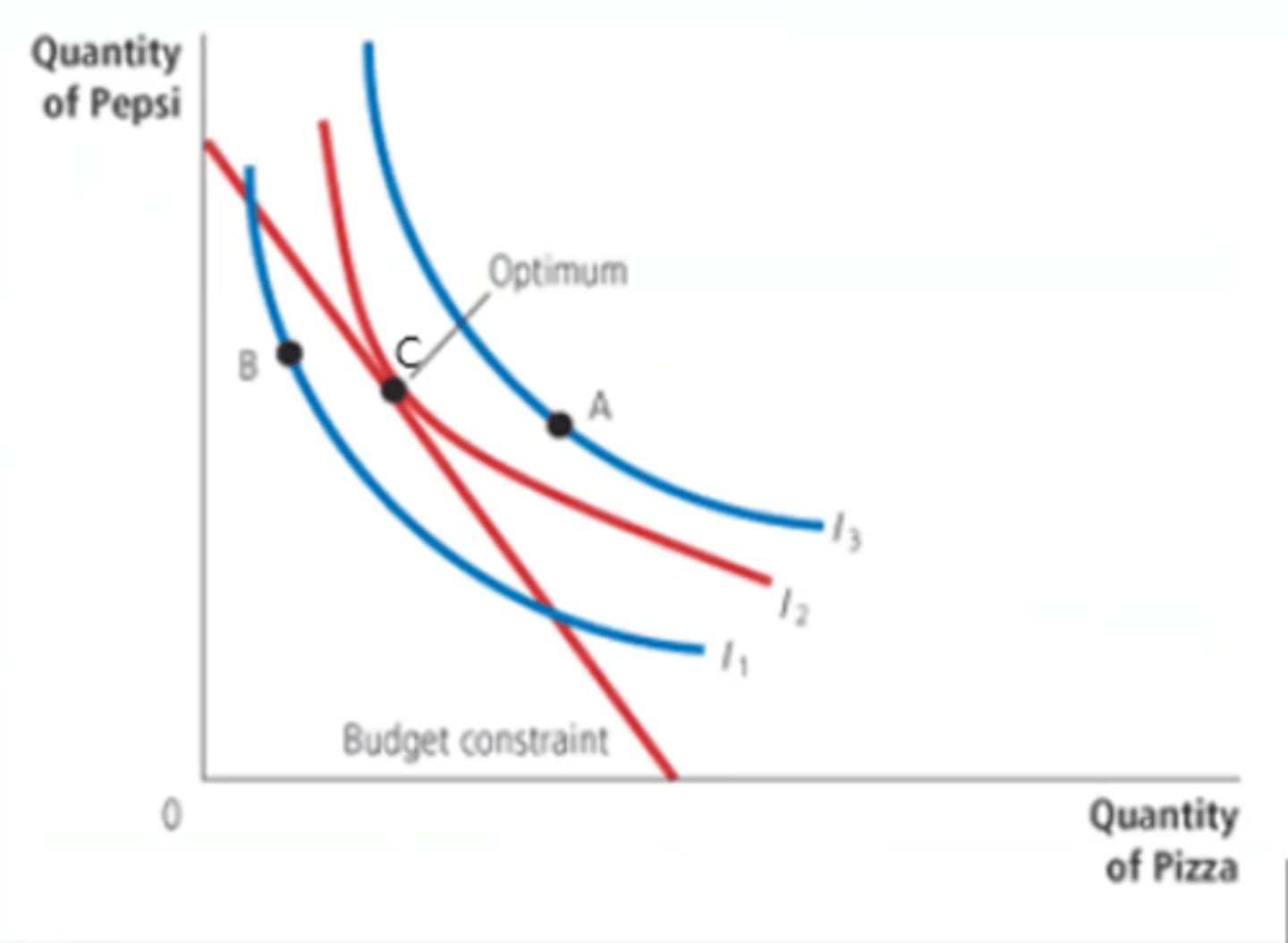
How is a consumer's optimal point of consumption determined precisely? What is the condition that must be met?
The point at which this indifference curve and the budget constraint touch (the best combination of pizza and Pepsi available to the consumer.) The marginal rate of substitution equals the relative price of the two goods.
Marginal cost (MC)
The increase in total cost that comes from producing one more unit.
Marginal cost = change in total cost/change in production.
For example, if Conrad increases production from 2 to 3 cups of lemonade, the total cost rises from $3.80 to $4.50, so the marginal cost of the third cup of lemonade is $4.50 minus $3.80, or $0.70.
How is marginal cost related to total cost?
Total cost = fixed + variable costs.
Marginal cost = change in total cost when you make one more product
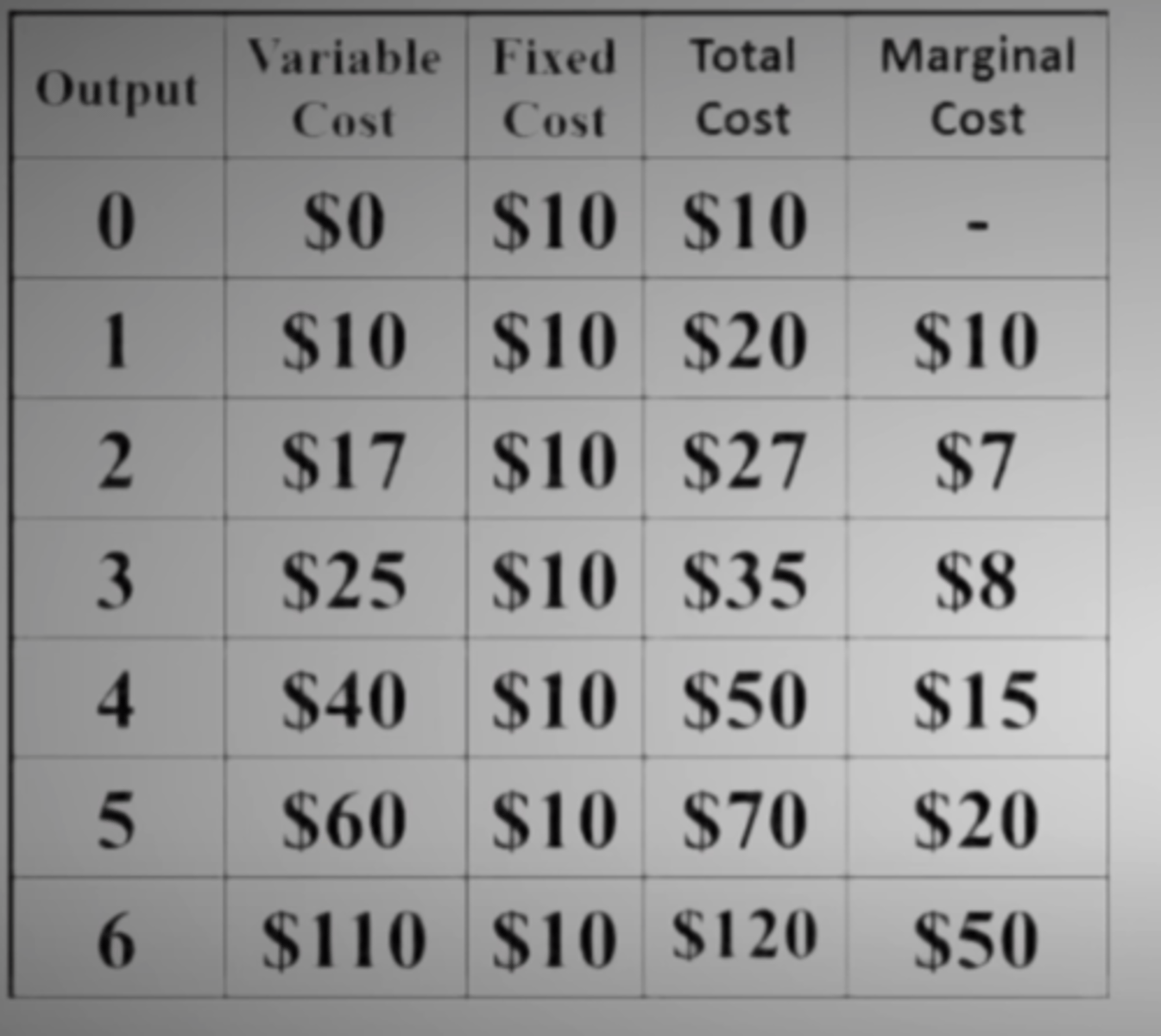
If Dave's company has a total cost of $100 when quantity output is 5, and a total cost of $115 when quantity output is 6, what is the marginal cost of producing the 6th unit?
$15
Total cost is made of two types of costs, what are they?
Fixed and Variable.
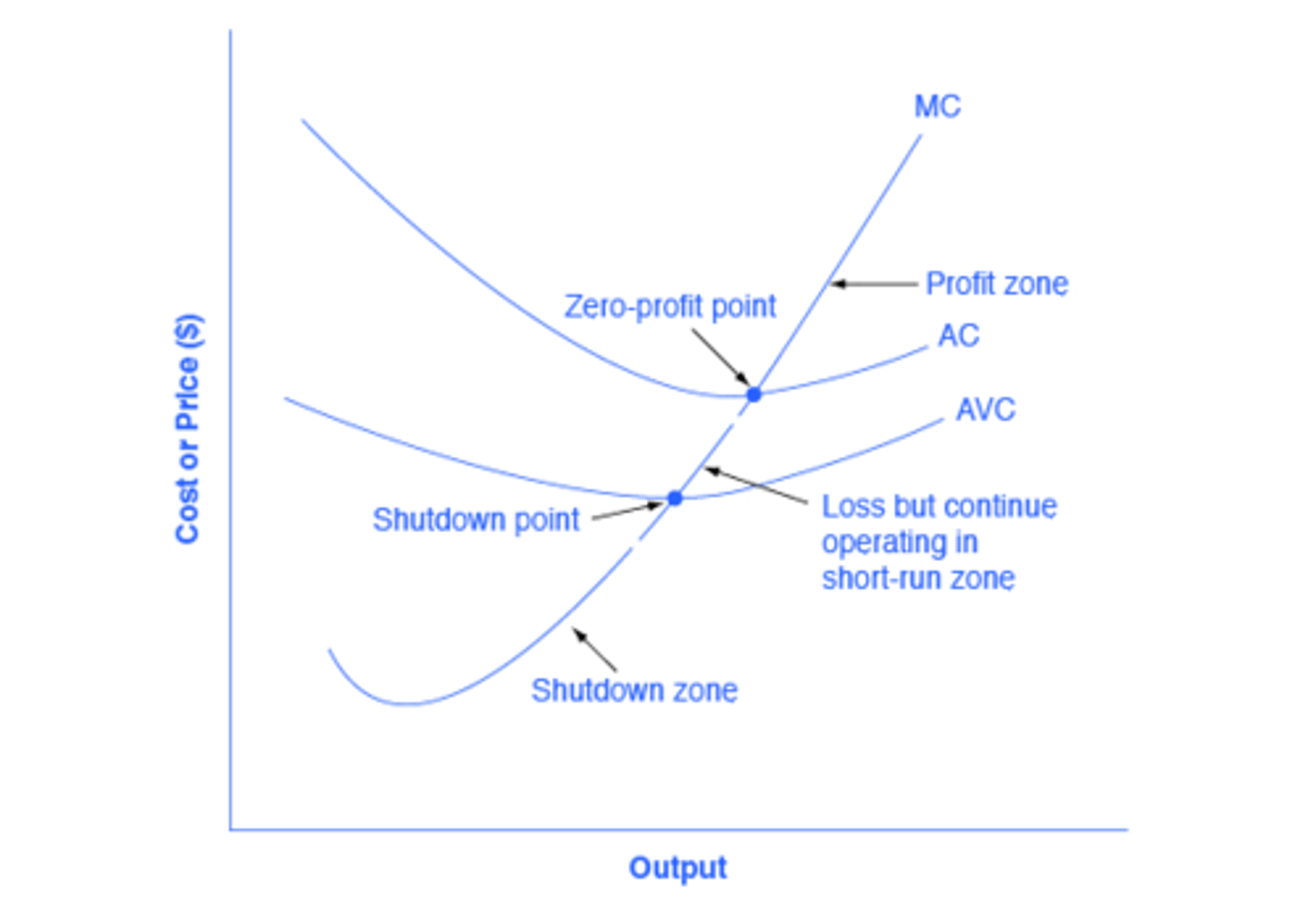
How does a firm determine when to shut down in the short-run? What rule characterizes this?
If the total revenue is less than your average variable costs (AVC), you should shut down.
If total revenue is between AVC and AC (average cost) you should continue operating in the short-run.
The shutdown rule characterizes this
What market structure is characterized as being a "price taker"
Competitive markets.
They are a company that must accept the prevailing prices in the market of its products, its own transactions being unable to affect the market price.
A competitive firm is a price taker and a monopoly firm is a price maker.
Price taker
One who must accept the price as the market determines
When a market is characterized as being a price taker, what fundamental shape does the demand curve for this market take?
Horizontal line.
Competitive market's demand curve is horizontal because there is not a trade-off between price ad quantity demanded for a competitive firm. The firm has to take the market price that is given.
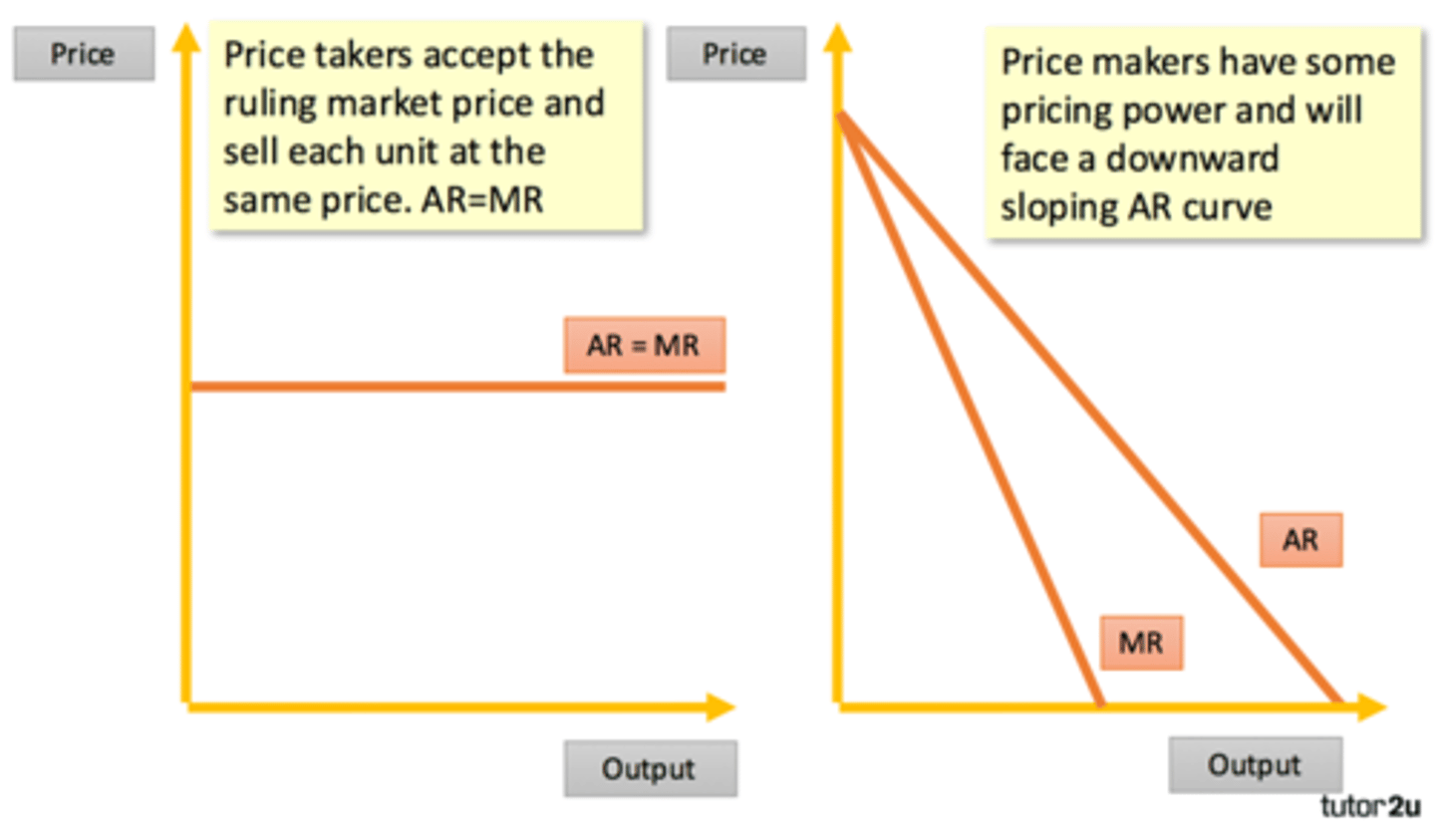
Demand curve for a perfectly competitive firm*
Horizontal line
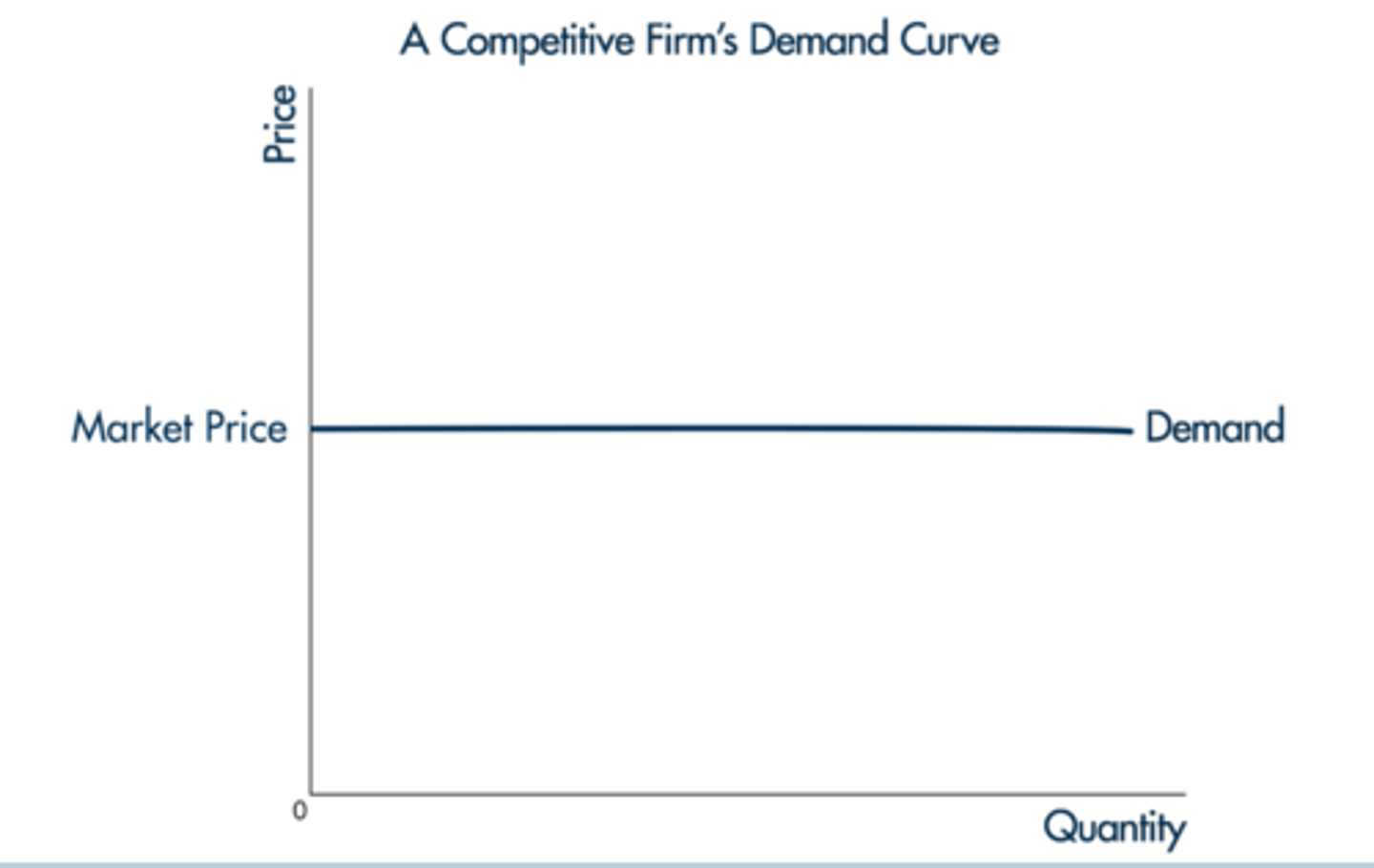
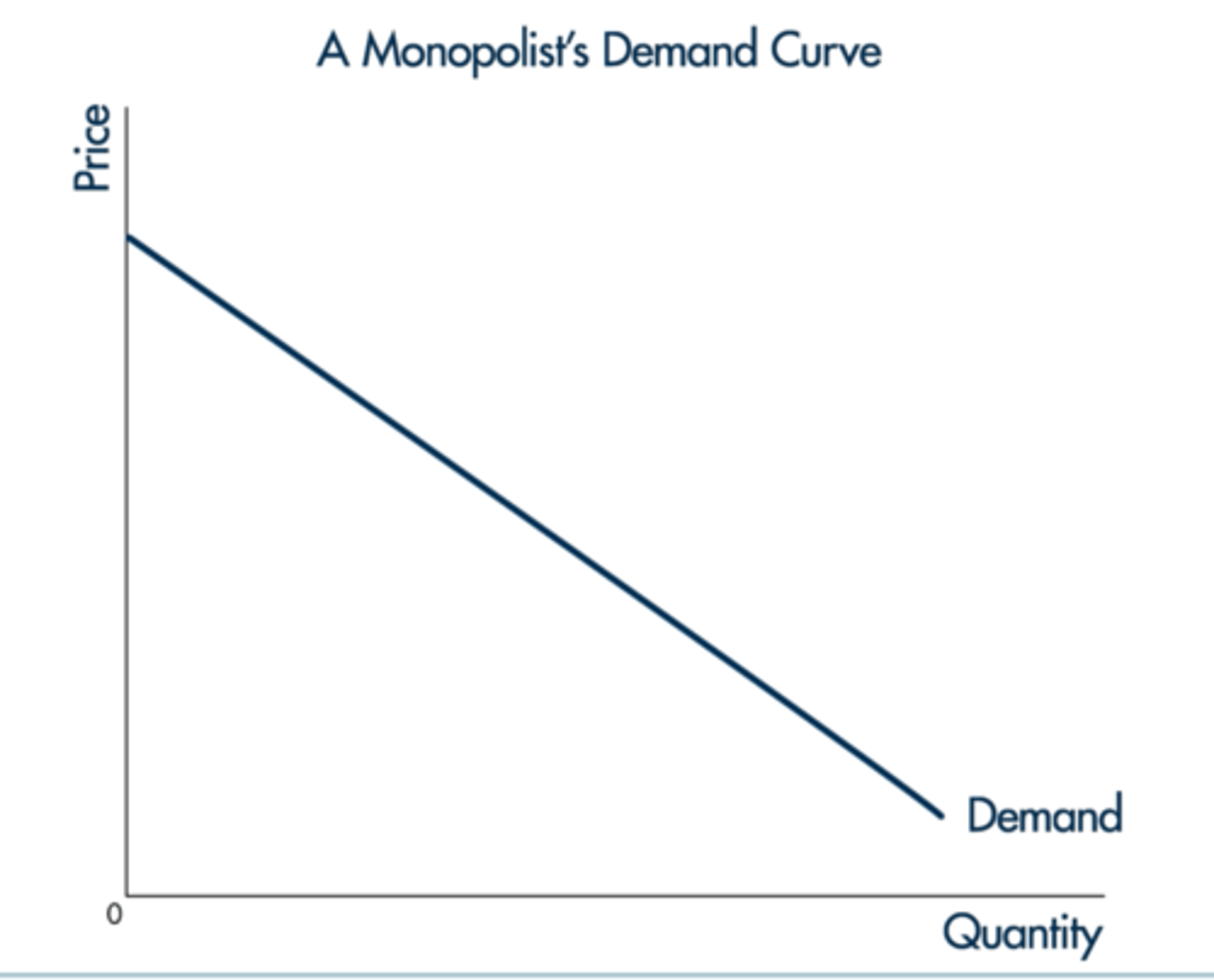
Demand curve for a monopolistic market
Downward-sloping
The curve is downward sloping because they have a tradeoff between price and quantity.
It is the same as the market demand curve.
Where do firms with market power determine the quantity of product/service they will produce?
A firm chooses a quantity of output so that marginal revenue equals marginal cost.
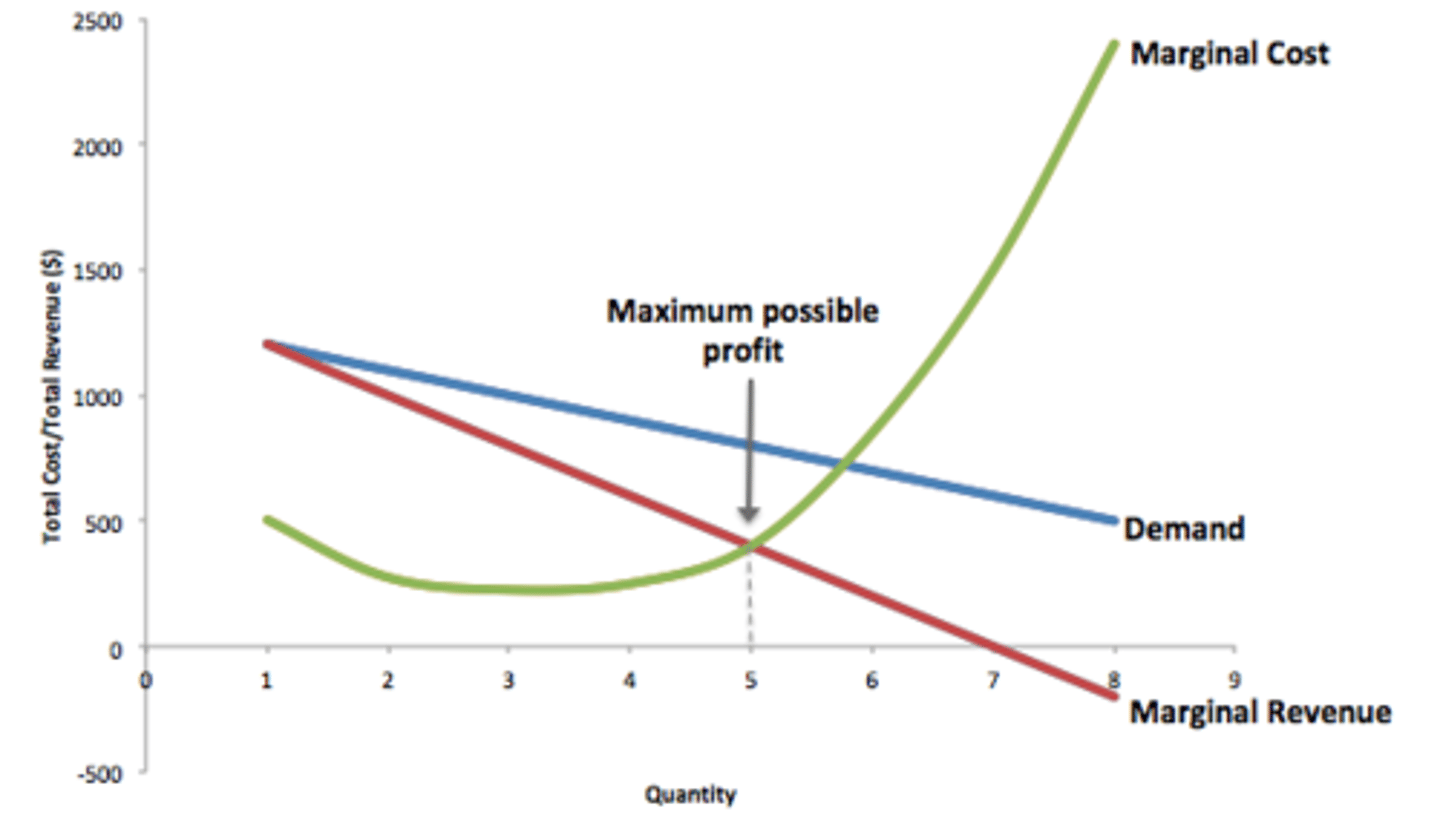
What is the primary goal/objective of a firm?
Maximize profit.
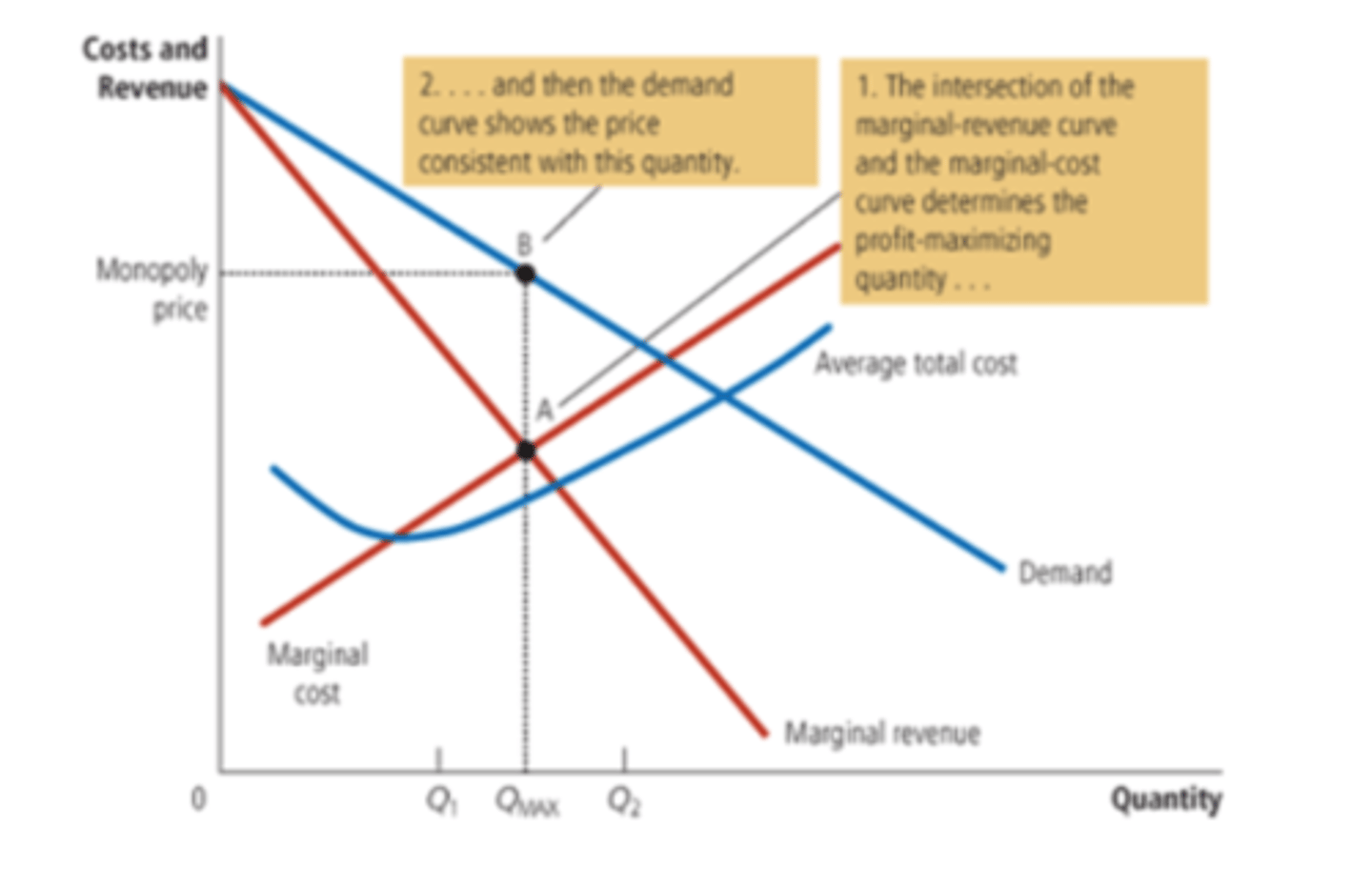
If a firm has a price-setting capacity, how will they use information about marginal costs and marginal revenues in order to accomplish their primary objective?
If they are price setters it is a monopoly. The monopolist's profit-maximizing quantity of output is determined by the intersection of the marginal revenue curve and the marginal-cost curve.
Describe the basic distinctions between the market models of monopoly, oligopoly, monopolistic competition, perfect competition.
Monopoly and Oligopoly have one to few firms, with limited products (cable TV), entry is difficult, and advertising is a natural feature.
Monopolistic competition a market structure in which many firms sell products that are similar but not identical
Perfect competition has identical products, entry is easy, and spend very little on advertising.
What is seen when studying the behavior of an oligopolistic firm within the context/model called "prisoner's dilemma"?
Self-interest drives the participants toward a non-cooperative outcome, which is worse for both parties.
Individuals' incentives often lead to a sub-optimal, non-cooperative outcome. Each firm follows the strategy that is in their own interest instead of working together.
Prisoners’ dilemma
In game theory, a type of game in which the outcome depends on two parties deciding whether to cooperate or to compete.
How might an oligopolistic firm behave like a monopoly? What forces may prevent this?
Forming a cartel and acting like a monopolist, but self-interest drives them towards competition.
What tools does the Federal Reserve have regarding monetary control?
Discount rates
Open market operations (Buying/selling bonds)
Reserve ratios
Open market operations
The purchase or sale of U.S. government treasury bonds.
When the Fed buys bonds back from the public, what impact does this have on the money supply and aggregate demand?
After the purchase, these dollars are in the hands of the public. Thus, an open-market purchase of bonds by the Fed increases the money supply.
When the Fed increases the money supply, it lowers the interest rate and increases the quantity of goods and services demanded increasing aggregate demand.
When the Fed sells bonds, what impact does this have on the money supply and aggregate demand?
After the sale, the dollars the Fed receives for the bonds are out of the hands of the public. Thus, an open-market sale of bonds by the Fed decreases the money supply and decreases aggregate demand.
What is the discount window rate, or just discount rate?
The interest rate banks pay when borrowing from the Federal Reserve.
The Federal Reserve is your bank's bank.
When the Fed reduces the discount rate, what impact will this have on the money supply and the aggregate demand?
A lower discount rate encourages banks to borrow from the Fed, increasing the quantity of reserves and the money supply, as well as aggregate demand, goes up.
When the Fed increases the discount rate, what impact will this have on the money supply and the aggregate demand?
A higher discount rate discourages banks from borrowing reserves from the Fed, reducing the quantity of reserves in the banking system, which reduces the money supply and aggregate demand.
Reserve ratio
The ratio of total deposits that a bank holds as reserves.
If the reserve ratio is 10% and someone deposits 100% banks have to keep $10 in their reserves.
What would the Fed need to do with the reserve ratio in order to increase the money supply and aggregate demand in the economy?
Decrease the reserve requirements; therefore lowering the reserve ratio.
What would the Fed need to do with the reserve ratio in order to decrease the money supply and aggregate demand in the economy?
Increase the reserve requirements; therefore raising the reserve ratio.
If the Fed uses monetary policy in a way that increases money supply, what effect will this have on interest rates and aggregate demand (consider them separately)?
Interest rates lower and aggregate demand increase.
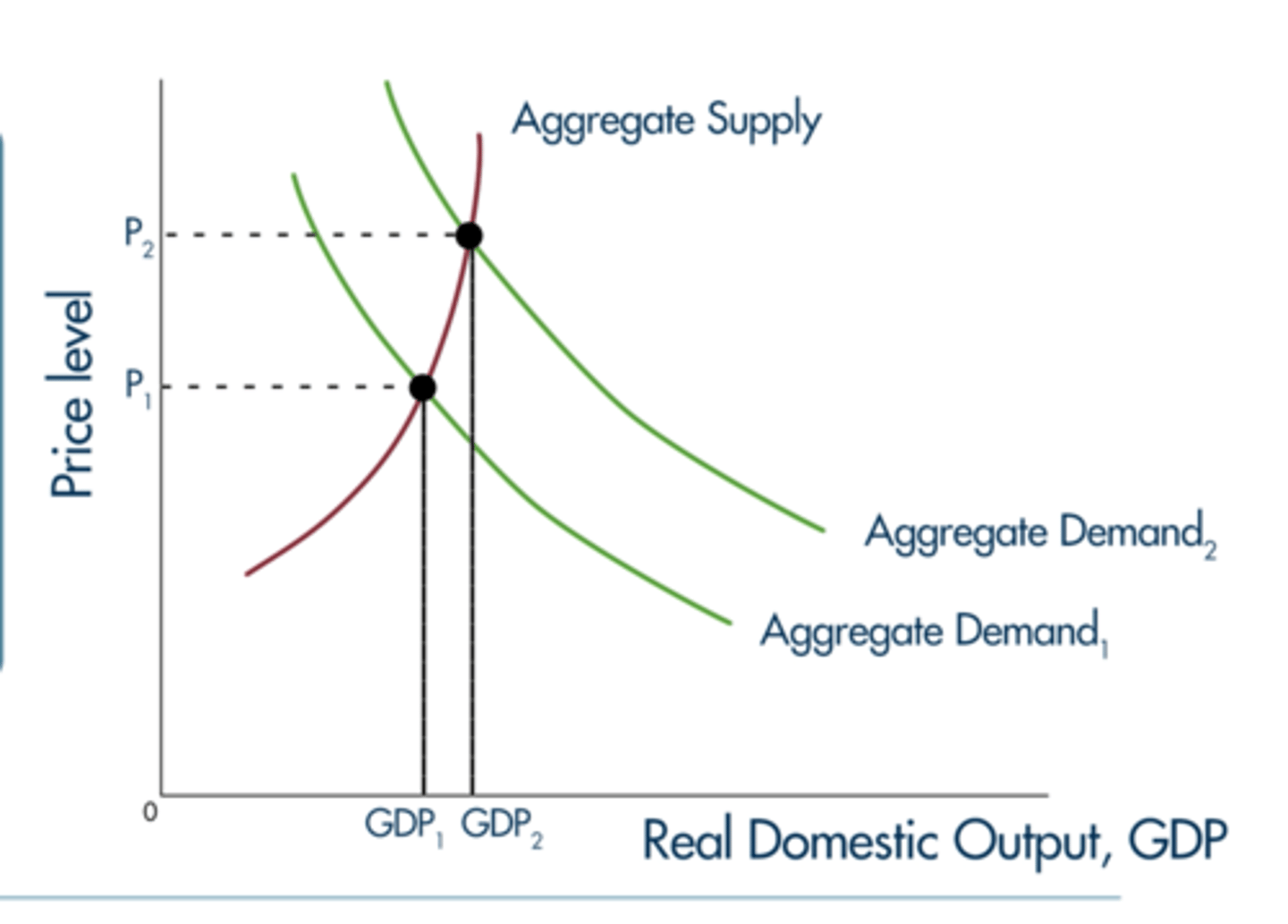
If the government uses fiscal policy to increase government spending what impact will this have on interest rates and aggregate demand?
Interest rates and aggregate demand increase.
If the government uses fiscal policy and cuts taxes, what effect will this have on interest rates and aggregate demand?
Both increase.
Raises interest rates and an increase in aggregate demand.
Explain the effect an income change might have on shifting the demand curve?
Lower income=less to spend in total=lower demand.
Higher income=more to spend in total=raise demand.
What is a normal good?
A good for which an increase in income leads to an increase in demand
Example: Stake
What is an inferior good?
A good for which an increase in income leads to a decrease in demand (car vs. bus ride)
Example: Ramen noodles
Explain how the price of related goods is related to changes in the demand curve?
When demand changes for one, it changes for the other.
If Luke and I are the only sellers of paper in a given market, and Luke drops his prices for paper, how will this impact the demand for my paper? Which way will your demand curve shift?
As Luke drops his price, your demand will decrease. Your demand curve will shift to the left.
Homogenous products
Goods that are physically identical or viewed as identical by consumers
What other factors might influence the position of the demand curve?
Price of the good itself
Income
Price of related goods
Tastes
Expectations
Number of buyers
What is the numerical value that determines whether or not a product/service is considered price elastic or inelastic?
If the elasticity quotient is 1 or higher, the demand is elastic. If the number is below 1 it is inelastic.
What is income elasticity?
Measures how much your demand changes when your income changes.
Income elasticity = % change in demand/% change in income
What is price elasticity of demand?
It measures how much the demand for a product changes when the price of that product changes.
If something is elastic, you buy more when it is cheap and don't buy it if it is expensive.
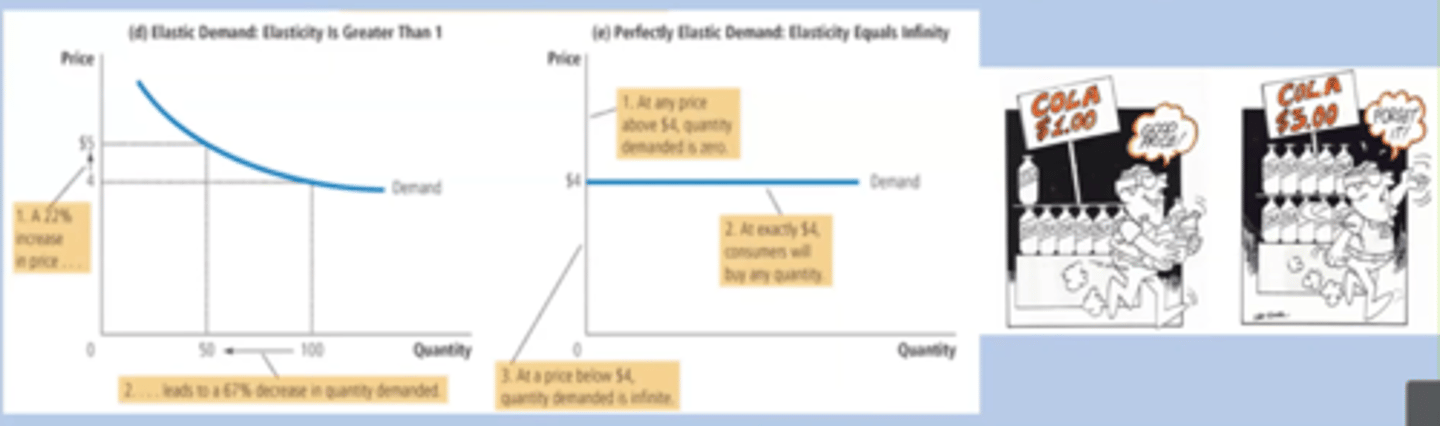
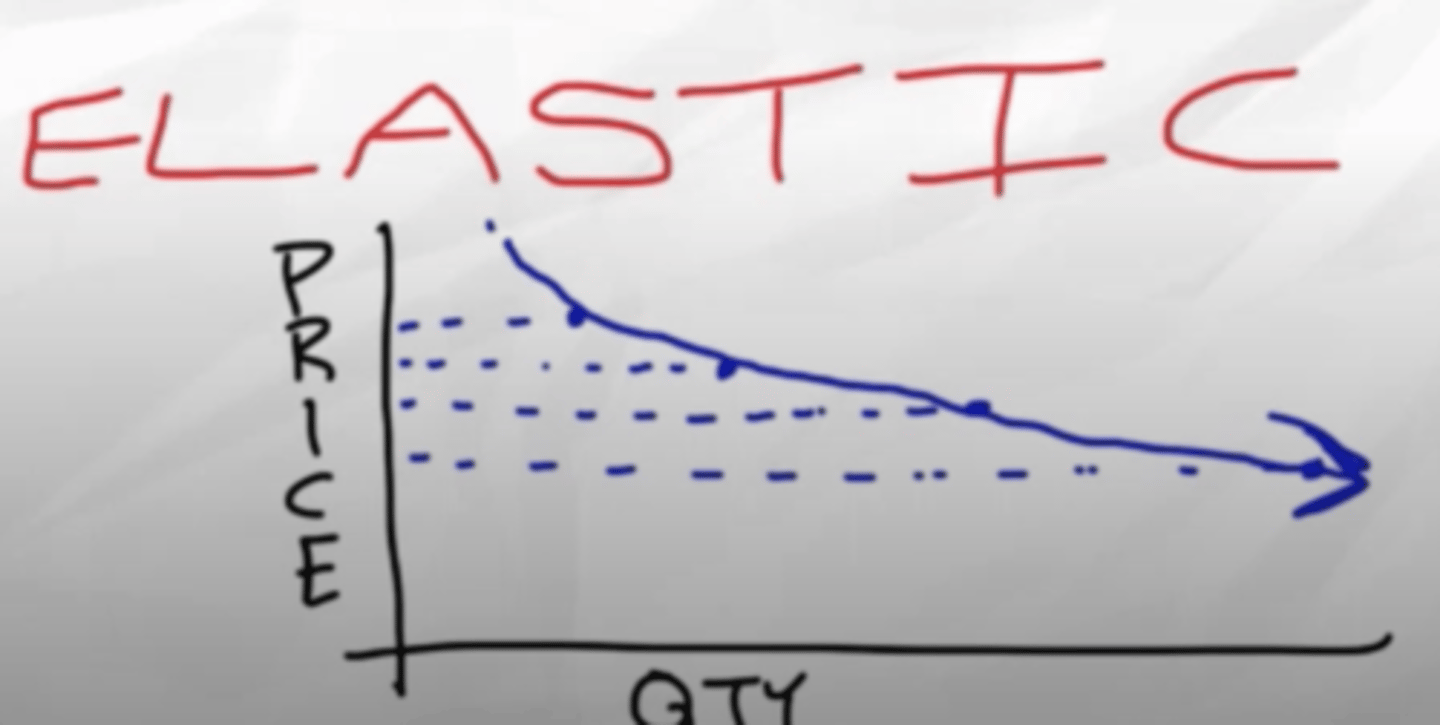
What does elastic mean?
How responsive is demand when price changes? (Price increase results in drastically lower demand).
Elastic goods = when you change the price demand changes quite a bit. Soda
Inelastic goods = when you change the price, demand does not change that much. Gas
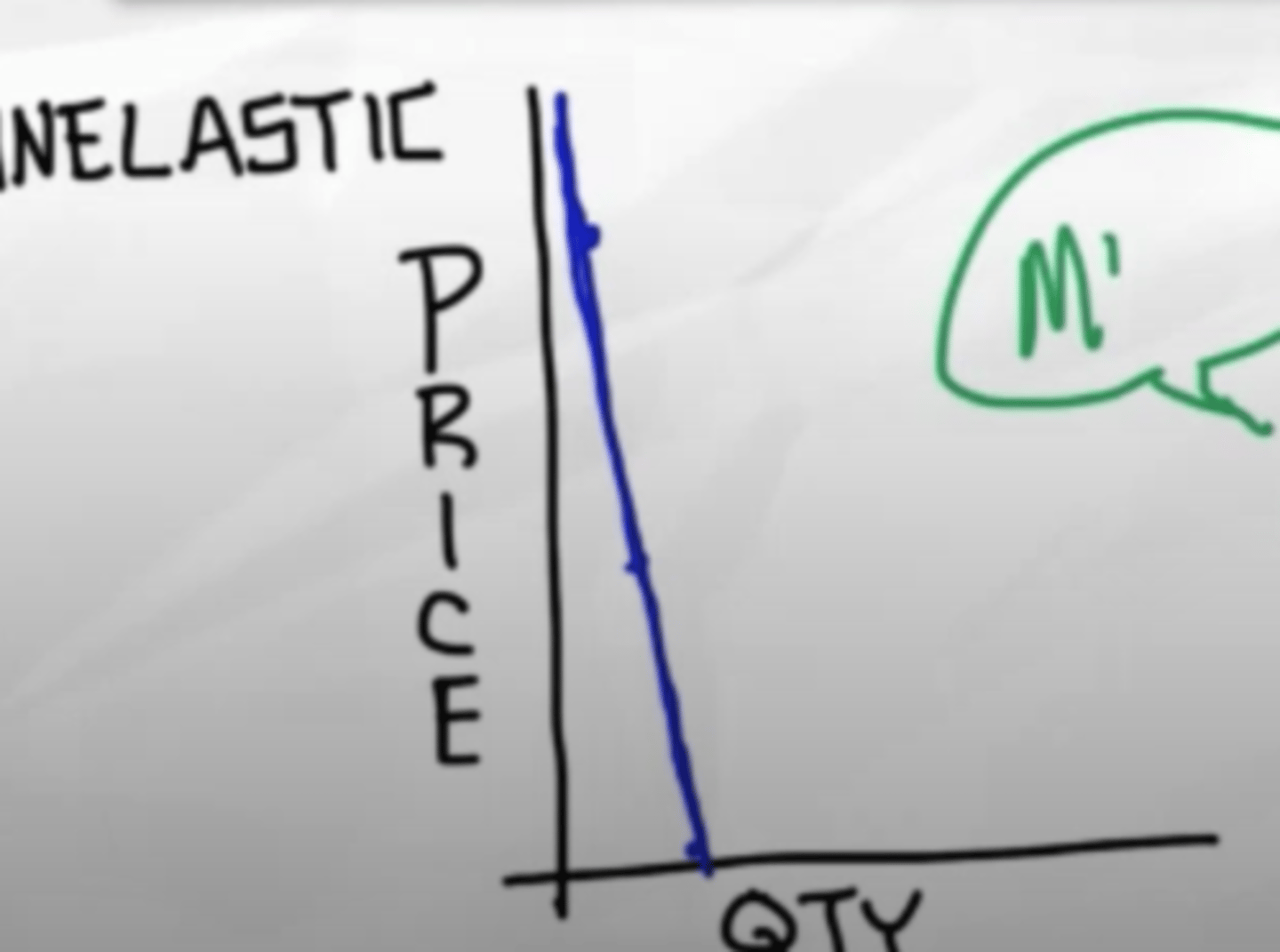
What does inelastic mean?
When the price changes our demand does not change much at all.
(Price increase results in slightly lower demand)
Examples: Milk, diapers, gas
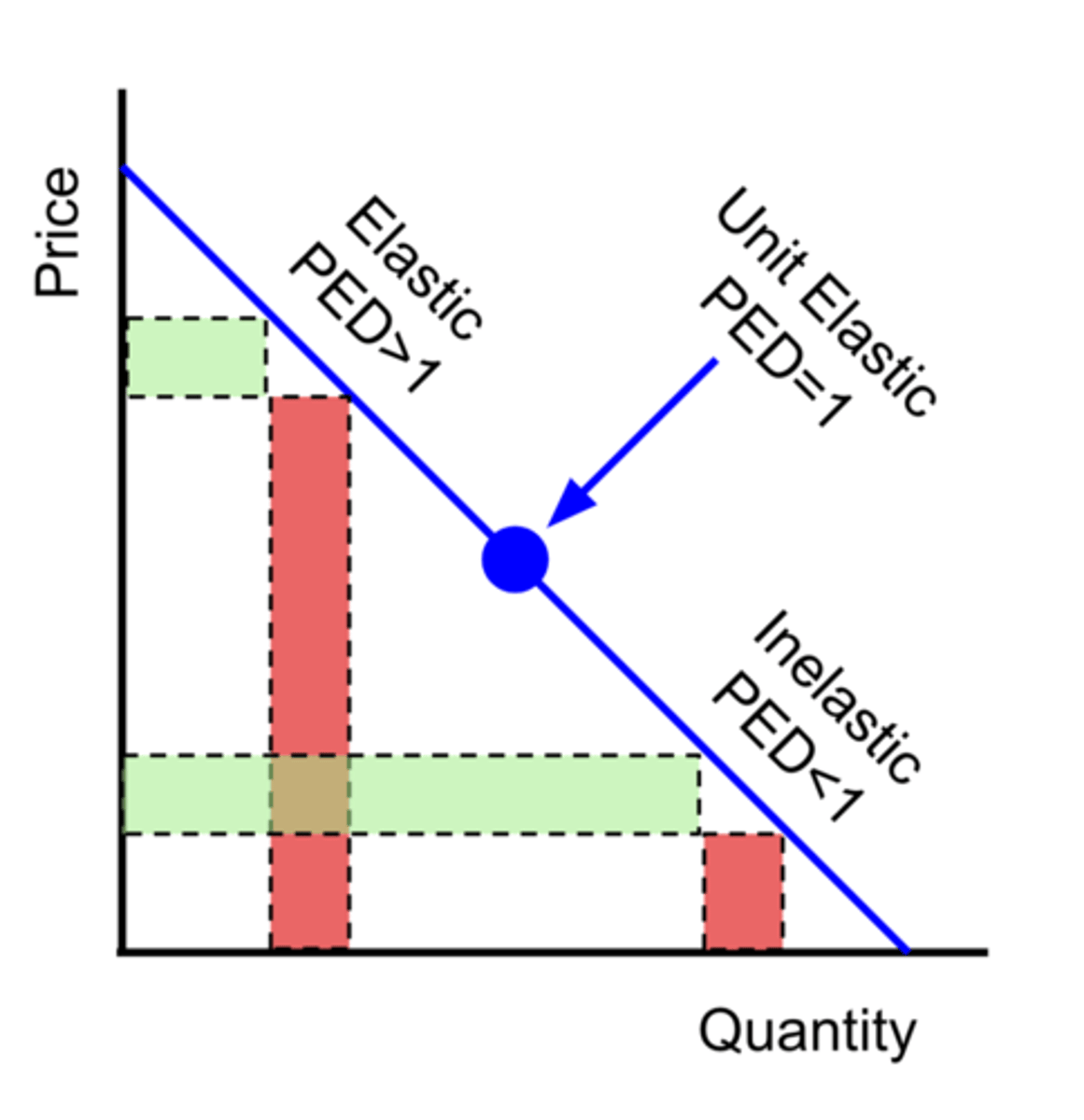
What is unit elastic?
Where any % change in price causes an equal % change in quantity.
A curve with an elasticity of 1 is unit elastic.
Inelastic is less than 1
Elastic is greater than 1
What are two results that stem from income elasticity?
Inferior goods, such as ramen noodles and bus rides, tend to have negative income elasticities. When you make less you have more of these things.
Normal goods, such as caviar and diamonds, tend to have positive income elasticities. When you make more money, you want more of these things.