Homework chapter 15 Part_3 (Hearing and Equilibrium)
 Call Kai
 Learn
Learn Practice Test
 Spaced Repetition
 Match
Match Flashcards
 Knowt Play
1/62

There's no tags or description
Looks like no tags are added yet.
Name | Mastery | Learn | Test | Matching | Spaced | Call with Kai |
|---|
No analytics yet
Send a link to your students to track their progress
63 Terms
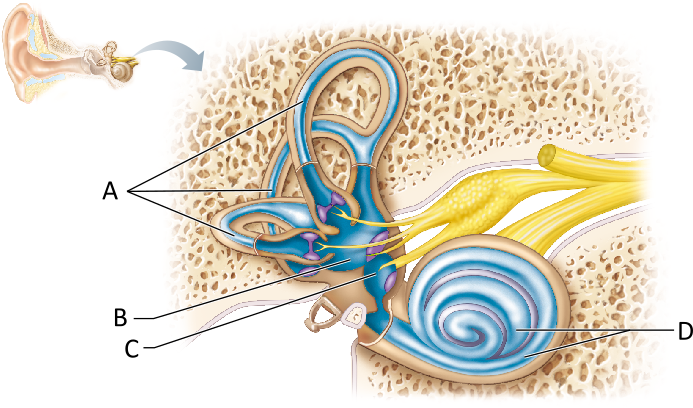
Which region of the ear houses perilymph and endolymph?
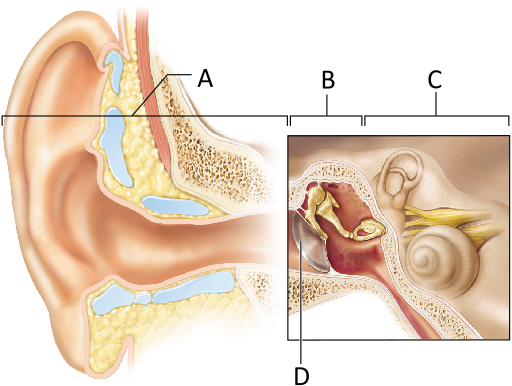
C
Which letter indicates structures involved in detection of BOTH hearing and equilibrium?
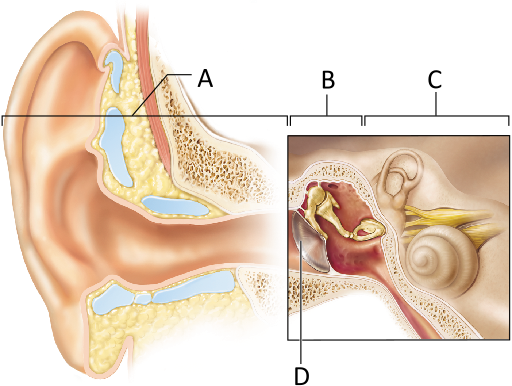
C
A middle ear infection (otitis media) would be located in which region?
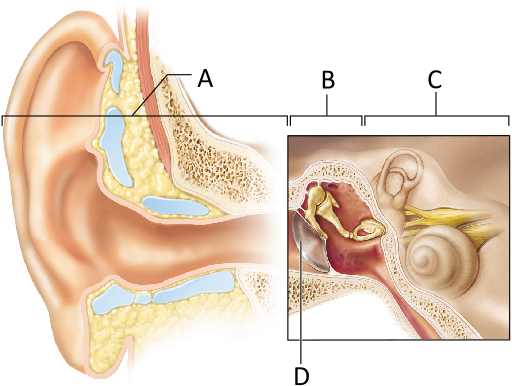
B
Damage to which of these structures can result in sensorineural deafness?
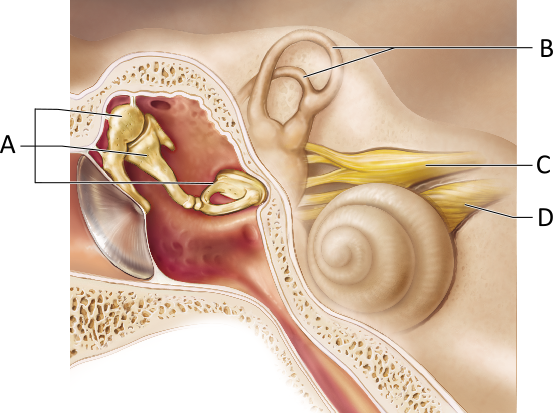
D
Otosclerosis, which can result in conduction deafness, affects which of these structures?
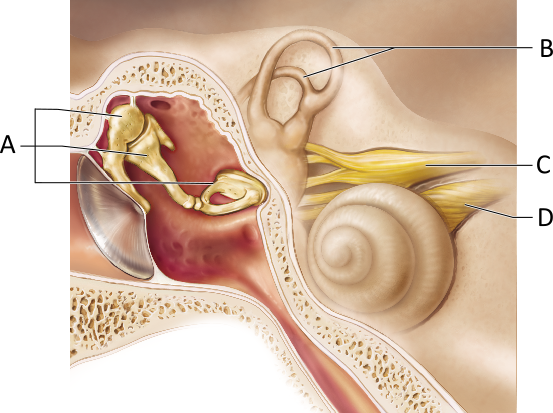
A
What are the names of the bones at A, in order from left to right?
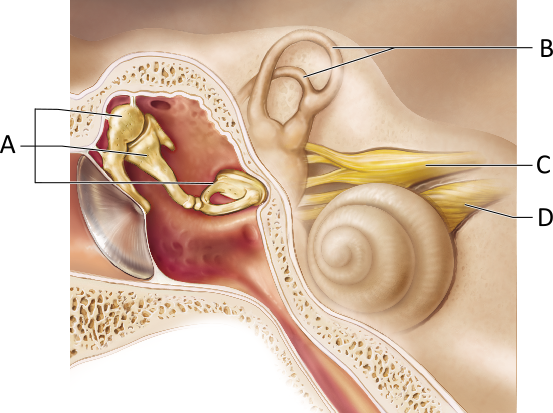
malleus, incus, stapes
What part of the inner ear houses the receptor organ of hearing, the spiral organ (organ of Corti)?
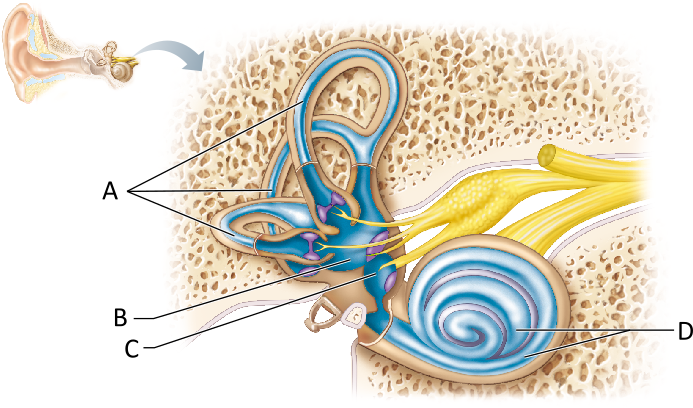
D
Which part of the inner ear houses receptors most responsive to rotational (angular) movements of the head?
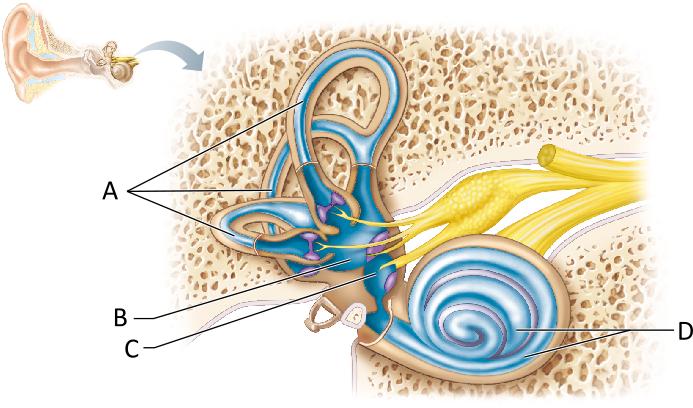
A
Name the structure located in the enlarged swellings in the tubes at A
ampulla
The fluid contained within the membranous labyrinth is called perilymph.
False
In order for sound to reach the spiral organ (of Corti), the auditory ossicles must vibrate the oval window and set the endolymph in motion
True
Ear stones.
otoliths
Separate(s) external acoustic meatus from the middle ear.
tympanic membrane
Contain(s) utricle and saccule.
vestibule
Detect(s) linear acceleration
maculae
Connect(s) the middle ear with the nasopharynx.
pharyngotypanic tube
What is the primary function of cerumen?
cleans and lubricates the external auditory canal
How many ossicles are found in the ear?
three
Which middle ear ossicle is attached to, and transmits vibratory motion to, the oval window?
stapes
Name the structure represented by (1).
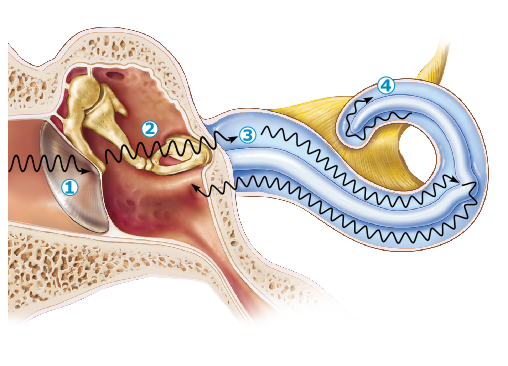
tympanic membrane
Identify the function of the structures labeled (2) in this image.
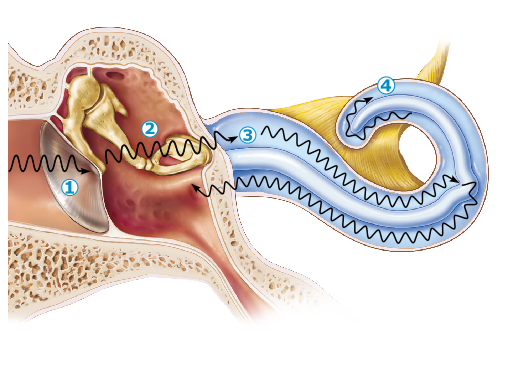
They conduct sound waves and amplify the vibrations within the middle ear
Why are the waves represented by the number 3 being sensed closer to the oval window than those represented by 4?
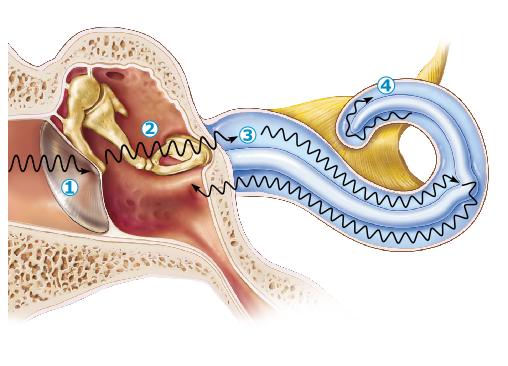
The waves at 3 have a higher frequency than 4.
Houses the spiral organ (of Corti.)
cochlear duct
The receptor organ for hearing.
spiral organ (of corti)
The central part of the bony labyrinth.
vestibule
A membrane that transmits sound vibrations to the auditory ossicles
tympanic membrance
Receptors for hearing are located in the ________.
cochlea
The oval window is connected directly to which passageway?
scala vestibuli
Which pairing of terms is incorrectly related?
frequency of sound waves: loudness of the sound
Which movement of ions produces EPSPs in cochlea hair cells?
Influx of K+ and Ca++
Which portion of the ear is responsible for sound transduction?
the cochlea
Transduction of lower frequency sound waves occurs at the __________ of the cochlea.
apex
Height of a wave is called the __________
amplitude
Sound is generally perceived in the occipital lobe of the cerebral cortex
False
A perceived increase in the volume of sound is best explained by ________.
an increase in the height of the sound wave
Tom is a 45-year-old male that has lost his ability to hear high frequency sounds. The most likely explanation for this would be ________
damage to the hair cells near the oval window in the cochlear duct
A patient has a loss of hearing in only one ear. Which of the following is likely to be a result?
The patient will not be able to localize the origin of sounds.
The sensation of loudness or the volume of a sound is detected by ________.
greater movement of the basilar membrane resulting in greater deflection of the hair cells
Static equilibrium involves the sensation of linear acceleration as well as changes in head rotation.
False
Hair cells receptive to changes in static equilibrium are found in this structure.
macula
Chemically sensitive microvilli found in this structure.
taste buds
Hair cells receptive to changes in dynamic equilibrium are found in this structure.
crista ampullaris
Chemically sensitive cilia are found in this structure.
olfactory epithelium
A condition that can result from a deficiency of vitamin A.
night blindness
A condition of deafness that may result from otosclerosis.
conduction deafness
An inflammation of the lining of the middle ear.
otitis media
A condition often leading to blindness due to increased intraocular pressure.
glaucoma
Labyrinthitis is a medical condition often caused by a viral infection, resulting in swelling and inflammation of the membranous labyrinth. Which of the following symptoms would you most associate with the condition of labyrinthitis?
loss of balance and dizziness
Dancers will use a technique called "spotting" when they perform spins of the body. By holding their head and eyes on a fixed point in front of them as their body spins they reduce the amount of head spinning and this prevents dizziness. Which of the following is the most likely explanation for why this works?
Reducing the inertia of head spin will reduce the flow of endolymph that deflects the hair cells of the crista ampullaris
The receptor for static equilibrium is the ________.
macula
Motion sickness seems to ________.
result from mismatch between visual and vestibular inputs
An essential part of the maculae involved in static equilibrium is (are) the ________.
otoliths
Select the correct statement about equilibrium.
Cristae respond to angular acceleration and deceleration.
Which of the following would be the LEAST likely to be associated with the development of motion sickness?
having a non-functional vestibular apparatus
The semicircular canals are adapted to detect static equilibrium.
False
Which of the following is true of receptors for dynamic equilibrium?
The receptors for dynamic equilibrium respond to rotational forces.
Where are equilibrium receptors located?
in the semicircular canals and in the vestibule of the ear
Which of the following correctly matches the equilibrium receptor to the type of equilibrium it monitors?
maculae: static equilibrium
What stimuli does the vestibular apparatus detect?
head position in space
Which of the following structures contain receptors that monitor changes in head rotation?
semicircular canals
Theoretically, an individual born without a middle ear would be able to hear by bone conduction with a hearing aid.
True
Fusing of the ossicles (otosclerosis) results in ________.
conduction deafness
Congenital sensorineural deafness most commonly involves damage to ______.
the cochlear hair cells