Subsidy to correct market failure
 Call Kai
 Learn
Learn Practice Test
 Spaced Repetition
 Match
Match Flashcards
 Knowt Play
1/7

There's no tags or description
Looks like no tags are added yet.
Name | Mastery | Learn | Test | Matching | Spaced | Call with Kai |
|---|
No analytics yet
Send a link to your students to track their progress
8 Terms
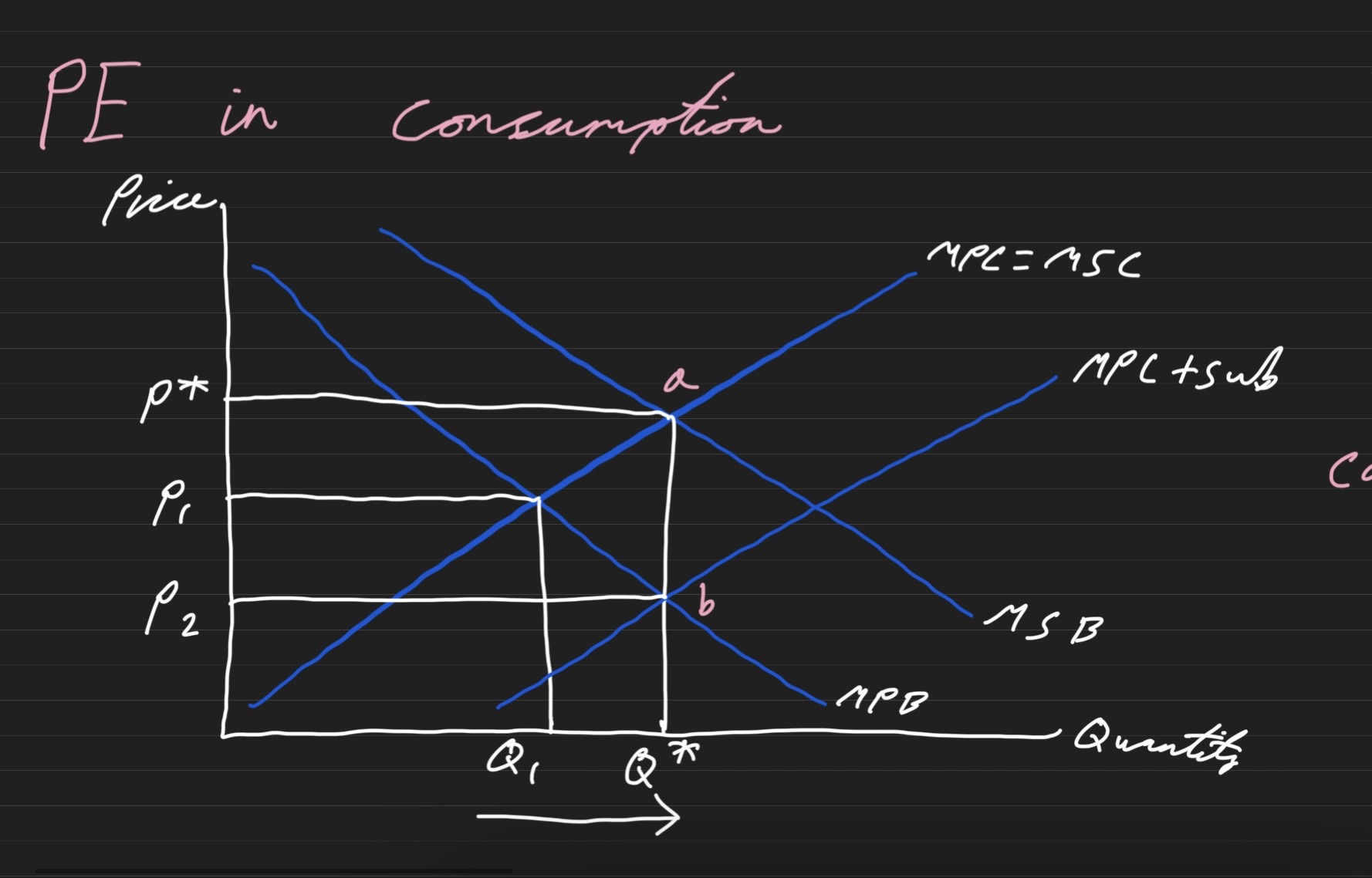
Subsidy to correct PE in consumption
The government can provide a subsidy to encourage the consumption of merit goods. This lowers the cost of production for firms shifting the supply curve from MPC to MPC+ sub = MSC if the subsidy is perfect. As a result the price reduces from p1 to p2 and quantity demanded increases from q1 to q* which solves underconsumption. This internalised the externality which leads to allocative efficiency.
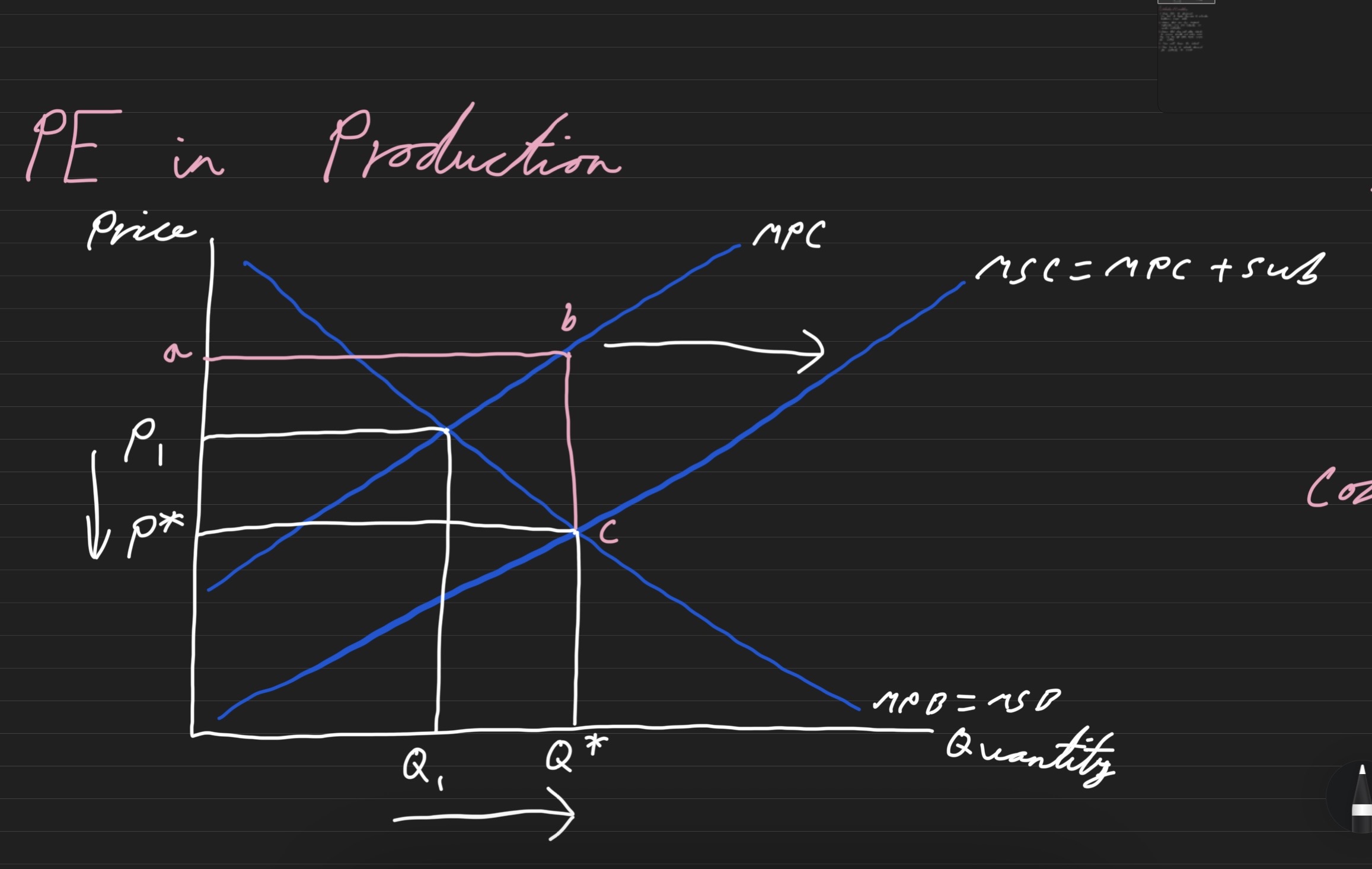
Subsidy to correct positive externality in production
Government can provide subsidy to firms producing goods with positive externalities, such as R and D. Currently firms are operating at p1q1 which private optimum level and there is an underproduction from q1q*. If the subsidy is at the perfect level the MPC will shift to the right to MPC+SUB=MSC. As a result, output increases from q1 to q* moving the production to the social optimal level. This helps correct the underproduction and leads to allocative efficiency as there is no more deadweight welfare loss.
Evaluation points
Huge costs to government
Assumes government has perfect information
Assumes firms will utilise subsidy
Firms may become too reliant
Elasticity of demand
Huge costs
Opportunity cost the money could be used elsewhere and can lead to higher taxes in the future and cuts to funding on healthcare and education
Perfect information
Ìf government does not have perfect information they may over subsidise or under subsidise
Assumption of firms
Firms may not use this money to increase output, they may use it to pay off debt on the company or even use it to increases wages for their workers.
Reliant firms
Firms will become too reliant on the government. This could make a firm act recklessly and become productively inefficient leading to a misallocation of resources