ACCTG 414 CHP 1 & 2
0.0(0)
Studied by 1 person Call Kai
 Learn
Learn Practice Test
 Spaced Repetition
 Match
Match Flashcards
 Knowt Play
Card Sorting
1/36

Earn XP
Description and Tags
Last updated 4:39 AM on 9/9/22
Name | Mastery | Learn | Test | Matching | Spaced | Call with Kai |
|---|
No analytics yet
Send a link to your students to track their progress
37 Terms
1
New cards
Organizations and Reporting Standards in Canada
Canadian Accounting Standards Board (AcSB), International Accounting Standards Board (IASB), Financial Accounting Standards Board (FASB)< and Various Securities Commissions
2
New cards
Canadian Accounting Standards Board (AcSB)
Primarily responsible for setting GAAP in Canada, Develops standards for Canadian private Enterprises (ASPE), not for profit entities and pension plans. Adopts international standards (IFRS) into Canadian GAAP
3
New cards
International Accounting Standard's Board (IASB)
Major international standard setting body, IFRS used by public companies in Canada since 2011, Private enterprises have an option of using IFRS
4
New cards
Financial Accounting Standards Board (FASB)
FASB is the major setting body in the US, US GAAP affects Canadian companies too, as many Canadian companies are listed on US Stock exchange.
5
New cards
Securities Commissions
Provincial securities commissions, oversee/monitor capital marketplace in their province, ensure strict adherence to securities law/legislation.
6
New cards
Hierarchy of GAAP, Under IFRS GAAP includes
International Financial Reporting Standards (IFRS), International Accounting Standards (IAS), Interpretations (IFRIC or SIC). Alternative sources, pronouncements of other standard setting bodies, or other accounting literature.
7
New cards
Conceptual Framework
Main foundation for establishing a set of accounting standards, some advantages include; foundation for creating consistent standards overtime, reference for solving emerging problems in financial reporting more quickly
8
New cards
Objective of financial reporting
is to provide information that is useful for decision making, fundamental and enhancing
9
New cards
Fundamental Qualitative Characteristics
Relevance and Representational Faithfulness
10
New cards
Relevance
Relevant information is capable of making a difference in a user's decision, in order to be relevant information should have predicative and feedback/ confirmatory value, include all material information that would make a difference to the decision maker
11
New cards
Representational Faithfulness
information faithfully reflects the underlying economic substance of an event or transaction; it represents what it says it represents. To be representationally faithful info should be complete, neutral and free from error
12
New cards
Conservatism
means to require a greater degree of verification before recognizing good news compared to bad news, err on the side of understating rather than overstating net income and net assets
13
New cards
Conservatism and Neutrality
is somewhat inconsistent with the concept of neutrality, conservatism underlies some accounting standards e.g., recording an impairment on assets that have declined in value
14
New cards
Enhancing Qualitative Characteristics
Comparability, verifiability, timeliness and understandability
15
New cards
Comparability
information measured and reported in a similar way both from company to company and for same company from year to year
16
New cards
Verifiability
different individuals would come up with similar results
17
New cards
Timeliness
information is available to decisions makers before it loses it ability to make a difference in their decisions
18
New cards
Understandability
information has sufficient clarity such that a reasonably informed user can understand it
19
New cards
Trade-offs
not always possible to have all fundamental and enhancing qualitative characteristics at the same time, e.g. trading off verifiability for timeliness, to meet a deadline
20
New cards
Cost vs Benefit
Always have to weigh the costs and benefits of providing information
21
New cards
Assets - B/S
Have three key elements; represent a present economic resource entity has control over that resource and results from a past transaction or event
22
New cards
Liabilities - B/S
Have three key characteristics, represent a present duty or responsibility, entity is obligated to transfer an economic resource, obligation results from a past transaction or event
23
New cards
Equity - B/S
Represents the owner's residual interest in the assets, after all liabilities are deducted
24
New cards
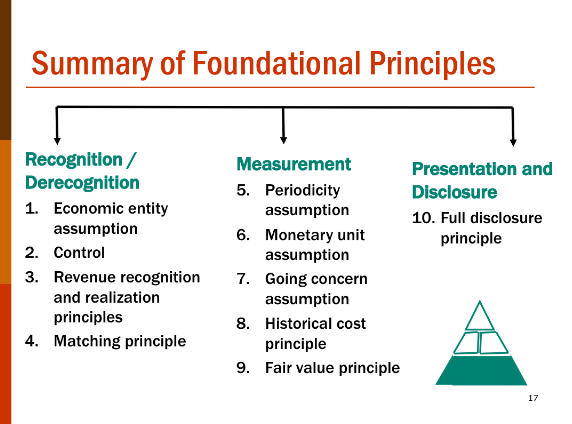
Foundational Principles
help explain which, when and how financial elements and events should be recognized/derecognized, measured and presented/disclosed by the accounting system
25
New cards
Recognition
act of including something on the BS or IS
26
New cards
Derecognition
Act of removing something from the BS or IS
27
New cards
Economic Entity Assumption
All economic events are identified with a particular economic entity, that economic entity is separate and distinct from its owners
28
New cards
Control
control is an important factor in determining entities to be consolidated and included in an economic entity, refers to having power over the investee
29
New cards
Revenue Recognition Principle
Determines when revenue should be recognized
30
New cards
Matching Principle
Expenses are recognized in same period as the related revenue, match expenses to related revenue
31
New cards
Measurement
all elements must be measurable to be recognized, some elements in statements require use of estimates which include uncertainty
32
New cards
Periodicity Assumption
economic activities of an entity can be divided into artificial time periods for reporting purposes, monthly, quarterly or yearly
33
New cards
Monetary Unit Assumption
Money is the unit of measurement for economic transactions, also make a stable dollar assumption whereby the effect of inflation and deflation are ignored in the financial statements
34
New cards
Going Concern Assumption
Assumption that a business enterprise will continue to operate in the foreseeable future
35
New cards
Historical Cost Principle
Financial statement item measured at the cost that was paid/received when the transaction took place
36
New cards
Fair Value Principle
the price that would be received to sell an asset or paid to transfer a liability in an orderly transaction between market participants at the measurement date
37
New cards
Full disclosure principle
the practice of providing information that is important enough to influence an informed users decisions, should provide sufficient detail, but still be condensed enough to remain understandable