BSCI223 Exam 2
 Call Kai
 Learn
Learn Practice Test
 Spaced Repetition
 Match
Match Flashcards
 Knowt Play
1/16

There's no tags or description
Looks like no tags are added yet.
Name | Mastery | Learn | Test | Matching | Spaced | Call with Kai |
|---|
No analytics yet
Send a link to your students to track their progress
17 Terms
General Bacterial Enumeration
General:
Relies on sampling
cells are evenly distributed
accuracy depends on samples being neither too dense nor too diluted
Expressed as:
cells/ml or CFU/ml (colony forming units)
cells/g or CFU/g
cell/m² or CFU/m²
ABS
Cells/ml and CFU/ml are equal in single, free living cells that can form colonies (ex: E.coli)
not equal for all organisms, because some organisms form pairs, chains, etc
Ways to Enumerate Bacteria
Viable Plate Count
only count living cells
plates, spreaders, incubators, etc
takes time (colonies)
start with original suspension, perform serial dilutions (usually 1:10 dilutions → dilutions have neg exponents, CFU/ml will almost always have positive exponents) in order to dilute to a countable amount, each tube is 10 fold less the concentration, and then plate tube that isn’t too dense and isn’t too dilute (tube can produce sampling error from too many colonies or too little colonies)
normally put around 0.1 ml onto plates (can give sampling error if too little = dries out or too much = takes too long to dry)
Direct Counts
immediate results after counting
requires counting chamber and microscope
cells need to be immobile
counts living and dead cells
count within glass grid (might need staining, but can’t tell if cells are dead or alive)
Spectrophotometry
immediate results (very fast results)
requires spectrophotometer
counts living and dead cells
gives density, not CFU/ml
0 absorbance = 100% transmittance of light (cells will absorb some of the light when present)
COUNTABLE PLATES: 30-300 colonies
Original Sample Density:
Divide all dilutions (including plating dilutions)
0.1 ml is 1/10 of 1 ml
0.1 ml plating dilution is a 1:10 dilution
# colonies from 1 plate/total dilution
Microbial Growth
Refers to cellular replication
Binary Fission
One cell becomes two cells
Most bacteria replicate this way
Budding
Yeasts
parental cell differentiates into parental cell and progeny cell (progeny cell usually smaller than the parental cell) and then detaches from the parental cell (still smaller), and then it grows in size to match that of parental cell size
Filamentous Growth
Fungi and some bacteria growth
more cells made
can have branching, maintained connection
Replication
Single cell with cytoplasmic membrane and chromosome bundled up, cell wall
Chromosomes replicated throughout entire cycle, but cell ends up with two copies of same chromosome, which are then separated
mechanisms to allow for symmetric division (asymmetric division can be fatal to one or both cells)
Chromosomes move to polar ends
Septum formed between two cells, connecting cytoplasmic membranes and cell walls
Can happen multiple times (exponential growth)
Generation time = time required for a population to double in number (doubling time), consistent between numbers
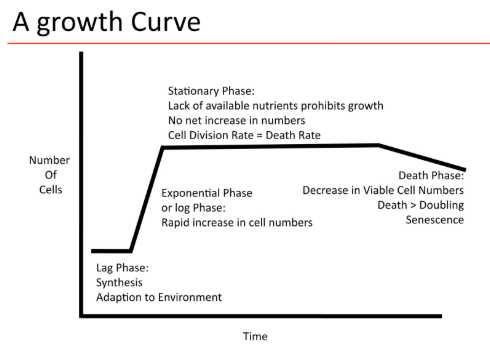
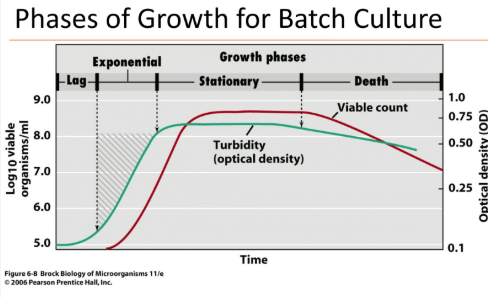
Phases of Growth in Batch Culture
Lag Phase = synthesis, adaptation to environment (kicking up metabolism)
number of cells not changing
Exponential or log Phase = rapid increase in cell numbers
actively dividing cells
depends on media, temperature, organism, etc
Stationary Phase = lack of available nutrients prohibits growth (media is no longer rich enough to increase growth)
no net increase in numbers
cell division rate = cell death rate
cells are still dividing
cells are using each other for growth
Death phase = decrease in viable cell numbers
stretch out stationary phase long enough and can see this
not present for all organisms
death > doubling
senescence → slowed down physiology
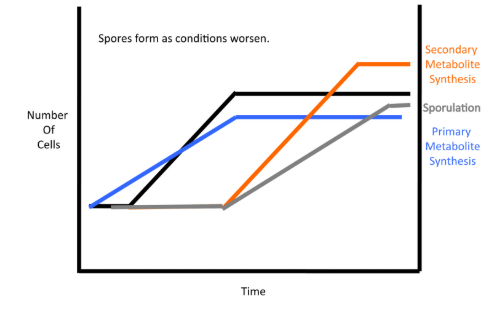
Growth Curve + Primary Metabolites
primary metabolite synthesis
essential for life (amino acids, DNA bases, vitamins, etc)
synthesized before division
DNA replication
Growth Curve + Secondary Metabolites
provide cells with selective advantages under some conditions
nonessential for life, but provide advantage (antibiotics)
cost cell energy investment to make
useful for eliminating competition for resources
synthesis occurs when nutrition is depleted in media and when cell number increasing
Growth Curve + Sporulation
spores form as conditions worsen
spore = dormant cell type that allows cells to survive adverse conditions until conditions improve
Growth Measurement
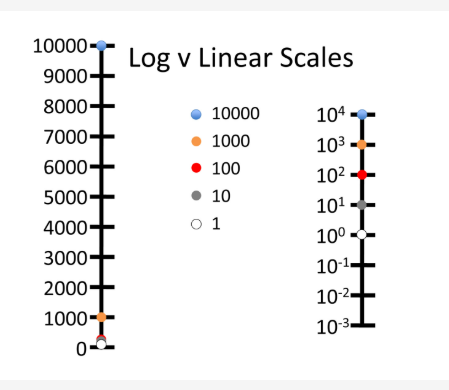
Log Scales
useful when measuring rapid changes
each tick is 10x different
10² = 100
10³ = 1000
Never gets to zero
Linear Scales
normal numbering, many ticks, but leads to many numbers that around the same amount being bunched up on top of one another → doesn’t visibly show minor differences between numbers
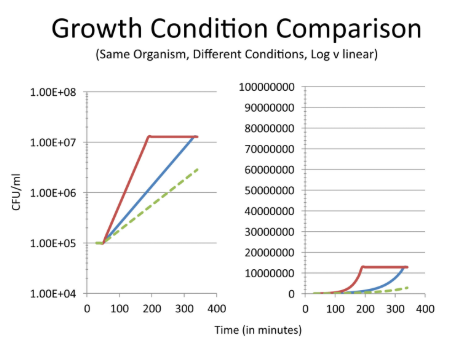
Growth Condition Comparison
log shows differences in data, while linear tends to clump data together and is harder to read at low time
Calculating Doubling Time
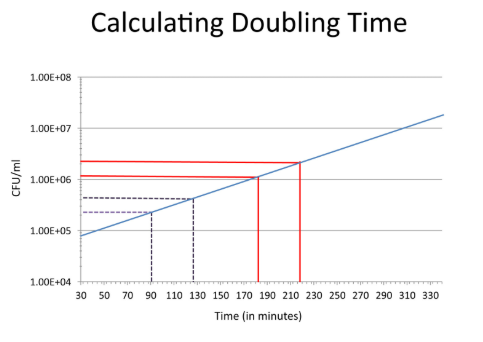
take two points on log graph (line of best fit) where CFU/ml doubles
subtract between the two times to calculate doubling time
Phases of Growth for Batch Culture
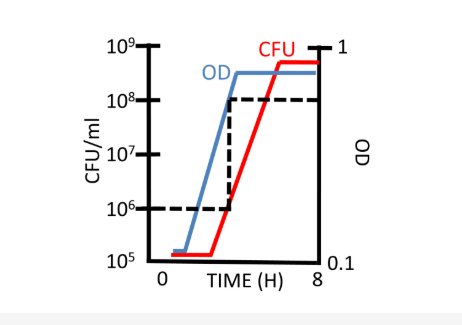
Determine OD required to grow a particular CFU/ml:
draw line from CFU/ml to time, then draw line from same time to where that time occurs on the OD line, then draw line to y axis of OD plot to determine OD required
Heat as Control Method
incineration
effects of high temperatures (above max temp)
denatures proteins
interferes with integrity of membranes and cell wall
disrupts structures and functions of nucleic acids
Thermal death point = lowest temperature that kills all cells in broth in 10 mins
Thermal death time (TDT) = time to sterilize volume of liquid at set temperature
has to be above maximum temperature, but hotter culture = shorter death time
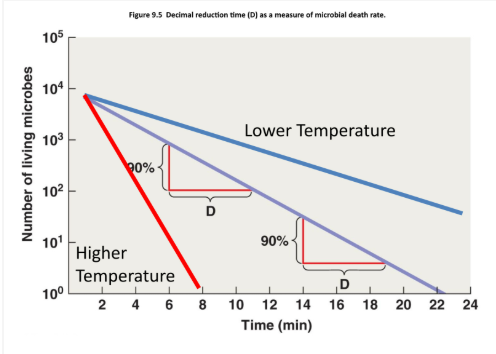
Decimal reduction time = time to achieve 10x reduction in number over a given time
one log loss of cells (lose 90% of cells)
lower temperature, but still above max temperature = extend decimal reduction time
higher temperature above max temperature = lowering decimal reduction time (die faster)
Cow
cattle breakdown feedstocks (cellulose) mechanically into smaller pieces to allow it to be digested later
cattle rumen → main part of cellulose digestion
rumen has huge population of microbes
cellulolytic bacteria, methanogens (generate CH4), etc
cellulolytic → process of breaking down cellulose into more simple sugar
very little oxygen = fermentation
products converted to volatile fatty acids = bacterial waste products absorbed by rumen wall, which feeds cows
methane produced, which can trap heat in the environment significantly more efficient than CO2
methanotroph = consumes methane
methane comes into membrane, converted into methanol via methane monooxygenase, oxygen, and 2 protons → creates alcohol group
by products can be converted into cell carbon or forms formate (aldehyde to formate produces NADH and formate to CO2 produces another NADH)
functional ETC and can make ATP
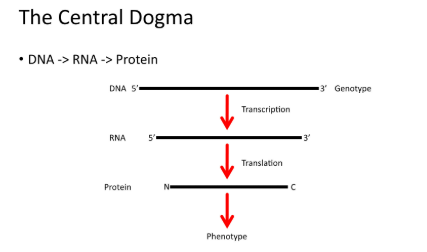
Central Dogma
phenotype = all measurable characteristics a cell
shape, color, structures, motile, etc
proteins do most of phenotype work
genotype = all genetic elements of a cell
gives rise to phenotypes
chromosomes
DNA is source of genotype
genes (DNA) → RNA → proteins
DNA molecule always larger than RNA molecule, RNA molecule always larger than protein, etc
all read left to right
information is organized on chromosomes
genes go in both directions
DNA double stranded, so genes can go from left or right
very rarely → genes overlap
can have long stretches of genes on one strand, but none on the other strand
gene name → lacZ, pmoA
DNA that makes up gene
protein name → LacZ, PmoA
protein name based on function → B-galactosidase, Particulate Methane Monooxygenase
Transcription