WORK, ENERGY, POWER
 Call Kai
 Learn
Learn Practice Test
 Spaced Repetition
 Match
Match Flashcards
 Knowt Play
1/21

There's no tags or description
Looks like no tags are added yet.
Name | Mastery | Learn | Test | Matching | Spaced | Call with Kai |
|---|
No analytics yet
Send a link to your students to track their progress
22 Terms
work formulas
w = F△x
full formula is F(II)cos△x
w = Fcos0△x
value of work when force is perpendicular to displacement
0
when it is 90 degrees
this also happens when the force acts vertically while displacement is horizontal
work energy theorem
when net external force does work (on an object), the CHANGE in kinetic energy (FINAL - INITIAL) is EQUAL to WORK done
work = change in ke
work energy theorem formula
W = 1/2mv²(f) -1/2mv²(i)
W can be expressed/substi too, as Fcos0△x or F△x
work done by gravity formula
W = Fcos△y, OR:
W = mg(y0-yf)
GPE definition
energy an object has due to its position, relative to surface of earth
conservation of mechanical energy formula
mgh(F) + 1/2mv²(F) = mgh(i) + 1/2mv²(i)
power formula
work/time
OR
change in energy/time
units of power
WATT (defined as one joule per second 1J/S)
or horsepower
how many watts is 1 horsepower
745.7
how many foot-pounds-per-second is 1 horsepower
550
internal force
forces that objects WITHIN SYSTEM exert on eachother
external force
forces exerted on object OUTSIDE SYSTEM
when is total linear momentum constant?
when the systems are isolated
what is the sum of average external forces in ISOLATED SYSTEMS
0
impulse formula
product of average force and time
J = F△t
momentum formula
p = mv
momentum is a vector
impulse-momentum theorem
when net force acts on an object, impulse and momentum are equal to echother
impulse-momentum formula
F△t = mv(f) - mv(i)
elastic collision
KE conserved, objects remain separated, total KE after collision = total KE before collision
‘perfectly/completely’ inelastic collision
KE not conserved. objects stick together
elastic collision formula for MOMENTUM AND KINETIC ENERGY
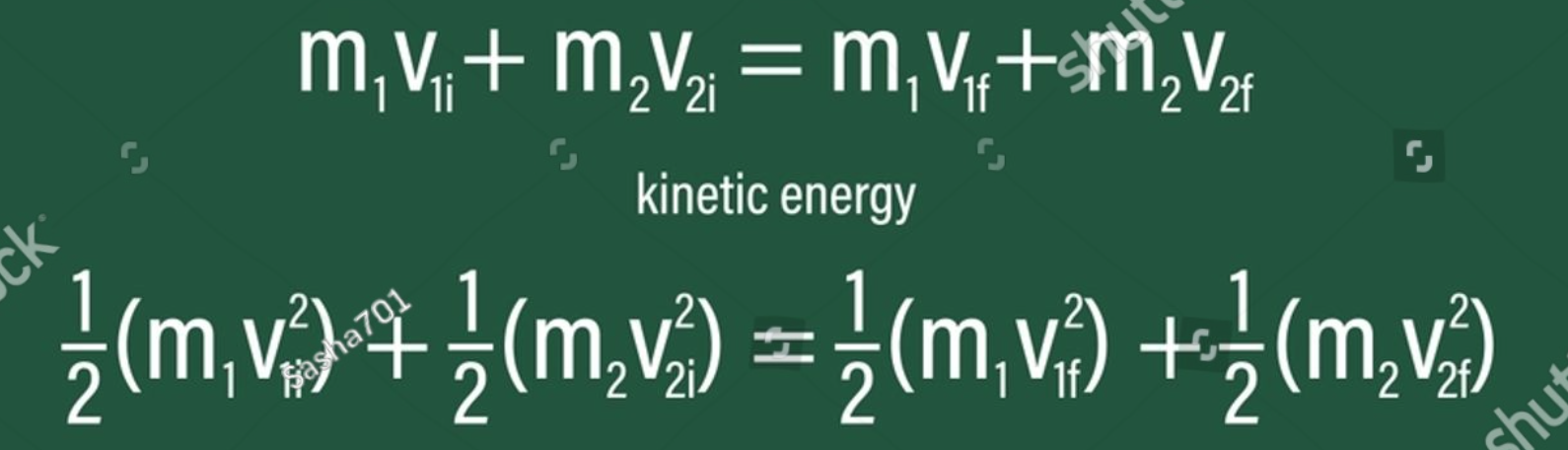
m1v1 + m2v2 (i) = m1v1 + m2v2 (F) = MOMENTUM
equation with the ½ = KINETIC ENERGY