OD515 Thermodynamics and Metabolism Pt1 (REDOX, Coupled Reactions, Thermodynamics)
 Call Kai
 Learn
Learn Practice Test
 Spaced Repetition
 Match
Match Flashcards
 Knowt Play
1/99

There's no tags or description
Looks like no tags are added yet.
Name | Mastery | Learn | Test | Matching | Spaced | Call with Kai |
|---|
No analytics yet
Send a link to your students to track their progress
100 Terms
What does ΔG represent in a reaction?
Amount of energy available to do work
What does an endergonic reaction mean in terms of ΔG?
Requires Energy, +ΔG
What does an Excergonic mean in terms of ΔG
Give off energy, -ΔG
The transfer of energy is….
Necessary for biological systems (life) to function.
Transfer of energy in living organisms…
Follow the laws of thermodynamics
Thermodynamics assess what?
Relation between energy, work, and heat
What’s is the 1st law of thermodynamics?
Total energy is constant. Can’t be destroyed or created, only transferred or transformed.
What is the second Law of Thermodynamics?
Energy spontaneously tends to disperse or become more disorderly. (Entropy)
How do living cells follow thermodynamics?
Increase in order within their system, but create disorder in surroundings
What is the system?
All reactants, products, solvent that contains them, and the immediate atmosphere.
What is an Isolated system?
Exchanges neither matter or energy with its surroundings
What is a closed system?
Exchanges energy but not matter with it’s surroundings
What is an open system?
Exchanges both energy and matter with its surroundings
(Like cells and organism)
What are Autotrophs
Use CO2 from atmosphere, sole source of Carbon
Make own food
What are Heterotrophs
Cannot use atmospheric CO2
Must obtain CO2 from enviro
Energy is often transferred via what reaction?
Oxidation-reduction redox reactions
What happens when one reactant is oxidized?
Loses electrons
What happens when an agent is reduced?
Gains electrons (oxidizing agents)
ΔS represents what?
Entropy (chaos)
What happens when ΔS is negative?
The reactants are more chaotic than the products
What happens when ΔS is Positive?
The products are more chaotic than reactants
What is ΔH?
Enthalpy, or heat content
Reflects the # and kinds of chemical bonds in reactants and products
What happens when ΔH is negative?
Release heat and is exothermic
What happens ΔH is positive
Heat is absorbed
Endothermic
What is ΔG
Amount of energy capable of doing work during reaction at constant temp and pressure
What happens when ΔG is +
Free energy is gained and reaction is endergonic
What happens when ΔG is -
Energy is released and is exergonic
In the free energy question, when ΔG -
The system proceeds spontaneously
In the free energy question, when ΔG Is +
The equation requires energy to complete, non-spontaneous
What is K’eq?
Standard equilibrium constant
ΔG’* states
when a reaction is thermodynamically favorable
A ΔG’* that is -
Is spontaneous or unfavorable at standard conditions
A ΔG’* that is +
Non-spontaneous at standard conditions
What is the relationship between K’eq and ΔG’*?
The relationship is exponential
If K’eq is > 1
its ΔG’* is - (Less reactants, more products)
If K’eq is < 1
its ΔG’* is + (More reactants, less products)
What happens when K’eq’ is 1?
ΔG = 0, is at equilibrium
How are ΔG’* s combined when individual reactions are coupled into overall reaction?
They are additive
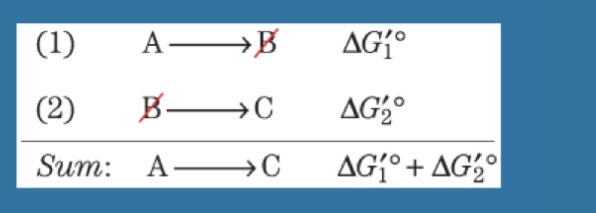
How are the Keq’s related when reactions are coupled?
They are multiplicative
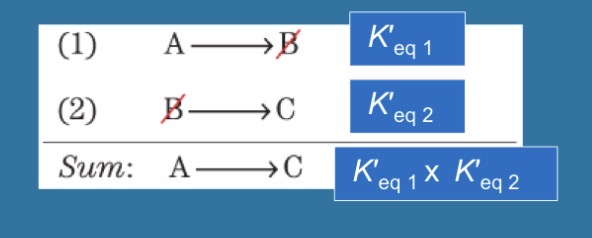
The amount of energy available to do work is always less than the theoretical. Amount of energy released because?
Entropy, some energy is wasted as heat
In a closed system, chemical reactions proceed ——- until ———
Spontaneously
Equilibrium is reach
Endergonic reactions are coupled to….
Exergonic reactions to achieve specific function
Metabolism is ——and it involves the ———- and describes the overall ——— of enzyme-catalyzed ——- and ——— pathways
Sum of the processes
Transfer of energy
Network
Catabolic and anabolic
What is intermediary metabolism?
Intricate web of chemical reactions within cells to convert absorbed nutrients into cellular building block and to generate energy
Catabolism and Anabolism
What are the intermediates of intermediary metabolism?
Metabolites
What are nearly identical in all living organisms?
Metabolic pathways
What keeps production and utilization of each metabolic intermediate in balance?
Feedback inhibition
What is the maximum energy available for work when a chemical reaction occurs?
Free-Energy Change (is sum of the two reactions)
What coupling favorable and unfavorable reaction, what drives it forward?
ATP Hydrolysis
What are enzymes?
Catalysts (usually proteins) that accelerate biochemical reactions. NOT consumed on use
How do catalysts work?
Lower activation energy, increasing reaction rates
What have higher free energy than reacts or products?
Transition states (unstable middle state)
What is activation energy?
Difference in energy between reactant in ground state and its transition state
What is enzyme regulation?
Response to external circumstances by either
Increasing # of enzyme molecules
changing catalytic activity of existing enzymes
What is universal energy currency in living organisms?
ATP
highly exergonic
Breakage of Phosphoanhydride
What does ATP help with in the body?
Muscle contraction
Pumping of solutes again [ ] gradients
Synth of complex molecules
What is a pathway?
Sequences w/ consecutive reactions where product of 1 is reactant in next
What is a Degradative pathway that yields free-energy captured in ATP or NAD(P)H ?
Catabolism
What is a synthetic pathway that requires input of energy to build?
Anabolism
Which pathway converges and which diverges?
Anabolic: Diverge (uses product to be reactant moving down path)
Catabolic: Converge (break into a product)
What are oxidation- reduction reactions and why are they central to cellular metabolism?
Oxidation: Loss e-
Reduction: Gain e-
Transfer of electrons is required for controlled transfer (extraction of energy)
Why must oxidation and reduction always occur together in biological systems?
e-‘s can’t exist freely in solution under biological conditions. Can’t have one without the other
What is PRIMARY biological purpose of oxidation reactions in living cells?
Is to release energy stored in bonds of food molecules. By oxidizing, cells take e- and use to generate ATP synthesis
How do you identify. If a substance is oxidized or reduced in a chemical reaction?
OIL RIG
Loss of e- or increase in oxidation → oxidized
Gain e- or decrease in oxidation → reduced
Loss of H or gain of O → usually oxidized
Gain of H or loss of O → Usually reduced
In a metal ion displacement (redox) reaction, how can changes in charge indicate oxidation or reduction?
If a metal ion becomes more + charged it lost e- → oxidized
If metal ion becomes less + charged it gained e- → reduced
General categorizes of biochemical reactions in living cells?
Reactions make or break C-C bonds
Internal rearrangements, isomerizations, eliminations
Free-radical reactions
Group transfers
Oxidation-reductions
What are functional groups which have and can donate e-
Nucleophiles
What are electron-deficient functional groups that seek electrons?
Electrophiles
What can act as either a nucleophile or electrophile?
Carbon
_____combines with and give up electrons to___
Nucleophiles
Elecrophiles
What is the cleavage of a covalent bond where each atom leaves the bond as a radical, carrying one unpaired e-?
Homolytic cleavage (radicals)
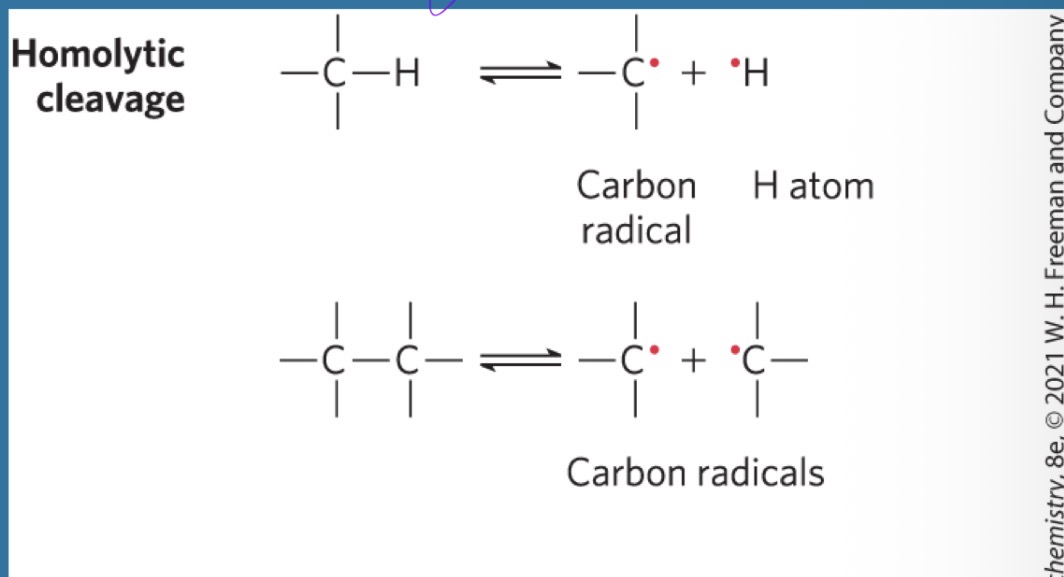
What is the cleaver of a covalent bond where one atom retains both bonding e-
Heterolytic cleavage (more common)
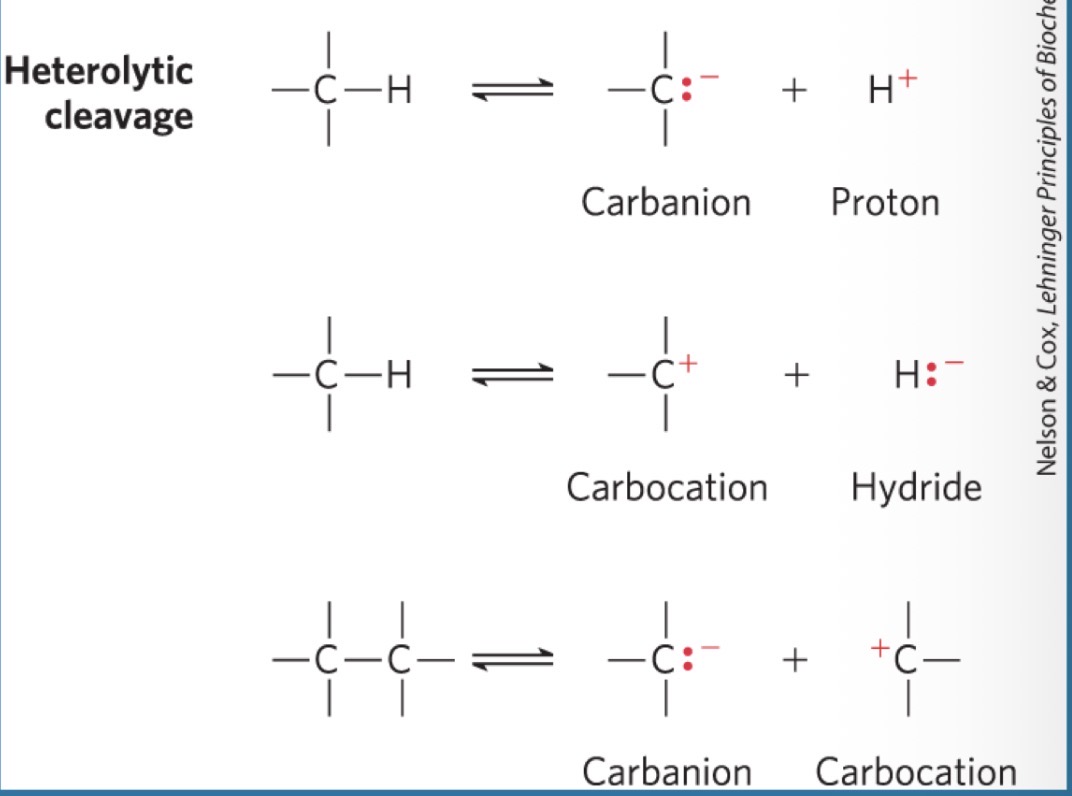
What are generated by elimination of an excellent leaving group?
carbocation intermediates
What are the products of a C-C heterolytic cleavage?
Carbanion( C: ) and a Carbocation (C+)
not common, unstable
Forms a C-C bond
DO rearrangements change oxidation states?
No
What is an isomer?
Same chemical formula, different arrangement
What are 3 isomer reaction examples?
Intermolecular oxidation and reduction
Change in cis-trans arrangement at double bond
Transposition of double bonds
What is an elimination reaction?
Loss of water from alcohol, creates C=C
Also happens in amines (peptide bonds)
What are the Homolytic cleavage of covalent bonds called?
Free-radical reactions
What do free-radical reactions lead to?
Oxidative damage, aging, and chronic disease
Antioxidants neutralize free radicals by donating e- for stabilization
What are group transfer reactions?
Moving a group from one Nucleophiles to another (common)
Forms intermediates
Ex: acyl, glycolysis, and phosphorylation groups transfer
*Acyl group transfer example in lipid synthesis
What involves nucleophillic substitution at c-1 of a sugar ring?
Glycosyl group transfer
kinase enzymes catalyze an example of?
Phosphoryl group transfers with ATP as a donor
What do kinases do?
Add phosphate from ATP onto an acceptor molecule
What removes a phosphoryl group from a phosphate ester?
Phosphatases
(Dephosphorylation)
What covalently removes phosphates to other molecules?
Phosphorylases
(Phosphorolysis)
What catalyze condensation reactions in which no nucleotide triphosphate is required?
Synthases
(Condensation reaction: 2 molecules combine into 1, losing small molecule such as water in process)
What break or cleave substrate molecules into smaller products?
Lyases
What catalyze biological oxidation reaction where oxygen is the electron acceptor, but oxygen is not an oxidized product?
Oxidases
(e- passed to a different e- acceptor
What catalyzes biological oxidation reactions where oxygen IS the electron acceptor and is an oxidized product?
Oxygenases
(Cyclooxygenase (COX) enzymes)
Monooxygenases: 1 O atom is incorporated in the product
Dioxygenases: 2 O atoms are incorporated in the product
What indirectly provides much of the energy required for ATP synthesis ?
Redox Reactions
Reduced substrates such as glucose are oxidized in several steps, with the energy of oxidation steps conserved in the form of a reduced cofactor NADH
e- energy stored in NADH is used to drive synth of ATP (NAD-H)
What is loss of a C-O bond or its equivalent?
Reduction reaction, gain of e- and formation of C-H bond
What is the formation of a C-O bond or its equivalent ( C-N, C-CL)
Oxidation
Loss of C-H bond
Loss of e-
In many biological oxidation’s, a compound loses ____ and ____
2 e-‘s and 2 H ions
Catalyzed by dehydrogenases
Carbon atoms exist in ______ depending on the ____ with which they share ____
Different oxidation states
Element
e-‘s
What catalyzes redox reactions in which H is removed from the substrate?
Dehydrogenases
*NAD+ is a common e- acceptor
O2 isn’t involved
What deals with descriptions, qualities, and meanings often using non-numerical information?
Qualitative data
things you can describe (qualify)
What involves measurements, numbers, and statistical analysis?
Quantitative data
(Things you can count)
What is the quantitative study of energy transductions?
Bioenergetics
What describes the change of one form of energy to another?
Energy transduction