cell membrane
 Call Kai
 Learn
Learn Practice Test
 Spaced Repetition
 Match
Match Flashcards
 Knowt Play
1/11

There's no tags or description
Looks like no tags are added yet.
Name | Mastery | Learn | Test | Matching | Spaced | Call with Kai |
|---|
No analytics yet
Send a link to your students to track their progress
12 Terms
What is the Fluid Mosaic Model?
→biological membranes consists of a fluid phospholipid bilayers in which proteins are embedded and freely move
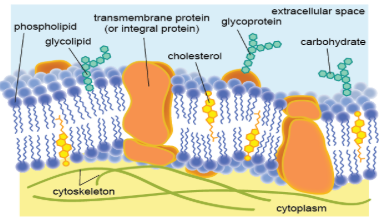
What are the components (4) of this model?
phospholipids
sterols
carbohydrates
proteins
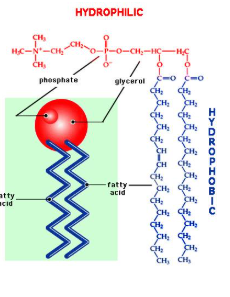
What are phospholipids?
→ double layer of phospholipid molecules arranged with the lipid tails in the middle
→ lipid molecules may vibrate, flex back and forth, spin around, move sideways and exchange places
fluidity is influenced by two factors:
composition of lipid molecules
temperature
What are sterols?
→ membrane stabilizers (ex. cholosterol in animals)
HIGH temps → restrain movement thus reducing fluidity
LOW temps → occupy space between preventing fatty acids from forming non-fluid gel
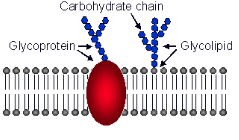
What are carbohydrates?
→ chains attach to lipids and proteins forming glycolipids and glycoproteins
→ located on exterior of cell ex. ABO blood type
→ role: recognition and cell-cell interactions
What are proteins?
Several different types of proteins determine function and uniqueness
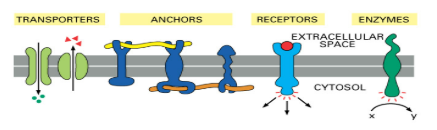
Types of proteins (4)
a) 🚚 Transport proteins
use cell energy to pick up and transport molecules across
control the movement of substances in and out of the cell (ex. ions)
b) 🧬 Enzymatic activity
some are enzymes like those in respiration
c) 📡 Triggering signals
receive hormone messages for cell communication
d) 👯 Attachment and Recognition
used as cell surface identification (ex. Rh factor)
attachment points for a range of cytoskeleton elements as well as cell-cell recognition
Two groups of proteins:
Peripheral Proteins
Intergral Proteins
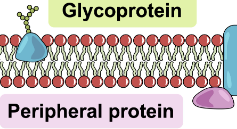
Peripheral proteins:
on surface held by hydrogen bonds and ionic bonds
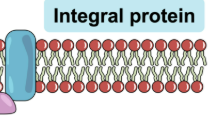
Integral proteins
Embedded in lipid bilayer
Have one region that interacts with hydrophobic core
Transmembrane → span entire bilayer

Label the following diagram
A. Lipid Bilayer
B. Phospholipids
C. Hydrophilic polar head
D. Hydrophobic non-polar tail
E. Cholesterol Molecule
F. Integral proteins
G. Peripheral Protein
H. Cytoskeleton Filaments
I. Alpha Helix Protein
J. Glycoprotein
K. Carbohydrate

How does the fluid mosaic model work?
→ The fluid mosaic model has four crucial components: phospholipid bilayer , sterols, carbohydrates & proteins
Phospholipid bilayer acts like a ‘semi-permeable’ membrane, blocking water-soluble substances while letting in small non-polar molecules like oxygen to enter
Sterols are sandwhcihed between the lipid tails and ensures that the membrane isn’t closely packed in cold temps & keeps it stable in warm temps
Carbohydrates acts as ‘identiification tags, allowing the immune system and other cells to recognize body’s own cells versus foreign invaders
Proteins scattered among the bilayer, integral protein acts as channels for larger molecules & peripheral protein attach to outer or inner surfaces to perform signalling