PHYS 202 Exam 2 Study Concepts and Definitions
 Call Kai
 Learn
Learn Practice Test
 Spaced Repetition
 Match
Match Flashcards
 Knowt Play
1/92

There's no tags or description
Looks like no tags are added yet.
Name | Mastery | Learn | Test | Matching | Spaced | Call with Kai |
|---|
No analytics yet
Send a link to your students to track their progress
93 Terms
When an uncharged capacitor is placed in a single loop with a resistor and a battery, the voltage across the capacitor increases as a function of time. Which of the following mathematical functions best describes this behavior?
Exponential
If an uncharged capacitor is connected in series to a resistor and a battery, which statement is true about the current through the battery?
The current through the battery decreases with time until the capacitor is fully charged.
Suppose that you wanted to increase the time constant for an RC circuit. Which of the following changes would you make?
Increase both the resistance of the resistor and the capacitance of the capacitor.
Which of the answers below best describes the precaution you must make before connecting a capacitor to a circuit?
The positive terminal of the capacitor must be at a higher potential than the negative terminal.
Approximately how long does depolarization and repolarization of the a nerve cell (i.e. the generation of the action potential) take to occur?
1 ms
Which of the following are necessary components of a model that properly accounts for the speed of nerve transmission? Select all that apply.
- The resistance of the axoplasm - The resistance of the cell membrane
- The capacitance of the cell membrane
When the thickness of the myelin sheath increases, the propagation of nerve impulses ____________.
increases
Magnetic fields point from ______ poles toward ______ poles.
north; south
A charge is moving through a magnetic field such that its velocity makes a non-zero angle with respect to the magnetic field. Which of the following statements are true? Select all that apply.
- The charge experiences a magnetic force that is perpendicular to the direction as the magnetic field
- The charge experiences a magnetic force that is perpendicular to the direction of its velocity.
What is a realistic value for the magnitude of Earth's magnetic field?
5×10⁻⁵ T
Look at the magnetic field created by a long, straight, current-carrying wire and the magnetic field inside a solenoid. Which of the following statements is/are true? Select all that apply.
- When current travels in circles, it creates magnetic field lines that are straight at the center of the circle
- When current travels in a straight line, it creates magnetic field lines that form circles around the current.
A long, straight, current-carrying wire creates a magnetic field. How does the direction of the magnetic field on one side of the wire compare to the magnetic field's direction on the other side?
They point in opposite directions.
Chose the option that best completes the following sentence: The "r
" in the equation for the magnetic field due to a straight, current-carrying wire represents the _______ and the "R
" in the equation for the magnetic field due to a current loop represents the _______.
distance from the wire, radius of the wire
Chose the option that best completes the following sentence: The ratio of a coil's radius to its length is _______ and the ratio of a solenoid's radius to its length is _______.
large, small
Which of the following will you need an equation for in order to determine the magnetic field due to power lines?
the magnetic field of a long, straight wire
Which of the following actions would cause the magnetic flux through the loop to change?
- rotate the loop
- change the area defined by the loop
- change the strength of the magnetic field
Which of the following statements are false? Select all that apply.
An induced magnetic field must point in the opposite direction of the applied magnetic field., An induced current exists in a loop if there is a constant magnetic flux through that loop., An induced magnetic field must point in the same direction as the applied magnetic field.
An object placed to the left of a converging lens, at a distance that is larger than the focal length of the lens (i.e. s>f), produces an image. Which of the following statements will always true about the image in this situation? Select all of the true statements.
The image will be real., The image will be inverted.
Suppose a converging lens forms a real image of an object. If an aperture (an iris) is placed directly in front of the lens so as to allow only rays that strike the lens near its center to pass through, what will happen to the image?
The image will be dimmer.
Which of the following statements are true about a lens that is thinner at its center than at its edges, if it forms an image by itself with no other lenses involved? Select all of the true statements.
- It forms a virtual image.
- It forms an upright image
- Its focal length is negative.
Overall magnification formula for final image of an object
m1m2
In a microscope that uses a CCD detector, is the final image real or virtual
Final image should be real
If a person has hyperopia, which of the following is true?
Her near point is larger than 25 cm.
A nearsighted man has a far point of 300 cm
Diverging
A lens has a refractive power of 20 diopters. What is its focal length?
5 cm
When you are looking at the most distant object of which your eye can produce a focused image, which statement is true?
Your eye is fully relaxed.
When the capacitor starts charging, the held charge is ______, the current through the circuit is ____ _____ and the voltage is ______.
0 C, max value, 0 V
When the capacitor has been charging for awhile, the held charge is ______, the current through the circuit is ____ _____ and the voltage is ______.
max C, 0 A, max V
A large time constant means a __________ change.
slow
A small time constant means a ________ change.
rapid
When the capacitor starts discharging, the held charge is ______, the current through the circuit is ____ _____ and the voltage is ______.
max charge, max current, max voltage
When the capacitor has been discharging for awhile, the held charge is ______, the current through the circuit is ____ _____ and the voltage is ______.
0 charge, 0 A, 0 V
Action potential speed depends on the ______ ________ for charging the membrane capacitance.
time constant
Magnetic field lines inside the magnet point
South to North (does not stop at poles)
_________ causes magnets to rotate.
Torque
________________ materials can become permanent magnets or are attracted to magnets.
Ferromagnetic
Right hand
Common method used to determine the direction of the magnetic force vector.
- thumb points in the direction of charge's velocity
- fingers point in direction of magnetic (B) field
- palm points in the direction of the acting force.
Field lines pointing out of the screen are represented by
dots
Field lines pointing into the screen are represented by
x's
Centripetal acceleration
acceleration of an object toward the center of a curved or circular path
Centripetal acceleration a =
v^2/r
Centripetal acceleration always points towards the ______ of the circle.
center
Right-hand rule for current-carrying wires
- Thumb points in direction of current flow
- Second finger points in direction of magnetic field
- middle finger points in the direction of the force of the magnetic field
New Right-hand rule for current and magnetic field direction
- Thumb points in the direction of the current
- fingers curl in the direction of the magnetic field
Solenoid
A coil of wire that produces a magnetic field when carrying an electric current (long compared to its diameter)
If the magnetic field passes through a conducting loop _________ with time, a current will be induced.
changes
Magnetic flux (Weber)
A measure of the strength of a magnetic field over a given area/ number of field lines.
Faraday's Law
An electromotive force (emf) is induced in any region of space in which a magnetic field is changing with time.
Three ways to change the magnetic flux through a loop:
- change the loop's area
- change the magnetic field
- change theta
Lenz's Law
The induced current flows in a direction so as to set up a magnetic field to oppose the change in magnetic flux
Reflected
light stays in the first medium than changes direction
Refraction
light moved into second medium and changes direction
Law of Reflection
angle of incidence = angle of reflection
Refraction occurs when light passes into a medium with a _______________ index of refraction.
Different
Snell's Law
n1sinθ1 = n2sinθ2
Total internal reflection
- Light does not refract into lower n
- Occurs (in denser to rarer media) when the angle of incidence exceeds the critical angle, refracted ray will be reflected into denser medium (internally).
- Light is coming from n2, at the critical angle, so it will exit at 90°. If we increase the critical angle (which is the angle of incidence), the light won't enter n1. It will be reflected!
Thin lenses
thickness is small compared to their radius of curvature
Optic axis
perpendicular to the lens surface and passes through its center
Converging lens
bends light rays towards the optic axis (f > 0)
diverging lens
bends light rays away from the optic axis ( f < 0)
Lens has a ______ ______ on each side.
focal point
Focal length depends on ___________ of surfaces and __.
curvature and n
Thin Lens approximation
- thickness is negligible compared to the radius of curvature
- light will only refract once through the lens
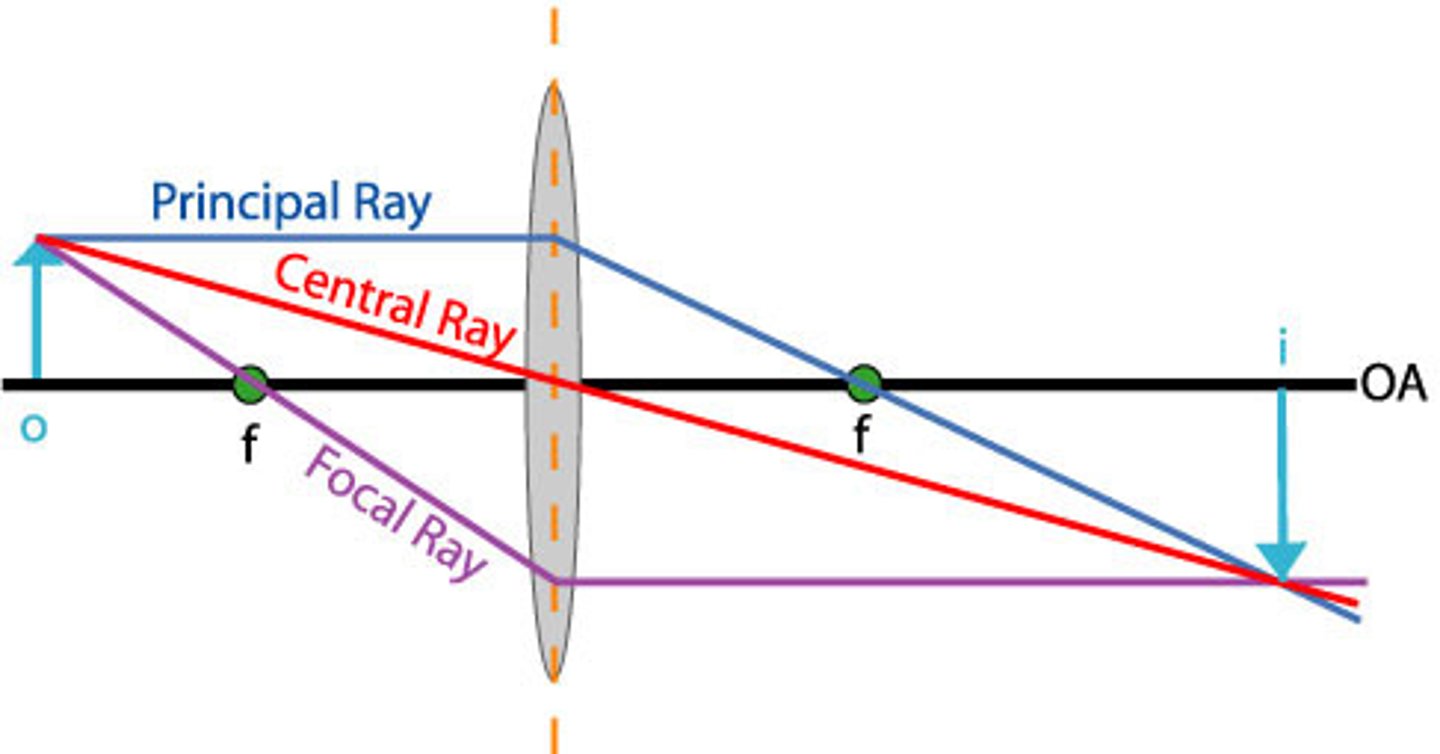
Objects outside the focal point of a converging lens will create
real and inverted images
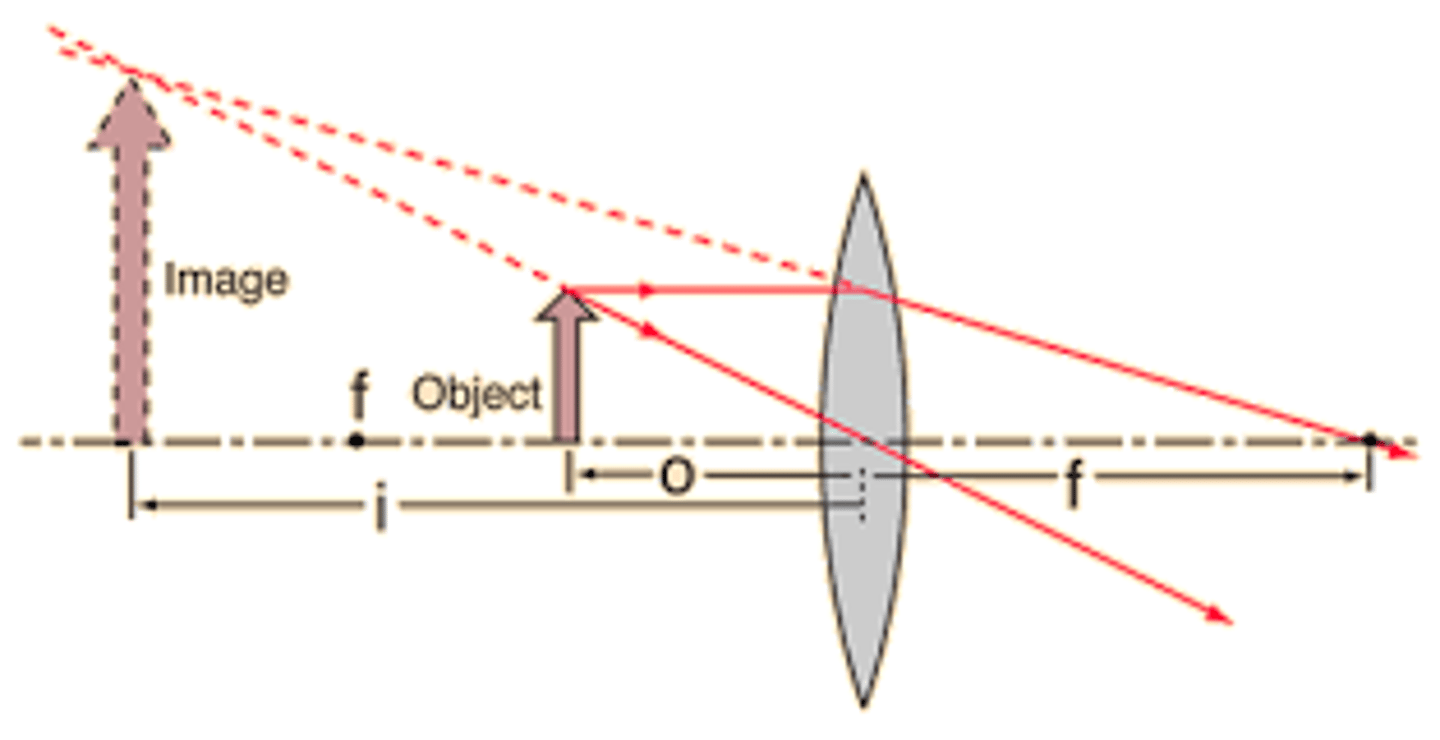
Objects inside the focal point of a converging lens will create
virtual, enlarged, and upright images
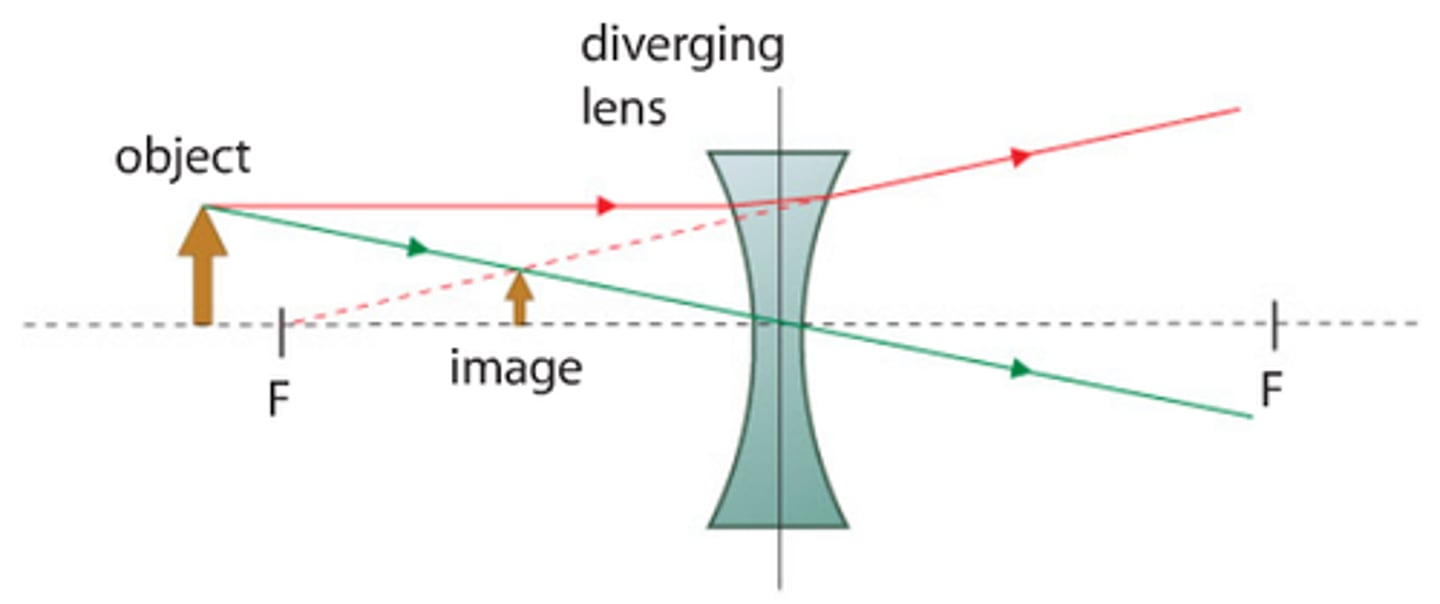
Diverging lenses create _______ images.
virtual
Thin lens equation
1/f = 1/di + 1/do
A ___________ magnification means the image is __________.
negative, inverted
A negative magnification means the image is __________.
inverted
If S' (image distance) is negative, the image is
virtual
If S' (image distance) is positive, the image is
real
By convention, the front side is on the ____, while the back side is on the _____.
left, right
Objects outside of the focal point of a converging lens create _______ images.
real
Objects inside of the focal point of a converging lens create _______ images.
virtual
The refractive power of a lens is the __________ of its focal length.
inverse (P= 1/f)
Lens with a ___________ refractive power (focal length) converges the light.
positive
Lens with a ___________ refractive power (focal length) diverges the light.
negative
Far point
the most distant point on which a completely relaxed eye can focus
near point
the closest distance at which an eye can focus when the ciliary muscles are fully contracted
For a normal, healthy eye, the far point is _______ and the near point is ______ cm.
infinity, 25
Myopia
nearsightedness
Myopia: an object at s = infinity will have an image that falls ___ ________ of the retina.
in front
The far point of myopic eye is at < ______.
infinity
What images do contact lenses need to create?
Virtual
People with myopia need _________ lenses, which results in a ____________ prescription.
diverging, negative
Hyperopia
farsightedness
Myopia: an object at s = 25 cm will have an image that falls ________ the retina.
behind
Hyperopia: the near point of an object at s >________.
25 cm
People with hyperopia need _________ lenses, which results in a ____________ prescription.
converging, positive
A hyperopic eye ______ point is closer to the eye.
far
The refractive power of a myopic eye is too ___.
big
A myopic eye ______ point is farther from the eye.
near
The refractive power of a hyperopic eye is too _____.
small