Localisation of function
 Call Kai
 Learn
Learn Practice Test
 Spaced Repetition
 Match
Match Flashcards
 Knowt Play
1/11

There's no tags or description
Looks like no tags are added yet.
Name | Mastery | Learn | Test | Matching | Spaced | Call with Kai |
|---|
No analytics yet
Send a link to your students to track their progress
12 Terms
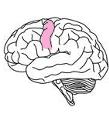
What is the location of the motor cortex and it’s function in the brain?
responsible for the generation of voluntary motor movements
frontal lobe
in both hemispheres
diff parts of motor cortex control different parts of body - regions arranged logically e.g. region that controls foot is near region that controls the leg
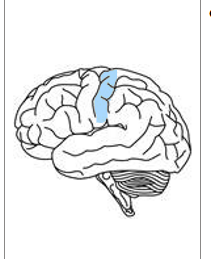
what is the location of the somatosensory area and function in the brain?
detects sensory events arising from different regions of the body
in parietal lobe
uses sensory information
in both hemispheres, receives info from opposite sides
Using sensory information from the skin, the somatosensory cortex produces sensation on touch, pressure, pain and temperature, which it then localizes to specific body regions.
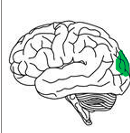
What is the location of the visual cortex and it’s function in the brain?
Visual cortex processes visual information from the eyes
Enables object recognition, motion detection, and spatial awareness
Primary visual cortex is in the occipital lobe
Visual processing starts in the retina (light hits photoreceptors)
Signals are sent from the retina to the brain via the optic nerve
Most signals go to the thalamus, which acts as a relay station to the visual cortex
A small number of signals go to areas controlling circadian rhythms
Visual information is contralateral:
Right hemisphere processes left visual field
Left hemisphere processes right visual field
The visual cortex has different areas for processing different features (e.g. colour, shape, movement)
What is the location of the auditory cortex and it’s function in the brain?
crucial for processing sound, language comprehension, and integrating auditory information with other functions
in temporal lobe on both sides of brain
Sound is converted to nerve impulses in the cochlea
Impulses travel via the auditory nerve to the brain
Pathway: brain stem (basic decoding) → thalamus (relay) → auditory cortex
In the auditory cortex, sound is recognised and interpreted, leading to a response
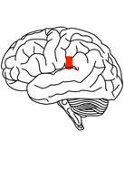
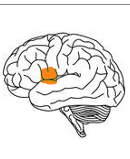
What is the location of Broca’s area and it’s function in the brain?
Crucial for speech production and language production
named after Paul Broca
in left hemisphere of brain
what was the experiment that discovered Broca’s area?
done by Paul Broca
treated a patient who was referred to as Tan as that is all he could say
he could understand but couldn’t speak or write
Broca later studied eight more patients with similar language difficulties and damage (lesions) in the left frontal hemisphere.
Patients with damage in the right hemisphere did not show the same language problems.
This led Broca (1865) to identify a ‘language centre’ in the posterior part of the left frontal lobe.
Broca’s area is important for speech production.
However, research shows Broca’s area is also active during non-language cognitive tasks.
Another researcher also discovered 2 regions of Broca's area, one selectively language, the other responding to many demanding tasks
What is the location of Wernicke’s area and it’s function in the brain?
primarily responsible for language comprehension - helps us understand both spoken and written words by interpreting the meaning of words and sentences
Discovered by carl Wernicke, shortly after Broca identified the speech production area
Patients with damage to Wernicke's area could speak but couldn't understand language (opposite to Broca's)
Wernicke proposed language involves separate motor regions (in Broca's area) for speech production and sensory regions (in Wernicke's area) for language comprehension
Motor region is near areas controlling mouth, tongue and vocal cords
Sensory regions is near areas for auditory and visual input
Input is sent to Wernicke's areas where it is recognised as language and given meaning

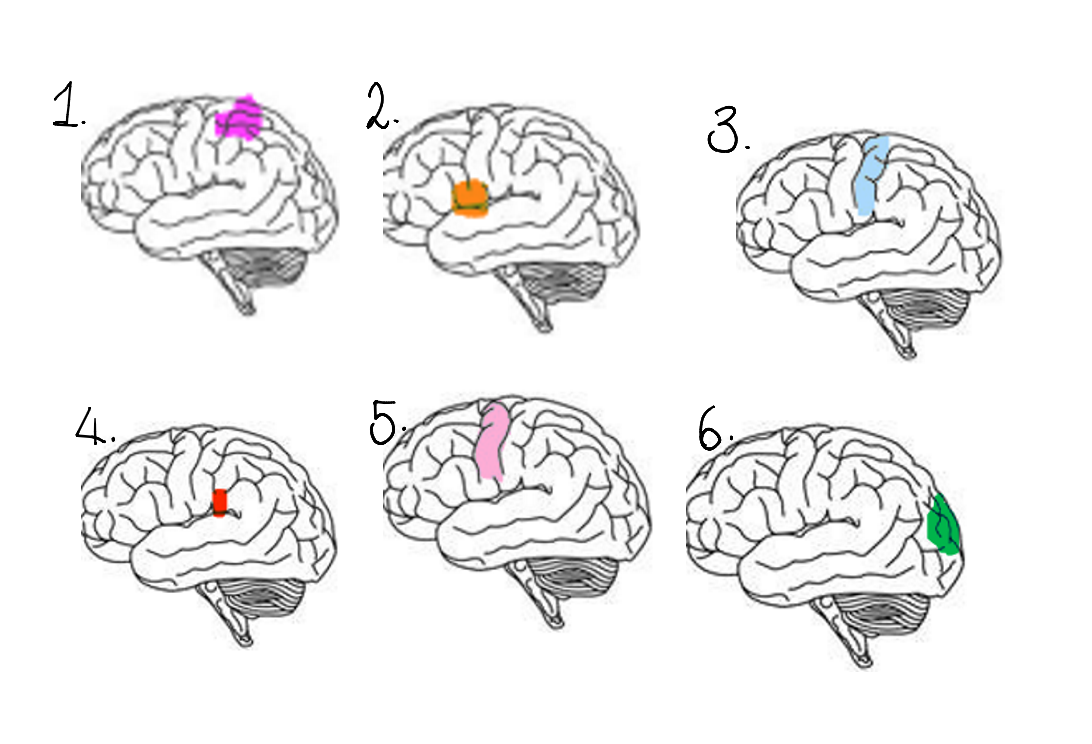
what are the names of the areas highlighted?
Wernicke’s area
Broca’s area
Somatosensory
Auditory
Motor
Visual
what are 2 evaluation points against localisation of function in the brain? (PET)
P – Equipotentiality theory challenges localisation of function.
E – Some researchers argue that while basic motor and sensory functions are localised, higher mental functions are not. Instead, intact areas of the cortex can take over functions after brain damage, meaning the effects depend on the extent of damage rather than its location.
T – Therefore, this suggests cognitive abilities are not confined to specific brain areas, challenging the idea of strict localisation.
P – The importance of communication between brain regions challenges localisation.
E – Carl Wernicke proposed that although brain areas have specialised functions, they must interact to work effectively. For example, a case showed reading ability was lost due to damage between the visual cortex and Wernicke’s area, not the areas themselves.
T – Therefore, complex behaviours like language and movement rely on networks of brain regions working together, rather than isolated localised areas.
what are 2 evaluation points to support localisation of function of the brain? (PET)
P – Localisation of language varies between individuals.
E – Patterns of activation during language tasks differ between people; one researcher found activity in the right temporal lobe as well as left frontal, temporal and occipital lobes when reading. Other studies show gender differences, with women having proportionally larger Broca’s and Wernicke’s areas.
T – Therefore, language functions are not localised in the same way in all individuals, challenging strict localisation.
P – Language production is not limited to Broca’s area alone.
E – Re-examination of Broca’s patients using MRI showed damage extended beyond Broca’s area, suggesting other regions contribute to speech; damage to Broca’s area alone usually causes only temporary disruption.
T – Therefore, language involves multiple brain regions working together, rather than a single localised area.
Briefly explain the Phineas gage example of localisation of the brain
Survived a severe brain injury where a iron rod was blasted through his skull during an explosion while preparing rock for railway construction
Rod destroyed part of his frontal lobe
He survived
Before the accident he was described as responsible, hardworking and well liked
After the accident there were many personality and behavioural changes such as: becoming impulsive and aggressive, poor decision making, difficulty controlling behaviour and acting in socially inappropriate ways
Provides early evidence that different areas of the brain have different functions
Damage to frontal lobe is linked to personality, decision making and behavioural control
Supports the idea of localisation in the brain
However, some later reports say his personality change may have been less extreme than originally reported
Also is only a single case study so can't be generalised to everyone
define localisation of function
refers to the principle that specific functions have specific locations within the brain