Externalities (2)
 Call Kai
 Learn
Learn Practice Test
 Spaced Repetition
 Match
Match Flashcards
 Knowt Play
1/10

There's no tags or description
Looks like no tags are added yet.
Name | Mastery | Learn | Test | Matching | Spaced | Call with Kai |
|---|
No analytics yet
Send a link to your students to track their progress
11 Terms
When do externalities occur ?
Externalities occur when there is an external impact on a third party not involved in the economic transaction
These impacts can be positive or negative and are often referred to as spillover effects
Impacts can be on the consumption side of the market (consumer demand)
Impacts can be on the production side of the market (producer supply)
When do external costs occur ?
External costs occur when the social costs of an economic transaction are greater than the private costs
A private cost for the producer is what they actually pay to produce a good/service
An external cost (negative externality) is the damage not factored in to the economic activity (for example, generating air pollution when producing electricity, which creates a third party cost)
Private cost + external cost = social costs
When do external benefits occur?
External benefits occur when the social benefits of an economic transaction are greater than the private benefits
A private benefit for the consumer is what they actually gainfrom consuming a good/service
An external benefit (positive externality) is the benefit not factored in to the economic activity (for example, someone who studies law enjoys private benefits but third parties benefit from having strong legal institutions)
Private benefit + external benefit = social benefits
External Costs of Production
Negative externalities of production are often created during the production of a good/service
The market is failing due to over-provision of these goods/services as only the private costs are considered by the producers and not the external costs
If the external costs were considered, the quantity of the goods/services provided would decrease and they would be sold at a higher price
Marginal analysis
Marginal analysis in economics considers the cost or benefit of the next unit produced or consumed
The marginal private cost (MPC) is the cost of the next unitproduced or consumed
The marginal private benefit (MPB) is the benefit derived from the production or consumption of the next unit
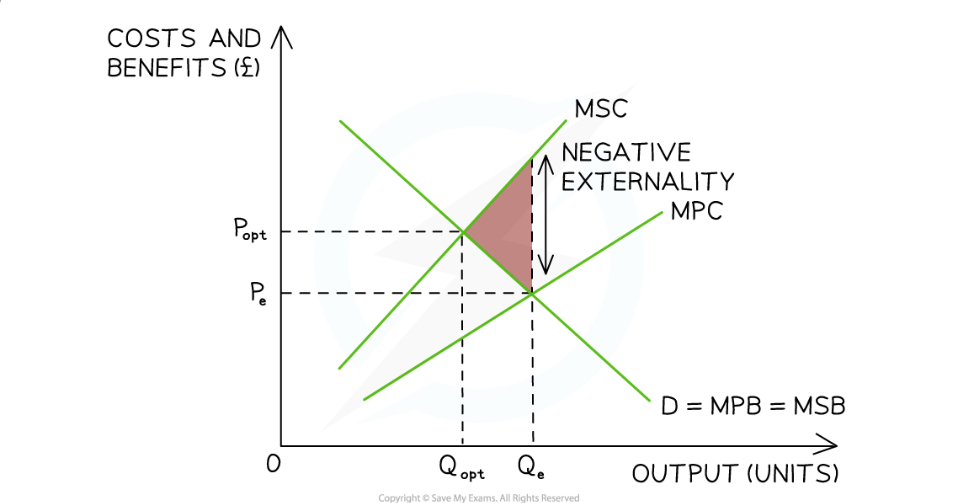
External costs of production (negative externality) result in an over-provision shown by the gap between Qopt and Qe - Diagram analysis
The marginal social benefit (MSB) is assumed to be equal to the marginal private benefit (MPB) as the focus is on the producer sideof the market
The free-market equilibrium can be seen at PeQe. This is where the MPC = MSB
The larger the external costs in production, the larger the gap between the MPC and the marginal social cost (MSC)
The optimal allocation of resources from society’s point of view, would generate an equilibrium where MSB = MSC. This can be found at PoptQopt. There is no market failure at this equilibrium
The free market is failing due to over-provision of this good/service at Qe
The factors of production used to manufacture this over-provisionrepresent a welfare loss to society (pink triangle)
To be socially efficient, fewer factors of production should be allocated to producing this good/service
There is an opportunity for government intervention (indirect taxes, legislation, regulation etc.), to force this market to be more socially efficient
Any intervention that reduces the welfare loss will be beneficial
External benefits of consumption
Positive externalities of consumption are created during the consumption of a good/service (merit goods)
The market is failing due to under-consumption of these goods/services as only the private benefits are considered by the consumers and not the external benefits
If the external benefits were considered, the quantity of the goods/services consumed would increase and they would be sold at a higher price
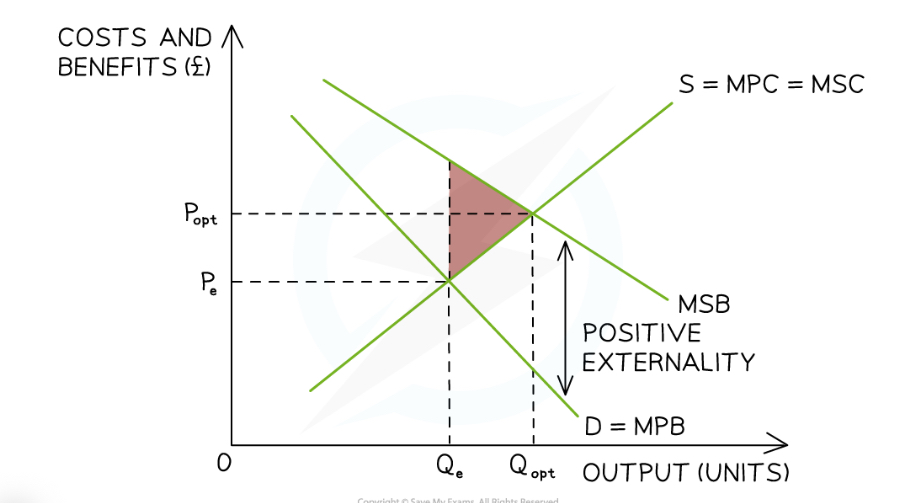
External benefits of consumption (positive externality) result in an under-consumption represented by the gap between Qe and Qopt - Diagram analysis
MSC is assumed to be equal to the MPC as the focus is on the consumer side of the market
The free-market equilibrium can be seen at PeQe. This is where the MPB = MSC
The larger the external benefits in consumption (positive externality), the larger the gap between the MPB and MSB
The optimal allocation of resources from society’s point of view would generate an equilibrium where MSB = MSC. This can be found at PoptQopt. There is no market failure here
The free market is failing due to an under-consumption of this good/service at Qe
More factors of production should be allocated to producing the optimal quantity as societal welfare will be gained (pink triangle)
There is an opportunity for government intervention (subsidies, partial provision etc.) to force this market to be more socially efficient
Any intervention that gains welfare will be beneficial
The Impact of Externalities & Government Intervention in Different Markets
Analysing externalities and the government intervention necessary to correct them is best done by considering real world examples
Analysis should always include the impact on stakeholders, including producers, consumers, government, and relevant third parties
The Impact of Negative Externalities and Government Intervention
Example | External Costs | Possible Stakeholders | Government Intervention |
|---|---|---|---|
Extraction of iron ore (mining) |
|
|
|
The Impact of Positive Externalities and Government Intervention
Example | External Benefits | Possible Stakeholders | Government Intervention |
|---|---|---|---|
Leisure Centres |
|
|
|